


More news on this day
For travelers staring at a departure board full of red “delayed” notices, it can feel as if flight disruptions arrive out of nowhere. In reality, most airport meltdowns are the visible edge of a complex, global system straining under weather shocks, staffing gaps, aging technology and tightly wound airline schedules.
Get the latest news straight to your inbox!
Weather: The Biggest Visible and Invisible Culprit
In the United States, publicly available data from the Federal Aviation Administration (FAA) show that weather remains the dominant driver of serious flight delays. One FAA summary of delays greater than 15 minutes between June 2017 and May 2023 attributes roughly three-quarters of those system-impacting disruptions to weather events such as thunderstorms, low visibility and high winds.
More recent FAA figures for 2024 indicate that around six in ten delays have been linked to weather, with smaller shares attributed to traffic volume, runway capacity and other factors. These numbers highlight how even on clear days, earlier storms in another region can ripple across the network, leaving passengers far from any bad weather still stuck at the gate.
Weather-related delays are not limited to departures. When storms or low ceilings hit major hubs, air traffic managers often slow arrivals and departures or impose ground delay programs at airports hundreds of miles away. Flights are held at origin to avoid gridlock in crowded skies, and the knock-on effect can stretch late into the evening as crews and aircraft fall out of position.
In Europe, network managers report similar patterns. Eurocontrol’s assessments of recent summer seasons point to convective storms, turbulence and other adverse conditions as key contributors to congestion and en route air traffic flow management delays across the continent’s busiest air corridors.
Staffing and Capacity: When the System Runs Too Hot
Behind the weather statistics, capacity limits in control centers and airports play a growing role in how long passengers wait. Eurocontrol’s analysis of the 2024 summer period in Europe found that air traffic control capacity and staffing issues together accounted for nearly half of all en route delay minutes, alongside strong traffic growth and bad weather.
In the United States, the FAA has repeatedly acknowledged that the system is operating close to its staffing edge in several high-demand regions. Inspector General reports for the Department of Transportation describe a long-standing shortfall of fully certified controllers, exacerbated when pandemic-era training pauses lengthened the time needed to qualify new staff. When a single busy sector or tower cannot be fully staffed, controllers must slow the rate of arrivals and departures, creating queues that passengers experience as rolling delays.
Staffing strains are not limited to control rooms. Airlines and maintenance providers have also reported shortages of skilled technicians and ground crews, which lengthen aircraft turnaround times. Industry groups note that limited maintenance capacity and parts availability have become increasingly visible in everyday operations, especially when aircraft require unscheduled work.
Airports themselves face capacity constraints that show up at peak hours. Terminals designed for lower passenger volumes, limited gate space and ramp congestion can all force aircraft to wait for parking stands or pushback clearance. European performance reviews for 2024 highlight terminal and runway capacity problems, often compounded by staffing gaps and weather, as drivers of rising delay minutes per flight.
Aging Technology and High-Profile Outages
While most delays accumulate in small increments, occasional technology failures have produced dramatic nationwide disruptions. In January 2023, a failure in the FAA’s Notice to Air Missions system led to a rare nationwide pause in U.S. departures, spotlighting the vulnerability of aging infrastructure. A later U.S. Government Accountability Office review identified more than a dozen critical air traffic systems as especially concerning in terms of age, sustainability and modernization timelines.
Global IT incidents have also underscored airline dependence on complex digital networks. In July 2024, a software update affecting Windows-based systems triggered widespread outages across industries, with airlines among those hardest hit. Public reports on the episode describe thousands of flight delays and cancellations as crew scheduling, check-in and dispatch tools went offline, leaving aircraft and staff in the wrong places for days.
The consequences of such outages go beyond the immediate failure window. Once flights are cancelled or severely delayed, crews often reach their duty-time limits under safety regulations, meaning they can no longer legally operate additional legs. This creates a secondary wave of disruption as airlines struggle to reassign staff and reposition aircraft, amplifying the original technology shock into a multi-day network problem.
Regulators and industry groups point to modernization programs, including the United States’ Next Generation Air Transportation System initiatives and similar European efforts, as essential to reducing these vulnerabilities. However, official progress updates emphasize that fully replacing or upgrading legacy systems will take years, during which operators must manage rising traffic with a patchwork of old and new technology.
Reactionary Delays: How One Late Flight Spreads Across the Day
For many passengers, the most frustrating delays are the ones that appear with no obvious external cause: clear skies, no visible storms, yet the flight is still late. Operational data from Europe and global airline associations highlight how so-called reactionary delays quietly dominate the passenger experience.
Eurocontrol’s recent delay snapshots show that reactionary or “knock-on” delays added more than eight minutes per flight on average in 2023, with peaks later in the day as earlier disruptions cascaded through tightly scheduled fleets. Industry analyses explain that when an aircraft or crew arrives late from a previous leg, every subsequent sector using that aircraft or team is at risk of departing behind schedule.
Airline ground operations add further complexity. Guidance from the International Air Transport Association on turnaround performance notes that delays in a single ground function, such as fueling, catering, baggage loading or cleaning, can trigger a snowball effect across the day. Because airlines schedule short turnarounds to maximize aircraft utilization, there is often little slack to absorb even minor setbacks.
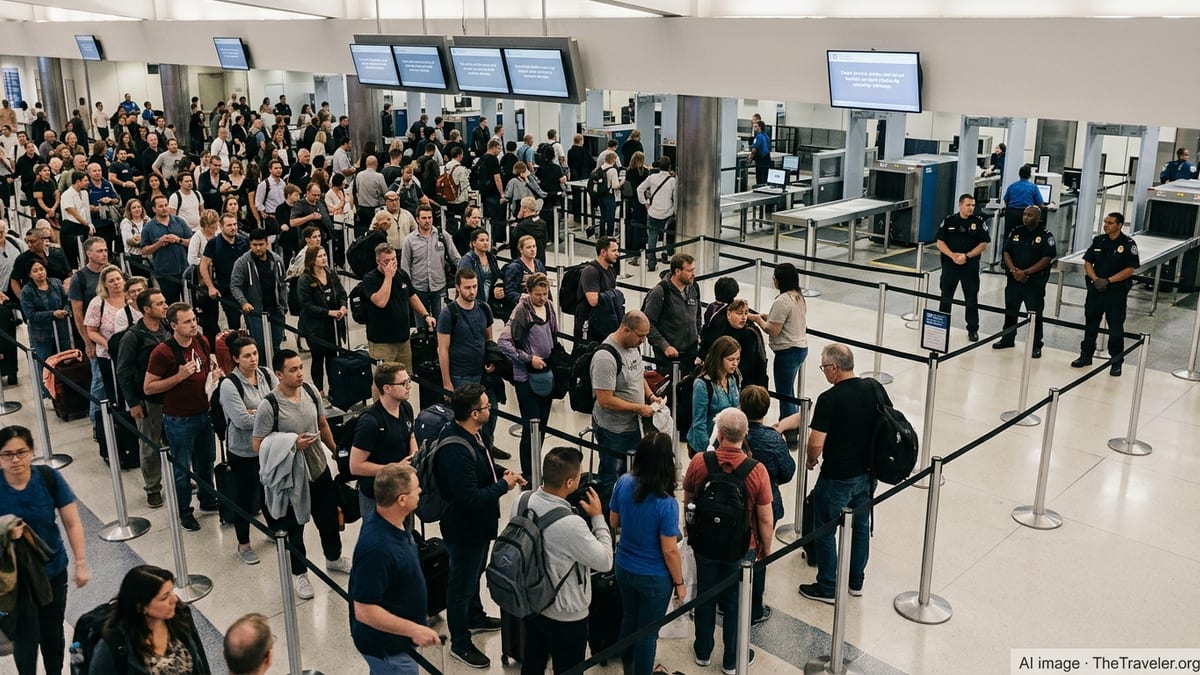
Government processes, including security screening and border control checks, also contribute small but measurable amounts of delay. Eurocontrol data attribute a fraction of average delay minutes to such procedures, which can nonetheless create bottlenecks at peak times, especially when passenger volumes exceed staffing or facility design assumptions.
Data, Accountability and What Passengers Can Expect
In the United States, the Department of Transportation requires major carriers to report detailed on-time performance and the stated causes of delays and cancellations in categories such as “air carrier,” “national airspace system,” “extreme weather” and “security.” According to agency documentation, this reporting is intended to clarify whether disruptions stem from controllable factors under airline responsibility or from broader system and weather conditions.
Standardized delay codes, developed through international aviation bodies, serve a similar purpose for airlines worldwide. These codes, applied at the flight level, distinguish between causes such as technical issues, crew shortages, airport congestion, reactionary knock-on effects and passenger-related delays. Aggregated statistics from these systems allow regulators, airports and carriers to identify recurring bottlenecks and target investments.
Oversight reports from transportation auditors in the United States emphasize that delays and cancellations have, in many periods, returned to or exceeded pre-pandemic levels as demand rebounded faster than staffing, infrastructure and technology upgrades. Analysts note that without improved resilience in controller staffing, maintenance capacity and digital systems, relatively routine shocks can still trigger major service disruptions.
For travelers, the practical effect is that a “simple” delay rarely has a single cause. A thunderstorm over one hub may combine with a controller shortage at another, a maintenance backlog and tight scheduling to turn a 20-minute hold into an evening of missed connections. Publicly available data and industry assessments suggest that as long as traffic growth outpaces infrastructure and workforce investments, the departure board will continue to reveal the strain of a system running close to its limits.
Eurocontrol Annual Network Operations Report 2024
IATA on aircraft turnaround efficiency