


Landing at Sydney Kingsford Smith Airport can feel hectic, especially if you are tired, jet-lagged or wrangling luggage and kids. Knowing exactly where to find a taxi or Uber, what the new CBD fixed fares mean, and how much you are likely to pay makes those first few minutes in Australia’s biggest city far less stressful. This guide walks you through Sydney Airport’s official taxi ranks, airport pickup areas for rideshare, typical fares into the city, and practical tips for late arrivals and families so you can step off the plane with a clear plan.
Get the latest updates straight to your inbox!
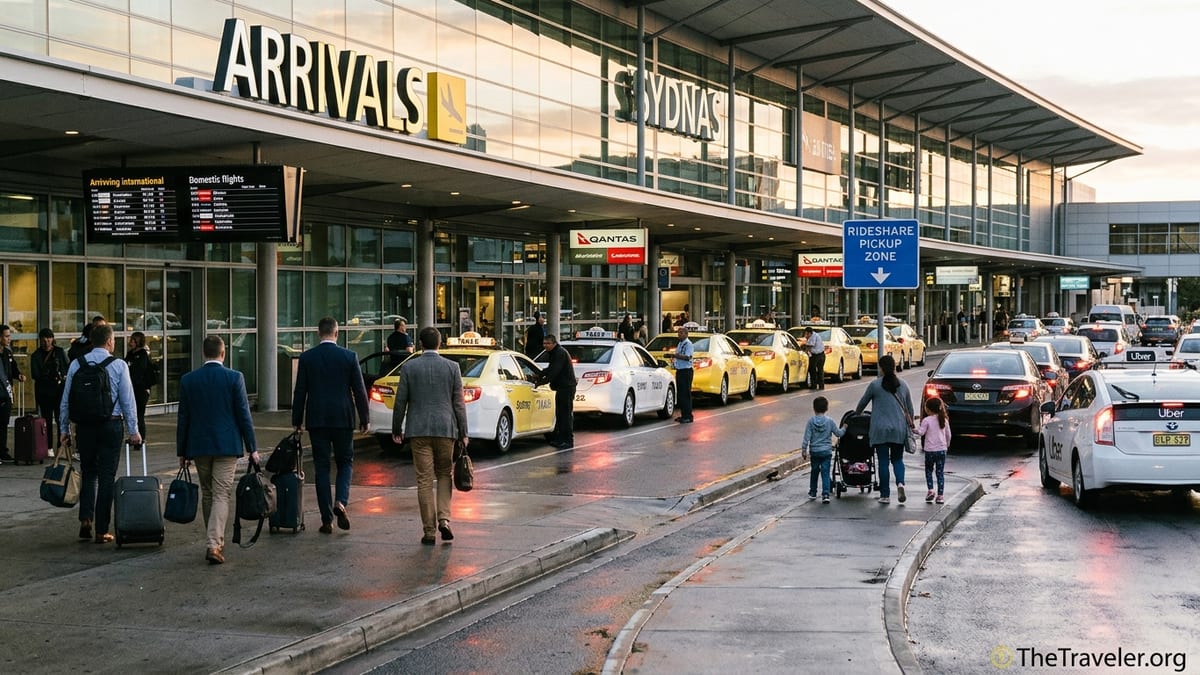
How Sydney Airport is laid out for taxis and rideshare
Sydney Airport sits about 8 kilometres south of the CBD and has three terminals: T1 International on the eastern side of the precinct, and T2 and T3 Domestic next to each other on the western side. All three terminals have clearly signed areas for taxis and for app-based rideshare services such as Uber. You cannot simply hail a taxi from the road outside the terminal; you must use the official ranks located within the airport precinct.
At T1 International, arriving passengers exit customs into the arrivals hall and follow yellow “Taxi” signs to a large, fenced taxi rank directly outside the terminal building. The rank is in a dedicated forecourt where airport staff help manage queues when it is busy. A similar system operates at T2 and T3 Domestic where the taxi ranks sit a short walk from baggage claim exits, again clearly signed with “Taxi” icons and floor markings.
Rideshare services, including Uber, do not use the same curb space as taxis. Instead, they have separate pickup areas that you walk to after ordering your ride in the app. For domestic terminals this may mean crossing a short stretch of roadway or a small section of car park, while at T1 International a newer kerbside Uber pickup zone has been introduced closer to the doors than the old multi-storey car park location. Give yourself an extra five to ten minutes to find these areas on your first visit.
Because all access roads within the airport precinct are controlled, both taxis and rideshare vehicles pay an airport ground transport or access fee to use these pickup zones. The fee is automatically added to your taxi meter or rideshare fare. You will see it itemised separately on a printed taxi receipt or within the Uber trip summary.
Official taxi ranks, airport fees and what to expect at the kerb
The safest place to get a taxi at Sydney Airport is always from the official rank outside each terminal. These ranks are regulated, covered by CCTV and supervised at busy times. You simply join the queue and airport marshals will direct you to the next available vehicle when it is your turn. You do not need to negotiate a price in advance and you should not accept offers from drivers approaching you inside the terminal building or on the footpath.
All licensed Sydney taxis taking passengers from the airport ranks are required to use their meter. The fare on the meter is based on time and distance, plus a small flagfall charge and the airport ground transport fee. As an example, a typical metered flagfall might be in the range of a few Australian dollars, with a per kilometre rate and a per-minute waiting rate. The airport access fee is an additional fixed amount that the driver pays to enter the rank and is allowed to pass on in full to the passenger.
Many visitors are surprised by how quickly the meter climbs if they hit traffic on the roads around the airport or entering the CBD. New motorway connections such as Sydney Gateway have helped ease some congestion, but weekday mornings and late afternoons can still be slow, especially around the domestic terminals. If your taxi spends long periods crawling in traffic the time-based component of the fare will add several dollars, even over a short distance.
At the rank you will see a mix of standard sedans, station wagons and sometimes larger people movers. If you are travelling with bulky luggage, such as surfboards or large ski bags, it is worth warning the marshal so they can allocate a wagon or larger vehicle. Wheelchair accessible taxis also use the ranks, but at peak times there can be a wait for one to arrive. If you need guaranteed accessible transport it can be better to pre-book a wheelchair taxi through a network such as 13cabs or Silver Service to meet you at a designated pre-booked bay within the airport precinct.
New fixed CBD taxi fares from Sydney Airport
From November 2025, New South Wales introduced a fixed fare trial for taxi trips from Sydney Airport taxi ranks to a defined CBD zone. Under this trial, any standard taxi that you board at the official ranks at T1, T2 or T3 and that travels directly to an address within the designated CBD area charges a pre-set flat price instead of the normal metered distance-and-time fare. The fixed amount is intended to include the airport access fee and any tolls on a direct route, so there should be no extras beyond an optional card surcharge or cleaning fee in unusual circumstances.
For travellers, the main benefit is certainty. Rather than worrying about being “taken the long way” or sitting in a traffic jam while the meter ticks over, you know the maximum you will pay before the car leaves the rank. As a rough guide based on current information, the flat fare from the airport to the CBD is in the ballpark of what a typical metered journey in moderate traffic would cost, often quoted around the high 50 to low 60 Australian dollar mark for a single uninterrupted trip, though the official amount is set by Transport for NSW and may be adjusted over time.
The fixed fare only applies in one direction and under specific conditions. Your journey must start at an official airport taxi rank and end at an address within the CBD trial area. If you ask the driver to make extra stops, detours or to travel beyond the CBD boundary, they are allowed to switch to the meter or renegotiate the arrangement in line with the rules. Trips from the CBD back to the airport do not fall under this trial and are charged on the meter as usual, plus any road tolls and the airport access fee on arrival.
Before your taxi leaves the rank the driver should clearly confirm that your destination is within the CBD fixed fare zone and state the fixed amount. If this does not happen, you can politely ask, “Is this trip covered by the CBD fixed fare, and what will the total be?” Having that quick conversation at the kerb helps avoid misunderstandings when you arrive at your hotel and ensures you are charged according to the latest official rules.
Typical taxi fares from Sydney Airport to the CBD and beyond
Even with the fixed fare trial in place, it is helpful to understand what a normal metered taxi fare looks like from Sydney Airport to popular destinations. In light to moderate traffic, a standard taxi from the airport to a central hotel near Town Hall or Wynyard might cost somewhere around 50 to 65 Australian dollars, including the ground transport fee, with the trip taking roughly 20 to 30 minutes. Heavy traffic, roadworks or crashes can quickly push travel times and costs higher.
Heading to nearby inner suburbs is often cheaper than going right into the CBD. For example, a ride from the airport to Newtown or Marrickville might fall in the 35 to 50 Australian dollar range depending on time of day and route. A taxi to Bondi Junction might land somewhere between a typical CBD fare and an inner west fare, especially if the driver uses toll roads to bypass congestion. Late-night surcharges may apply on weekend evenings, adding a small percentage to the total meter reading.
For longer trips, such as to Parramatta in Sydney’s west or Manly on the northern beaches, fares can exceed 100 Australian dollars once distance, time, tolls and the airport fee are added. In these cases it is often worth comparing the taxi estimate to an UberX or Uber Comfort quote in the app, or combining public transport with a shorter taxi or Uber leg. For example, some locals take the airport train into the CBD, then a taxi from Central or Circular Quay to their final destination to keep costs down.
Remember that card payments in taxis commonly attract a small non-cash surcharge, usually a percentage of the final fare. If you prefer, you can pay the driver in cash in Australian dollars to avoid this surcharge, although many travellers appreciate the convenience and record-keeping of paying by card or mobile wallet despite the extra cost.
Uber and rideshare pickups: how they compare on price and convenience
Uber is widely available at Sydney Airport and is a popular choice for travellers who prefer app-based pricing and digital receipts. Other rideshare brands also operate, but Uber has dedicated airport pickup zones at all three terminals and often has the largest pool of available drivers. To use Uber, you request a ride in the app once you are landside and have collected your bags, then walk to the signed pickup point shown on the in-app map.
At T3 Domestic and, more recently, T1 International, Uber operates kerbside pickup areas that are significantly closer to the terminal doors than the older multi-storey car park locations. This means that instead of dragging luggage through several levels of a car park, you walk 20 to 50 metres from the exit doors to an Uber-branded area where cars queue. At the international terminal, Uber has introduced a PIN system for standard UberX rides: you receive a short code on your phone, line up in a marked lane, and give your code to the next available driver rather than matching with a specific car in the app.
In terms of price, an UberX from Sydney Airport to a CBD hotel will typically show an upfront fare quote similar to or slightly lower than a metered taxi fare in normal conditions. For example, you might see an estimate in the 45 to 60 Australian dollar range for an off-peak airport to city trip, including the airport access fee. However, dynamic pricing means that during peak demand or major events, an Uber fare can surge to well above what a taxi meter would charge for the same trip.
Uber also offers larger vehicle categories, such as UberXL, that are useful for families or groups of four to six with luggage. An UberXL from the airport to the CBD might cost roughly 1.3 to 1.6 times the UberX price in many situations. That means if UberX is quoting 50 Australian dollars for a city trip, UberXL could be closer to 70 to 80 Australian dollars. Even so, this can still work out cheaper than paying for two separate taxis if your group and luggage will not fit in a single standard cab.
Arriving late, travelling with luggage or kids: choosing between taxi and Uber
For late-night arrivals or when travelling with tired children, the biggest priorities tend to be speed and simplicity. Taxis have the advantage of being immediately visible once you step outside: you follow the signs, join the queue and get into the next available car. There is no need to find mobile data or navigate to a specific bay while juggling bags. If you arrive on a busy long-haul flight there may be a short wait, but the process is straightforward.
Uber can be just as convenient if you are comfortable with the app and have roaming or local mobile data. The benefit is that you see the price estimate before confirming the ride and can choose a larger vehicle category if you have bulky luggage or a stroller. Parents often appreciate being able to enter their exact destination address in the app, which reduces the chance of misunderstandings late at night when everyone is exhausted.
If you are travelling with infants or small children, note that Australian taxis and rideshares are not always equipped with dedicated child seats by default. For older children, it is legal in New South Wales for them to travel in the rear seat without a child restraint under certain circumstances, but many parents prefer to bring their own travel booster or to pre-book a “baby seat” taxi through a specialist service. Uber also offers child-seat options in some Australian cities through specific product types from time to time; check the app in advance to see what is available on your travel dates.
For travellers with oversized sports equipment, such as golf clubs or surfboards, taxis from the rank may be more hit-and-miss, as most vehicles are standard sedans. In this case, checking the Uber app for an UberXL or similar larger vehicle can be a smart move. Alternatively, you can warn the taxi marshal at the rank that you require a station wagon or maxi taxi, but you may need to wait a little longer for a suitable vehicle to arrive.
Real-world price comparisons: taxi vs Uber from Sydney Airport
To get a feel for real-world costs, consider a weekday afternoon arrival into T1 International around 3 pm. You are a solo traveller heading to a hotel near Circular Quay with one suitcase and a cabin bag. A taxi from the rank will likely fall under the CBD fixed fare if it is still within the trial period and your hotel is inside the defined area, giving you a known price in the region of the high 50 to low 60 Australian dollars. An UberX quote at the same time might show an upfront price of, say, 50 to 55 Australian dollars, but that could edge higher if there is heavy demand or a sudden burst of rain.
Change the scenario to a Saturday night arrival at 11.30 pm at the domestic terminals with three adults and four suitcases heading to Surry Hills. The taxi rank will still be operating, though queues can be longer if several flights land together. A taxi fare might come out somewhere between 45 and 65 Australian dollars, depending on traffic and whether late-night surcharges apply. Open the Uber app at the same time and you might find an UberX quote in the mid 50s, but if there is a surge multiplier in place it could nudge into the 70s, at which point the taxi might be better value.
For a family of five landing mid-morning and heading to a serviced apartment in Darling Harbour, a single standard taxi may be too tight with luggage. Two taxis could cost 90 to 120 Australian dollars in total. By comparison, an UberXL might quote an upfront price in the 75 to 95 Australian dollar range, potentially saving money and keeping the family together in one vehicle. However, if Uber demand is high, that price advantage can disappear, and the guaranteed availability of taxis at the rank becomes more attractive.
These examples underline why it is worth checking both options in real time. As you walk through arrivals, glance at the taxi queue and, at the same time, open the Uber app to compare estimated prices and pickup times. Factoring in the certainty of the CBD fixed taxi fare, the airport access fees and any surge pricing, you can make a quick, informed choice rather than defaulting automatically to one mode.
The Takeaway
For most visitors, getting from Sydney Airport to the CBD or nearby suburbs comes down to a choice between the official taxi ranks and app-based rideshare services like Uber. Taxis offer simplicity and the reassurance of the new fixed fare trial for direct CBD trips, which removes much of the uncertainty that once surrounded airport rides. Uber and other rideshare services, meanwhile, provide upfront pricing and flexible vehicle types, with increasingly convenient kerbside pickup zones at both domestic and international terminals.
In practice, the best option on the day depends on your arrival time, group size, luggage volume and appetite for using an app after a long flight. If you arrive late at night with young kids and just want to get to a central hotel with minimal fuss, following the signs to the taxi rank and accepting the fixed CBD fare is hard to beat. If you are comfortable with your phone and see a competitive UberX or UberXL price, especially outside peak times, ordering a rideshare to a dedicated pickup bay may save a few dollars and suit families or small groups well.
Whichever you choose, stick to the official ranks and marked pickup zones, ignore unofficial touts, and do not be afraid to ask your driver about the fixed CBD fares or to request a receipt showing the airport access fee. With a little advance knowledge of how the system works, your first encounter with Sydney’s roads can be as smooth as the harbour you will soon be exploring.
FAQ
Q1. Where are the official taxi ranks at Sydney Airport?
The official taxi ranks are directly outside the arrivals areas of all three terminals. At T1 International, follow the yellow “Taxi” signs to the main rank in the arrivals forecourt. At T2 and T3 Domestic, similar signs lead you from baggage claim to ranks a short walk from the exits.
Q2. How much does a taxi from Sydney Airport to the CBD cost?
In normal conditions, a taxi to a central CBD hotel typically falls somewhere around 50 to 65 Australian dollars including the airport access fee. Under the current fixed-fare trial for direct CBD trips from the airport ranks, you will pay a set price instead of the meter, which is generally in that same broad range.
Q3. Is Uber cheaper than a taxi at Sydney Airport?
Often, but not always. At quiet times an UberX can be slightly cheaper than a metered taxi for an airport to CBD trip. During peak demand or when surge pricing applies, Uber can be more expensive than both a standard metered taxi and the fixed CBD taxi fare.
Q4. Where do I meet my Uber at Sydney Airport?
After requesting your ride in the app, follow the “Rideshare” or “Uber” signs to the dedicated pickup area for your terminal. At T1 International and T3 Domestic, these are kerbside zones close to the terminal doors. The app will show an exact map of the pickup point.
Q5. What is the new fixed taxi fare from Sydney Airport to the CBD?
The fixed fare is a trial scheme for rank-and-hail taxis departing from the official airport ranks to a defined CBD zone. Instead of paying a distance and time based fare, you pay a single set amount that includes the airport access fee and tolls on a direct route. The exact figure is set by Transport for NSW and may change over time, but is broadly similar to a typical metered fare in moderate traffic.
Q6. Do taxis and Ubers charge extra for the airport?
Yes. Both taxis and rideshare vehicles pay a ground transport or access fee to use the airport’s pickup zones. This fee is added to your fare. In a taxi it appears on the meter and receipt; with Uber it is itemised in your trip summary.
Q7. Is it safe to take a taxi from Sydney Airport late at night?
Yes. The official taxi ranks are monitored by airport staff and cameras, and licensed taxis must display identification. For extra peace of mind, note the taxi number and ask for a printed receipt showing your route and fare when you arrive.
Q8. Can I pay for my airport taxi by card?
Almost all Sydney taxis accept credit and debit cards as well as mobile wallets. A non-cash surcharge often applies, usually a small percentage of the fare. If you want to avoid this, you can pay in Australian dollars cash instead.
Q9. What is the best option for families with lots of luggage?
For two adults and one or two children with moderate luggage, a standard taxi or UberX usually works well. Larger families or groups, or those with bulky items like prams and travel cots, may find an UberXL or a pre-booked maxi taxi more comfortable, even if the fare is a little higher than a standard cab.
Q10. Are there alternatives to taxi or Uber from Sydney Airport?
Yes. The T8 Airport Line train runs frequently between the airport and the CBD, with an additional station access fee. There are also public buses and private shuttle services to some suburbs and hotels. Many budget conscious travellers combine the train with a short taxi or Uber ride at the city end.