


More news on this day
Flights into and out of Sydney Airport have faced fresh disruption after two air traffic controllers reportedly called in sick at short notice, triggering capacity cuts and exposing how easily Australia’s busiest aviation hub can be thrown off schedule.
Get the latest news straight to your inbox!
Two Sick Calls, Dozens Of Delayed Flights
Published coverage and operational data indicate that a pair of controller absences in Sydney’s air traffic control tower led to rapid adjustments to the day’s traffic plan, with arrivals and departures slowed to match the reduced staffing. Because tower positions must be filled by highly trained, current and endorsed controllers, there was limited scope to replace the missing staff at short notice.
Real-time tracking from aviation data providers showed departure queues building on the ground, with aircraft pushed into holding patterns and turnaround times lengthening at the gates. Some domestic services left more than an hour behind schedule, while a smaller number of flights were cancelled outright as airlines reworked rosters and aircraft rotations.
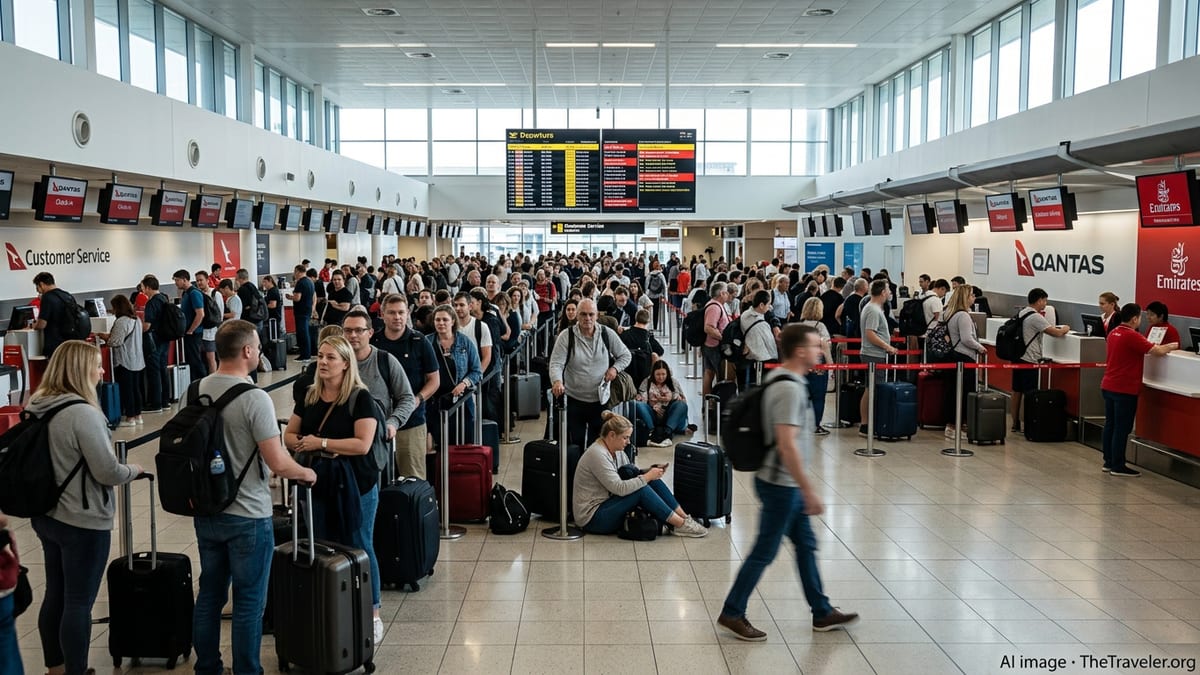
The incident unfolded during a busy travel period, compounding the impact for passengers already moving through crowded terminals. Social media posts and local media reports described lines at check in and security swelling as delays cascaded through the schedule, with late-arriving aircraft and crew in Sydney in turn affecting flights in Melbourne, Brisbane and other Australian cities.
Publicly available information from previous disruptions at Sydney shows that when tower staffing drops unexpectedly, traffic managers often respond by reducing the number of allowable runway movements per hour. That type of cap appears to have been introduced again, magnifying the effect of only two controllers calling in sick.
Why Sydney’s Control Tower Is So Vulnerable
The latest disruption has renewed attention on the structural fragility of air traffic control staffing in Sydney. Evidence submitted to recent government and regulatory processes describes how even one or two unplanned absences in the tower can lead to ground delay programs, as there are too few qualified controllers on standby to absorb last-minute sick leave.
Training and licensing requirements mean it can take years for a new controller to become fully productive, and each must be specifically rated for particular airspace and runway configurations. Publicly available documents from industry bodies note that this long pipeline has left Sydney operating with relatively lean staffing margins, particularly in peak periods such as school holidays.
Reports also highlight that controllers are often rostered to cover multiple complex positions in a shift, limiting flexibility if someone becomes unwell. When two staff call in sick, as in the latest episode, supervisors may be forced to combine sectors or close positions, reducing the rate at which aircraft can be safely sequenced for take off and landing.
Industry analysis submitted to regulators has previously warned that this kind of lean resourcing can turn routine sick leave into a network-wide problem. The incident in Sydney is being cited by travel and consumer advocates as a textbook example of how a small staffing shock in a control tower can ripple through an entire aviation system.
Passenger Experience: Long Queues And Missed Connections
For travelers passing through Sydney, the operational details were less visible than the immediate impact on their plans. Domestic passengers reported via social media that departure boards were dotted with delayed and cancelled flights, with staff at airline counters working to rebook those who faced missed connections or same-day event deadlines.
According to published coverage, some passengers in regional centers such as Canberra and Hobart also experienced knock-on effects when aircraft and crews were held in Sydney longer than scheduled. In a tightly timed network, a late inbound jet can quickly leave an outbound flight without either a plane or a full cockpit and cabin crew.
Travel advisors point out that when air traffic restrictions are imposed, airlines often have little choice but to prioritize certain services, such as longer-haul routes that are harder to re-time. This can leave shorter domestic hops more exposed to cancellation, as carriers attempt to preserve the integrity of their overall network.
The delays also had a financial and logistical cost for passengers, many of whom faced extra expenses for meals, airport parking or last-minute accommodation. While some travelers may be entitled to assistance under individual airline policies, Australia does not have a unified compensation regime for air traffic control related disruption, leaving outcomes highly variable.
Broader Debate Over Resilience And Responsibility
The Sydney incident is feeding into a broader national conversation about aviation reliability and who should bear responsibility when staff shortages disrupt travel. Recent competition and performance reviews have highlighted that staffing resilience in critical roles, such as air traffic control, has lagged behind the rapid post-pandemic rebound in passenger numbers.
According to publicly available submissions from airports, airlines and industry associations, there is concern that the system has been allowed to run with minimal spare capacity in key safety-critical positions. In this context, two controllers calling in sick at Sydney has become a pointed symbol of how little margin for error remains in one of the country’s most important pieces of infrastructure.
The episode is also being widely compared with similar events overseas, where isolated sick leave in control towers has forced dramatic cuts to runway movements and wave after wave of delays. Commentators argue that such patterns show a common underlying issue: a reluctance to fund and maintain the depth of staffing needed to absorb routine illness without disrupting the public.
For frequent flyers and occasional holidaymakers alike, the practical lesson is that staffing issues hundreds of feet above the runway can be just as disruptive as storms or mechanical faults. With Sydney’s latest delays traced back to only two staff members unable to work, travelers are being reminded yet again how finely balanced the aviation system has become.