


More news on this day
TAAG Angola Airlines is preparing to relaunch nonstop flights between Luanda and Guangzhou, re-establishing a direct air bridge between Angola and mainland China and strengthening the carrier’s growing long-haul network across Africa, Europe, the Middle East and South America.
Get the latest news straight to your inbox!
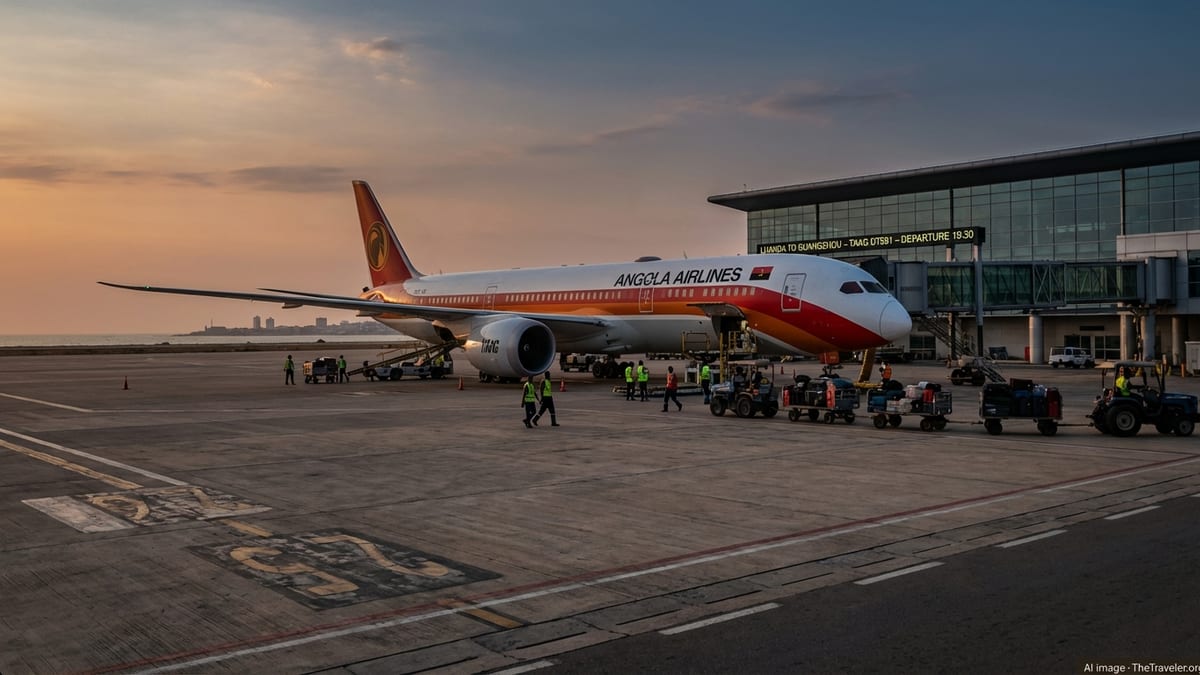
Weekly Luanda–Guangzhou Flights Return to the Schedule
According to industry schedule filings and specialist aviation coverage, TAAG has re-filed a weekly Luanda–Guangzhou service, due to restart from June 23 using Boeing 787-10 aircraft. The flights will operate from Dr António Agostinho Neto International Airport, Luanda’s new hub, to Guangzhou Baiyun International Airport, one of China’s largest aviation gateways.
Route data services indicate that the flight will run once a week and is currently one of the longest services in TAAG’s network, with a block time of around 13 to 14 hours. The non-stop operation places Luanda among a small group of African capitals with direct connectivity to southern China.
Publicly available airport information shows that TAAG is the only carrier currently scheduled to operate non-stop passenger flights between Luanda and Guangzhou, giving the airline a unique position on traffic flows between southern Africa and southern China. The route also complements Guangzhou’s role as a major hub served by dozens of international airlines across Asia, Europe and the Middle East.
The decision to restore the service marks a reversal from 2024, when earlier iterations of the Luanda–Guangzhou route were suspended. Regional aviation reporting notes that the flights had been withdrawn in August 2024 before plans for a 2026 comeback were placed into the schedules.
China Joins a Growing List of Intercontinental Markets
With Guangzhou back on the map, China now sits alongside Portugal, Brazil, South Africa, the United Arab Emirates and other key markets in TAAG’s expanding long-haul portfolio. Network maps compiled by route-tracking platforms list Luanda–Lisbon, Luanda–Porto, Luanda–Johannesburg, Luanda–Cape Town, Luanda–São Paulo, Luanda–Havana and Luanda–Dubai among the carrier’s principal intercontinental and regional links.
From Luanda, TAAG already provides direct access to Portugal through Lisbon and Porto, reflecting Angola’s historic ties and ongoing trade with its former colonial power. Schedules also show strong connectivity to Brazil, particularly São Paulo, positioning TAAG as a niche player on South Atlantic traffic flows between South America and Africa.
In Southern Africa, Johannesburg and Cape Town feature prominently as regional gateways, while services to Dubai anchor the airline’s presence in the Gulf region. The Guangzhou relaunch adds a major Asian destination, reinforcing the carrier’s ambition to position Luanda as a connecting point between multiple continents rather than solely an origin and destination market.
Network summaries from aviation data providers highlight that Guangzhou now ranks among TAAG’s longest non-stop sectors, comparable in stage length to Luanda–Havana. This underlines the airline’s pivot towards modern long-haul operations centered on a handful of high-potential trunk routes.
New Luanda Hub Aims to Capture Connecting Traffic
The Luanda–Guangzhou route is being developed in parallel with the gradual ramp-up of operations at Dr António Agostinho Neto International Airport, the new airport serving the Angolan capital. Government and airport documentation describe the facility as a multibillion-dollar hub designed to replace the city’s older terminal complex and provide TAAG with a modern base for both passenger and cargo activities.
Reports indicate that domestic flights began transferring to the new airport in late 2024 and early 2025, with TAAG progressively growing its schedule as additional infrastructure came online. Airport statistics cited in public sources suggest that, by April 2025, TAAG was already operating an average of more than ten daily departures from the facility, primarily to Angolan cities.
With international flights, including Luanda–Guangzhou, now scheduled from Dr António Agostinho Neto, TAAG can begin to test the hub’s potential as a regional transfer point. The weekly China service is expected to feed traffic from West, Central and Southern Africa through Luanda, offering an alternative to routings via the Gulf or other African capitals.
The combination of a new airport, refreshed fleet plans and a long-haul route to one of China’s largest cities gives Luanda new visibility on global aviation maps. For Angolan authorities seeking to diversify the economy and boost tourism, improved air access is seen as a prerequisite to attracting business travelers, investors and leisure visitors.
Trade, Investment and Diaspora Links Underpin Demand
China has been one of Angola’s most significant economic partners over the past two decades, particularly in energy, infrastructure and construction. Analysts of Africa–China relations often note that bilateral trade, investment flows and financial arrangements in Angola have made air links strategically important, even if they are relatively low-frequency compared with routes in more mature markets.
Travel industry observers point out that direct flights between Luanda and Guangzhou are well positioned to serve multiple niches: business and government travel, specialist labor flows, students and medical passengers, as well as ethnic and diaspora traffic on both sides. The route also offers opportunities for Angolan and regional exporters to move high-value or time-sensitive cargo to southern China and beyond.
TAAG has been developing its cargo business at the new Luanda airport, with local transport ministry bulletins and airline communications referencing the start of regular freight services in 2024. The widebody aircraft selected for the Guangzhou route are expected to carry significant bellyhold cargo alongside passenger traffic, potentially including oil- and mining-related equipment, consumer goods, and agricultural products.
For Chinese travelers, the service provides a one-stop gateway into a cluster of African markets via Luanda, including connections to Namibia, South Africa and other Southern African Development Community countries. This aligns with broader trends in which African airlines are seeking to capture more intra-African and Africa–Asia flows instead of ceding them entirely to large foreign carriers.
Competitive Landscape and Outlook for Travelers
Even at a weekly frequency, the reinstated Luanda–Guangzhou route subtly reshapes competition on Africa–China travel. Publicly available scheduling data indicates that, at present, no other Southern African airline is operating a non-stop passenger service to mainland China, leaving the field largely to Gulf, European and Chinese carriers via their home hubs.
By offering a direct option, TAAG can compete on total journey time for passengers originating in Angola and neighboring states, while also marketing Luanda as a convenient transfer point with fewer backtracking miles than some traditional routings. The airline’s strategy appears to lean on a combination of competitive fares and the novelty of shorter itineraries to win over both price-sensitive and time-conscious travelers.
From a traveler perspective, the development expands the menu of long-haul options available from Luanda. Alongside existing non-stop services to Lisbon, Porto, São Paulo, Johannesburg, Cape Town, Dubai and Havana, Guangzhou brings another major global metropolis within a single flight of Angola’s capital. For corporate travel planners, tour operators and individual passengers, this broadens itinerary design and may introduce new multi-stop combinations linking Asia, Africa, Europe and South America through a single hub.
The performance of the Luanda–Guangzhou route over the coming months will be closely watched by aviation analysts and regional planners. Strong load factors could encourage TAAG to increase frequency or add additional points in China or wider Asia, while weaker demand might see the service adjusted. For now, the scheduled relaunch marks a significant symbolic and practical step in Angola’s efforts to deepen its global connectivity.