


Taksim Square sits at the heart of modern Istanbul, a busy crossroads where metro lines, airport buses, nostalgic trams, chain hotels and crowds all converge. For first-time visitors, it can feel overwhelming on arrival. Understanding where Taksim is, how to reach it, what the main landmarks mean and what to expect from the atmosphere will make your first days in Istanbul smoother and more enjoyable.
Get the latest updates straight to your inbox!
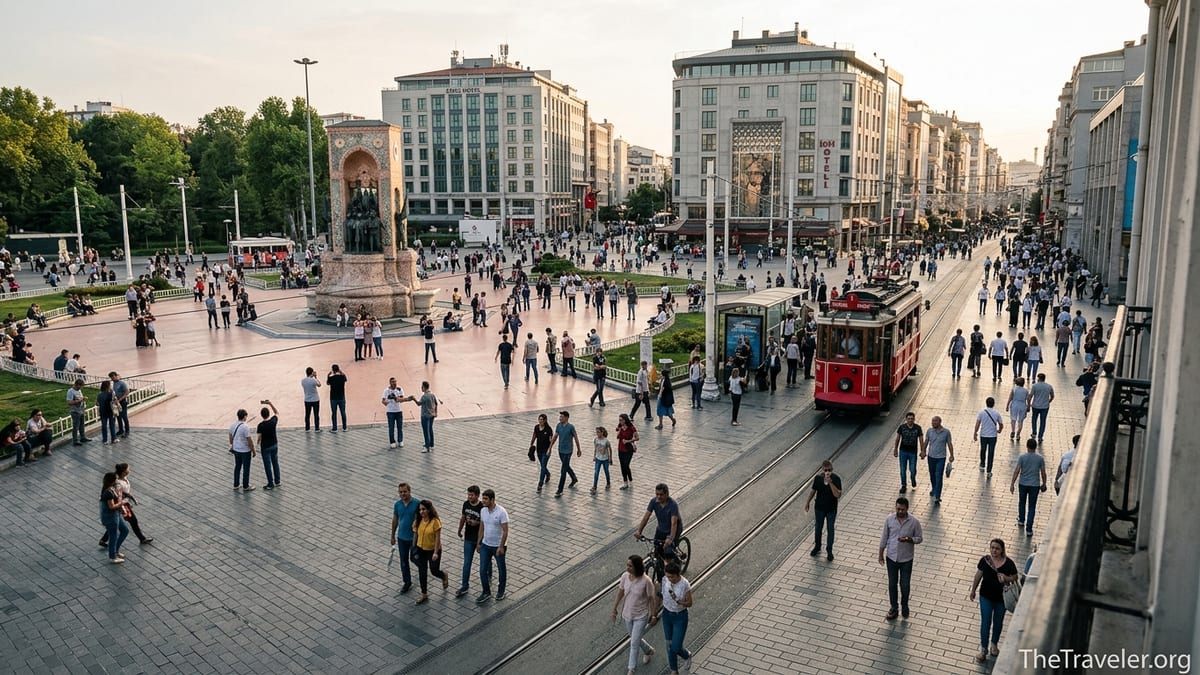
What Taksim Square Actually Is Today
Taksim Square is the main transport and meeting hub of Beyoğlu, on the European side of Istanbul. Historically it was where water lines were distributed to the city; today it is an open plaza framed by Gezi Park, the Atatürk Cultural Center and large hotels, with İstiklal Avenue running downhill from its southern edge. Many locals use "Taksim" as shorthand for the whole surrounding nightlife and shopping district, so when a hotel or tour says "near Taksim" they usually mean within a 5 to 10 minute walk of the square itself.
Physically, Taksim is less of a picturesque old-world piazza and more of a large, mostly paved space that feels like a modern civic square. You will see lines of taxis, buses, police vehicles and groups of locals meeting friends or waiting for tours. It is not a historic bazaar like the Grand Bazaar, nor a waterfront area like Eminönü or Karaköy. Think of it as a starting point and orientation anchor rather than a destination where you will spend hours sitting in cafes on the square itself.
For many travelers, the first real impression of Taksim comes at night: illuminated hotels such as The Marmara Taksim, the red nostalgic tram waiting at the head of İstiklal Avenue, and a constant flow of people streaming toward the bars and restaurants of Beyoğlu. During the day, it can look stark under strong sun, but its value lies in its excellent connections and its position at the top of İstiklal, not in ornate architecture.
The square has also been the symbolic stage for political rallies, May Day gatherings and the 2013 Gezi Park protests. Even when nothing is happening, you may see a visible police presence and occasional cordoned-off areas. This is normal for Taksim and not usually a sign of immediate danger; it reflects the square’s political importance as much as its role in daily life.
Getting to Taksim: Airport Buses, Metro and Funicular
Most first-time visitors arrive at Istanbul Airport on the European side and head directly to Taksim. The most popular budget-friendly option is the Havaist airport shuttle, currently running the HVIST-19 line to Taksim. Buses depart from the lower-level bus station beneath the main terminal. Depending on traffic, the trip typically takes about 60 to 90 minutes and costs in the low hundreds of Turkish lira per person, paid by contactless bank card or Istanbulkart. You load your luggage under the coach and get dropped near the square, a short walk from the hotels that ring Taksim.
If you prefer rail, the M11 metro line connects Istanbul Airport to the city. To reach Taksim, you currently need to connect to the M2 line, which runs directly to Taksim station; this involves a transfer, so it is cheaper but more cumbersome with heavy bags. Many visitors choose Havaist on arrival when tired, then experiment with the metro later in their stay once they know the system. Taxis are available outside the terminal and will usually be faster than the bus late at night but can be slower at rush hour, with a metered fare that is significantly higher than the shuttle for a solo traveler yet reasonable when split among three or four people.
From Sabiha Gökçen Airport on the Asian side, you can use HAVABUS shuttles to Taksim, again for a moderate fixed fare. The ride can easily take 70 to 90 minutes or more in peak traffic as the bus crosses the Bosphorus bridges into Europe. It drops passengers on the edge of Taksim Square in a place similar to the Havaist stop, so the experience feels familiar if you use both airports.
Once in the city, the key local connection is the M2 metro and the F1 funicular. Taksim station on the M2 line puts you directly under or beside the square; you reach the surface via escalators and elevators. At the northern edge of the square sits the entrance to the F1 Kabataş funicular, a short underground shuttle that links Taksim with Kabataş tram and ferry piers. For example, you might take the funicular from Taksim down to Kabataş, board the T1 tram toward Sultanahmet to visit Hagia Sophia, then return the same way and be back in Taksim without ever needing a taxi.
The Republic Monument and the Start of İstiklal Avenue
The most recognizable feature of Taksim Square is the Republic Monument, an imposing stone and bronze structure roughly in the middle of the plaza. Unveiled in 1928, it commemorates the foundation of the modern Republic of Turkey and depicts Mustafa Kemal Atatürk as both a military commander and statesman. In practice, it also functions as a landmark and meeting point. If a walking tour tells you to meet “by the monument in Taksim,” this is the spot. You will often see small groups taking photos here before heading down İstiklal.
Just south of the monument begins İstiklal Caddesi, or İstiklal Avenue, Istanbul’s most famous pedestrian shopping street. It stretches around 1.4 kilometers downhill from Taksim to Tünel Square, lined with international brands like Zara and Mango, Turkish chains, patisseries such as Hafız Mustafa and Mado, and side passages that hide smaller cafes and meyhanes. A red nostalgic tram runs the length of the avenue, beginning from its little terminal on the Taksim side of the square, though in busy periods it can move very slowly through the crowds.
A practical way to get your bearings on your first evening is to start at Taksim Square just before sunset, take a quick look at the Republic Monument, then walk slowly down İstiklal toward Galata Tower. You might pause at St. Anthony of Padua Church, step into Çiçek Pasajı for a photo, and finish with a dessert stop near the Galata end before catching the M2 or T1 back to your hotel. This simple walk shows clearly how Taksim, İstiklal and the lower Beyoğlu neighborhoods connect to each other.
Note that while İstiklal is officially pedestrian, it is almost always busy. Street musicians, chestnut and corn sellers, and crowds around chain cafes like Starbucks and Simit Sarayı create occasional bottlenecks. Pickpocketing is not rampant but does occur, especially at night; keeping bags closed and phones in front pockets is usually sufficient caution for most visitors.
Crowds, Protests and What They Mean for Visitors
Taksim’s reputation as a protest site can worry first-time visitors, especially when they see large numbers of police in helmets or armored vehicles parked on the square. Historically, Taksim has been the focal point for labor rallies, women’s marches, LGBTQ events and the 2013 Gezi Park protests. Authorities frequently restrict access to the square on politically sensitive dates such as May 1, some national holidays or after high-profile court decisions. On such days, side streets may be blocked, the metro station can close intermittently, and pedestrian traffic is redirected.
In most cases, tourists are not targets of either protesters or police. Disruptions are more likely to involve temporary closures, being told to change route, or, in rarer cases, exposure to tear gas if you are standing right beside a confrontation. A common local recommendation is straightforward: if you see a dense police line forming or hear loud chants and sirens, step away down a side street and wait 15 to 20 minutes in a cafe. For example, on some recent protest days locals simply ducked into a nearby simit shop off Sıraselviler Caddesi until things calmed, then continued on their way to dinner.
Day to day, the crowds you encounter in Taksim are less political and more practical: office workers commuting through Taksim station, tourists boarding airport shuttles, families using the square as a rendezvous. On Friday and Saturday nights, the demographic shifts toward younger locals and visitors headed to bars in Cihangir, Çukurcuma or Nevizade. Noise levels increase but serious trouble is rare; the main issues are drunken arguments, loud music and the usual big-city petty crime.
The main time when staying directly on the square can be a nuisance is during large public events. On New Year’s Eve, for example, Taksim and İstiklal swell with people and the police presence is intense. Road closures can make it hard for taxis or ride-hailing drivers to reach hotel entrances. If you prefer quiet, booking a hotel 7 to 10 minutes’ walk away, perhaps toward Cihangir or the upper end of Cihangir Caddesi, allows you to enjoy the atmosphere when you choose while keeping a buffer between you and the thickest crowds.
Staying Around Taksim: Hotels and Which Streets Feel Different
Accommodation around Taksim ranges from large international chains to small boutique properties on steep side streets. On the square itself, landmark hotels like The Marmara Taksim and Point Hotel Taksim appeal to travelers who want direct access to the metro and airport buses. Rooms facing the square can have wide city views, but they also pick up more noise from traffic and occasional late-night activity. If you arrive on a late Havaist bus after midnight, these hotels are convenient because you can be in your room within a 5 to 10 minute walk from the drop-off point.
Just beyond the square, mid-range hotels cluster along roads such as Sıraselviler Caddesi, İstiklal’s side streets and the back streets toward Şişli. These areas vary significantly in character within a few blocks. A hotel on a narrow alley directly off İstiklal might feel quiet during the day but be only 30 meters from a row of loud bars that operate until 2 or 3 a.m. In contrast, a guesthouse further into Cihangir, perhaps near a small park or mosque, can be much calmer while still allowing you to reach Taksim Square on foot in 10 minutes.
Reviews often mention noise and hills. For instance, a boutique hotel behind İstiklal may note "lively nightlife" in its description; in practice this can mean thumping bass until late hours. If you are sensitive to noise, look for properties that explicitly advertise soundproof windows or that are a little downhill toward Gümüşsuyu, where residential buildings outnumber clubs. Street gradients are another consideration: dragging a heavy suitcase up from Kabataş to Taksim is tiring, which is why many guests prefer to ride the F1 funicular instead of walking.
Price-wise, staying around Taksim is usually slightly cheaper than comparable-quality hotels in Sultanahmet during peak season, but still firmly mid-range by Istanbul standards. You might find international-brand rooms in high season for the equivalent of a mid-tier European city rate, while simpler guesthouses a few blocks away offer more basic rooms at lower prices. First-time visitors who care most about brand familiarity and predictable service often choose the big hotels framing the square. Travelers who prioritize neighborhood feel and evenings in local cafes lean toward areas like Cihangir or the streets closer to Galata, accepting the extra 10 to 15 minutes’ walk to Taksim.
When It Makes Sense to Base Yourself Near Taksim
Choosing whether to stay near Taksim or in another part of Istanbul depends largely on your priorities. Taksim is an ideal base if you plan to explore multiple districts across both the European and Asian sides and value fast transport links more than immediate proximity to the historic core. From Taksim you can ride the M2 metro to business and residential neighborhoods like Levent, use the F1 funicular plus T1 tram to reach Sultanahmet, or head to Kabataş and Karaköy for ferries across the Bosphorus to Kadıköy and Üsküdar. For example, a traveler attending a conference in Şişli might stay near Taksim to have easy metro access in one direction and sightseeing in the other.
It also suits visitors who enjoy nightlife and modern city energy. If you expect to spend your evenings in bars around Nevizade, music venues in Asmalımescit or cafes in Cihangir, walking home from these areas to a hotel near Taksim usually takes 10 to 20 minutes and avoids late-night taxi negotiations. In contrast, if you stay in the old city around Sultanahmet, you will likely find evenings quieter and more focused on restaurants, with fewer late-night options within a short walk.
On the other hand, travelers focused almost entirely on major monuments such as Hagia Sophia, the Blue Mosque and Topkapı Palace may prefer to base in Sultanahmet to minimize daily travel time. While Taksim to Sultanahmet is simple using the funicular and tram, it still involves at least one transfer and 25 to 35 minutes door to door. Families with small children, or older travelers who tire easily, often appreciate being able to walk directly from their hotel to the main sights without changing lines.
Season matters too. In winter, when daylight hours are shorter and evenings cold and damp, staying near Taksim means you are close to indoor attractions such as shopping malls in Şişli and cinemas in Beyoğlu. In high summer, when temperatures and humidity rise, some visitors find the shade of Sultanahmet’s old streets and proximity to the sea more comfortable than Taksim’s open plaza. If your visit coincides with politically sensitive dates like May 1 or major demonstrations, it may be easier to stay slightly away from Taksim to avoid possible closures, while still planning a daytime visit to understand its role in the city.
Practical Tips for First-Time Visitors in Taksim
On arrival, it helps to pin a few key reference points in your mind: the Republic Monument roughly at the center of the square, the start of İstiklal Avenue at its southern edge, the large Atatürk Cultural Center building on one side, and the Havaist and HAVABUS bus stops along the perimeter. Walking once around the square on your first day, even if you are tired, will make it much easier to orient yourself later when returning from another part of the city after dark.
Buying and using an Istanbulkart will simplify almost all your journeys. You can obtain one at machines in or around Taksim metro station and load it with cash or card. The same card works on the metro, funicular, tram, public buses and even some ferries, although the Havaist airport service may have separate payment arrangements using bank cards or QR codes at times. Keep the card handy as you will often tap in when entering and occasionally when exiting stations.
Safety-wise, Taksim is typical of a busy central square in a major city. Violent crime against tourists is uncommon, but keep an eye on wallets and phones in crowded spots like the narrowest sections of İstiklal or when boarding a packed metro train. Take normal precautions with street scams: be cautious if an overly friendly stranger insists on guiding you to a bar or offers a deal that sounds too good to be true. Established venues on or just off İstiklal, or restaurants recommended by recent travelers, are generally a safer bet than unmarked doorways approached by touts.
Finally, build a little flexibility into your plans when using Taksim as a transit hub. Allow extra time when heading to the airport from the square, especially in the late afternoon or early evening, in case of traffic or queues for the shuttle bus. If you arrive to find the square partially closed or the metro entrance locked due to an unannounced event, do not panic; walk a block or two toward Cihangir or Gümüşsuyu and you will usually find an alternative route, a taxi rank or a quieter street where you can regroup. Understanding that Taksim can shift quickly from ordinary to crowded and back again will help you treat it as a living part of Istanbul rather than a static landmark.
FAQ
Q1. Is Taksim Square safe to visit for first-time tourists?
Yes, Taksim Square is generally safe, with a constant flow of locals and visitors. You should still use normal big-city precautions against pickpocketing and avoid standing close to any tense protests or police lines.
Q2. How do I get from Istanbul Airport (IST) to Taksim Square cheaply?
The Havaist HVIST-19 shuttle from Istanbul Airport to Taksim is usually the best-value option, offering a direct coach ride to the square for a moderate fare, cheaper than a taxi and easier with luggage than the metro.
Q3. How long does the airport bus from IST to Taksim take?
Depending on traffic and time of day, expect roughly 60 to 90 minutes. During rush hours or in bad weather the journey can be longer, so allow plenty of time when returning for your flight.
Q4. Where exactly does İstiklal Avenue start in relation to Taksim Square?
İstiklal Avenue begins at the southern edge of Taksim Square, just beyond the Republic Monument. The nostalgic red tram and the first cluster of shops and cafes mark the start of the pedestrian street.
Q5. Should I stay in Taksim or Sultanahmet on my first visit?
Choose Taksim if you want central transport links and nightlife, and Sultanahmet if you mainly want to walk to historic sites like Hagia Sophia and the Blue Mosque. Many visitors split their stay between the two.
Q6. Are protests in Taksim Square something tourists should worry about?
Protests and heavy police presence do occur on some days, especially around political anniversaries. They mostly lead to temporary closures and diversions rather than direct risks to tourists, who can usually avoid them by stepping away from the area.
Q7. Is it noisy to sleep in a hotel directly on Taksim Square?
Rooms facing the square can be noisy due to traffic, late-night activity and occasional events. If you are sensitive to sound, consider a hotel a few streets away or request an interior-facing room.
Q8. How do I reach Sultanahmet from Taksim Square by public transport?
Take the F1 funicular from Taksim down to Kabataş, then transfer to the T1 tram toward Bağcılar and get off at Sultanahmet. The whole trip usually takes around 25 to 35 minutes.
Q9. Is Taksim a good area for nightlife and dining?
Yes, Taksim and the surrounding Beyoğlu streets offer extensive nightlife, from meyhanes and rooftop terraces to live music bars. Many visitors stay nearby specifically for evening options.
Q10. When is it better not to stay directly by Taksim Square?
If you prefer quiet nights, are visiting during major political dates such as May 1, or are traveling with young children, you may find it more comfortable to stay a short walk away in calmer nearby neighborhoods.