


Walking from Taksim Square to Galata Tower and on to Karaköy is one of Istanbul’s great classic strolls. In just under an hour of easy walking time, you pass from the bustle of modern Beyoğlu into fin-de-siècle passages, music-filled slopes and, finally, the waterfront ferries of the Golden Horn. This guide breaks the route into manageable sections, with concrete tips on where to stop for coffee, how to ride the nostalgic tram or Tünel funicular if the hills feel long, and exactly how to link Taksim, Galata and Karaköy into one seamless city walk.
Get the latest updates straight to your inbox!
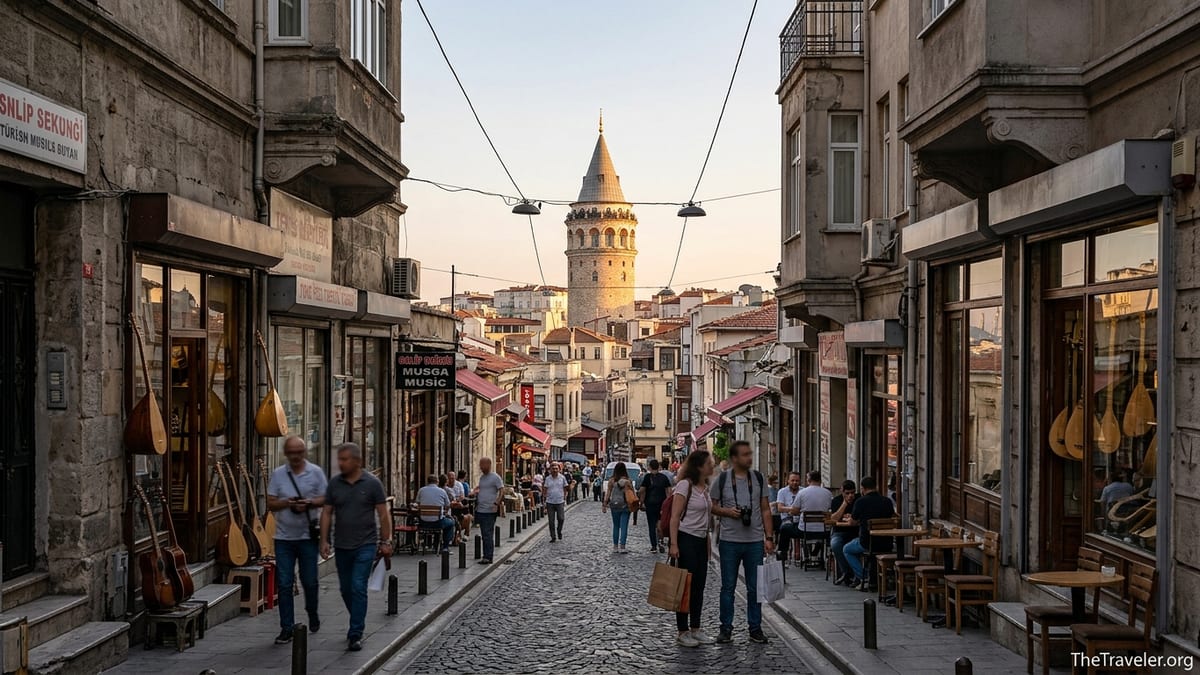
Overview: Distance, Timing and What to Expect
The classic walking route runs from Taksim Square down İstiklal Avenue to Tünel Square, then along Galip Dede Street to Galata Tower, and finally downhill to Karaköy. The distance from Taksim to Galata Tower is roughly 1.7 kilometers and usually takes 20 to 30 minutes of continuous walking. Adding the final descent to Karaköy brings the total walk to around 2.5 kilometers, which most visitors cover comfortably in 45 to 60 minutes, not including café or photo stops.
The walk is mostly flat or gently downhill from Taksim to Tünel, with a steeper but short slope on Galip Dede Street and another descent into Karaköy. Surfaces are a mix of smooth paving stones, older cobblestones and occasional tram tracks. Comfortable shoes with decent grip are important, especially in wet weather when the stones can be slick.
Along the way you will pass Istanbul’s nostalgic red tram on İstiklal Avenue, the 19th century Tünel funicular at the lower end of the avenue, the slope of Galip Dede lined with instrument shops and cafés, and the medieval Galata Tower rising above a tangle of narrow streets. From there, continuing down to Karaköy connects you with tram line T1, the Galata Bridge and ferries that reach Kadıköy, Üsküdar and the Princes’ Islands.
This route is especially lively in the late afternoon and early evening, when locals are out shopping, meeting for coffee or heading to bars and restaurants. Daytime is ideal for photography and families, while late evening brings louder crowds around some nightlife spots. For a relaxed experience, many visitors prefer starting around 10:00 in the morning or just before sunset.
Starting at Taksim Square: Orientation and First Steps
Taksim Square is one of Istanbul’s main transport hubs, served by the M2 metro line, numerous city buses and the Havaist airport shuttle from Istanbul Airport. Once you emerge at the square, you will see the Republic Monument at its center and the entrance to İstiklal Avenue opening toward the south. The nostalgic red tram line begins here and runs the length of the pedestrian avenue toward Tünel.
If you want to conserve energy, you can ride this heritage tram from Taksim to Tünel. The line is about 1.6 kilometers long and the journey takes roughly 15 to 20 minutes depending on pedestrian traffic. You pay with the same Istanbulkart used for regular trams and metro, usually at a standard city fare, making it an inexpensive way to sample a historic mode of transport while still seeing İstiklal’s facades from the tram windows.
Before setting off, this is a good moment to stock up on water or a quick snack. There are small markets on the side streets and international chains on the square, but many travelers prefer to wait a few minutes and grab something more local just off İstiklal. If you are sensitive to crowds, keep in mind that weekends, especially Saturday evenings, can be extremely busy around Taksim and along the avenue.
From the square, begin walking down İstiklal Avenue, keeping the tram tracks roughly in the center of your view. The first section is wide and relatively modern, framed by retail chains and bright signs. As you move further downhill, the architecture becomes increasingly historical, revealing fin-de-siècle apartment buildings, ornate balconies and the entrances to small side passages.
Strolling İstiklal Avenue: Cafés, Passages and Photo Stops
İstiklal Avenue is one of Istanbul’s most famous pedestrian streets, known for its mix of global brands and traditional institutions. As you walk, you will pass branches of well-known coffee chains alongside local outfits. For a local feel, many visitors duck into a side street for Turkish coffee or tea instead of stopping on the main avenue itself. A typical double Turkish tea glass in a modest café still often costs only a little more than a soft drink from a convenience store, making it an easy, low-budget pause.
About 5 to 10 minutes down from Taksim, you reach one of the avenue’s classic photo opportunities: the nostalgic tram framed by late 19th century buildings. To capture it, stand at a slight angle rather than directly head on, and wait for a tram to appear over the gentle rise, pedestrians parting around it. Early morning or just after sunset can provide softer light, with street lamps and shop windows adding reflections to the paving stones.
Several historic passages branch off İstiklal and are worth a short detour. Flower Passage (Çiçek Pasajı) and the nearby narrow arcades offer atmospheric ceilings, old signage and restaurant tables clustered under glass roofs. Even if you are not stopping to eat, slipping inside for two or three minutes can give you impressive interior shots and a sense of late Ottoman Beyoğlu. Keep an eye on your belongings, particularly in crowded spots along the avenue, as pickpockets do occasionally operate in the area.
Continuing downhill, you will notice the atmosphere gradually changing from mainstream shopping to smaller boutiques and independent cafés. This is a good time for a second stop: maybe a simit from a street seller, or a slice of baklava with a glass of strong Turkish tea. Expect to pay only a few euros equivalent for a pastry and drink in a simple bakery, somewhat more in trendier coffee shops along side streets such as Asmalımescit or the lanes toward Cihangir.
Reaching Tünel Square: Funicular, Alternatives and Shortcuts
At the southern end of İstiklal Avenue you arrive in Tünel Square, a compact open area where the nostalgic tram terminates and the 19th century Tünel funicular begins its underground journey down to Karaköy. Tünel, which opened in the 1870s, is often cited as one of the world’s earliest underground urban railways. Today it functions as a short but steep link between the hilltop of Beyoğlu and the waterfront below, with a travel time of around 90 seconds.
From the square, you have a few options. If your goal is Galata Tower, the most scenic choice is to ignore the funicular for now and follow Galip Dede Street downhill. This narrow, slightly curving street begins just a minute or two from the square and leads directly to the base of the tower. On the other hand, if you are tired or short on time and want to connect quickly to Karaköy and the tram line T1, you can ride Tünel down first, then later walk back uphill to the tower, or visit Galata on a separate loop.
The Tünel funicular uses the same Istanbulkart system as other public transport, with standard inner-city fares. Because the ride is so short, it is primarily valuable for avoiding the hill rather than saving time. Many travelers choose to ride it at least once for the experience and its historical significance, combining it with a walk in one direction. For example, you might walk down from Taksim to Galata Tower, then continue to Karaköy and ride Tünel back up to Tünel Square before wandering İstiklal again.
Tünel Square is also close to Şişhane station on the M2 metro line, which you can reach in roughly 5 to 10 minutes on foot. This makes the area a useful junction: from here you can head back to Taksim by metro, descend to Karaköy by funicular or on foot, or proceed along Galip Dede toward Galata Tower.
Galip Dede Street to Galata Tower: Music Shops and Historic Slopes
From Tünel Square, look for the beginning of Galip Dede Street, a sloping road lined with music stores, souvenir stalls and small cafés. You will know you are in the right place when you start seeing guitars, drums and traditional instruments like bağlama and oud displayed outside shopfronts. The walk from here to Galata Tower typically takes 10 to 15 minutes, depending on crowds and how often you stop.
The street is relatively narrow and paved with older stones, so the going can feel steeper, especially on the way back up. For anyone with knee issues, it is usually more comfortable to walk down from Tünel to Galata rather than the other way. Families with small children or strollers may wish to take their time, pausing at flatter doorways or café terraces. Many visitors buy simple souvenirs here because prices are often more competitive than right at the base of major sights.
Good photo opportunities on Galip Dede include looking back up toward the arch near the top of the street, shooting downward into the curve of shops, or framing locals browsing instruments against the backdrop of aging facades. Because the street faces generally east and west in different sections, you can find interesting side light both in the morning and afternoon. On warm days, shaded café corners offer a welcome break; a small Turkish coffee or glass of ayran is usually inexpensive and gives you an excuse to linger and people-watch.
As you approach the end of Galip Dede Street, the view opens to a small square dominated by Galata Tower. Built in stone and towering above surrounding rooftops, it is one of Istanbul’s most recognizable landmarks. Ticket prices and visiting conditions can change periodically, so it is wise to check locally or at official counters rather than relying on older guidebooks. Expect queues to be longest in the middle of the day and shortest early in the morning or in the couple of hours before closing.
From Galata Tower Down to Karaköy: Streets, Views and Transport Links
After visiting Galata Tower or simply enjoying the square, you can complete the link to Karaköy by continuing downhill through the Galata and Bankalar Caddesi area. Several streets lead down toward the waterfront; many visitors follow the streets roughly aligned with the tram tracks overhead or ask a café staff member to point them in the direction of the Galata Bridge. The descent usually takes 10 to 15 minutes at a relaxed pace.
On the way down you pass a mix of residential buildings, boutique hotels, art spaces and the former financial district of late Ottoman Istanbul. The Kamondo Steps, an ornate set of curved stone stairs built by a wealthy banking family, are a popular detour and photo spot. Their exact location can be a bit hidden among side streets, but they sit roughly between the tower and the main street leading to the bridge. Because of their popularity on social media, expect a small crowd waiting to pose during peak hours.
Once you reach Karaköy, you will find yourself close to the T1 tram line that runs toward Sultanahmet in one direction and Kabataş in the other. Ferries depart from nearby piers to Kadıköy and Üsküdar on the Asian side, as well as to the Bosphorus. Karaköy itself has become one of the city’s liveliest café and restaurant districts, with options ranging from inexpensive simit and tea stands to mid-range seafood restaurants overlooking the water.
This downhill extension makes the Taksim to Galata walk more than just a point-to-point stroll between two landmarks. It effectively links three neighborhoods in one continuous experience: modern, high-energy Taksim; historic, bohemian Galata; and waterfront Karaköy with its access to old Istanbul across the Galata Bridge. If your schedule allows, plan at least half a day so you can explore side streets and take a break by the water instead of rushing through.
Route Variations, Weather and Accessibility Tips
While the core route from Taksim Square to Galata Tower via İstiklal and Galip Dede is straightforward, several variations make sense depending on mobility, weather and time of day. In hot summer months, many travelers prefer to walk downhill in the late afternoon to avoid midday sun on the stone pavements, then use public transport such as the nostalgic tram or metro to return uphill in the evening.
For visitors with limited mobility or those using a stroller, the steepest sections on Galip Dede and the streets between Galata and Karaköy can be challenging. In that case, one option is to take the T2 nostalgic tram from Taksim to Tünel, ride the Tünel funicular down to Karaköy, and then use taxis or ride-hailing services in the flatter waterfront areas. You can still visit Galata Tower by approaching from nearby Şişhane metro station, which offers a gentler incline compared with climbing directly up the steepest streets.
In rainy weather, the combination of sloping cobblestones and tram tracks requires some care. Shoes with good traction and a slower pace are important. Street vendors may put down mats or cardboard over puddles, and umbrellas are sold everywhere along İstiklal. Winter conditions in Istanbul are usually mild compared to many northern cities, but short bursts of snow or sleet can occur, briefly making surfaces slick. If conditions are poor, you might break the route into shorter segments on different days.
Safety along this route is generally comparable to other central European-city walks. The main issues are petty theft in crowds and occasional scams targeting tourists, such as overly friendly strangers insisting on escorting you to certain bars or carpet shops. Keeping valuables zipped away, declining unsolicited invitations and using official taxi stands or reputable apps are usually enough to avoid problems. Most visitors complete this walk with nothing worse than tired feet.
The Takeaway
The walk from Taksim Square to Galata Tower, continuing down to Karaköy, is one of the simplest ways to understand how different layers of Istanbul fit together. In under an hour of walking time, you experience a central transport hub, a legendary pedestrian avenue, a 19th century underground funicular, a musical hillside street and a medieval watchtower that now serves as a panoramic viewing platform.
By planning a few well-timed stops for coffee, snacks and photography, you can turn this into a half-day exploration that still leaves room in your itinerary for a Bosphorus cruise or a visit to Sultanahmet. Whether you ride the nostalgic tram, descend with Tünel or rely purely on your own feet, this route offers an accessible, real-world introduction to Beyoğlu’s urban fabric that goes beyond any single monument.
Most importantly, this is a walk you can adapt. Early risers may enjoy empty streets and soft morning light, while night owls might prefer the neon glow and crowd energy of İstiklal after dark. Families can shorten the route to focus only on Taksim and the tower, while keen walkers can extend it across the Galata Bridge toward the historic peninsula. However you choose to tackle it, the Taksim to Galata and Karaköy walk deserves a place near the top of any Istanbul plan.
FAQ
Q1. How long does it take to walk from Taksim Square to Galata Tower?
The walk from Taksim Square to Galata Tower via İstiklal Avenue and Galip Dede Street is about 1.7 kilometers and usually takes 20 to 30 minutes of continuous walking, not counting café or photo stops.
Q2. Is the route from Taksim to Galata Tower suitable for children and older travelers?
Yes, many families and older travelers do this walk, but it involves some slopes and cobblestones. Taking the nostalgic tram between Taksim and Tünel, and walking downhill from Tünel to Galata Tower, can make it easier for those who prefer to avoid steeper climbs.
Q3. Can I visit Galata Tower and Karaköy in the same walk from Taksim?
Yes, a common route is Taksim Square to Galata Tower via İstiklal and Galip Dede, then continuing downhill to Karaköy. This usually totals around 2.5 kilometers and can be done comfortably in 45 to 60 minutes of walking time.
Q4. What is the best time of day to walk from Taksim to Galata Tower?
Late morning and late afternoon are popular because the light is good for photography and the temperatures are more comfortable in summer. Evenings are lively and atmospheric, but İstiklal can be very crowded at peak times, especially on weekends.
Q5. How do I avoid the steepest sections if I have mobility issues?
To minimize steep climbs, you can ride the T2 nostalgic tram from Taksim to Tünel, then walk gently downhill along Galip Dede to Galata Tower. For reaching Karaköy, you can use the Tünel funicular instead of walking the steeper streets, or approach the area from Şişhane metro, which offers a less demanding gradient.
Q6. Is the Taksim to Galata walk safe after dark?
The main route through İstiklal Avenue and the squares around Tünel and Galata Tower usually remains busy and feels reasonably safe into the evening. As in any major city, stay on well-lit streets, keep valuables secure and avoid very quiet back alleys late at night.
Q7. Do I need a ticket to ride the nostalgic tram or Tünel funicular?
Yes, both the T2 nostalgic tram and the Tünel funicular use Istanbul’s standard public transport system. You tap in with an Istanbulkart or compatible payment method, and each ride costs approximately the same as a short tram or metro journey within the city.
Q8. Are there good places to eat along the way?
Yes, İstiklal Avenue and its side streets are full of cafés, bakeries and restaurants ranging from inexpensive simit and pastry stands to mid-range meyhanes and international chains. Around Galata Tower and down in Karaköy you will find more cafés, dessert shops and seafood places, many with outdoor seating.
Q9. Can I start the walk in Karaköy and finish in Taksim instead?
Absolutely. Many visitors start in Karaköy, walk uphill to Galata Tower, continue up Galip Dede to Tünel and then along İstiklal to Taksim. This version has more climbing but ends at a major transport hub where you can easily take the metro or buses back to your hotel.
Q10. Do I need a guide, or can I do this route on my own?
You can easily follow this route on your own using basic maps and the clear orientation offered by İstiklal Avenue, Tünel Square and Galata Tower. However, if you are interested in detailed history and architecture, joining a walking tour or hiring a licensed guide for a few hours can add valuable context to what you are seeing.