


For visitors basing themselves in Tallinn, two of Estonia’s most appealing short escapes are Tartu and Pärnu. Yet they offer very different experiences. Tartu is a lived-in university and museum city that remains busy and interesting throughout the year. Pärnu is Estonia’s classic Baltic seaside resort, buzzing in summer but noticeably quieter once the beach season ends. Understanding these contrasts is essential when you are choosing where to spend a precious weekend or planning a mix of culture and coast in a longer stay.
Get the latest updates straight to your inbox!
Getting There: Trains to Tartu vs Buses to Pärnu
Travel patterns already reveal the fundamental difference between the two trips. Tartu is firmly on Estonia’s rail network, with frequent Elron trains from Tallinn Baltic Station. On a typical weekday in late 2026 there are roughly one to two departures each hour during the day on the Tallinn–Tartu line, with additional services at peak times. Standard journey times on the direct fast trains are around 2 hours 5 minutes to 2 hours 15 minutes, depending on intermediate stops. Advance online tickets on Elron’s site for Tallinn–Tartu start from around 10 to 13 euros one way for adults, with discounts for children, students and some concession categories according to current Elron pricing tables.
By contrast, regular passenger rail between Tallinn and Pärnu was withdrawn several years ago because of track condition on the southern part of the line, and as of November 2026 there is still no reinstated everyday passenger rail service on this corridor. Travel between Tallinn and Pärnu is therefore coach based, typically from Tallinn’s central bus station to Pärnu bus station. Lux Express, FlixBus and Estonian operators run the route, with journey times generally advertised at about 1 hour 40 minutes to just over 2 hours depending on stops and traffic. Recent timetable data and booking platforms show one-way fares often starting around 6 to 8 euros if booked early, rising toward 15 euros or a little more at busy times.
The station-to-center connection is very straightforward in Tartu. Trains arrive at Tartu railway station on Vaksali Street, roughly 1.5 kilometres from Town Hall Square. City buses and frequent local taxis connect the station to the Old Town in about 5 to 10 minutes, and many visitors simply walk via the leafy Vaksali district and over the Kaarsild pedestrian bridge in around 20 minutes. In Pärnu, intercity coaches arrive at the compact central bus station a short walk from the historic centre along Rüütli and adjacent streets. The main beach area is roughly 2 kilometres from the bus station; you can reach it by local bus, by taxi in about 5 to 10 minutes, or on foot in about 25 minutes through the grid of central streets and coastal parks.
The key point for planning is that Tartu can be marketed and relied upon as a frequent rail destination from Tallinn, while Pärnu should not be described as having equivalent regular passenger rail today. Future Rail Baltica services may change that, but for now summer visitors headed to the beach should expect to arrive by coach or car.
City Personalities: University and Museums vs Baltic Seaside Resort
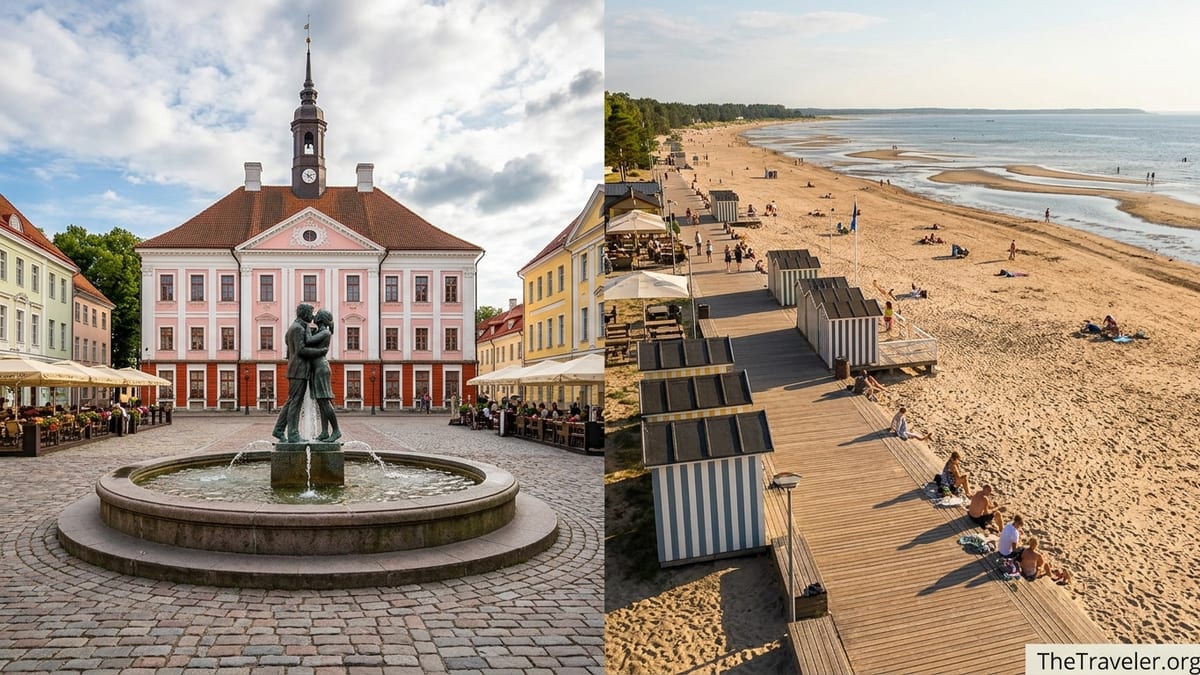
Tartu’s identity is inseparable from the University of Tartu, founded in 1632 and spreading its faculties across the central city. Town Hall Square, with its pink classical town hall and “Kissing Students” fountain, is the heart of the Old Town and a reminder that this is Estonia’s main university city. Cafes and pubs lining the square and the surrounding streets cater to students and academics as much as tourists, and the atmosphere remains lively even in January exam season. The University of Tartu Museum occupies buildings on Toomemägi hill, including the atmospheric ruins of the medieval cathedral. It typically opens year-round, with slightly shorter hours in winter; current schedules show standard daytime opening from late morning to early evening on most days outside of a brief winter holiday closure.
A short bus or taxi ride north of the centre, the Estonian National Museum (Eesti Rahva Muuseum) is one of the country’s flagship cultural attractions. Housed in a contemporary building at Raadi, it offers extensive permanent exhibitions on Estonian everyday life and Finno-Ugric cultures across roughly 6,000 square metres of space. Visitor information confirms it operates throughout the year, usually six days a week, with closing days and winter opening hours clearly listed but without a high-season-only pattern. Together with the University of Tartu Art Museum, Tartu Art Museum on the riverfront and smaller galleries, these institutions give Tartu a dependable programme of indoor cultural activity regardless of the season.
Pärnu, on the other hand, is introduced to most travellers through images of wide sands and striped bathing cabins. Pärnu Beach is Estonia’s best-known resort beach, with shallow, relatively warm water by Baltic standards and a long season of beach promenading even before swimming is comfortable. The official tourism information describes a lifeguard season from 1 June to 31 August, with lifeguard towers displaying flags that indicate water conditions. During these months, changing cabins, showers, playgrounds, ball courts, equipment rentals and several beach cafes usually operate daily, and spa hotels near the waterfront run packed summer programmes.
Step back from the sand, and Pärnu’s compact historic centre is pleasant, with wooden villas and 19th-century resort architecture. However, the city’s cultural institutions are smaller in scale than Tartu’s. Pärnu Museum, with its exhibits on city history and local culture, operates year-round with standard museum hours, and there are seasonal exhibition spaces and events such as Pärnu Music Festival in summer. Yet the overall rhythm of the town still revolves strongly around warm-weather beach life rather than a dense year-round museum scene.
Neighbourhoods and Sights: From Toomemägi and Supilinn to Pärnu Beachfront
Many of Tartu’s core sights cluster within walking distance of Town Hall Square. Toomemägi Park rises directly behind the square, offering wooded paths, viewpoints over the city and access to the cathedral ruins and University of Tartu Museum. Even in winter, locals use the park for walking and sledding, and it remains atmospheric under snow. On the opposite side of the river lies Supilinn, a low-rise former working-class district whose name translates as “Soup Town,” with street names like Kartuli (Potato) and Oa (Bean). Over the last decade it has become a fashionable residential quarter of wooden houses, small cafes and community gardens, giving visitors a glimpse into everyday Tartu beyond the Old Town postcard.
The Estonian National Museum’s grounds extend into Raadi Park and a sculpture park developed with Tartu Art Museum, providing an easy way to combine indoor exhibition time with a walk by the lakeside. In poor weather, you can stay indoors at the museum for several hours, with a restaurant and cafe on site. This flexibility is one of the reasons Tartu works well as a winter or shoulder-season destination; rain or snow rarely ruin the day, they simply push you more toward its many indoor venues.
Pärnu’s sights orient outward toward the sea. The main Pärnu Beach stretches for several kilometres, framed by a revamped promenade completed in the early 2020s and flanked by classic resort architecture, including the Beach House and nearby spa hotels. In July, the sand near the main access points is busy with families, volleyball and water sports rentals. Water quality monitoring reports for recent summers have rated Pärnu’s central beach water as very good, reinforcing its status as the country’s flagship seaside. Coastal parks such as Rannapark offer shaded lawns and walking paths behind the dunes, with playgrounds, cafes and seasonal music events.
The historic centre lies just inland, with streets like Rüütli lined with cafes, restaurants and small shops. The timber villas of the resort district show off the town’s late 19th and early 20th-century heyday. Outdoor attractions like mini-golf, bike rentals and some playground facilities run mainly from late spring into early autumn. Outside June to August, the promenade and parks remain open for walks and cycling, but many seasonal kiosks and beach-focused services close, and the beach itself becomes a place for brisk walks in windproof clothing rather than bathing.
Seasonality, Weather and Nightlife
Between June and August, average daytime highs in both Tartu and Pärnu tend to fall in the low 20s Celsius, with warm spells often reaching the high 20s. In recent summers, Pärnu’s shallow bay has warmed to around 20 degrees Celsius or a little higher during sustained warm weather, while Tartu’s riverbanks offer more limited swimming at designated spots. For sea swimming, Pärnu is clearly superior, especially from late June through mid-August when water temperatures are highest and lifeguard cover is in place. However, cold or rainy spells can arrive at any time, and even in July nights can be cool enough to need a jacket.
From September onward, conditions diverge more sharply from the summer resort image. Autumn storms on the coast can make Pärnu feel raw, and although spa hotels and a few beach cafes continue operating, the shoreline is often sparsely populated. Average highs slide into single digits Celsius by November and hover around freezing in January and February. Tartu experiences similar temperatures, but its indoor focus makes this less of a drawback. Museums, university events, theatres and student bars continue with full programmes, giving the city an underlying buzz even when the streets are covered in snow.
Nightlife illustrates this contrast. In Pärnu, summer weekends see bars and beach clubs near the waterfront and in the centre extend terraces and host DJ nights, catering to both Estonian holidaymakers and visitors from neighbouring countries. Some of these venues cut back hours or close entirely outside the summer season, leaving a more local, low-key bar scene in autumn and winter. In Tartu, student-driven nightlife on and around Town Hall Square, Rüütli Street and the riverside remains active throughout the academic year. Even on a February Thursday, it is common to find several pubs and clubs busy with students, while live music venues and theatres programme performances regardless of tourist demand.
For travellers who want reliable evening options outside June to August, Tartu generally offers more consistency. For those whose priority is open-air nightlife steps from the beach, Pärnu’s peak-season energy is hard to beat, but it comes with higher accommodation prices and larger crowds.
Where to Stay: Tartu Old Town and Karlova vs Central and Beachfront Pärnu
Tartu’s accommodation concentrates in three main areas: the Old Town around Town Hall Square, the riverfront on both banks and the characterful Karlova district to the southwest. In the Old Town and along the river, international chain hotels and local boutique properties offer mid-range and upper-mid-range options. Karlova features smaller guesthouses and apartments in wooden houses, popular with longer-stay visitors and those seeking a quieter, residential feel. Checking a selection of booking platforms for summer 2026 weekends, double rooms in well-rated central Tartu hotels commonly cluster in the 90 to 140 euro per night range, with apartments and guesthouses somewhat lower. Winter weekend rates in January and February often drop by 20 to 30 percent compared with late July, particularly outside major events such as student festivals or conferences.
Pärnu presents a more dramatic spread between high and low season. Central Pärnu hotels near the historic centre may have standard double rooms in the 70 to 110 euro range on a typical March or November weekend, and some apartments price below that level. On peak July weekends coinciding with warm weather, demand surges for both central and beachfront rooms, and many properties near the sea list doubles for 150 to 250 euros or more per night. Spa hotels and higher-end beachfront properties can easily climb higher for seafront rooms with balconies. This pattern supports the view that Pärnu’s accommodation becomes substantially more expensive during peak beach season, especially for stays within walking distance of the sand and promenade.
In winter, Pärnu’s spa hotels reposition themselves more toward wellness weekends and conference business. Packages including room, breakfast and spa access can actually represent good value compared with their own summer rates, particularly for midweek stays. For travellers choosing between the cities in January, Pärnu can work well if you are specifically seeking spa time and coastal walks, while Tartu remains stronger for those prioritizing museums, cafes and a broad choice of cultural activities within walking distance.
For families, apartment-style accommodation is easy to find in both cities. Tartu’s Karlova and riverfront neighbourhoods feature many two-bedroom apartments, while Pärnu’s central and resort districts offer holiday apartments and aparthotels that cater to summer self-catering stays. The main trade-off is between paying a premium for July proximity to the beach in Pärnu, or choosing better-value year-round central locations in Tartu where the main children’s attractions, such as the Estonian National Museum and AHHAA Science Centre, are indoors.
Sample Two-Day Itineraries and a Three-Day Combination Trip
A realistic two-day Tartu itinerary from Tallinn might begin with an early-morning train from Balti Jaam, arriving in Tartu in time for a late breakfast near Town Hall Square. Day one could focus on the Old Town and Toomemägi: exploring the square, visiting the University of Tartu Museum and cathedral ruins, walking through Toomemägi Park and ending with dinner at a restaurant overlooking the river. On day two, you could take a taxi or city bus to the Estonian National Museum for several hours, then return via the sculpture park in Raadi and a stroll through Supilinn, before catching an afternoon or evening train back to Tallinn. In winter, this itinerary remains almost unchanged, with more time allocated indoors at the museums and cafes.
For Pärnu, a two-day break might start with a mid-morning Lux Express or FlixBus departure from Tallinn’s bus station, arriving around lunchtime. After checking into a central or beachfront hotel, you could spend the afternoon walking the historic streets, visiting Pärnu Museum and enjoying dinner at a restaurant in the centre. On day two in summer, you could devote the bulk of the day to Pärnu Beach: renting sun loungers near the main lifeguard zone between June and August, trying stand-up paddleboarding from one of the rental stands if conditions are calm, and using showers and changing cabins along the promenade before returning to Tallinn on an evening bus. Outside summer, the second day might focus instead on spa treatments in a beachfront hotel, combined with bracing walks along the promenade and through Rannapark.
Travellers with three days could combine both destinations in a small circuit. One option would be to take a morning train from Tallinn to Tartu on day one, explore the Old Town and Toomemägi, then spend day two at the Estonian National Museum and AHHAA Science Centre or additional museums and galleries. On day three, you could travel from Tartu back toward Tallinn and continue to Pärnu by bus, or connect via Tallinn, arriving in time for an afternoon on the promenade and a night in a spa hotel before returning to Tallinn the following morning. In summer, the Pärnu segment can emphasize beach time, while in winter it can focus on spas and coastal walks, with Tartu anchoring the trip as the museum-rich cultural base.
Naturally, individual interests will shape the details, but these sketches show that two full days feels comfortable for each city on its own, and a three-day combination works best when you accept that one day will involve more travel time between centres.
Indicative Budgets: Couples, Families and Value
Exact trip costs vary by booking date and preferences, but recent fare and accommodation sampling in late 2026 allows for some realistic ballpark budgets. For a couple taking a two-night summer weekend in Tartu, return Elron train tickets from Tallinn bought in advance might total around 40 to 55 euros for two adults. A mid-range central hotel at around 120 euros per night would come to 240 euros for two nights. Allowing roughly 70 to 90 euros per day for meals, drinks and coffee breaks for two, plus around 30 to 40 euros for museum admissions such as the University of Tartu Museum and the Estonian National Museum, yields a total in the region of 450 to 550 euros for the couple for two nights.
The same couple spending two July nights in Pärnu near the beach might find return bus tickets from Tallinn costing 25 to 40 euros for two, depending on operator and how early they book. A well-located beachfront or spa hotel could easily average 180 to 220 euros per night in high season, totalling roughly 360 to 440 euros for accommodation alone. Adding 80 to 100 euros per day for meals, snacks and beachside drinks, plus small extras for sunbed rental or spa access, can produce an overall weekend bill closer to 550 to 700 euros for two, especially in prime July and early August periods.
For a family of four with two school-age children, budgets shift more noticeably. In Tartu, rail discounts and family tickets may reduce transport costs; an indicative return total might sit around 60 to 80 euros for the family. A family room or two-bed apartment near the centre could fall in the 140 to 180 euro per night range in summer, or less in shoulder seasons, while self-catering helps moderate meal costs. Allowing 80 to 110 euros per day for food plus 40 to 60 euros total for museum and science centre admissions, a two-night Tartu stay might land somewhere around 500 to 650 euros. In Pärnu in July, a family room or apartment within easy walking distance of the beach during peak season may approach 200 to 260 euros per night or more, making accommodation the dominant cost. Cheaper bus tickets and the fact that beach access itself is free help, but extras like equipment rentals, ice cream, beach snacks and occasional spa entry can bring a two-night family total into the 650 to 850 euro range at busy times.
Outside the June to August peak, both cities become more affordable, but Tartu’s prices fluctuate less dramatically and its main attractions do not rely on summer weather. Pärnu’s spa deals can offer good off-season value for couples prioritizing wellness, yet travellers primarily interested in sightseeing and museum-going will usually find Tartu the more efficient use of time and money in autumn and winter.
Access, Winter Conditions and Getting Around
In terms of basic accessibility, both cities are manageable for most visitors. Tartu’s centre is compact and largely flat, with paved streets between Town Hall Square, the riverfront and key museums. Toomemägi Park includes slopes and stairs that become slippery in snow, but alternative streets offer gentler routes. Elron trains used on the Tallinn–Tartu line provide level or near-level boarding at many platforms, with dedicated spaces for wheelchairs and prams, and Tartu’s city buses connect the station, Old Town and Estonian National Museum. In winter, snow clearing is reasonably efficient, though icy patches can linger on side streets and park paths.
Pärnu’s beach promenade and coastal parks are broadly accessible, with smooth surfaces and ramps to key viewpoints. However, the transition from promenade to sand involves soft ground that can be challenging for wheelchair users or prams. During winter, strong winds from the bay and drifting sand can complicate conditions on the seafront. The central bus station and surrounding streets remain easy to navigate year-round, and most spa hotels are well adapted for guests with limited mobility, featuring lifts, ramps and accessible rooms. Local buses offer simple routes between the bus station, centre and resort district, although reduced off-season frequencies mean some planning is helpful.
Weather is a more decisive factor. On particularly cold days in January, Pärnu’s seafront can feel significantly harsher than inland Tartu because of wind chill, reducing the appeal of long walks. Tartu’s inland position does not guarantee milder air temperatures, but the balance of indoor options and sheltered streets makes moving between venues more comfortable. Both cities can experience ice and snow on pavements, so travellers who visit in winter should pack footwear with good grip and consider walking poles if balance is a concern.
From Tallinn’s airport, connections are relatively simple. For Tartu, travellers can take a short tram or bus ride into the city centre and walk or ride to Balti Jaam for the onward train. For Pärnu, airport buses link to the main bus station, from which coaches depart for the coast. In both cases, door-to-door journeys generally fall within three hours total travel time, making weekend breaks feasible even on Friday evenings.
Which City for Whom: Final Recommendations
For beach-focused travel, Pärnu is the clear choice. Its wide, shallow beach with monitored swimming between 1 June and 31 August, extensive promenade and concentration of spa hotels right behind the dunes create an experience that Tartu simply does not attempt to match. Travellers who dream of long days on the sand, casual seaside dining and sunset walks will get far more out of Pärnu, especially in July and early August when water temperatures are highest.
For museums and cultural depth, Tartu stands out. The Estonian National Museum, University of Tartu Museum, AHHAA Science Centre, Tartu Art Museum and numerous smaller institutions form a cultural cluster unmatched elsewhere in the country outside Tallinn. Because these venues operate year-round with robust winter hours, Tartu is far better suited to November city breaks or February weekends when the coast is grey and windy. For travellers who like to structure days around exhibitions, talks and performances, Tartu offers more dependable content in every season.
For nightlife, the choice depends heavily on timing. In summer, Pärnu’s beach bars and seasonal clubs provide lively evenings that spill outdoors, complemented by events and live music linked to the holiday season. Outside that window, Tartu’s student bars, pubs and clubs deliver more consistent energy from September to May, making the university city the better base for those who want busy nights irrespective of tourist seasons. Couples weighing romance versus buzz might lean toward Pärnu for a high-summer seaside atmosphere and spa pampering, or toward Tartu for cosy cafes, riverfront walks and wintery Old Town charm.
For families and year-round value, Tartu usually has the edge. Its combination of interactive museums, science centres and parks offers more options on a rainy day, and hotel rates fluctuate less violently between seasons than in Pärnu’s beachfront district. Families planning a single summer weekend by the sea will still appreciate Pärnu’s lifeguarded bay and playground-filled parks, but those scheduling trips outside school holidays or in unpredictable shoulder seasons will often find Tartu a safer bet. Ultimately, many travellers will benefit from experiencing both: a cultural weekend in Tartu at almost any time of year, and a separate high-summer escape to Pärnu when the Baltic shines at its best.