


More news on this day
Flights across the U.S. Northeast were thrown into chaos on Monday after damaged communications lines at a key regional air traffic control center in Philadelphia disrupted operations at some of the country’s busiest airports, including all three major New York City hubs.
Get the latest news straight to your inbox!
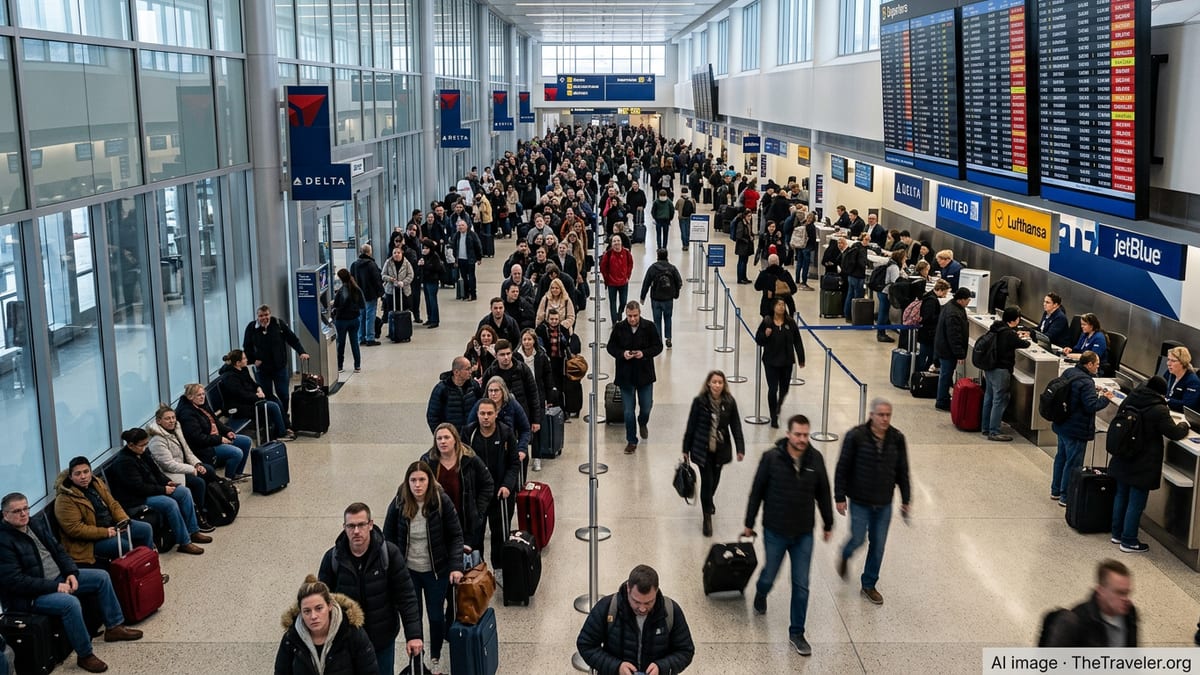
Hours-long interruption hits New York–area airports
Publicly available flight-tracking data shows that commercial traffic into Newark Liberty International Airport fell to almost zero for much of Monday, with no commercial flights landing between roughly 9:40 a.m. and just after 5:20 p.m. local time. Arrivals into John F. Kennedy International Airport and LaGuardia Airport were also sharply curtailed as controllers limited traffic flows while backup procedures were activated.
Coverage from multiple U.S. news outlets indicates that the disruption began when data and communications lines serving a Federal Aviation Administration facility in the Philadelphia area failed, cutting or degrading connections needed to safely manage high-density airspace over the Northeast corridor. Technicians later restored the damaged lines, allowing traffic to ramp back up through the late afternoon and evening.
By Tuesday morning, departures and arrivals at New York–area airports had largely resumed, but schedules remained fragile. Airlines continued to post significant delays and scattered cancellations as they repositioned aircraft and crews that had been stranded out of place by Monday’s stoppage.
The timing of the outage added to its visibility. The disruption coincided with the annual United Nations General Assembly in New York, a week when airspace around the city is already tightly managed and commercial schedules are particularly busy with visiting delegations, business travelers, and international media.
Ripple effects from Boston to Washington
The failure at the Philadelphia-area facility sent shock waves through the broader Northeast network, affecting airports as far north as Boston and as far south as the Washington, D.C., region. Flight-status boards at Boston Logan International Airport showed dozens of delays and cancellations tied to the communications issue, while travelers at Reagan National and Dulles International near Washington reported extended waits and last-minute schedule changes.
According to publicly available airline and airport data, carriers implemented a combination of ground stops, airborne holding, and diversions as the scope of the problem became clear. Some transatlantic flights bound for the New York area were rerouted to alternate airports in Canada and other U.S. cities, while short-haul services within the Northeast were delayed repeatedly or scrubbed entirely.
The disruption also affected connecting passengers far beyond the immediate region. Major hubs in the Midwest and South reported knock-on delays as aircraft that were supposed to operate later flights remained stuck on the ground in the Northeast. For leisure travelers returning from late-summer trips and business passengers heading into a busy fall travel period, the outage created missed connections and unexpected overnight stays.
Published coverage notes that rail services such as Amtrak’s Northeast Corridor trains experienced heavier demand as some travelers chose to abandon disrupted short-haul flights in favor of ground transportation. However, the sudden shift was not sufficient to absorb all of the stranded passengers, leaving airports across the region crowded well into Monday night.
What caused the outage at the Philadelphia facility
According to reporting from national and local outlets, the failure originated with data and communications lines that feed a key air traffic center responsible for managing portions of the busy corridor between Washington, New York, and Boston. Early indications point to physical damage to fiber-optic infrastructure serving that facility, although detailed investigative findings had not yet been made public by Tuesday.
Once the primary lines failed, backup circuits also did not function as intended, which forced the facility to operate with significantly reduced capability. In high-density airspace, controllers rely on a continuous flow of radar, flight-plan, and voice-communication data to safely coordinate aircraft. When that information flow is interrupted, standard safety protocols require traffic volume to be reduced dramatically until reliable connections are restored.
Specialists worked through Monday to locate and repair the damaged lines, and public statements from transportation officials on social media late in the day indicated that repairs had been completed and that air traffic operations were resuming. Even after technical service was restored, however, it took hours for congestion to ease as backlogs of delayed flights worked through the system.
The affected facility is one of several regional centers that manage en route traffic across the continental United States. Aviation analysts quoted in recent coverage note that these nodes are critical to maintaining the flow of aircraft and that disruptions at any one center can quickly propagate across large sections of the national network.
Spotlight on aging infrastructure and modernization push
The latest failure has renewed attention on the condition of the systems that underpin U.S. air traffic control. Federal budget documents and previous investigative reports describe a patchwork of aging hardware and software still in service alongside newer digital platforms, a mix that can be vulnerable to both technical faults and external damage.
In the wake of several high-profile incidents over the past two years, including radar and communications outages at facilities serving Dallas, Minneapolis, and Newark, Congress has already approved billions of dollars for a multiyear modernization program. Recent analysis in specialist transportation media notes that the Philadelphia-area disruption is being cited as further evidence that this overhaul needs additional funding to update communications networks, improve redundancy, and replace legacy components.
Aviation experts quoted in published coverage emphasize that the U.S. air traffic control system remains fundamentally safe, in part because conservative safety rules require traffic to be slowed or stopped whenever data quality drops. However, those same safeguards mean that when infrastructure fails, the resulting delays and cancellations can be severe, especially in saturated regions like the Northeast corridor.
Industry groups representing airlines and airports have called in past policy statements for more resilient network architecture, including physically diverse routing of critical fiber lines and more robust fallback capabilities. The Philadelphia incident is likely to feature prominently in upcoming legislative and regulatory discussions about where to prioritize new investment.
Guidance for affected and upcoming travelers
Publicly available advisories from airlines and airport operators on Tuesday urged passengers traveling to, from, or through Northeast airports to allow extra time and to monitor their flight status closely. Because aircraft and crews were displaced across the network, some schedules remained vulnerable to further disruption even after the immediate technical problem had been resolved.
Travelers with nonessential trips were encouraged in some airline communications to consider rebooking to later in the week, with many carriers offering fee waivers for changes involving New York City, Newark, Philadelphia, Boston, and Washington-area airports. Specific conditions varied by airline and fare type, and passengers were directed to check their carrier’s official channels or mobile app for the latest options.
For those already on the road, consumer advocates quoted in recent articles advised keeping documentation of delays and additional expenses, such as hotel stays or meals, in case they qualify for compensation or reimbursement under airline policies. While U.S. rules do not mandate broad compensation for disruptions caused by air traffic control issues, some airlines provide travel credits or other assistance as a goodwill measure during major operational events.
With the fall travel season and holiday bookings approaching, the outage serves as a reminder for travelers to build buffer time into tight connections, especially when flying through congestion-prone hubs in the Northeast. Flexible itineraries, real-time flight alerts, and backup ground-transportation options can help mitigate the impact when critical infrastructure problems suddenly reshape the skies.