


More news on this day
Flight operations at Newark Liberty International Airport and Philadelphia International Airport are gradually stabilizing after an air traffic control equipment outage triggered hundreds of cancellations and delays across the Northeast, disrupting travel at the start of a busy week.
Get the latest news straight to your inbox!
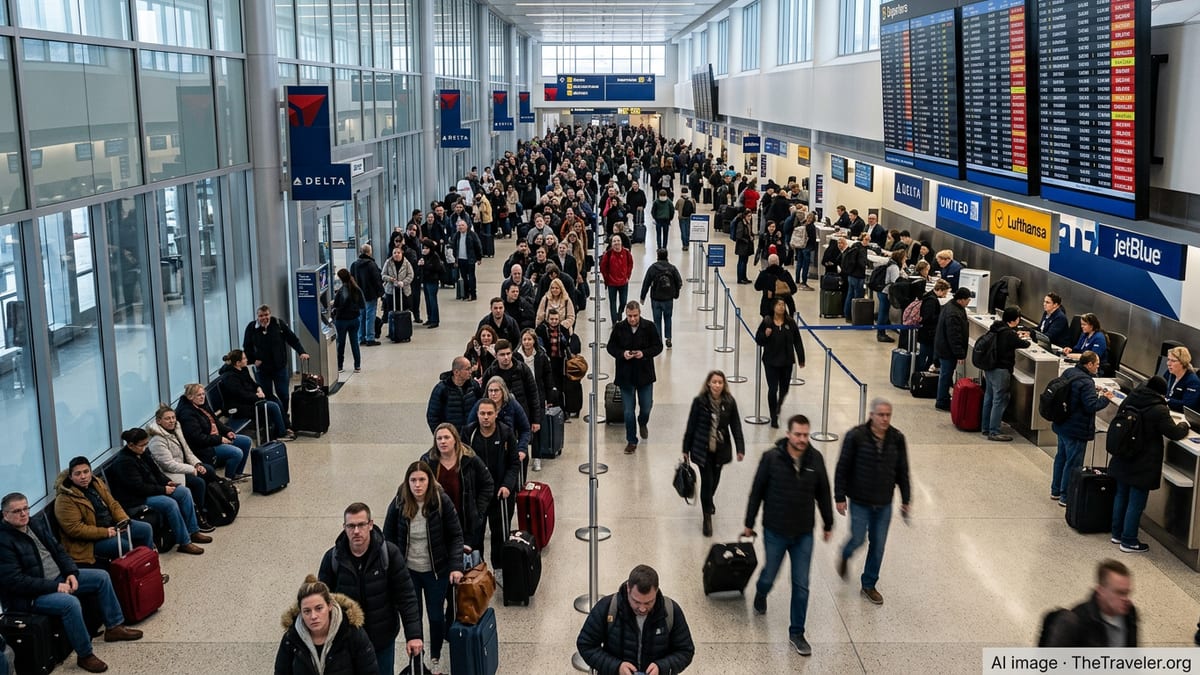
Traffic recovers after Monday’s widespread ground stops
Publicly available data from flight tracking and airline schedule services indicates that commercial traffic into Newark was severely constrained for much of Monday, with arrivals largely halted from mid-morning into the early evening while controllers worked around the equipment failure affecting the Philadelphia Terminal Radar Approach Control facility.
Coverage from major news outlets reports that more than 200 flights into and out of Philadelphia were canceled on Monday, while Newark experienced an extended period with virtually no commercial landings and extensive departure delays. Additional knock-on delays were recorded at New York’s LaGuardia and John F. Kennedy airports, as well as at nearby business aviation hubs.
By late Monday night, federal aviation updates and airline advisories indicated that the immediate ground stops had been lifted and that flows into the New York and Philadelphia areas were being gradually increased. On Tuesday, schedules at both Newark and Philadelphia showed a marked reduction in cancellations compared with the peak of the outage, although residual delays continued through the morning.
The timing of the disruption added to its impact. The outage unfolded as transatlantic and domestic business travel was ramping up for the week, and as New York City was hosting high-profile events that already placed pressure on airport capacity in the region.
Damaged fiber line linked to radar and communications failure
According to published coverage that draws on statements from federal transportation officials, the disruption traces back to a failure on a primary circuit serving the Philadelphia radar approach control facility, followed by problems with the backup connection. Subsequent reporting indicates that the backup line had been severed at a construction site in New Jersey, leaving controllers temporarily without normal radar and radio functionality for a large swath of Northeast airspace.
In recent years, responsibility for managing arrivals and departures in Newark’s low-level airspace has been shifted from a New York area control facility to Philadelphia. Industry and regulatory documents describe this setup as relying on high-capacity communications links to route radar and data feeds between multiple locations, improving efficiency when systems function normally.
The latest outage, however, highlighted the vulnerability of those links when both a primary and backup circuit are compromised. Aviation-focused publications and specialist forums note that when radar or communications coverage is reduced, controllers must dramatically cut the rate of arrivals and departures to preserve required separation between aircraft, resulting in rapid gridlock at large hubs such as Newark and Philadelphia.
Technical details of the outage and the precise sequence of failures have not yet been fully disclosed in official investigative summaries. Early descriptions of the event nevertheless point to a convergence of infrastructure damage and limited redundancy as key factors behind Monday’s disruption.
Impact on travelers and airlines across the Northeast
For travelers, the outage translated into multi-hour waits in terminals, abrupt cancellations at the gate and missed connections across domestic and international networks. Airline operations centers were forced to reassign aircraft and crews, with planes and staff ending up out of position after long ground holds at Newark and Philadelphia.
Published reports estimate that several thousand flights across the United States experienced delays or cancellations connected in some way to the Northeast disruption, as aircraft scheduled to fly through the affected airspace were rerouted or rescheduled. With Newark serving as a major hub for transatlantic services and Philadelphia acting as a key connecting gateway, disruptions quickly spread to flights serving the Midwest, South and West Coast.
Industry analyses suggest that recovery from such an outage often takes more than a day, even after equipment is restored. Crews may time out under duty rules, and aircraft that ended the day at the wrong airport must be repositioned before schedules can fully normalize. That pattern was visible on Tuesday, as both Newark and Philadelphia still showed elevated levels of delays, though far below the peaks recorded on Monday.
Travelers with upcoming itineraries through the affected airports are being advised, through airline and airport communications, to monitor their flight status closely, allow extra time for connections and consider earlier departures if they have critical same-day commitments.
Ongoing questions about infrastructure resilience
The latest outage has renewed attention on the resilience of telecommunications and radar infrastructure that underpins air traffic management in one of the world’s busiest air corridors. Government documents and prior oversight reports have previously flagged the concentration of traffic, aging equipment and complex network architecture around Newark and Philadelphia as areas of concern.
Aviation policy discussions in recent years have focused on increasing redundancy for critical circuits linking radar sites, control centers and tower facilities, as well as on modernizing legacy systems. Coverage of Monday’s event notes that additional high-bandwidth connections and alternative routing paths are among the measures under consideration to reduce the risk that a single damaged cable can significantly disrupt major hubs.
Travel industry observers point out that while severe outages remain relatively rare compared with weather-related disruptions, their effects can be more difficult to manage because they strike without seasonal pattern and can affect multiple airports at once. For passengers, that means traditional strategies such as avoiding peak holiday periods may offer limited protection against this particular type of disruption.
Analysts also highlight that the New York and Philadelphia areas sit at the heart of many global airline networks. Any interruption to air traffic control operations in this region can ripple quickly into long-haul schedules, cargo logistics and corporate travel plans worldwide.
What travelers connecting through Newark and Philadelphia should know now
As of Tuesday afternoon, publicly available tracking data shows that both Newark Liberty and Philadelphia International are operating close to their planned schedules, though with scattered delays that reflect aircraft and crews still returning to their normal rotations. Airlines are continuing to adjust timetables and aircraft assignments to absorb the previous day’s disruption.
Travelers planning to use these airports over the next several days may still encounter isolated schedule changes, particularly on routes that require specific aircraft types or that depend on inbound planes from cities heavily affected on Monday. Experts cited in aviation coverage recommend building in extra buffer time for connections and considering nonstop options where available to reduce exposure to knock-on disruptions.
Passenger advocates stress the importance of understanding individual airline policies on rebooking and compensation, which can differ by carrier and by route. While the equipment outage itself is categorized as an air traffic control issue, airlines may still offer travel credits, fee waivers or hotel assistance in some circumstances, particularly for passengers facing overnight delays.
For now, the easing of cancellations and the resumption of more typical arrival and departure rates at Newark and Philadelphia indicate that the acute phase of the disruption has passed. The longer-term impact is likely to center on renewed scrutiny of infrastructure resilience and operational planning in one of the nation’s most critical air travel regions.