


Landing at Tel Aviv Ben Gurion Airport after a long flight, most travelers want a safe, simple way to reach their hotel. Taxis remain the most straightforward option, but understanding where to find the official ranks, how the meter and surcharges work, and what to expect late at night can save you both money and stress. This guide walks you through the process step by step so you can leave the terminal confident you are getting a legitimate ride at a fair price.
Get the latest updates straight to your inbox!
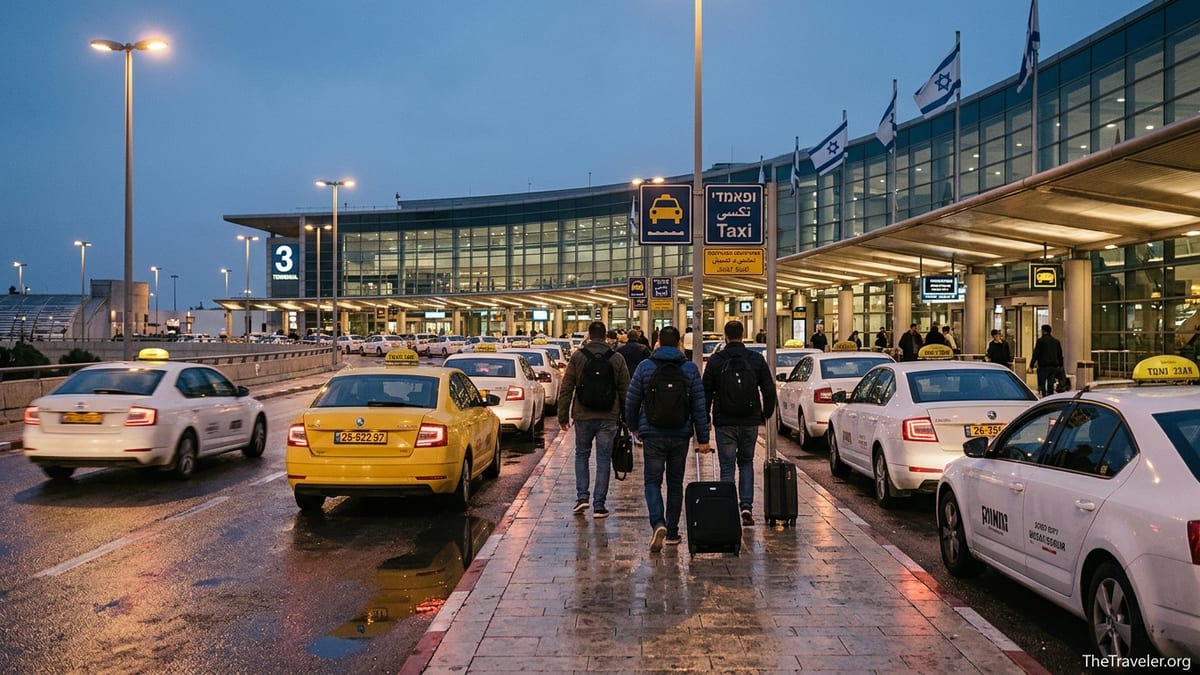
How the Official Taxi System Works at Ben Gurion Airport
Ben Gurion Airport’s taxis are regulated, and the official ranks are overseen by the Israel Airports Authority. When you exit the arrivals hall at Terminal 3, you will find a clearly marked taxi stand outside, staffed by an attendant whose job is to match passengers with licensed taxis and record the ride details. For most visitors going into Tel Aviv, this is the safest and simplest way to start your trip.
Official airport taxis are regular metered taxis, not a special airport-only brand. They must display a roof light, a meter visible inside the car, and a license plate that matches the number shown on the sticker or sign on the vehicle’s doors. Before you get in, the dispatcher at the stand may hand the driver a slip with your destination written in Hebrew, which helps avoid confusion if you do not speak the language.
Fares are controlled by national tariff regulations rather than by individual drivers. The meter is set to a specific tariff depending on time of day and day of the week, with an additional fixed airport supplement added for trips leaving Ben Gurion. While prices may change periodically with government updates, the structure stays consistent: base flag drop, per‑kilometer charge, time component in heavy traffic, and extras such as luggage or night and Shabbat surcharges.
Unlike some airports that publish a single flat “downtown” tariff, Ben Gurion taxis usually operate on the meter. That means you can expect a range rather than a single fixed price, depending on traffic. For central Tel Aviv hotels, travelers typically report paying somewhere in the region of around 110 to 190 shekels for a standard daytime ride, rising at night or on weekends when higher tariffs apply.
Finding the Taxi Ranks and Understanding the Level 2 Option
The main taxi rank for international arrivals at Terminal 3 is located just outside the arrivals level. After clearing passport control and baggage claim, you walk through customs and into the public arrivals hall. From there, follow the “Taxis” signs toward the sliding doors that lead to the curbside. You will first pass people offering private transfers and shuttles inside the terminal. Ignore them and continue to the marked taxi station outside.
Ben Gurion’s parking and road system is arranged in levels, and travelers sometimes hear about the “Level 2” taxi area. In practice, the simplest option is to use the primary taxi line on the arrivals level, staffed by the Airports Authority. The Level 2 area is part of the multi-level road system around the terminal and may be mentioned in signage or online discussions, but for a straightforward, regulated ride into Tel Aviv you should focus on the well-marked official rank at the main exit.
If you arrive into Terminal 1 on a low-cost or domestic flight, shuttle buses connect Terminal 1 and Terminal 3. Most international visitors will still collect their bags and exit at Terminal 3, where the main taxi infrastructure is concentrated. If you are ever uncertain, look for the airport information desk inside the terminal and ask them to direct you to the official taxi stand rather than relying on individuals approaching you in the arrivals hall.
For travelers with limited mobility or heavy luggage, note that the distance from baggage claim to the main rank is relatively short and step-free, with elevators and ramps throughout. If you need additional assistance, you can approach the tourism information desk near arrivals and ask them to call an accessible taxi or guide you to the correct pick-up point.
Typical Fares, Surcharges and Luggage Charges
Because taxis operate with meters and traffic conditions vary, it is best to think in ranges rather than exact numbers. For a standard taxi from Ben Gurion to a central Tel Aviv hotel near Rothschild Boulevard or Dizengoff Center during regular daytime hours on a weekday, you can generally expect a fare somewhere in the low to mid-hundreds of shekels. That usually includes the airport surcharge and a couple of suitcases placed in the trunk.
At night, on Israeli holidays, and during Shabbat (from Friday evening to Saturday evening), a higher tariff applies. If you land at 02:00 on a Saturday and head to a beachfront hotel on Herbert Samuel Street, for example, your fare will likely be noticeably higher than the daytime equivalent. Travelers arriving at those times sometimes report paying close to the top of the typical range when traffic is light but night and weekend surcharges are applied.
Luggage fees can confuse first-time visitors. Small bags you keep with you in the cabin of the taxi are not normally charged separately. However, larger suitcases placed in the trunk are usually subject to a small extra fee per item. For a couple checking into a hotel like the Hotel Montefiore or Brown TLV with two large checked bags in the trunk and two carry-ons in the back seat, the additional luggage component will be modest compared with the overall fare but will still appear as a legitimate extra on the meter or receipt.
It is always reasonable to ask the driver before departure whether the trip will be on the meter and which extras apply. You can phrase it simply: “Meter please, and airport plus luggage only?” A professional driver will confirm and start the meter in your presence. If a driver refuses to use the meter without a good reason, you can step out and return to the dispatcher at the rank to request another taxi.
Routes and Realistic Times to Popular Tel Aviv Hotel Areas
Ben Gurion Airport lies roughly 20 kilometers southeast of central Tel Aviv. For most travelers, the key question is how long it will take to get from the terminal to their hotel. In light to moderate traffic, expect around 20 to 30 minutes to reach central Tel Aviv neighborhoods such as Rothschild, Florentin, or the City Center. During the evening rush hours, the same trip can stretch to 40 minutes or more, particularly if there are roadworks or congestion on the Ayalon Highway.
For beach hotels along the western seafront, such as those on Hayarkon Street near Gordon Beach or Frishman Beach, the taxi will likely exit the highway closer to the northern part of the city and then cut west toward the shoreline. In normal conditions, this adds only a few minutes compared with reaching a more central address like Allenby Street or Nachalat Binyamin. If your hotel is in the Old Jaffa area or in the southern neighborhoods, the driver may follow a slightly different route through the city, but the fare will remain within a similar broad range for central destinations.
It helps to know the general direction of your hotel so you can follow along on your phone’s map. For instance, if you are staying at a boutique hotel near Rothschild Boulevard and the driver appears to be taking a long detour via north Tel Aviv, you can politely ask if there is a traffic issue or road closure necessitating the route. Usually, drivers will prefer the quickest route, which benefits both parties, but being aware of the geography gives you additional confidence.
Traffic patterns can also differ significantly on Fridays and holiday eves, when many locals travel ahead of Shabbat or major celebrations. Landing on a Friday afternoon and heading to a hotel near Dizengoff Square, you may encounter heavier traffic leaving the airport and arriving into central Tel Aviv. Building in extra time, particularly if you have a fixed check-in or tour reservation, will help avoid stress.
Late-Night Arrivals, Shabbat Travel and Backup Options
Many international flights to Ben Gurion land late at night or in the early morning hours, and weekend schedules are affected by Shabbat, when most trains and many buses do not run. The good news is that licensed taxis operate around the clock, including overnight and during Shabbat. Even if you arrive at 03:00 on a Saturday, you will still find taxis at the official rank waiting for incoming flights.
Because public transport options are reduced at those times, demand for taxis can be higher, and tariffs are elevated due to night and weekend surcharges. If three friends arrive together on a late Friday flight and split a taxi to a shared apartment near Kerem HaTeimanim, the individual cost per person may still be reasonable compared with other airports in Western Europe, but the total fare will be higher than a midweek daytime arrival.
Shared taxis, commonly called sherut, also serve the airport, particularly for routes to cities such as Jerusalem and Haifa. For Tel Aviv, the shared taxi options are more variable, and services can change over time. When they are available, sherut minibuses usually charge a fixed per-person fare that is lower than a private taxi but higher than a bus or train ticket. They typically leave when full and drop passengers at several stops in the destination city, such as near Tel Aviv’s central bus station or main railway stations.
If your budget is tight and you arrive in the daytime on a weekday, combining the airport train with a short city taxi ride is often the most economical approach. You might take the train from Ben Gurion to Tel Aviv HaHagana Station and then a short taxi ride to a hotel near Levinsky Market, for example, paying a modest train fare plus a small intra-city taxi fare at urban rates. Late at night or during Shabbat, when trains are less frequent or not operating, a direct taxi from the airport becomes the most reliable choice.
Avoiding Informal Drivers and Common Taxi Pitfalls
Like many major airports, Ben Gurion attracts a small number of unlicensed or semi-formal drivers who approach travelers inside the terminal. They might offer to “save you money” or promise a faster VIP ride to Tel Aviv or Jerusalem. To avoid problems, adopt a simple rule: do not accept unsolicited taxi offers inside the terminal and do not get into a vehicle that is not waiting at the official rank or booked via a reputable app.
One common scenario involves a driver quoting an attractive-sounding flat price and steering you away from the official line. Once you are outside and your luggage is in the trunk, some travelers report that the price suddenly increases due to “extras” that were not mentioned initially. Sticking to the regulated rank, where prices follow the meter and the driver’s details are recorded, greatly reduces this risk. If anyone pressures you, simply say that you have prearranged transport or that you will take the official taxi line, and keep walking.
Another pitfall is failing to ensure the meter is running from the moment the taxi departs. After you leave the airport compound and merge onto the highway, it is harder to argue about the fare. Before the vehicle moves, glance at the meter display; it should show the starting tariff and begin counting once the journey begins. If the driver claims the meter is broken or refuses to use it, you are within your rights to return to the dispatcher and request another taxi.
To further protect yourself, make a quick note or photo of the taxi’s license number and the driver’s details, which are usually displayed inside the vehicle. If there is a serious dispute, you can contact the taxi company or consumer hotline later with concrete information. Fortunately, most rides proceed smoothly, and many travelers describe Ben Gurion taxi drivers as efficient and businesslike, especially on the busy airport–Tel Aviv route.
Paying, Tipping and Using Taxi Apps From the Airport
Most airport taxis accept both cash and card payments, although it is wise to confirm before starting the trip if you plan to pay with a foreign credit card. Carrying some shekels makes things easier, especially if the card reader has connectivity issues. There are ATMs in the arrivals area and near the exits, so you can withdraw local currency before reaching the taxi rank if necessary.
Tipping practices in Israel are relatively modest for taxis. Many locals either round the fare up to the nearest convenient amount or add around 5 to 10 percent for good service, such as helpfulness with heavy luggage or patient navigation to an apartment rental on a small side street. There is no expectation of a large percentage tip as in some other countries, and drivers are accustomed to passengers paying the exact metered amount without additional gratuity.
Several popular taxi apps operate in Tel Aviv, allowing you to order a cab to or from your hotel once you are in the city. For journeys starting from the airport, some apps can be used in combination with QR codes or designated pickup zones, while others focus more on rides within Tel Aviv itself. If you prefer app-based rides, you can still take a regular taxi into the city on arrival and then rely on apps like Gett or Yango for subsequent journeys between neighborhoods, beach areas, and nightlife districts.
When leaving Tel Aviv for a return flight, ordering a taxi via app from your hotel can be convenient, especially early in the morning. You can enter “Ben Gurion Airport” as the destination and see an estimated fare before confirming. If you are staying at a major hotel such as the Dan Tel Aviv, Crowne Plaza, or a large beachfront property, the front desk can also call a licensed taxi on your behalf and advise on realistic travel times to the airport depending on traffic.
The Takeaway
For most travelers, taking a taxi from Ben Gurion Airport into Tel Aviv is a straightforward process as long as you stick to the official ranks, insist on the meter, and understand that surcharges apply at night and on weekends. Knowing that a typical daytime fare into central Tel Aviv falls within a broad but predictable range, and that you may pay more during Shabbat or late-night hours, helps set expectations before you land.
If you prefer to save money and your arrival time allows, combining the efficient airport train with a short city taxi can be an attractive alternative, especially if your hotel is near one of the main Tel Aviv stations. For groups or those arriving with substantial luggage, though, the door-to-door convenience of a taxi is hard to beat.
Above all, avoid informal drivers approaching you inside the terminal, confirm the meter and payment method before departure, and keep your hotel address written down in both English and Hebrew if possible. With these simple steps, your first journey from Ben Gurion into Tel Aviv can be safe, predictable and a smooth start to your time in Israel’s most vibrant coastal city.
FAQ
Q1. Where exactly is the official taxi rank at Ben Gurion Airport?
The main official taxi rank for international arrivals is just outside the Terminal 3 arrivals hall. After exiting customs into the public hall, follow the “Taxis” signs to the sliding doors, then continue to the staffed taxi station on the curb.
Q2. How much should I expect to pay for a taxi from Ben Gurion to central Tel Aviv?
Fares vary with traffic, time of day and surcharges, but most travelers can expect to pay somewhere in the low to mid-hundreds of shekels for a standard daytime ride to central Tel Aviv, with higher fares at night and on weekends.
Q3. Do taxis from the airport run on a meter or a fixed price?
Airport taxis generally run on the meter, using nationally regulated tariffs plus a fixed airport supplement. Some drivers might offer a flat rate, but it is usually safer to insist on using the meter unless you fully understand and agree to the quoted price.
Q4. Are taxis available at Ben Gurion late at night and during Shabbat?
Yes. Licensed taxis operate 24 hours a day, including overnight and during Shabbat. Even if public transport is limited, you will find official taxis at the airport rank serving flights that arrive late at night or early in the morning.
Q5. What is the “Level 2” taxi option I have read about?
The airport’s roads and parking are structured on several levels, and some online references mention taxis at a different level of the terminal complex. For a straightforward, regulated ride, most travelers should simply use the clearly marked official taxi rank outside the Terminal 3 arrivals hall.
Q6. How can I avoid being overcharged or scammed by taxi drivers?
Use only the official taxi rank or reputable apps, refuse unsolicited offers inside the terminal, ensure the meter is running before departure, and avoid getting into any car that does not look like a licensed taxi with a visible meter and roof light.
Q7. Do airport taxis accept credit cards, or do I need cash?
Many taxis accept major credit cards, but not all. It is best to confirm with the driver before starting the trip and to carry some local currency as backup, using ATMs in the arrivals area if needed.
Q8. Is tipping expected for taxi rides from Ben Gurion to Tel Aviv?
Tipping is not mandatory, but rounding up the fare or adding a modest amount, often around 5 to 10 percent, is appreciated for good service. There is no expectation of a large percentage tip.
Q9. What if my hotel is in a smaller neighborhood rather than near the beach or Rothschild?
Licensed taxis will take you to any address in Tel Aviv, whether a major hotel on Hayarkon Street or a guesthouse in Florentin. Have the full address written down, and consider showing the driver a map on your phone to avoid confusion with similar street names.
Q10. Are shared taxis (sherut) a good alternative from the airport to Tel Aviv?
Shared taxis, or sherut, can be a cheaper option on some routes and at certain times, but their availability and routes may change. When they operate to Tel Aviv, they usually charge a fixed per-person fare and depart when full, making them a budget-friendly but sometimes slower alternative to a private taxi.