


More news on this day
Thailand and Laos are rapidly upgrading cross-border rail links and bridge infrastructure in a push to channel more tourists through the heart of mainland Southeast Asia and into a future ASEAN-wide rail tourism network.
Get the latest news straight to your inbox!
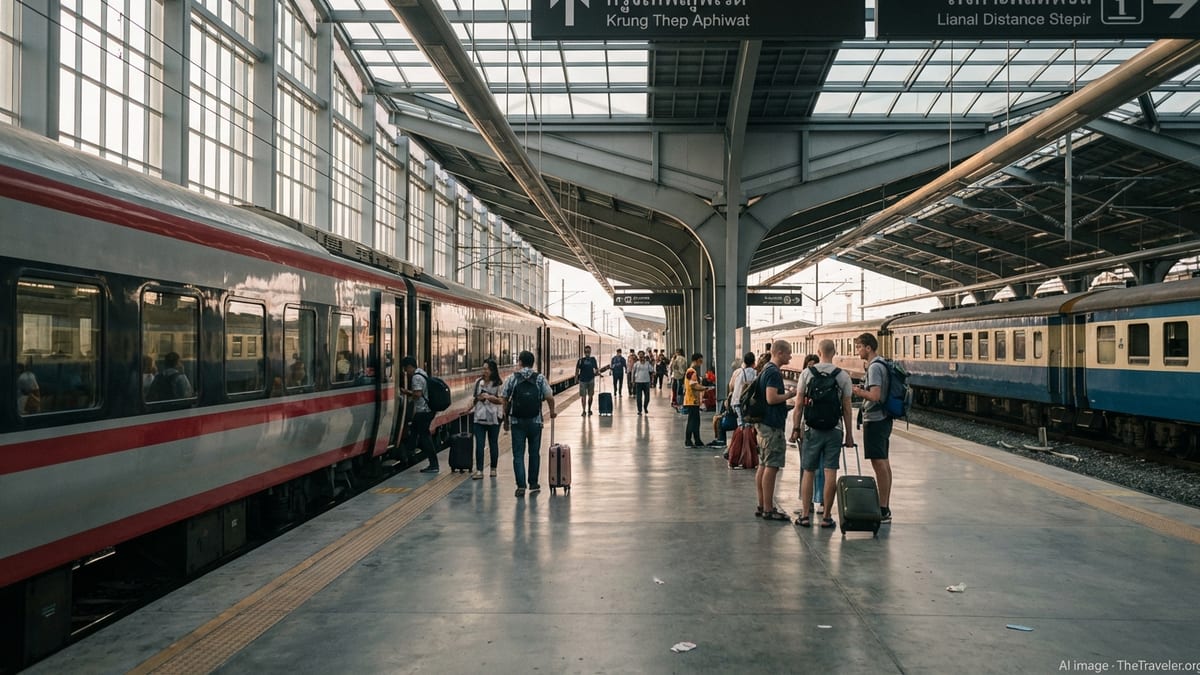
New Cross-Border Passenger Services Reshape Mekong Travel
Recent upgrades to the rail connection across the Mekong River between Nong Khai in Thailand and Vientiane in Laos are transforming a border link once seen mainly as a freight and day-trip route into a strategic tourism corridor. The existing metre-gauge line, which first brought passenger services into Laos in 2009, has been extended from the original Thanaleng terminal to the new Khamsavath station serving Vientiane, creating a clearer gateway for visitors arriving from Bangkok and beyond.
Travel information platforms now highlight through journeys that combine a sleeper train from Bangkok to Nong Khai with a short cross-border leg onward to Vientiane, turning what used to be a multi-stage bus and taxi journey into a relatively streamlined rail itinerary for international visitors. The border crossing at the Thai–Lao Friendship Bridge remains part of the process, but the ability to stay largely within the rail system is emerging as a selling point for overland travelers seeking lower-carbon, scenic alternatives to regional flights.
According to publicly available route guides, scheduled services operate between Nong Khai and Khamsavath, with immigration procedures handled at the border while passengers transfer between Thai and Lao rolling stock. This arrangement allows travelers to make the full Bangkok–Vientiane trip largely by train, underscoring how incremental investments on both sides of the Mekong have begun to converge into a marketable tourism product rather than purely a logistical link.
The original Thanaleng station has since pivoted toward handling freight, illustrating how passenger operations are gradually being concentrated at Vientiane’s new terminal while cargo moves through dedicated facilities. For tourism planners, that separation raises the potential to brand Vientiane as a true rail gateway city for mainland ASEAN itineraries.
Laos–China Railway Becomes a Backbone for Regional Tourism
The rapid growth of the standard-gauge Laos–China Railway is amplifying the impact of the Thailand–Laos connection by turning Vientiane and northern Lao destinations into key stops on longer rail journeys. Lao tourism statistics and domestic media reports show that millions of passengers have now used the Laos–China line since it opened in late 2021, with cross-border trips between Laos and China forming a significant share and Chinese leisure travel expanding strongly.
Tourism authorities in Laos report that international arrivals surpassed 4 million in 2024, with Thailand and China among the top source markets and rail described as an increasingly important mode for regional visitors. Analysts note that the railway has shortened travel times between Vientiane, Luang Prabang and the Chinese border at Boten, helping to disperse tourists more evenly across northern Laos and stimulating new hospitality investment near key stations.
Regional tourism promotion campaigns, including “Visit Laos 2024,” have explicitly incorporated the Laos–China Railway as a flagship experience, encouraging visitors to pair heritage towns such as Luang Prabang with modern rail travel. Additional daily services have been introduced on the line to accommodate the expected surge in demand, reflecting a strategy that links transport capacity directly with national tourism targets.
Thailand is positioning itself to tap this momentum by marketing overland itineraries that connect its own rail network with the Laos–China backbone. Public documents from tourism and transport agencies describe the Bangkok–Vientiane route as a feeder into fast services northward, allowing international travelers to imagine journeys that link Thai cities with Chinese destinations via a continuous chain of rail segments across Laos.
Plans for a New Mekong Rail Bridge Signal Deeper Integration
While the existing Friendship Bridge continues to handle combined road and rail traffic, Thailand and Laos are advancing plans for a new rail-dedicated bridge across the Mekong River near Nong Khai and Vientiane. Meeting summaries released by Lao and Thai agencies describe October 2025 discussions focused on a structure designed specifically for trains, aimed at easing congestion and preparing for higher volumes of both freight and passengers.
Transport planning documents characterize the proposed rail bridge as part of a broader vision to enhance cross-border logistics and to create smoother flows for tourists using the Bangkok–Vientiane corridor. By separating heavy goods trains and future high-capacity passenger services from mixed-use crossings, the project is expected to reduce delays and make timetable planning more reliable, a key factor for international travelers who connect across multiple countries.
The bridge proposal is widely interpreted as a precursor to more ambitious rail upgrades on the Thai side of the border, where work on a standard-gauge high-speed network is proceeding in phases. Although the Nong Khai section of the Thai high-speed project is still under consideration, official planning papers link it conceptually to eventual standard-gauge continuity into Laos, which already operates its main north–south route on that gauge.
For ASEAN tourism strategists, such infrastructure is not only about freight competitiveness. A dedicated rail bridge, combined with high-speed or upgraded conventional lines on both sides, would help anchor an interlinked tourism region in which visitors can move between major cities and secondary destinations with fewer mode changes, shorter travel times and clearer ticketing options.
ASEAN Rail Vision: From Singapore–Kunming Concept to Marketable Routes
The Thailand–Laos rail developments are unfolding within a longer-term ASEAN agenda to knit together national networks into what planners once framed as the Singapore–Kunming Rail Link. Policy papers and connectivity maps from ASEAN institutions continue to reference this concept, showing lines that run from Singapore through Malaysia and Thailand before branching into Cambodia, Laos, Myanmar and onward into China.
Although full high-speed continuity is still years away, the combination of existing Thai metre-gauge routes, the upgraded cross-border link to Vientiane and the standard-gauge Laos–China Railway already offers a practical spine for overland travelers. ASEAN land transport mapping tools now present rail and highway corridors side by side, highlighting how stations, special economic zones and tourist areas cluster along these routes.
Recent ASEAN tourism publications have begun to explore rail as a distinctive regional product, pointing to itineraries such as Thailand–Laos–Vietnam or extended journeys that follow segments of the Laos–China line as examples of how connectivity can be translated into visitor experiences. Concepts such as “Travel ASEAN by Rail” appear in these materials, reflecting a shift from purely infrastructural thinking to a more consumer-facing narrative.
In this context, the Thailand–Laos corridor functions as a bridge between the more mature rail systems of peninsular Malaysia and Thailand and the emerging network in mainland Southeast Asia’s interior. Operators and tourism boards are experimenting with cross-border packages that combine city visits, river cruises and rail segments, suggesting that as the hard infrastructure improves, commercial innovation is likely to follow.
Opportunities and Constraints for Future Rail Tourism Growth
Despite the progress, a number of practical constraints still shape how quickly rail tourism can expand between Thailand, Laos and the wider ASEAN region. Existing Nong Khai–Vientiane passenger services involve train changes and immigration procedures that can be unfamiliar to first-time visitors, and onward links from Vientiane to the Laos–China line typically require local transfers between stations or shuttle services in the absence of a seamless hub.
Reports analyzing the Thailand–Laos transport corridor note that integrated ticketing, synchronized timetables and clearer wayfinding at border stations would significantly improve the visitor journey. Tourism planners also point to the need for better coordination between rail operators and local transport providers so that travelers can reliably connect to hotels, river piers and attractions on both sides of the Mekong without resorting to ad hoc arrangements.
On the positive side, the growing popularity of rail among regional tourists, combined with national commitments to lower-emission transport, is generating political and commercial incentives to close these gaps. Thailand and Laos both present rail as part of broader sustainable tourism strategies, and ASEAN connectivity frameworks emphasize rail’s role in shifting some travel demand away from short-haul flights and long-distance buses.
As new infrastructure such as the proposed Mekong rail bridge moves from planning into construction, and as operators refine cross-border products that link Bangkok, Vientiane, Luang Prabang and Chinese destinations, the Thailand–Laos corridor is expected to become an increasingly visible showcase of ASEAN rail tourism in practice rather than only on policy maps.
How to travel by train between Bangkok, Vientiane, Laos and China
ASEAN land transport and Singapore–Kunming rail network map