


More news on this day
Thailand’s long-awaited push to bring rail to Chiang Rai is gathering pace, with construction milestones on the Den Chai–Chiang Rai–Chiang Khong line positioning the northern city for faster, more direct future connectivity with Bangkok and the wider Mekong subregion.
Get the latest news straight to your inbox!
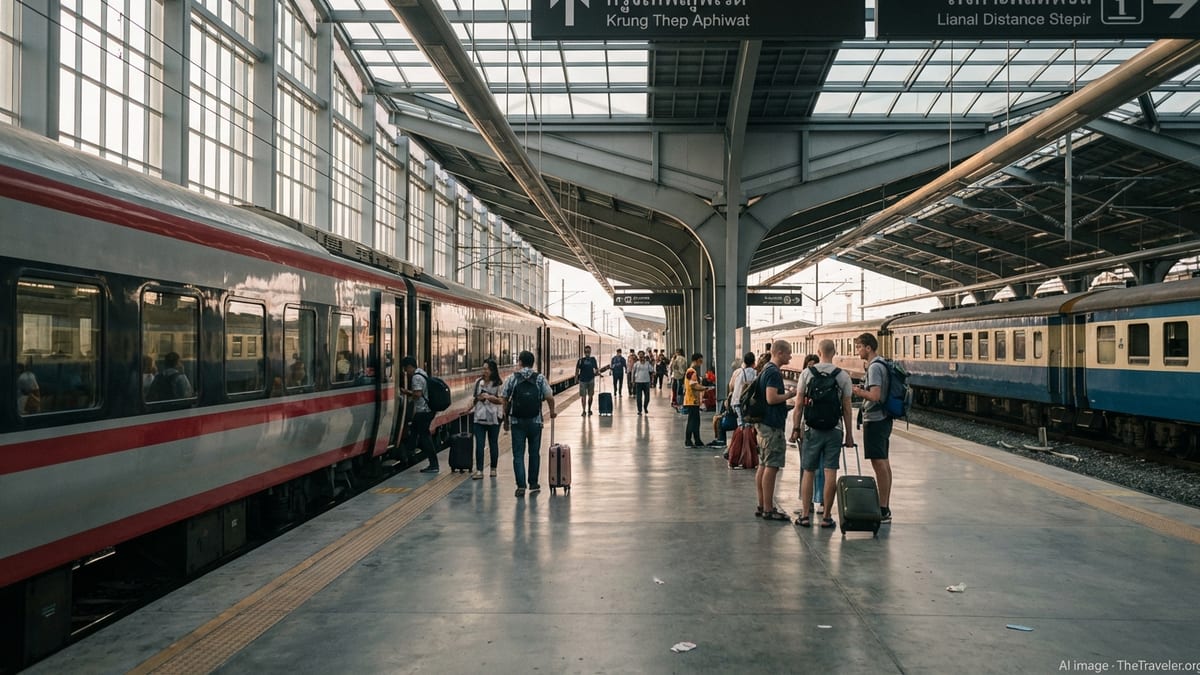
New Northern Spine Sets Up Faster Chiang Rai–Bangkok Journeys
The 323-kilometer Den Chai–Chiang Rai–Chiang Khong double-track line is emerging as the backbone of Thailand’s next-generation northern rail network. Publicly available information from rail authorities and local reporting indicates that overall construction has passed the halfway mark, with recent updates placing progress at just over 60 percent and signaling that major civil works are now well advanced.
The new line branches off the existing Northern Line at Den Chai in Phrae Province, which links southwards to Bangkok via Phitsanulok, Nakhon Sawan and Ayutthaya. Once operational, through-services will be able to run between Chiang Rai and the capital using upgraded double-track sections on the main Bangkok–Chiang Mai corridor, cutting journey times and easing current bottlenecks on the largely single-track network.
Thailand’s transport planning documents and investment reports describe the Den Chai–Chiang Rai–Chiang Khong project as a strategic double-track investment valued at more than 70 billion baht. The line is designed to carry both passengers and freight, with higher speeds and capacity than older northern sections, pointing to a new phase where Chiang Rai is integrated more tightly into the country’s long-distance rail grid.
For long-haul travelers between Chiang Rai and Bangkok, the project is expected to reduce reliance on overnight buses and domestic flights once schedules are introduced. While precise future timetables and travel times have not yet been published, transport policy papers emphasize that the goal is to offer faster, more frequent services that complement air and road options rather than replace them.
Tunnel Breakthroughs and Engineering Landmarks in the Highlands
Central to the transformation of northern rail connectivity is the construction of Thailand’s longest rail tunnel on the Den Chai–Chiang Rai–Chiang Khong route. Recent engineering updates highlight the Ngaw tunnel in Lampang Province, stretching more than 6 kilometers through mountainous terrain and forming the single largest structure on the project.
Reports on construction progress show that overall works on the line, including tunnels, viaducts and protective infrastructure, have been tracking only slightly behind initial plans. Transport agencies have highlighted risk-management measures built into the design, such as upgraded drainage systems, reinforced slopes and bridges, and grade-separated crossings to reduce accidents at road–rail intersections along the corridor.
Earlier progress bulletins from Thailand’s rail and transport departments described the Den Chai–Chiang Rai–Chiang Khong project as a showcase for modern double-track standards. These include higher axle loads for freight, signaling designed for increased train frequencies, and route alignments that cut curves and gradients compared with legacy lines in the north, all intended to support faster and more reliable operations.
Although exact opening dates have not been formally fixed in the public domain, the construction timetable extends toward the late 2020s. With more than half of the physical work now completed, industry observers suggest that upcoming phases will increasingly focus on systems installation, station development and testing, setting the stage for future timetabling between Chiang Rai, Den Chai and Bangkok.
Bangkok–Mekong Economic Rail Corridor Takes Shape
The Den Chai–Chiang Rai–Chiang Khong line is not only a domestic connector; it forms part of a wider economic corridor linking Bangkok to Laos and southern China. Chiang Khong, at the Mekong River border opposite Huay Xai in Laos, is already a key freight gateway via the Fourth Thai–Lao Friendship Bridge. Rail planners envisage future cross-border connections that would align Thailand’s northern network with the regional Kunming–Bangkok vision.
Thailand’s official infrastructure and transport action plans for 2025 to 2032 position the new northern double-track line alongside the Bangkok–Nong Khai high-speed project and other corridor schemes intended to strengthen trade flows and tourism across the Greater Mekong Subregion. Policy documents underline the role of rail in reducing logistics costs and shifting cargo from road to track, using hubs like Chiang Rai and Chiang Khong as intermodal junctions.
Economic analysis from local research units and commercial banks has highlighted the Den Chai–Chiang Rai–Chiang Khong scheme as one of the country’s major rail investments now under way. Commentary notes that, despite some schedule risks across the wider megaproject portfolio, projects already in construction such as this northern line are progressing and expected to underpin Thailand’s ambition to become a regional transport hub.
As these links develop, longer-distance itineraries from Bangkok up the Northern Line to Den Chai and onward to Chiang Rai and the Mekong border are expected to evolve into a more cohesive Chiang Rai–Bangkok rail corridor. For travelers, this could eventually offer a continuous rail experience from the capital through the northern highlands to the Lao frontier, with potential future connections further into mainland Southeast Asia.
Tourism Strategy Aligns With a “Rail-First” Future
Thailand’s tourism policy is increasingly framed around high-value, low-impact travel and improved connectivity across secondary cities. Government communications on tourism development emphasize that rail upgrades are a central tool for dispersing visitors beyond traditional hubs and supporting more sustainable transport options.
Recent tourism and transport briefings outline a wider push for seamless journeys that integrate air, road, rail and water transport. While much of the current focus is on regional air connectivity and airport-linked itineraries, these strategies repeatedly reference the role of expanded rail services in supporting multi-destination trips, including in the northern and northeastern clusters.
For Chiang Rai, the forthcoming rail connection is expected to complement its profile as a gateway to the Golden Triangle and hill-country attractions. By providing an alternative to domestic flights and long bus journeys, the Chiang Rai–Bangkok rail axis could help lengthen stays, encourage rail-based touring circuits and support new tourism products such as scenic daytime services and overnight journeys.
Thailand’s emerging regulatory framework for rail, including a new act that enables greater private participation on the State Railway of Thailand network, is also opening space for premium and themed trains. Industry coverage indicates that luxury and charter services are already being explored on existing routes, suggesting that the northern corridor, once fully connected, may see similar experiential products designed around Chiang Rai and nearby destinations.
From Single Track to National Rail Transformation
The Den Chai–Chiang Rai–Chiang Khong line sits within a much broader program to convert Thailand’s conventional network from predominantly single track to extensive double-track operations. A recent national rail infrastructure report details dozens of projects either completed, under construction or planned, stretching from the Eastern Economic Corridor to the deep south and across multiple branches of the Northern and Northeastern lines.
According to summary documents from transport agencies, rail schemes account for the largest share of Thailand’s current strategic infrastructure pipeline, with nearly 70 projects highlighted in the 2025–2026 roadmap alone. These range from suburban Red Line extensions around Bangkok to long-distance double-track enhancements and preparatory works for future high-speed services.
This system-wide expansion is intended to shift both passengers and freight to rail, ease pressure on highways, and underpin new logistics hubs nationwide. As double-track segments are completed and signaling is upgraded, planners expect to increase train frequencies, improve punctuality and deliver shorter end-to-end travel times, especially on corridors linking the capital with outlying regions.
In this context, the northern double-track through Den Chai to Chiang Rai and Chiang Khong functions as one of several anchors for a “rail-first” transport model. When paired with other upgrades on the Bangkok–Chiang Mai main line, it is set to turn what has long been a fragmented, winding route into a more coherent high-capacity spine. For travelers heading between Chiang Rai and Bangkok, that amounts to the beginning of a travel revolution built on steel rails rather than new highways.
https://www.chiangraitimes.com/news/chiang-rai/chiang-rai-railway-53-percent
https://www.nationthailand.com/news/general/40062549
https://thailand.localplus.city/2026/05/25/northern-line-railway-tunnels-progress-and-challenges
https://www.otp.go.th/uploads/tiny_uploads/PDF/2568-06/POTP-25062025-ActionPlanforTransport_Eng.pdf
https://www.drt.go.th/wp-content/uploads/2026/03/Rail-Infrastructure-Report-2025-EN.pdf