


Spend an hour in Newark’s airport and you may think you have seen Newark. For many travelers, the city flashes by as a runway, a rental car counter, and a glimpse of highways from the AirTrain. Then they leave convinced Newark is only a gritty gateway to somewhere else. That snap judgment is the biggest mistake visitors make. Newark rewards anyone willing to step outside the terminal and look beyond old stereotypes.
Get the latest updates straight to your inbox!
How Newark Got Its Unfair Reputation
Most travelers’ impressions of Newark are shaped from behind glass: the airplane window, a taxi windshield, or the big panes inside Newark Liberty International Airport. They see warehouse roofs, rail yards and the orange glow of industrial lights along the Turnpike and conclude the whole city looks and feels this way. It is an understandable first impression, but a narrow one that ignores the neighborhoods, parks and cultural institutions only a 10 to 15 minute ride away.
Newark’s reputation was also frozen in time by decades-old headlines. The city’s history of industrial pollution along the Passaic River and the 1967 uprising still color how outsiders talk about it, even though they are events from another era. Meanwhile, more current realities like a growing downtown residential population, a revitalized riverfront and a maturing dining scene rarely make the news in the same dramatic way, so they stay under the radar for infrequent visitors.
Consider a common scenario. A traveler lands at Newark on a Friday evening, waits in a crowded rideshare pickup zone and notices the tangle of highway ramps and trucks. They decide to stay at an airport hotel, eat at a national chain restaurant and fly out the next morning without ever seeing downtown’s Theater Square, Branch Brook Park’s cherry trees in season, or Ferry Street’s Portuguese bakeries. Later they tell friends they have “been to Newark,” when in reality they have only experienced a thin slice of the airport perimeter.
That quick judgment not only sells the city short, it also deprives travelers of experiences that are unusually accessible for a stopover city. From Newark Penn Station, for example, you can be walking along the Passaic River at Riverfront Park, sitting down to grilled sardines in the Ironbound or taking your seat at the New Jersey Performing Arts Center within minutes. Very few major airports put that diversity of options so close at hand.
Seeing Beyond the Airport and Highway Ramps
The biggest mental shift visitors need is to separate “EWR” from “Newark.” Newark Liberty International Airport sits in an industrial corridor straddling multiple municipalities. The airport hotels clustered around the McClellan Street and Frontage Road exits are convenient for catching early flights, but they are a world apart from the neighborhoods where Newarkers actually live, work and spend their leisure time.
If you are arriving by air, the most useful move you can make is to ride either the AirTrain to Newark Liberty International Airport Station and transfer to a New Jersey Transit train, or take an express bus or rideshare directly to Newark Penn Station. The trip is short, usually 7 to 15 minutes depending on the option, and suddenly you step into a different Newark: an early 20th century train hall with high ceilings, art deco details and pedestrian access to downtown streets instead of interchanges.
From Newark Penn Station, the geography becomes much friendlier for a visitor on foot. To the north and slightly west lies the core of downtown, with the New Jersey Performing Arts Center, Military Park and the Prudential Center arena within walking distance. To the east, a five to ten minute walk along Ferry Street takes you into the Ironbound, a dense residential and commercial neighborhood famous for its Portuguese, Brazilian and Spanish restaurants. Head north along McCarter Highway and you reach sections of the expanding Riverfront Park with its bright orange boardwalk and seasonal programming.
In practice, this means you can treat Newark like any urban stopover: drop your bags, catch a show, explore a neighborhood on foot and be back at the airport the next day with little stress. A traveler with an eight-hour layover could, for instance, check into a downtown hotel near Prudential Center, have lunch on Ferry Street, walk the riverfront in late afternoon light and still comfortably return to the terminal for an evening departure.
Discovering the Ironbound: Newark’s Culinary Calling Card
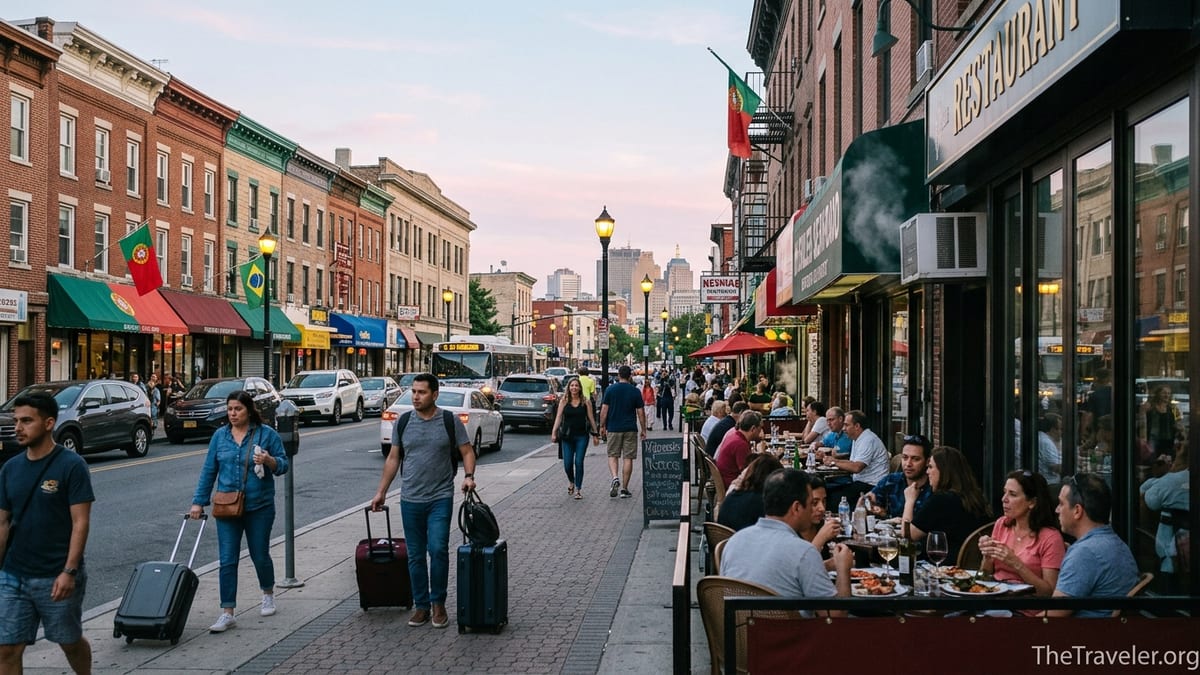
The Ironbound is the clearest example of what rushed travelers miss. Bordered historically by rail lines, this neighborhood east of Newark Penn Station grew into a hub for Portuguese, Spanish and later Brazilian immigrants. Today its main artery, Ferry Street, is lined with bakeries, churrascarias, seafood houses, casual cafes and small grocery stores where you hear European Portuguese, Brazilian Portuguese and Spanish on the sidewalks as often as English.
On a typical evening, visitors might find a line out the door at a Portuguese bakery where a pastel de nata costs only a few dollars, locals lingering over espresso at standing-height counters and families sharing platters of grilled octopus or picanha steaks at long tables. A mid-range dinner for two with shared starters, mains and a carafe of vinho verde often runs less than the price of a single steak entrée at a similar-quality restaurant in midtown Manhattan. That price difference becomes even more striking for groups coming in to see a concert at Prudential Center, which is within a 15 to 20 minute walk of Ironbound dining rooms.
Recent coverage by regional food publications has highlighted newer-wave spots in the Ironbound alongside long-established institutions. Travelers can now choose between classic rodizio restaurants where servers carve skewered meats tableside and more contemporary bistros run by chef-owners putting modern spins on Iberian and Brazilian flavors. There are also increasingly diverse options beyond Lusophone cuisine, including Mexican taquerias tucked onto side streets, South American bakeries selling filled savory pastries and casual burger joints serving local craft beer.
This variety is what travelers miss when they write Newark off as only an airport town. An evening on Ferry Street is lively without feeling overly curated, and lingering over grilled seafood on a patio or a tiled dining room gives a more human sense of the city than any drive along the Turnpike viaducts could. For visitors passing through on a Friday or Saturday, building in even a few hours to wander the Ironbound can completely rewrite their impression of Newark.
The Riverfront and Parks: A Different View of the Passaic
Another blind spot for many travelers is Newark’s riverfront. For decades, the Passaic River was defined in the public imagination by stories of industrial pollution and warehouse-lined banks viewed from commuter trains. In recent years, however, Newark has been steadily reclaiming sections of the shoreline for public use, and travelers who take the time to walk those paths see a very different side of the city.
Newark Riverfront Park, opened in phases over the last decade, now stretches along a growing portion of the Passaic with bright orange boardwalks, lawns, a small amphitheater and public art. A more recent phase, nicknamed “The Notch,” created a continuous walkway from the downtown area near the New Jersey Performing Arts Center toward the Ironbound, making it easier for visitors to leave a performance or a hockey game and stroll directly to the water. Seasonal programming has included outdoor movie nights, yoga classes and community festivals that draw both residents and curious visitors.
Within a short ride of downtown, travelers can also visit Riverbank Park in the Ironbound, one of Newark’s older public parks, and Branch Brook Park farther north, which is famous for its spring cherry blossom display. Many first-time visitors are surprised to learn that Branch Brook’s collection of cherry trees rivals more widely known displays in Washington, D.C., and that a short light rail ride from Newark Penn Station brings them to that landscape of lawns, lakes and trees in bloom.
For a traveler whose only mental image of Newark is highway cloverleafs and freight yards, walking a section of Riverfront Park at sunset, with commuter trains rumbling in the background and the skyline reflected in the Passaic, provides important context. It shows Newark as a place where environmental cleanup and public recreation are ongoing priorities, not just an industrial corridor to speed through on the way to somewhere else.
Culture, Sports and Events Hiding in Plain Sight
Another way travelers misjudge Newark is by overlooking how much culture and entertainment is packed into its compact downtown. The New Jersey Performing Arts Center, or NJPAC, sits on Center Street just north of Military Park and regularly hosts touring Broadway shows, classical performances, jazz concerts, comedy tours and community festivals. On a given week, a traveler might choose between a symphony performance, a stand-up headliner and a dance company, all in a venue that is a short walk or rideshare from Newark Penn Station.
Just a few blocks away, the Prudential Center draws National Hockey League fans and concert-goers year-round. Visiting supporters of teams like the New York Rangers or Philadelphia Flyers often step off regional trains directly into the arena district, then head to nearby bars or restaurants before and after games. For business travelers staying in downtown hotels, that means they can catch a top-tier concert or a professional hockey game with minimal planning on a free evening instead of commuting into midtown Manhattan.
Travelers with more time can explore Newark’s museums and galleries, which add further depth to a short stay. The Newark Museum of Art, located near Washington Park, houses significant collections of American art, decorative arts and a respected Tibetan art collection, along with a small planetarium that hosts public shows. The museum’s scale is manageable for a half-day visit, and its location within a walk or short light rail ride from downtown hotels makes it an easy addition to a Newark-focused itinerary.
What many visitors do not realize is that Newark’s calendar is dotted with festivals and neighborhood events that give insight into the city’s communities. In the Ironbound, for example, Portuguese and Brazilian celebrations often fill Ferry Street with music and flags during major football matches or cultural holidays. Downtown, food truck festivals and outdoor performances near Military Park and Riverfront Park attract families and office workers alike. Travelers who plan ahead by checking event listings around their travel dates can transform a routine business trip into a weekend that happens to include a major show or community festival.
Safety, Practicalities and Where First Impressions Go Wrong
Safety is one of the main reasons travelers say they avoid leaving the airport in Newark. The concern is not baseless, as Newark, like many mid-sized American cities, has neighborhoods that struggle with crime. The mistake is treating city-wide statistics as a reason to avoid specific, heavily trafficked areas that are accustomed to hosting visitors. Downtown around NJPAC, the Prudential Center and the main hotel cluster is typically busy during events, and the Ironbound’s main streets stay active well into the evening with families and workers going about their routines.
As in any urban destination, common-sense precautions help: stay on well-lit commercial streets, avoid deserted corners late at night, and keep valuables secure. Planning your movements also matters. A traveler landing after midnight with luggage might reasonably choose a downtown or airport hotel and postpone exploring until morning, rather than wandering in search of dinner in unfamiliar blocks. During the day and early evening, however, walking between Newark Penn Station, Military Park, NJPAC and the Ironbound is a regular part of life for commuters and residents, and visitors who follow those same routes generally find them manageable.
Cost is another area where first impressions mislead. Some travelers assume staying near the airport is automatically cheaper, but room rates in downtown Newark can be competitive, especially on weekends without major events at Prudential Center. Meanwhile, dining in the Ironbound often provides better value than restaurants in nearby Manhattan or Jersey City, with generous portions and mid-range pricing. A pair of travelers might share a large seafood platter, bottle of wine and dessert for a total that would barely cover two entrees at a midtown steakhouse.
Transport logistics, too, are often easier than outsiders expect. New Jersey Transit and Amtrak trains connect Newark Penn Station to New York Penn Station in as little as 20 minutes on many departures, and the city’s own light rail system links downtown to neighborhoods like Broad Street and Branch Brook Park. Rideshares and taxis cluster around Newark Penn Station and major hotels, with typical rides between the airport and downtown taking less than 20 minutes outside peak traffic. Once you factor in these connections, building Newark into a broader New York area trip becomes more straightforward, and the idea that you must rush straight out of town starts to feel less compelling.
Turning a Layover into a Real Visit
For many readers, the most practical question is how to turn an unavoidable stop in Newark into an opportunity. The key is to treat even a short window as a mini-trip rather than dead time near the gate. If you have six hours or more between flights during the day, for example, you can reasonably leave the airport, store your bags and catch a sample of the city before returning through security with time to spare.
One realistic pattern for a mid-day layover looks like this: ride the AirTrain and connecting train to Newark Penn Station, walk ten minutes into the Ironbound for a late lunch, then head north along the signed paths to stroll a section of Riverfront Park. Afterward, you can cut back through downtown, pausing briefly at Military Park or the exterior of NJPAC, before returning to the station for your train back to the airport. In under four hours on the ground, you will have eaten well, walked by the Passaic and seen at least two distinct neighborhoods.
For overnight stays, consider choosing a hotel downtown instead of next to the runways. This allows you to drop your bags, explore on foot and head out again in the evening without long transfers. You might, for instance, arrive on a Thursday afternoon, spend that evening at a concert or show at NJPAC, and devote Friday morning to the Newark Museum of Art before departing. Even business travelers whose meetings are in nearby office parks sometimes opt for downtown lodging so they can enjoy Ironbound dinners and a short hop to the airport afterward.
The broader mindset change is to see Newark not as a place you accidentally pass through, but as a small city with its own identity, stories and attractions that happen to sit at a major air and rail crossroads. Once you make that shift, decisions like adding a night to your itinerary, adjusting a return flight to allow a dinner in the Ironbound, or choosing a morning train that leaves time for a park walk start to feel less like risks and more like natural extensions of your travel habits.
The Takeaway
The biggest mistake travelers make with Newark is not that they dislike it after exploring, but that they dismiss it without ever really seeing it. Confusing airport frontage roads with city streets and outdated headlines with current realities leads people to judge Newark too quickly, often from the back seat of a cab or during a rushed sprint between terminals.
When you move beyond that first glance, a different Newark appears. It is a city where you can eat grilled fish on a busy Iberian avenue, watch the sun set over a reclaimed riverfront, attend a world-class performance and still be at the airport in time for an early flight. It might not replace New York City on your itinerary, but it does not have to. Newark works best as itself: compact, diverse, and surprisingly accessible to anyone willing to invest a few hours.
On your next trip through the region, instead of counting the minutes until your connection, ask whether you can spare some of them for Newark. Take the short train ride into town, follow the crowds to Ferry Street or the river, and let your own impressions form at street level. You may still decide Newark is a brief stop in your wider journey, but at least that decision will come from experience rather than assumption.
FAQ
Q1. Is it realistic to leave Newark Airport during a layover to explore the city?
Yes, if you have at least six hours between flights during the day. That window gives you time to ride the AirTrain and connecting train to Newark Penn Station, explore a nearby neighborhood like the Ironbound or Riverfront Park, and return through security without rushing.
Q2. Which areas of Newark are most convenient and comfortable for first-time visitors?
For most travelers, the easiest introduction to Newark is the triangle between Newark Penn Station, downtown around Military Park and the Prudential Center, and the Ironbound along Ferry Street. These areas are well used by commuters and visitors and offer dining, parks and cultural venues within a short walk.
Q3. Is the Ironbound safe to walk around in the evening?
The Ironbound’s main streets, especially around Ferry Street and surrounding blocks, stay busy into the evening with residents, families and restaurant-goers. As in any city, it is wise to stick to well-lit commercial streets, be aware of your surroundings and use a rideshare or taxi rather than walking long distances late at night on quieter side streets.
Q4. How do I get from Newark Airport to downtown Newark without a car?
You can take the AirTrain from your terminal to Newark Liberty International Airport Station, then transfer to a New Jersey Transit or Amtrak train for the short ride to Newark Penn Station. Express buses and taxis also run between the airport and downtown, but the train connection is often the most predictable option during busy periods.
Q5. What kind of food is Newark known for?
Newark is best known for the Portuguese, Spanish and Brazilian restaurants concentrated in the Ironbound, where you will find grilled seafood, rodizio steakhouses, bakeries and casual cafes. The city also has growing options for other cuisines, including Latin American, West African and contemporary American spots closer to downtown.
Q6. Are there worthwhile cultural attractions in Newark for a short visit?
Yes. The New Jersey Performing Arts Center hosts concerts, theater and community events, while the Newark Museum of Art offers notable art and cultural collections in a manageable size. Depending on the season, you can also attend professional hockey games or major concerts at the Prudential Center.
Q7. Is it better to stay in an airport hotel or downtown Newark?
If you only need a bed before a very early flight, an airport hotel can be convenient. However, staying downtown gives you direct access to restaurants, parks and venues like NJPAC and the Prudential Center, and travel time to the airport is still short, especially outside peak rush hours.
Q8. Can Newark be a base for visiting New York City?
It can. Trains from Newark Penn Station reach New York Penn Station in roughly 20 minutes on many departures, which allows some visitors to combine more affordable Newark lodging and dining with day trips into Manhattan. This works best for travelers comfortable using regional trains and planning around scheduled departure times.
Q9. What surprises visitors most when they finally explore Newark?
Many are surprised by the lively, walkable feel of the Ironbound, the restored sections of Riverfront Park along the Passaic and the quality of performances at NJPAC. Others mention how compact downtown feels compared with larger cities, which makes it possible to see several neighborhoods in a single afternoon.
Q10. How much time should I plan to get back to Newark Airport from downtown?
As a rule of thumb, allow at least an hour from downtown to your gate: about 20 minutes for the train or taxi ride back to the airport, plus time for the AirTrain and security. During peak travel times or bad weather, giving yourself extra buffer is sensible so you can enjoy the city without worrying about missing your flight.