


I had seen a thousand photographs of Tuscany before I ever held a set of Italian car keys. Golden hills, solitary cypress trees, stone farmhouses balanced on ridgelines like mirages. But nothing prepared me for the feeling of actually steering a small rental car into that honeyed landscape for the first time, the road unwinding ahead of me like a promise.
Get the latest updates straight to your inbox!
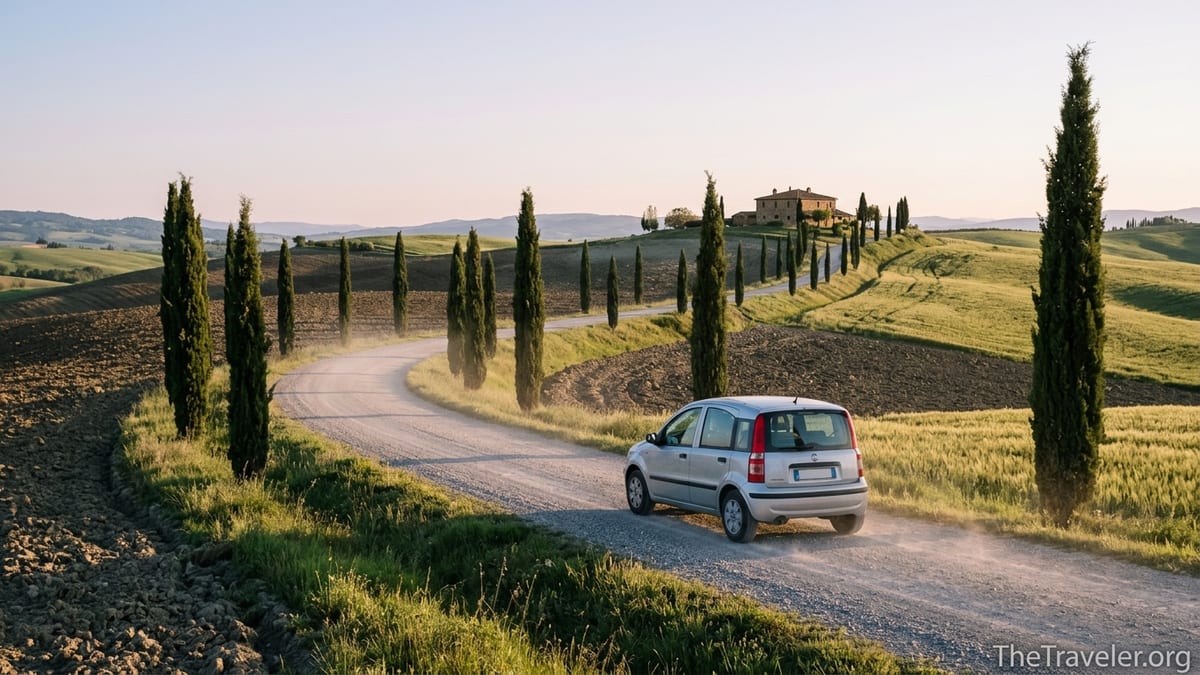
Picking Up the Keys: Florence to the Open Road
My first Tuscan drive started in Florence, which is both the best and the worst place to meet your rental car. The airport on the edge of the city is ideal: within fifteen minutes you can be beyond the urban ring roads and heading for the hills. Collecting a compact manual car here in late spring typically costs somewhere in the region of 30 to 60 euros per day, more in high summer and for an automatic. That morning, I signed the paperwork, took a quick walk around the car to check for scratches, and suddenly the keys were in my hand. Tuscany was not just a postcard anymore. It was somewhere I could reach by pressing the accelerator.
The first lesson came quickly. Italian cities like Florence are crisscrossed with ZTL zones, restricted traffic areas policed by cameras. Drive under the wrong archway and you can receive a fine weeks later. Before leaving, I studied a simple rule that turned out to be essential: in the historic centers, if you see a white circular sign with a red border, assume you are not allowed through unless you know for certain that your hotel has registered your plate. So instead of driving into the heart of Florence, I followed the signs for the ring road, kept a respectful distance from medieval towers and camera lenses, and aimed for the countryside.
It took only a few kilometers before the dual carriageways thinned into something more intimate. The houses lowered, vines appeared, and the first lines of cypress trees rose like sentries on the ridges. My satnav announced a new name, one I had seen on maps but never heard aloud: "Chiantigiana." The Chianti road. SR222. Suddenly the romance of the idea and the reality of the road collided, right there in front of the windshield.
Following the Chiantigiana: A Ribbon Through Vineyards
Many Tuscan journeys start with the Chiantigiana, and for good reason. The SR222 runs roughly 70 kilometers from Florence toward Siena through the heart of Chianti Classico. My own first day behind the wheel followed just a small part of this route, but it felt like a masterclass in what driving in Tuscany can be. As soon as I left the outskirts of Florence, the road began to climb gently. Vineyards fanned out from the slopes, their early-summer leaves bright and taut, while silvery olive groves filled in the gaps like watercolor shading.
Traffic was light that morning, mostly local drivers who seemed to know every bend. The Chiantigiana is not a high-speed highway; it is a road that invites unhurried progress. Between Florence and the wine town of Greve in Chianti, there are viewpoints where you can pull over safely on the right-hand side and simply stand at the roadside, listening to birds and the distant hum of a tractor. At one such pullout, I watched as the sun slid across the hills, transforming the color of the vines from pale green to deep emerald in a matter of minutes.
Greve provided my first proper pause. The main square was waking up, café chairs being dragged into place, a few cyclists propping their bikes against stone walls. I parked in a blue-lined paid spot on the edge of town, fed a couple of euros into the meter for an hour, and walked into the piazza. A cappuccino and a slice of focaccia cost less than what I would pay for coffee alone in many European capitals, yet I sipped it surrounded by wine shops displaying dusty old Chianti bottles in straw flasks. Back at the car, the parking ticket still had time left. It felt like a small, unexpected luxury: in Tuscany, even the clock seemed to slow down a little for visitors.
Into the Val d’Orcia: The Tuscany of Postcards
From Chianti I drove south, eventually joining smaller provincial roads that peeled away toward the Val d’Orcia, the UNESCO-listed valley of cinematic fame. As I approached, the landscape shifted subtly. Vineyards gave way to long swells of cultivated fields, freshly plowed in some places, velvety with crops in others. The lines of cypresses seemed more deliberate here, as if someone had carefully placed them for maximum drama along each rise and curve.
The road that finally stole my breath was the SP146 between San Quirico d’Orcia and Pienza. It is not long in distance, around ten kilometers, but it holds within it many of the images that travelers carry in their minds when they think of Tuscany. The asphalt undulates along the spine of the hills, with occasional pullouts just wide enough for a couple of cars. At one stop a farmhouse perched on a knoll, encircled by a ring of cypresses that looked almost too perfect to be real. This was the sort of view that usually lives on a glossy calendar, yet here it was, framed not by a photographer but by my car window.
Driving this stretch in the late afternoon felt especially magical. The sun was lowering behind me, casting long shadows from each cypress tree and turning the fields ahead into a patchwork of gold and soft green. I kept the window cracked despite the warm air just to hear the sound of the tires over the road and the faint chime of cowbells somewhere far below. Several times I pulled over simply to stand at the guardrail, hands on the warm metal, reminding myself that this was not a dream. It was an ordinary regional road, traveled by farmers and locals every day, and yet for a first-time visitor it felt like driving through the opening scene of a beloved film.
Life at an Agriturismo: Evenings among Fireflies
A drive through Tuscany gains another dimension when you pair it with a stay at an agriturismo, a working farm that offers rooms or apartments. My first night after that Chianti and Val d’Orcia drive was spent at a stone farmhouse about fifteen minutes outside Pienza. Reaching it meant leaving the main paved road for a white gravel lane that crackled under the tires, climbing between fields until the house appeared, weathered and square, with terracotta pots of geraniums on the steps.
Rooms at agriturismi in this area can vary widely, but many sit in a middle ground between rustic charm and modern convenience. A simple double room in shoulder season often starts around 120 to 180 euros per night, sometimes including a breakfast of homemade cakes, local pecorino cheese, and fruit from the orchard. Apartments for a week can range from roughly 600 euros in low season to more than 1500 in peak months for larger spaces with pools. What they consistently offer, though, is immersion. Instead of traffic noise, I fell asleep to the low croak of frogs from a nearby pond and the hum of crickets.
That evening, the owner invited guests to a communal dinner under a pergola. A fixed menu, about 35 euros per person, included bruschetta with tomatoes still warm from the sun, pici pasta topped with a rich ragù, grilled pork from the farm, and carafes of the house red. Around the long table sat couples from Germany and the United States, a family from Milan, a solo traveler from Australia. Conversations drifted between languages as the sky deepened into a violet-blue and the first fireflies traced faint, erratic paths above the grass. I realized that the magic of my drive had not ended when I turned off the engine. It had simply changed gear.
Practical Realities Behind the Romance
As enchanting as those first drives felt, the realism of navigating Tuscany by car quickly surfaced, and in its own way that practicality deepened my appreciation. Renting a car is not just a set of keys and a soft-focus sunset. It is understanding that an automatic transmission can cost significantly more than a manual, sometimes nearly double in peak July and August weeks. It is budgeting for fuel at prices that fluctuate but often sit higher than in North America, and remembering that service stations along the autostrade can be more expensive than those in small towns.
I also learned that Tuscan roads demand respect. Speeds drop as you approach villages, with cameras silently enforcing the rules. Locals are generally patient, but they expect visitors to keep right except when overtaking and to use pullouts where possible if a line of cars builds up behind on narrow roads. Some of the most photogenic bends are precisely where stopping is unsafe. The best photographs of those winding cypress-lined lanes are often captured by people who planned a stop at a safe lay-by, then walked back along the verge, rather than braking suddenly when the view appears.
Navigation technology, helpful as it is, can be a double-edged sword. On one occasion my mapping app tried to send me through the core of a hill town where only residents were allowed to drive. The trick became learning to zoom out, to read the land as much as the screen. If a route looked like it threaded straight through a medieval center, I would aim instead for the signed parking lots outside the walls, usually marked with a blue "P" and often charging just a few euros for several hours. From there, the joy of walking narrow stone streets replaced the pleasure of the drive, and the car waited calmly under a line of cypresses until I returned.
Moments that Defined the Magic
Looking back, it is not the big logistical points that rise first in my memory, but a series of small, vivid scenes that together explain why that first drive felt more magical than I had imagined. There was the morning mist pooling in the folds of the Val d’Orcia, so dense in the hollows that only the tops of lone trees emerged, turning the valley into a sea of pale blue. I pulled into a gravel turnout and watched as the sun slowly burned through, the land reappearing in soft focus like a Polaroid developing in front of my eyes.
Another moment came later that same day, on a backroad between Montepulciano and Monticchiello. The asphalt narrowed, and for several minutes I saw no other car at all. A farmer in a three-wheeled Ape rumbled past, raising a hand in an easy greeting. Just beyond, I rounded a corner to find a view laid out below me: terraced fields, a winding lane marked by pointillist dots of cypresses, and in the far distance the rounded silhouette of Monte Amiata, hazy and blue. I turned off the engine and simply sat in the quiet, the ticking of the cooling metal the only sound inside the car.
Even practical stops had their own charm. Filling up at a small station near Siena, I followed the attendant’s instructions to pay inside first. While I waited for my change, a radio played Italian pop, and a shelf displayed jars of honey from local hives and bottles of olive oil pressed from groves just over the hill. I left with a full tank and a small jar of wildflower honey wrapped in brown paper, a tangible souvenir of an otherwise mundane chore. In Tuscany, it seemed, the line between the ordinary and the poetic was pleasantly thin.
The Takeaway
My first drive through Tuscan landscapes taught me that the region’s magic lies not only in the views but in the rhythm of moving through them at your own pace. Behind those endlessly shared photographs are real roads, with speed limits and speed cameras, with fuel costs and tricky parking signs. Yet within that framework, there is immense freedom. With a car you can watch dawn break over the Val d’Orcia one day and linger over a Chianti hillside sunset the next, stopping wherever curiosity nudges you.
If you are considering your own first drive in Tuscany, know that it will likely be more textured than the brochure version: a mix of navigational puzzles, laughter when you stall on a steep medieval slope, simple roadside picnics, and unexpected vistas. That texture is precisely what makes it memorable. Prepare well enough to avoid obvious pitfalls like ZTL fines and rushed schedules, then leave space for detours. The unplanned left turn toward a row of cypresses, the decision to follow a sign to an agriturismo you have never heard of, the choice to switch off the engine and simply listen to the wind in the wheat: these are the moments that will linger long after you hand the keys back.
FAQ
Q1. Do I really need a car to enjoy Tuscany’s countryside?
While you can reach major Tuscan towns by train or bus, having a car opens up backroads, agriturismi, and small villages that are difficult or time-consuming to access with public transport. For exploring areas like Chianti and the Val d’Orcia, a car transforms what you can see in a single day.
Q2. Is it difficult to drive on Tuscan country roads for a first-timer?
Most Tuscan country roads are well paved and reasonably signed, but they can be narrow and winding. If you are comfortable driving a manual car and staying alert on curves, you will likely adapt quickly. Allow extra time for each journey so you never feel rushed.
Q3. How much should I budget for a rental car in Tuscany?
Prices vary by season and transmission type, but a small car in shoulder season often costs somewhere between 30 and 60 euros per day, before fuel and any extra insurance. Automatics and peak summer weeks can cost noticeably more, so booking early and being flexible with dates helps.
Q4. What is a ZTL, and how do I avoid fines?
A ZTL is a restricted traffic zone usually found in historic centers of cities and larger towns. Entry is controlled by cameras. As a visitor, assume you cannot drive into the old town unless your hotel has arranged permission in advance. Watch for circular signs with a red border and choose parking lots on the edge of town instead.
Q5. Are there toll roads on the classic scenic routes?
Many of Tuscany’s beloved scenic drives, such as the Chiantigiana (SR222) and the SP146 between San Quirico d’Orcia and Pienza, are toll free. Major autostrade that cross the region do have tolls, but you can often plan routes that combine short toll sections with longer stretches on picturesque regional roads.
Q6. What is staying at an agriturismo really like?
Stays vary, but many agriturismi offer simple, comfortable rooms or apartments on working farms, with breakfasts featuring local products and the option of communal dinners. Expect gravel access roads, starry skies, and a quieter, more rural atmosphere than in town hotels.
Q7. When is the best time of year for a first drive through Tuscany?
Late spring and early autumn are often ideal, with mild temperatures, generally good driving conditions, and landscapes either fresh green or softly golden. Summer brings long days and vivid colors but also higher prices and more traffic on popular routes.
Q8. Do I need an international driving permit in Tuscany?
Travelers from some countries are required or strongly advised to carry an international driving permit along with their home license. It is wise to check current rules from your own motoring authority before you travel and bring both documents if recommended.
Q9. Is parking easy in hill towns like Pienza and Montepulciano?
Within historic centers, parking is usually limited to residents and permit holders. Visitors typically park in signed lots just outside the walls, often paying a modest hourly fee. From there, it is a short uphill or downhill walk into the old town streets.
Q10. How can I make my Tuscan drive feel less stressful and more magical?
Build in generous time for every leg of your journey, avoid driving into city centers, and plan no more than a few key stops per day. Embrace slower speeds, stop at safe pullouts for photos instead of improvising, and allow yourself unplanned detours. The combination of preparation and spontaneity is what lets the magic of the landscape fully sink in.