


By the time the trail narrowed and the trees fell away, I realized Charlies Bunion was not the friendly viewpoint I had imagined from glossy Great Smoky Mountains brochures. The last few hundred yards tilted toward a steep drop, stone and dirt crumbling underfoot, the wind pushing at my backpack. My heart rate spiked faster than it had on any uphill switchback. Yet when I finally stepped onto the rocky outcrop and saw an endless sweep of ridges fading into blue, every shaky step felt worth it.
Get the latest updates straight to your inbox!
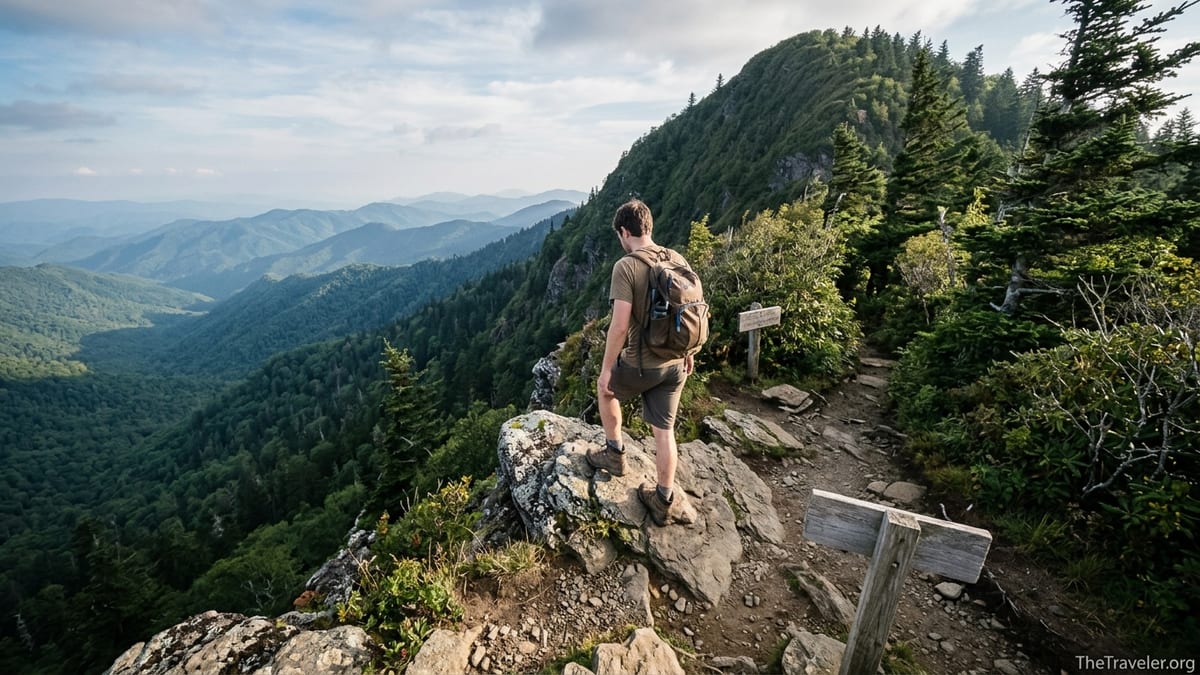
Meeting Charlies Bunion in Real Life, Not in Brochures
On paper, Charlies Bunion sounds straightforward: roughly 8 miles round trip along the Appalachian Trail from Newfound Gap, with about 1,600 feet of elevation gain. Most guidebooks label it “moderate” or “moderate to strenuous,” and the photos usually show hikers lounging casually on a big gray rock with the Great Smoky Mountains rippling away behind them. It is easy to underestimate just how exposed and intimidating that final approach can feel when you are the one standing on the ridge.
The day I hiked it, Newfound Gap felt busy but manageable. Cars with Tennessee and North Carolina plates squeezed into every open space, and day trippers drifted from the overlook to the state-line sign. Yet as soon as I followed the white-blazed Appalachian Trail into the trees, the crowd thinned. Within half a mile, the chatter of the parking lot had vanished, replaced by the scrape of trekking poles and the soft thud of boots on dirt. I felt like I was on a classic eastern mountain walk, not a route that would soon test my tolerance for exposure.
For the first few miles, the trail was exactly what I expected: roots, rocks, steady climbing, and cool air drifting through spruce and fir. Every so often, gaps in the trees revealed ridge after ridge rolling away across Tennessee and North Carolina. I passed couples in trail runners, a family with older kids, and a pair of backpackers heading the opposite direction toward Icewater Spring Shelter. No one seemed particularly on edge. If anything, the atmosphere was relaxed, almost casual, which made the shock of the final stretch even sharper when it arrived.
Somewhere past Icewater Spring Shelter, the character of the hike shifted. The forest opened, the footing grew rougher, and low shrubs gave way to stone. The wind picked up and stayed there, brushing the back of my pack. The first true glimpse of Charlies Bunion arrived not as a gentle rise, but as a jagged cluster of rock that looked far steeper and more exposed than it had in any photo I had studied back at home.
Why the Final Stretch Feels So Much Scarier Than the Mileage Suggests
Parts of the last quarter mile to Charlies Bunion feel less like a friendly national park viewpoint and more like a narrow mountain shoulder, perched above steep slopes with little to stop a fall. Technically, the standard route follows a spur trail that peels left from the Appalachian Trail and runs a short distance out to the famous rock. It is not a knife-edge ridge in the sense of western climbs like Angels Landing in Zion, and you will not find chains or man-made aids. What you will find is a faint tilt toward the drop-off, loose gravel hiding between roots, and a sense of exposure that can catch even experienced hikers off guard.
On my hike, the trail had dried from a light overnight rain. Mud clung to the rocks, but nothing looked especially dangerous at a glance. Yet as I began traversing that final section, it became clear that photographs had not captured the angle of the slope or the way the ridge falls away beneath your feet. To my right, the land rose in scrub and boulders. To my left, the mountains simply fell away into a blue-green void. Even though the actual tread was about a boot and a half wide, my brain insisted it was far narrower.
Several small moments added up to the fear: a loose rock that shifted just enough to remind me of gravity, a gust of wind that caught my hat brim, and the sight of another hiker inching along with one hand on the uphill side, clearly not enjoying the exposure. When I paused to let a faster group pass, a woman in trail runners admitted, “This part is freaking me out way more than I thought it would,” while her partner stared resolutely at his boots instead of the view. It was a reminder that “moderate” on a trail sign says nothing about your personal comfort level with drop-offs.
If you are sensitive to heights, the final approach to Charlies Bunion can feel far scarier than any guidebook description suggests. There are no railings, no fences, no warning tape, just a simple wooden sign and a big, lumpy outcrop of rock hanging over thousands of feet of mountain air. The park service urges visitors to use extreme caution near exposed cliffs for good reason. There is plenty of room to stand safely, but you need to choose your steps with care and accept that your heart rate may climb even if the grade does not.
Step by Step: What the Hike Actually Feels Like From Newfound Gap
From Newfound Gap, the hike begins innocently. You leave the crowds at the overlook, cross to the Appalachian Trail sign, and step into a shaded corridor of trees. For the first mile, the path climbs steadily but not brutally, with roots forming natural steps. Day hikers in cotton hoodies and sneakers often turn around here, satisfied with a brief taste of the famous trail and a few peekaboo views back toward the road.
As you continue, the Appalachian Trail plays along the spine of the Smokies. Stone staircases appear where erosion has bitten deeply into the hillside. Trees thinned by past storms allow glimpses across the higher ridges, and you may notice the temperature stay stubbornly cool even on a summer morning. The Icewater Spring Shelter, a busy stop for backpackers, arrives roughly three miles in. Many hikers pause here briefly, using the log benches as a snack stop before pushing on. It is also a good place to gauge how you are feeling; if you already feel tired or unsteady here, the loose footing later may not be enjoyable.
Beyond the shelter, the trail undulates more, with small ups and downs that test your legs. The forest becomes patchier, and there are stretches where your boots clack on rock more than they squish on soil. On clear days, you start catching big, open views toward Mount Le Conte and other peaks along the main ridge. The sense of walking a high corridor intensifies; even before you reach the final spur, you begin to feel exposed to the sky instead of cradled in forest.
When you reach the signed junction for Charlies Bunion, the main Appalachian Trail continues ahead, and the spur peels left. This is where nerves often kick in. The path immediately narrows and tilts. You step between low shrubs and weathered stones until, quite suddenly, the outcrop opens in front of you. A faint boot track continues across the lumpy rock, angling toward the most photogenic point where many hikers sit for pictures. You do not need to go all the way to the edge to enjoy the views, but it can be tempting to follow the worn route where others have gone, especially after hiking four miles to stand here.
Fear Management: How I Talked Myself Through the Exposed Sections
Standing at the beginning of that final spur, my instinct was to turn around. My palms were damp, my stomach fluttered, and I felt that unmistakable flush of adrenaline that says, “This is not your comfort zone.” Instead of pushing blindly forward, I took a moment to reset. I drank water, ate a small snack, and watched how other hikers were moving along the rock. Some strode easily all the way to the tip of the Bunion. Others hugged the uphill side and stopped at more conservative viewpoints. It helped to see that there was no single mandatory place you had to stand to “do it right.”
What worked for me was breaking the final approach into tiny segments. Rather than focusing on the yawning slope below, I gave myself specific micro-goals: walk to that next flat rock, then reassess; step to that small cluster of spruce, then pause. I kept my eyes mostly on the tread in front of my boots, occasionally glancing up to enjoy the view instead of staring continuously into the drop. Each short, deliberate section dialed down the fear a notch.
I also consciously chose safer stances for my photo stops. Instead of sitting right at the lip like so many social media shots show, I found a broad, slightly recessed slab of rock where I could sit with plenty of stone under and behind me. From there, the panorama was still astonishing: a sea of ridges marching away into the haze, with the long sweep of the Appalachian Trail visible along the spine. The feeling of being high and exposed remained, but without the sense that one misstep would send me sliding into space.
If you are planning this hike and worry about the exposure, it helps to know your boundaries in advance. Decide that you will stop at the first comfortable vantage point rather than forcing yourself all the way to the narrowest spot. Communicate clearly with your hiking partners; it is fine for one person to venture farther while another stays back. Carrying trekking poles can also make a noticeable difference. Being able to plant two extra points of contact helped me feel anchored whenever the gravel under my boots shifted unexpectedly.
Practical Details: Timing, Gear and Realistic Expectations
Most hikers take between four and six hours to complete the round trip to Charlies Bunion from Newfound Gap, including breaks. A fit, experienced day hiker moving steadily might finish closer to four hours, while groups stopping frequently for photos and snacks will land on the longer end. Starting early matters. Summer afternoons in the Smokies are notorious for fast-building thunderstorms, and the upper portions of this trail are both high and exposed. On my hike, I left the parking lot just before 8 a.m. and was back by early afternoon, with time to grab a late lunch in Gatlinburg before traffic thickened on Newfound Gap Road.
Footwear is not the place to cut corners. The trail’s combination of roots, rock steps and occasional mud makes sturdy hiking shoes or boots with good tread a smart choice. I saw more than one hiker in smooth-soled sneakers sliding on damp rock near the spur to the Bunion. In shoulder seasons, lightweight traction devices that slip over your shoes can be invaluable if overnight temperatures dip and the trail ices. The park service routinely notes that ice can linger in shaded sections long after it has melted at the parking lot.
Water and layers matter more than many visitors expect. Even in late spring, I started my hike in a light insulated jacket at Newfound Gap, where the elevation sits around 5,000 feet, then peeled down to a T-shirt as the climbing warmed me up, only to pull the jacket back on when the wind picked up near the Bunion. I carried about two liters of water and finished most of it. While there is a spring near the Icewater Spring Shelter, treating water takes time, and day hikers are better off arriving prepared rather than relying on backcountry sources.
As for logistics, Newfound Gap has restrooms and a large parking area, but it still fills quickly on popular weekends and during fall color season. Arriving before 9 a.m. dramatically increases your chances of finding a straightforward spot instead of circling. If you are staying in Gatlinburg or Cherokee, factor in a 30 to 45 minute drive, sometimes longer during peak traffic. There is no fee for day-use entry into Great Smoky Mountains National Park, but as of recent years, a parking tag or similar system is in place for vehicles staying more than a short period. Budget a small daily cost into your trip planning and purchase it in advance or at designated outlets in the gateway towns.
Staying Safe on a Popular But Serious Smokies Classic
Part of what makes the final stretch to Charlies Bunion unnerving is the contrast between how ordinary the outing seems at first glance and how serious the consequences of a mistake could be on the cliffside. This is not a technical climb, and you do not need ropes or specialized gear. Yet every season, rangers respond to accidents and near misses in high, exposed areas like this, especially when rain, fog, or ice complicate the footing. Treat the last half mile with the same respect you would give a more famously dangerous trail.
Weather deserves special attention. In summer, build your schedule around early starts to avoid both heat and afternoon storms. Lightning along an exposed ridge is more than a theoretical risk. If dark clouds start stacking up or you hear thunder, the safest choice is to retreat toward the treeline rather than trying to squeeze in a summit before the skies open. In cooler months, check recent conditions with rangers or visitor center staff before heading up. A trail that looks benign from the parking area can turn into a slick, compacted snow chute in the shade of the forest.
Crowds can add their own hazards. On busy weekends, the narrow outcrop at Charlies Bunion can feel congested, with visitors jostling for photo angles or stepping around one another on uneven rock. Give yourself permission to wait for a lull rather than squeezing past people near the edge. When children or dogs are present, things get even more complex. Pets are not allowed on most Smokies trails, including this one, but you may still encounter groups pushing comfort limits in the name of a good story. You do not need to match anyone else’s risk tolerance for your hike to be a success.
Finally, build an exit plan into your thinking. Know in advance that turning around early is not a failure. Plenty of hikers stop at viewpoints along the main Appalachian Trail before the spur to the Bunion and still enjoy sweeping vistas. If fatigue, anxiety about heights, or changing weather make the final approach feel wrong, you can head back to Newfound Gap and still have had a rewarding day on one of the park’s signature high-elevation routes.
The Takeaway
By the time I left the rocky lip of Charlies Bunion and stepped back into the shelter of the forest, the fear that had clenched so tightly on the way out had loosened. The hike back to Newfound Gap felt almost relaxed by comparison. I could admire the way the Appalachian Trail threads along the ridge without constantly weighing each foothold against the drop below. The memory that stuck with me was not the spike of adrenaline on the exposed sections, but the sweep of mountains layered in shades of blue and the small satisfaction of having figured out how to move through my fear safely.
If you are considering Charlies Bunion and find yourself worried about the final stretch, know that you are not alone. Many hikers discover on that spur trail that they care more about exposure than they realized while planning at home. With an early start, realistic expectations, proper footwear, and a firm commitment to your own comfort limits, this route can still be deeply rewarding. You do not have to stand at the furthest, narrowest point on the rock to claim the experience.
In the end, the hike to Charlies Bunion is about more than reaching a named outcrop. It is about walking a high, historic section of the Appalachian Trail, feeling the wind slide over the ridge, and glimpsing the Smokies from a vantage point that photographs never fully capture. For me, the final stretch was scarier than expected. It also sharpened every sense, making the view from the top that much more vivid. The mountains felt larger, wilder, and more alive precisely because I had to work through that edge of unease to meet them.
FAQ
Q1. How long does the hike to Charlies Bunion take from Newfound Gap?
Most hikers spend between four and six hours on the round trip, including breaks for snacks, photos, and a short rest at the outcrop.
Q2. Is the final stretch to Charlies Bunion safe for people afraid of heights?
The last section feels exposed and can be uncomfortable if you dislike drop-offs. Many height-sensitive hikers stop at earlier viewpoints or at the start of the spur trail instead of going all the way out.
Q3. Are there railings or barriers at Charlies Bunion?
No, there are no railings, fences, or man-made barriers on the rock outcrop. You must choose your footing carefully and stay well back from the edge if you feel uneasy.
Q4. What kind of footwear is best for this hike?
Sturdy hiking shoes or boots with good tread are strongly recommended. Smooth-soled casual sneakers do not grip well on the trail’s rocks, roots, and occasional mud.
Q5. When is the best time of year to hike Charlies Bunion?
Late spring through fall offers the most reliable conditions, but weather can change quickly at high elevation. In winter and early spring, ice and snow can linger on the trail.
Q6. Do I need any special permits or reservations to hike to Charlies Bunion?
You do not need a backcountry permit for this day hike, but you should check current rules about parking tags or similar requirements for leaving a vehicle at Newfound Gap.
Q7. Is the Charlies Bunion trail suitable for children?
Older, experienced hiking kids may handle the distance well, but the exposed final stretch requires close supervision and clear limits. Many families turn around at safer viewpoints before the spur.
Q8. Can I refill water along the trail?
There is a spring near a backcountry shelter along the route, but day hikers should not rely on it. Bring enough treated water for the full hike from the start.
Q9. How crowded does Charlies Bunion get?
The trail is popular, especially on weekends and during peak seasons. Early morning starts typically mean lighter crowds on both the ridge and the outcrop.
Q10. What should I do if the final stretch feels too scary once I get there?
It is completely acceptable to stop at the point where you still feel secure, enjoy the views, and turn back. You do not need to step onto the narrowest rock to have a successful hike.