


If you only have one precious day in Great Smoky Mountains National Park, choosing how to spend it can feel like high–stakes trip planning. For many hikers, Charlies Bunion, an eight–mile round–trip on the Appalachian Trail from Newfound Gap, is near the top of the list. The question is whether this ridge–top trek, with its rocky perch and sweeping views into Tennessee and North Carolina, is the best use of limited time, or whether you would be better off with a shorter waterfall walk or a different summit trail such as Alum Cave to Mount LeConte.
Get the latest updates straight to your inbox!
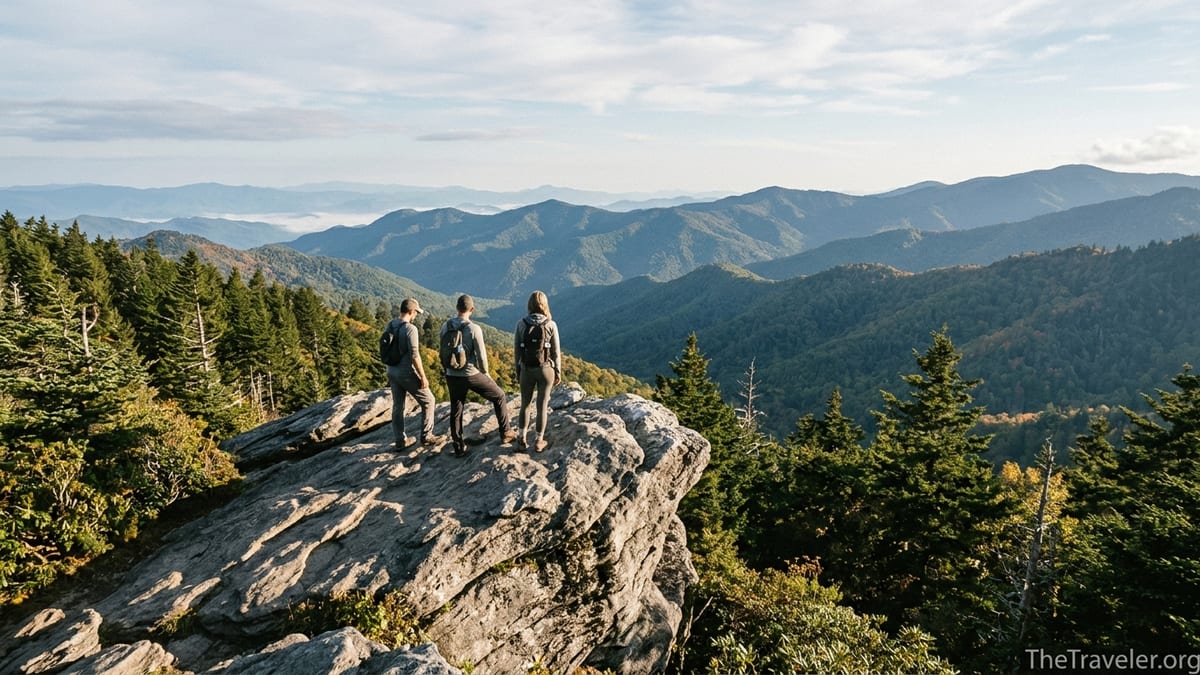
What Exactly Is Charlies Bunion?
Charlies Bunion is a rocky outcrop on the state–line ridge in the heart of Great Smoky Mountains National Park, roughly four miles east of Newfound Gap along the Appalachian Trail. The cliffy knob sits above 5,500 feet and drops steeply on several sides, creating a dramatic balcony over a sea of blue ridges. On clear days, you can pick out Mount Kephart rising to the west and the high, remote bulk of Mount Guyot to the east. The rock itself is weathered Anakeesta shale, the same crumbly, gray rock that forms the famous Chimney Tops, and it feels very different from the forested summits common elsewhere in the Appalachians.
The name is part joke, part Smokies lore. In the 1920s, outdoors writer Horace Kephart supposedly joked that a misshapen rock resembled his hiking partner Charlie Conner’s bunion, and the nickname stuck. When the Civilian Conservation Corps built this section of the Appalachian Trail in the 1930s, the new park adopted the colorful name. Today, Charlies Bunion is one of the most photographed viewpoints in the Smokies and is routinely listed by regional hiking guides as a standout day hike, especially for visitors who want a taste of the Appalachian Trail without committing to backpacking.
For practical purposes, what most visitors mean by “hiking Charlies Bunion” is the out–and–back route from Newfound Gap on Newfound Gap Road, which connects Gatlinburg, Tennessee, and Cherokee, North Carolina. This location makes the trailhead easy to fold into a one–day visit that also includes scenic overlooks and auto tours along the park’s main spine.
Because the hike follows the Appalachian Trail, it feels like a slice of a much longer journey. You share tread with thru–hikers and section hikers, pass a backcountry shelter, and trace the high ridge that continues all the way to Mount Katahdin in Maine. That sense of being briefly plugged into a legendary long–distance route is part of the appeal for many first–time visitors.
Trail Basics: Distance, Time, and Difficulty
The standard route to Charlies Bunion is approximately 8 miles round trip with about 1,600 to 1,800 feet of cumulative elevation gain, depending on which guidebook you consult. The National Park Service describes it as a strenuous day hike, and that label is fair. While there are no technical sections, the trail rolls along a high ridge, with several extended climbs on the return from Charlies Bunion back toward Newfound Gap. You are hiking between roughly 5,000 and 6,000 feet the entire time, which can feel surprisingly taxing if you are coming straight from sea level.
Most reasonably fit hikers should plan on 4.5 to 6 hours of hiking time, not counting long breaks. A common pattern looks like this: leaving Newfound Gap around 8 a.m., reaching Charlies Bunion around 10:30 or 11 a.m., lingering for photos and a trail lunch, then arriving back at the car by mid–afternoon. Faster hikers or trail runners may shave that to about four hours, while families with younger children or anyone carrying a heavy camera kit might need closer to seven.
Underfoot, the trail is typical Smokies terrain: rocky in stretches, with roots and occasional muddy patches after rain. Because the route stays high, it can hold ice and packed snow long after lower–elevation trails have dried out, particularly between December and March. In shoulder seasons, it is common to see hikers at Newfound Gap in T–shirts while rime ice coats the spruce–fir forest a short walk up the trail. Packing a light insulating layer, a rain shell, and at least 2 liters of water per person is wise, even for a summer day hike.
If you are used to short, flat strolls, the distance and elevation change on Charlies Bunion may stretch you. On the other hand, hikers who routinely do 8 to 10 mile weekend hikes in places like Shenandoah or the White Mountains will likely find this a solid but manageable effort, similar in difficulty to trails such as South Kaibab to Skeleton Point in Grand Canyon in terms of overall exertion, though with cooler temperatures and much more shade.
The Experience on the Trail and at the Viewpoint
One of the best arguments for choosing Charlies Bunion with just a day in the park is how quickly the hike leaves the road behind. From Newfound Gap, the Appalachian Trail climbs steadily through mixed hardwoods before transitioning into high–elevation spruce–fir forest. Within the first mile, distant road noise fades, replaced by the sound of wind through conifers and, in spring, the calls of warblers and thrushes. In early June, you might see white–blossomed serviceberry trees and blooming trillium; by late September, the ridges can be aflame with early fall color.
About 3 miles in, the trail passes Icewater Spring Shelter, one of the better known Appalachian Trail shelters in the park. Even if you do not need water from the spring, this is a natural place for a snack break and a glimpse into backpacking culture. In peak thru–hiker season, typically April through early May, you may see campers packing up, swapping trail stories, or adjusting their gear. For many day visitors, this quick immersion into the trail community is an unexpected highlight.
The final approach to Charlies Bunion leaves the main ridge briefly to traverse a narrow side path. Here the forest thins, and the first real views open up through the trees. The outcrop itself is compact, with room for only a handful of people at a time on the most exposed rocks. On a crystal–clear autumn afternoon, visibility can stretch for dozens of miles; layers of blue–green ridges march toward the horizon, and the saddle between Mount Kephart and the Anakeesta ridge feels close enough to trace with your finger. In contrast, on a foggy July morning you may find yourself looking into a white wall of cloud, with only hints of the drop–off below. Checking the forecast and having a flexible start time can make the difference between world–class views and a moody but limited experience.
The exposure at the overlook is real, and that is worth emphasizing if you dislike heights. There are safe places to sit back from the cliff, and many hikers enjoy the viewpoint without ever edging out onto the most dramatic rock. Families with younger children often keep a firm grip and set clear boundaries about where kids can explore. This is not a place for pets or for clambering beyond the obvious use paths; small slips here can have serious consequences.
How Charlies Bunion Compares to Other One–Day Options
Choosing Charlies Bunion for your one day in the park usually means saying no to a waterfall hike, a drive to Kuwohi (the peak formerly known as Clingmans Dome), or a trip up Alum Cave to Mount LeConte. To decide whether it is worth it, it helps to understand how the experience compares. In broad terms, Charlies Bunion is best for visitors who prioritize long–range views and the feel of a high–country ridge walk, rather than waterfalls or historic homesteads.
For example, the popular Alum Cave Trail to the shoulder of Mount LeConte is slightly shorter, around 10 to 11 miles round trip to the summit area, but significantly steeper, with more continuous climbing and narrow ledges with hand cables. It passes natural rock arches and bluff overhangs and has equally impressive views from the top, but the feel is more vertical and sustained. Many local hikers say that if you are comfortable with longer mileage and do not mind a tougher climb, LeConte via Alum Cave offers the park’s quintessential summit day hike, while Charlies Bunion is a slightly easier, more rolling introduction to high–elevation hiking.
By contrast, classic waterfall hikes such as Laurel Falls, Grotto Falls, or Rainbow Falls provide big visual payoffs for much less effort. Laurel Falls, for instance, is about 2.6 miles round trip on a mostly paved path, often completed in under two hours. These trails are ideal if your group includes toddlers, grandparents, or anyone with limited hiking experience who still wants to stretch their legs in the woods. The tradeoff is that they can feel extremely crowded in peak season, and they do not deliver the expansive ridge–top vistas that define Charlies Bunion.
If you prefer a driving tour with short walks, you might choose to spend your one day on Newfound Gap Road overlooks, the Roaring Fork Motor Nature Trail near Gatlinburg, and a quick stroll on a nature trail. In that case, Charlies Bunion may feel like too big a time and energy commitment. On the other hand, if your travel style is to pick one anchor activity and build the day around it, an 8–mile ridge hike that leaves time for a picnic and a sunset stop at an overlook can be an efficient way to experience the park’s high country.
Logistics: Getting to the Trailhead and Managing Crowds
The Charlies Bunion hike begins at Newfound Gap, a major pass on Newfound Gap Road roughly a 35– to 45–minute drive from Gatlinburg and about an hour from Cherokee, traffic and construction dependent. The parking area serves not only hikers but also general sightseers drawn to its panoramic overlook and the famous state–line sign. On busy weekends in April, summer, and October, it often fills by late morning. Arriving by 8 or 8:30 a.m. on those days typically makes parking straightforward, while a midday arrival can mean circling for a spot or waiting for others to leave.
Since March 2023 the park has required a paid parking tag for vehicles parked longer than 15 minutes, including at trailheads. As of 2026, the one–day tag is modestly priced and can be purchased online in advance or at automated kiosks at several visitor centers. For a one–day visit focused on Charlies Bunion, planning to stop at Sugarlands Visitor Center near Gatlinburg on your way in to pick up a paper trail map and your tag is a practical approach. The tag must be displayed on your dashboard, and rangers do patrol popular lots such as Newfound Gap.
Even though Newfound Gap itself can feel extremely crowded, the Appalachian Trail thins out fairly quickly. Within the first mile you may find yourself walking in relative quiet, punctuated by encounters with other hikers and backpackers. Expect more company in peak mid–day hours between Icewater Spring Shelter and Charlies Bunion than in the early morning or late afternoon. If you value a quieter summit experience, consider starting before 7:30 a.m. or leaving the trailhead after lunch and planning for an early–evening return, taking headlamps and extra layers if you choose the latter.
Weather and road conditions are also key logistical considerations. Newfound Gap Road can be temporarily closed in winter due to snow or ice, even when lower–elevation roads are clear. If you are visiting between December and early March, checking the park’s current conditions page or calling recorded road updates the morning of your hike is essential. In summer, heavy afternoon thunderstorms are common, and ridge–top trails offer little shelter from lightning. An early start to be off the most exposed stretches by mid–afternoon is the safest plan.
Who Will Love Charlies Bunion, and Who Might Skip It
Charlies Bunion is particularly rewarding for visitors who already enjoy day hikes in the 6– to 10–mile range, are excited by big mountain views, and like the idea of walking a piece of the Appalachian Trail. If you are the type of traveler who happily spends a full morning on a trail and builds the rest of your day around that outing, this hike fits naturally into a one–day Smokies itinerary. It can be especially meaningful for aspiring thru–hikers who want a first taste of the AT or for families with teens who can handle the distance and will appreciate the exposed, photogenic viewpoint.
On the other hand, if your group includes people with limited mobility, an intense fear of heights, or very young children who are not used to longer hikes, Charlies Bunion may not be the best first impression of the park. The distance is enough that turning around partway still involves several hours on your feet, and the viewpoint itself is not designed with railings or wide, graded platforms. In such cases, lower–key options like Clingmans Dome observation tower, where a short but steep paved path leads to a 360–degree view, may provide more bang for the effort and a safer environment.
Time of year matters as well. In April and early May, weather at Newfound Gap can be raw, with temperatures near freezing and occasional icy patches on the trail, even when wildflowers are blooming in the valleys. For a single–day visit in shoulder season, you may decide that a lower–elevation hike such as Porters Creek, with its mossy footbridges and rich spring ephemerals, offers a more comfortable and reliable experience. In midsummer and early fall, when the ridge is typically dry and the air clear, Charlies Bunion becomes a much more broadly appealing choice.
Your personal priorities also play a role. If you are a landscape photographer chasing sunrise or sunset light, the exposed perch and east–facing vistas of Charlies Bunion can be spectacular, but reaching it at golden hour requires hiking in the dark either in or out. That is an adventure best reserved for confident, prepared hikers with navigation tools and headlamps. Casual visitors may prefer daytime visits and more accessible overlooks closer to the road.
How to Fit Charlies Bunion Into a One–Day Smokies Itinerary
For many visitors, the most efficient way to structure a one–day trip built around Charlies Bunion is to make the hike your anchor activity in the morning and leave the afternoon for scenic driving and short stops. A sample day from Gatlinburg might look like this: leave town by 7 a.m., stop briefly at Sugarlands Visitor Center to confirm trail conditions and pick up a map, then drive Newfound Gap Road to arrive at the trailhead by 8 a.m. After a steady climb and unhurried breaks, you return to the parking lot by 2 p.m., eat a late picnic lunch at the Newfound Gap overlook, and then spend the late afternoon driving to Clingmans Dome or back toward Gatlinburg with stops at roadside pullouts.
If you are staying on the North Carolina side near Cherokee or Bryson City, you can invert that program. Start your day with early light over the Oconaluftee River, drive up to Newfound Gap for the hike, then descend to Gatlinburg for dinner before returning east. In both cases, keeping expectations realistic is important. The Smokies cover more than 500,000 acres, and trying to combine a full Charlies Bunion hike with major detours to Cades Cove or the Deep Creek waterfalls in a single day will likely leave you rushed and frustrated.
Families often find that pairing Charlies Bunion with one shorter, contrasting experience works best. That might be an evening stroll along the Gatlinburg Trail from Sugarlands Visitor Center, where you can see old stone walls and remnants of homesteads, or a leisurely drive on the Roaring Fork Motor Nature Trail with its preserved log cabins and rushing creeks. This combination gives you a high–country adventure in the morning and a lower–key taste of Smokies history in the afternoon or evening.
If you only have a few hours in the park rather than a full day, it is usually better to choose a different objective. The out–and–back nature of Charlies Bunion means you will need to turn around partway to avoid hiking out in the dark or rushing on the way back. In that case, a half–day hike such as Chimney Tops (when open), Andrews Bald, or a waterfall trail may offer a more relaxed schedule and still deliver a satisfying sampler of the park’s landscapes.
The Takeaway
So, is Charlies Bunion worth hiking if you only have one day in Great Smoky Mountains National Park? For many visitors, the answer is yes, provided that you are comfortable with an 8–mile round trip and want your limited time to revolve around a single, memorable mountain hike. The route delivers classic Smokies scenery: deep green valleys, far–reaching ridgelines, and a high–elevation spruce–fir forest that feels a world away from the busy tourist strips in Gatlinburg and Pigeon Forge. You also get the intangible bonus of walking a celebrated stretch of the Appalachian Trail and sharing the path with long–distance hikers.
That said, Charlies Bunion is not a one–size–fits–all recommendation. Visitors traveling with young children, older relatives, or anyone uneasy with drop–offs may find more enjoyment in shorter waterfall walks or accessible viewpoints like Clingmans Dome. Travelers visiting in winter or early spring, when Newfound Gap Road can be icy and weather unpredictable, may be better served with lower–elevation hikes that offer wildflowers and historic sites without the exposure of a high ridge.
If you imagine your ideal Smokies day as a long walk on a mountain spine, lunch on a rocky outcrop, and the satisfaction of tired legs by late afternoon, then Charlies Bunion is an excellent use of a one–day visit. With an early start, realistic pacing, and a flexible backup plan in case of fog or storms, this rugged little knob can easily become the defining memory of your time in the park.
FAQ
Q1. How long does the Charlies Bunion hike take for most people?
Most day hikers should plan on 4.5 to 6 hours of hiking time for the 8–mile round trip, not including longer breaks for photos or lunch at the viewpoint.
Q2. Is Charlies Bunion suitable for beginners or kids?
The hike is considered strenuous because of its distance and rolling elevation, but fit beginners and older children who are used to walking can handle it. Very young kids or anyone uncomfortable with heights may find it challenging, especially near the exposed overlook.
Q3. What is the best time of year to hike Charlies Bunion?
Late spring through fall is generally best. April and May can be chilly on the ridge, summer offers lush green views but more humidity, and late September through October often brings clear air and fall color. Winter hikes are possible but require checking road conditions and preparing for ice and cold.
Q4. Do I need a permit or pass to hike Charlies Bunion?
You do not need a separate trail permit for a day hike, but you must have a valid Great Smoky Mountains National Park parking tag if your vehicle will be parked more than 15 minutes at Newfound Gap.
Q5. How early should I arrive at Newfound Gap to find parking?
On busy weekends and holidays, aiming to arrive by about 8 a.m. usually makes parking easier. On quieter weekdays outside peak season you can often find a space later in the morning, but earlier is still better.
Q6. Is the trail to Charlies Bunion dangerous?
The trail itself is well–defined and not technical, but there are roots, rocks, and some steep drop–offs at the overlook. Staying on the main path, keeping a safe distance from the cliff edge, and avoiding wet or icy rock greatly reduce risk for most hikers.
Q7. Can I combine Charlies Bunion with another major hike in the same day?
Most visitors find that Charlies Bunion is enough of an effort to stand as the main activity of the day. You can comfortably add a short nature trail or scenic drive, but pairing it with another long hike such as Mount LeConte in the same day is usually too ambitious.
Q8. Are restrooms and water available at the trailhead?
Newfound Gap has restroom facilities, but there is no treated drinking water available at the parking area. There is a spring near Icewater Spring Shelter on the trail, but day hikers should still carry their own water or bring proper filtration if they plan to refill.
Q9. Is Charlies Bunion a good choice in bad weather?
During heavy rain, thunderstorms, or thick fog, Charlies Bunion is less rewarding and can be more hazardous because of slick rocks and reduced visibility near the cliffs. In those conditions, a lower–elevation forest or waterfall hike is usually a better option.
Q10. If I only have half a day, is Charlies Bunion still worth attempting?
With only a half day, most visitors will feel rushed trying to complete the full 8–mile hike safely. Unless your group is very fast and experienced, it is wiser to choose a shorter trail and save Charlies Bunion for a future visit when you have more time.