


More news on this day
Global aviation maps are being redrawn in real time as escalating conflict and recurring airspace shutdowns across the Middle East push airlines to route long-haul flights around, rather than through, the region’s once-dominant hub airports.
Get the latest news straight to your inbox!
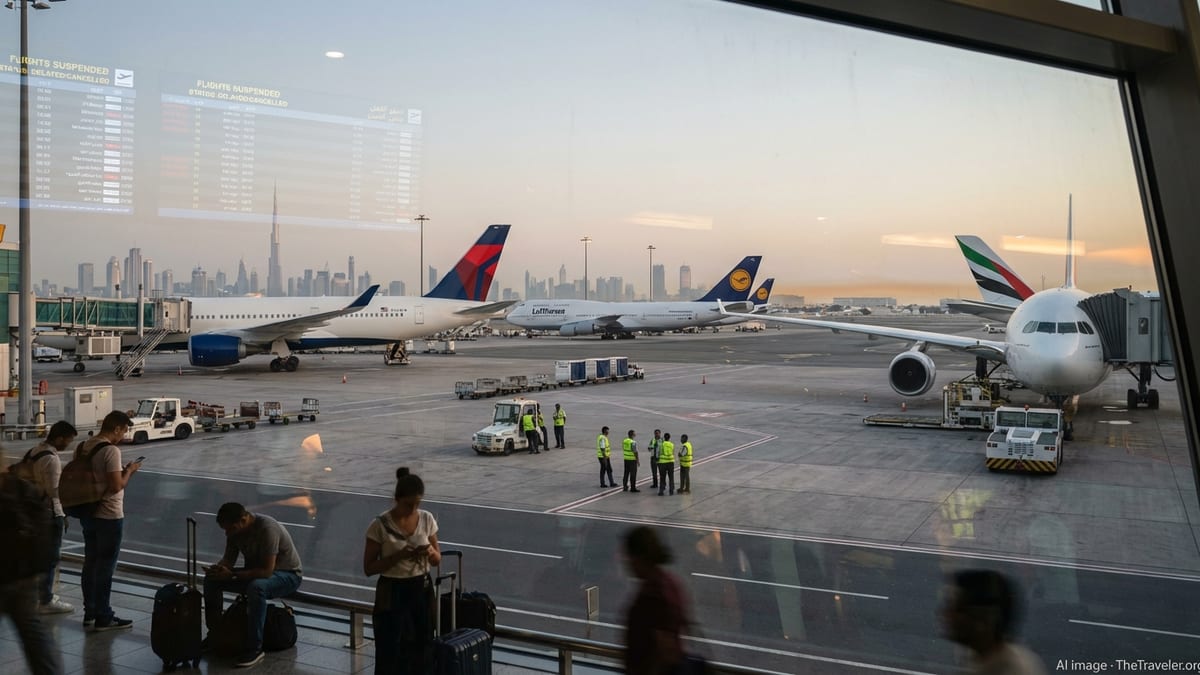
A Conflict Zone at the Heart of Global Airspace
The latest round of tensions involving Iran, Israel and the United States has turned one of the world’s busiest aviation crossroads into an unstable patchwork of no-go zones and temporary closures. Publicly available flight-tracking data shows repeated shutdowns of airspace over Iran, Iraq, Israel, Jordan and parts of the Gulf since early 2024, with renewed disruption following strikes and counterstrikes in early 2026. Each closure forces airlines to improvise new paths linking Europe, Africa and the Americas with South and East Asia.
Reports from aviation analytics firms indicate that these cascading restrictions now rival the impact of the 2022 closure of Russian airspace on Europe Asia traffic. When multiple Middle Eastern flight information regions close in quick succession, the central east west corridor effectively disappears, compelling aircraft to divert far north via Central Asia or far south via Egypt, Saudi Arabia and the Arabian Sea. Flights that would once have crossed Iraq or Iran in a straight line increasingly loop wide around the region’s most volatile airspace.
While closures are sometimes lifted within hours or days, the pattern of repeated shutdowns and advisories has altered how airlines plan routes and schedules. Safety advisories from regulators in Europe, Asia and North America have urged carriers to exercise caution over conflict zones, reinforcing a trend toward conservative routing that treats much of the central Middle East as a risk area rather than a default shortcut between continents.
Gulf Super-Hubs Lose Their Central Advantage
The rise of mega-hubs such as Dubai, Abu Dhabi and Doha over the past two decades was built on geography. Located near the midpoint between Europe and Asia, these airports captured transfer traffic by offering one-stop connections with short detours and efficient banks of departures. Recent disruptions have exposed how vulnerable that model is to regional instability when the surrounding skies become contested.
According to published coverage based on data from flight-tracking services, waves of airspace closures since 2024 have repeatedly shut or severely curtailed operations at the main airports in Dubai, Abu Dhabi and Doha. When neighboring states close their skies or when inbound missiles trigger temporary ground stops, hub operations can unravel in hours, leading to mass cancellations, aircraft stranded out of position and crews timing out across multiple continents.
Airlines using Gulf hubs have responded by rerouting around the most sensitive zones, often stretching flying times well beyond original schedules. Some carriers have pushed more Europe Asia flows onto northern tracks via Turkey, the Caucasus and Central Asia, where capacity allows. Others are favoring southern options via Saudi Arabia and Egypt when those airspaces remain open. Either way, the effect is to weaken the centrality of the Gulf super-hubs and spread connecting traffic across a wider set of waypoints.
For travelers, this means that routings which once defaulted to a middle-of-the-map connection are increasingly being replaced by itineraries through Istanbul, Riyadh, Jeddah or European and Asian hubs such as Frankfurt, Delhi or Singapore. The Gulf remains a powerful player in long-haul aviation, but its role as the unavoidable bridge between continents is now under pressure.
The Long Way Around: New Corridors and Longer Flights
As airlines seek to avoid stacked risks over Iran, Iraq and Israel, new patterns of global connectivity are emerging. Industry analyses describe two broad alternatives becoming more prominent. The first is a northern arc that leans on Turkish, Caucasus and Central Asian airspace, suitable for certain Europe to India and Southeast Asia flows when those regions are stable. The second is a southern arc that hugs Saudi, Egyptian and Red Sea corridors before turning east toward the Indian Ocean.
Both options tend to be longer than traditional direct tracks through the central Middle East. Aviation consultancies report block time increases of 30 to 90 minutes on some Europe Asia sectors, depending on the extent of airspace restrictions in place on a given day. For airlines already contending with higher fuel prices and tight aircraft availability, those extra minutes translate into higher costs per flight, compressed schedules and less slack to absorb further disruption.
The shift is also changing the hierarchy of transit points. As more traffic uses the southern route when available, major airports in Saudi Arabia and Egypt are seeing growing interest as alternative hubs or technical stops. To the north, Istanbul’s large connecting operation is well positioned to capture flows that might previously have funneled through the Gulf. Meanwhile, carriers based in India and Southeast Asia are rebalancing their schedules to rely more heavily on nonstop services to Europe or on connections through European partner hubs, bypassing Middle Eastern stops altogether.
These adjustments remain fluid, and airlines continue to tweak routings as conflict lines, regulatory advisories and commercial priorities evolve. Still, the direction of travel is clear: when risk maps for the Middle East light up, the rest of the network bends around them.
Stranded Passengers, Rising Costs and Operational Strain
The human impact of the great air bypass has been visible at airports far from the conflict zone. News reports over recent months describe hundreds of thousands of passengers stranded or diverted after sudden strikes triggered simultaneous closures of multiple Middle Eastern airspaces. With Dubai, Abu Dhabi and Doha operating at reduced capacity or temporarily halted during several recent flare-ups, travelers have found themselves held on tarmacs, rerouted mid-flight or deposited at unfamiliar airports to await new connections.
For airlines, the operational strain is significant. Rerouted flights can burn thousands of kilograms of additional fuel and may require payload restrictions on the longest sectors. Crews approaching duty-time limits sometimes need to divert to unscheduled stops, triggering knock-on delays across an airline’s network for days. Maintenance schedules, aircraft rotations and cargo commitments all become harder to manage when standard routings can no longer be assumed.
Insurance and risk-management costs are also edging higher. With regulators and safety agencies urging caution over conflict zones, carriers are under pressure to justify any decision to overfly sensitive areas. Many are choosing the more conservative and costly path, accepting longer routes as a price for reducing exposure to fast-changing security threats. That calculus is likely to reach passengers in the form of higher fares or reduced frequencies on certain long-haul routes.
Travelers are responding by seeking routings that minimize exposure to volatile airspace. Booking patterns reported by global distribution systems suggest growing interest in itineraries that avoid connections in the core Middle Eastern hubs, particularly for discretionary leisure travel. Corporate travel managers are also revising policies to steer employees away from perceived hotspots where alternative options exist.
A New Map for Global Aviation
Industry outlooks published in 2026 suggest that even if a durable ceasefire takes hold, the effects of the recent conflict on global aviation may linger. Once airlines have restructured schedules, secured new overflight permissions and shifted marketing toward alternative hubs, there is little incentive to snap back overnight to old patterns that run through recently contested skies.
Longer term, the disruptions are accelerating strategic shifts that were already under way. Major European and Asian carriers have been investing heavily in ultra-long-haul fleets that can link key city pairs nonstop, reducing dependence on intermediate hubs. At the same time, emerging transit centers in Turkey, Saudi Arabia and South Asia are positioning themselves as more stable alternatives for connecting traffic that still requires a stop.
For the big Gulf hubs, the challenge will be to reassure airlines and travelers that their operations can remain resilient even when nearby airspace is disrupted. That may involve greater investment in contingency planning, diversified routings, and closer coordination with neighboring states to keep at least some corridors open during future crises. Until that confidence is restored, the great air bypass will continue to define how much of the world flies between continents.