


More news on this day
As artificial intelligence moves from experimental tools to everyday trip planners and virtual concierges, a growing body of surveys and industry research shows that human expertise remains central to how people actually plan, book and troubleshoot travel.
Get the latest news straight to your inbox!
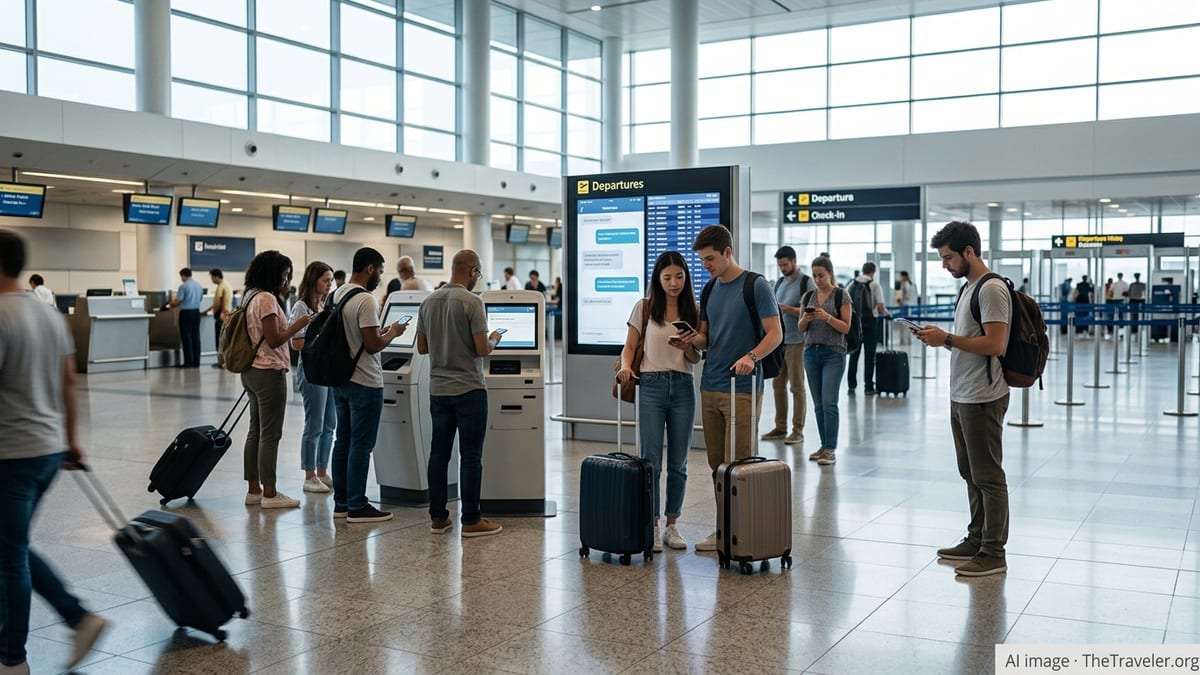
AI Becomes a Mainstream Travel Companion
AI trip planners, chat-based search and virtual customer service agents are rapidly becoming standard features across the travel sector. Industry research from McKinsey and Skift describes “agentic AI” systems that can search inventory, assemble itineraries and rebook disrupted trips with little manual input, promising faster responses and lower costs for providers worldwide.
Consumer adoption is rising alongside this investment. A survey of more than 5,700 travelers commissioned by Expedia Group found that just over half of respondents already use AI for inspiration and suggestions, and around 40 percent rely on it to help build itineraries. At the same time, nearly 70 percent said they still prefer to complete bookings with trusted brands rather than AI chatbots or standalone digital agents, underscoring a gap between experimentation and full delegation of decisions.
Other polling focused on U.S. travelers paints a similar picture. Research summarized by travel publisher Beach.com reports that Americans most often use AI to look for flights, compare attractions and outline trip ideas, while relatively few hand over full control of dates, routing and payment to automated systems. This pattern suggests that AI is emerging first as a planning companion, with human judgment retained for final calls that carry financial or safety consequences.
Industry analysts note that this gradual shift is reshaping back-office operations as well as customer-facing tools. McKinsey’s travel and logistics research highlights how AI is already helping with workforce planning, dispatch and demand forecasting, freeing human staff to focus on high-value interactions rather than repetitive tasks.
Trust, Risk and the Limits of Machine Recommendations
Despite clear efficiency gains, several recent studies highlight structural limitations in today’s generative AI systems when they are used for travel planning. Academic work on tourism-specific models and large language models points to well-documented issues such as hallucination, where a system presents invented information as fact, and algorithmic bias in how destinations and experiences are described. Separate technical surveys of language models refer to hallucination as one of the biggest obstacles to reliable deployment in real-world decision support.
These technical concerns align with traveler attitudes. A 2024 survey on AI use for summer vacation planning, published by HUMAN Security, found that while frequent travelers are far more likely to experiment with AI tools than occasional travelers, many respondents remain reluctant to let algorithms manage payments or complex, multi-stop itineraries without oversight. The same report notes that AI is earning trust first as a guide, not yet as a fully independent agent.
Concerns are not limited to factual accuracy. An OECD report on artificial intelligence and tourism warns that poorly governed recommendation systems can exacerbate overcrowding in already popular areas and sideline less-promoted destinations. Researchers examining generative AI travel planners have also documented new forms of bias in suggested cities, neighborhoods and activities, raising questions about transparency, diversity and local impact.
For individual travelers, these systemic issues translate into practical risks. A mis-specified visa requirement, an inaccurate transfer time between airports or an overlooked seasonal closure can turn an itinerary from smooth to stressful. As a result, many travelers appear to welcome AI-generated options but still look for a human expert to validate edge cases, resolve conflicts and account for personal constraints that are hard to encode in prompts.
Where Human Travel Experts Add Distinct Value
Industry white papers and customer experience studies consistently point to specific points in the travel journey where human support remains critical. A research report on transforming travel customer experience published by Sutherland Global, for example, notes that a large majority of surveyed travelers consider human interaction crucial when something goes wrong or when they face complex, high-stakes choices. Similar academic work on tourism technology finds that while travelers appreciate digital tools, they tend to prefer human agents when problems are intricate or emotionally charged.
In practice, this preference covers situations such as last-minute rerouting after a disruption, multi-generational family trips involving medical or mobility needs, and itineraries that cross multiple visa regimes or rely on non-obvious connections. Human advisors can weigh trade-offs across airlines, insurance policies and local regulations in a way that is sensitive to risk appetite, budget and personal comfort in unfamiliar environments.
Human expertise is also central to interpreting information. A model can list dozens of hotel options near a city center, but an experienced consultant understands which streets feel safe at night, how construction noise affects certain blocks and which properties are responsive when guests need flexibility. These nuanced judgments rest on lived experience, pattern recognition from prior clients and cultural fluency that current AI systems only partially replicate.
For travel brands, the same dynamic plays out inside customer service operations. Analysts describe AI-assisted call centers in which software handles repetitive verification and data retrieval while human agents focus on empathy, reassurance and problem-solving. In this configuration, AI augments the human workforce rather than replacing it, shortening resolution times while preserving the interpersonal elements that drive loyalty.
Human-in-the-Loop Models Reshape Service Design
Many travel companies are responding to these trends by redesigning their service models around human-in-the-loop AI. Consulting and technology reports describe emerging architectures where generative tools draft options, check inventory and surface potential issues, while human specialists review, adjust and approve the final plan. This approach aims to capture speed and scale without forgoing accountability.
McKinsey’s research on agentic AI in travel suggests that such hybrid setups may become the dominant pattern in the near term. According to its analysis, relatively routine processes such as simple rebookings or straightforward loyalty queries are likely candidates for higher levels of automation. More complex judgment calls, including compensation decisions, safety-sensitive routing or exceptions to standard policies, are expected to continue requiring human sign-off.
Customer-facing experimentation is already visible in products such as virtual travel agents embedded in established brands’ websites and apps. Reports from Cognizant on traveler use of AI recommend that providers start by applying AI to individual components of the journey, such as accommodation search or support chat, before expanding to fully packaged offers. This staged approach reflects both technological constraints and the need to earn traveler trust incrementally.
Workforce implications are significant. McKinsey’s workforce planning analysis for travel and logistics companies argues that AI can help match staffing more closely to demand, but emphasizes that realizing these benefits depends on retraining staff for higher-value tasks rather than simple headcount reduction. That shift, in turn, places more emphasis on soft skills, cultural competency and decision-making under uncertainty.
Balancing Automation With the Human Experience of Travel
As the technical capabilities of AI systems evolve, policymakers, researchers and industry groups are increasingly focused on how to preserve the human experience at the center of tourism. The OECD’s work on AI and tourism notes that unchecked automation can have unintended consequences for destination sustainability, local employment and market competition, and calls for frameworks that keep human oversight and responsibility in the loop.
Academic studies of generative AI in travel planning likewise underscore the importance of transparency about how suggestions are generated and the limitations of the underlying models. Experiments examining how language models frame destinations and experiences indicate that subtle differences in tone and emphasis can influence traveler choices, suggesting that clear disclosures and accessible opt-outs will be important as more platforms embed AI-powered recommendations.
For individual travelers, the near-term reality is a blended ecosystem in which AI tools help narrow options and surface possibilities, while human experts, frontline staff and local hosts provide context, care and last-resort problem solving. Surveys across markets consistently show that people are comfortable using AI as a planning aid but still seek the reassurance of human judgment when trips are complex, expensive or emotionally significant.
Viewed through this lens, the “human advantage” in the age of AI is less about competition and more about complementarity. In travel, where experiences unfold in real time and far from home, the combination of algorithmic efficiency and human empathy is emerging as the model many travelers trust most.