


First time flying into Los Cabos and not sure what to expect at the airport? Los Cabos International Airport (SJD) is the main gateway for Cabo San Lucas, San José del Cabo, and the resort corridor between them. It is busy, a bit chaotic at peak hours, and full of sales pitches, but it is also very workable when you know the layout, how transportation works, and what to ignore. This guide walks you through SJD step by step, with concrete examples of prices, timing, and real services that travelers actually use.
Get the latest updates straight to your inbox!
Getting Oriented: Where SJD Is and How the Terminals Work
Los Cabos International Airport sits just outside San José del Cabo, roughly 11 kilometers from town and about 45 minutes by road from central Cabo San Lucas, depending on traffic. Despite sometimes being called the Cabo San Lucas airport in casual conversation, SJD actually serves the whole region and handles the vast majority of tourist flights. There is a smaller Cabo San Lucas airport closer to town, but most visitors will never use it.
SJD currently operates two main passenger terminals. Terminal 1 handles domestic flights within Mexico along with some regional and low-cost international services. Terminal 2 is dedicated primarily to international flights from the United States, Canada, and Europe. If you are flying in from cities like Los Angeles, Dallas, Denver, Vancouver, or Toronto, you will almost certainly arrive at Terminal 2. If you connect from Mexico City, Tijuana, or Guadalajara, you will likely use Terminal 1.
The two terminals are separate buildings but close together, linked by sidewalks and a simple shuttle, so it is possible to walk between them if you have reason to, such as traveling with someone on a different airline. Most first-time vacationers will not need to change terminals at all. Your airline and boarding pass will clearly indicate which terminal to use, and local staff at the airport entrance will confirm you are at the right building.
Inside, both terminals are compact compared to big hubs like Mexico City or Dallas, but they can feel crowded on weekends and around midday when multiple flights arrive at once. Plan on three hours before departure for international flights during high season and at least two hours for domestic connections, especially on Saturdays when many resort changeovers happen.
Arrivals Step by Step: From Plane Door to Curb
After landing at SJD, you will disembark either via jet bridge or stairs to the tarmac, then walk into the terminal and follow the signs for immigration. Expect to stand in line anywhere from 10 minutes to nearly an hour at busy times, especially midday on Saturdays when many flights from North America arrive. Keep your passport and completed immigration form handy if your airline has provided one in flight; in some cases forms are now digital or completed at kiosks, and airport staff will direct you accordingly.
Once you clear immigration, you proceed to baggage claim. Carousels are small and sometimes crowded, but they generally move steadily. Many travelers report waiting 15 to 30 minutes for luggage at peak times. While you wait, it is a good moment to switch your phone to roaming, grab a quick restroom break, and double-check your transfer details or hotel address.
After retrieving your bags, you walk through customs. Mexico periodically uses a red-light / green-light system where you may press a button and, if it flashes red, your bags go through a spot inspection. In practice, most passengers get the green light and are waved through in seconds. Once you exit customs, you enter one of the most confusing parts of the airport for first-timers: the time-share and tour sales zone.
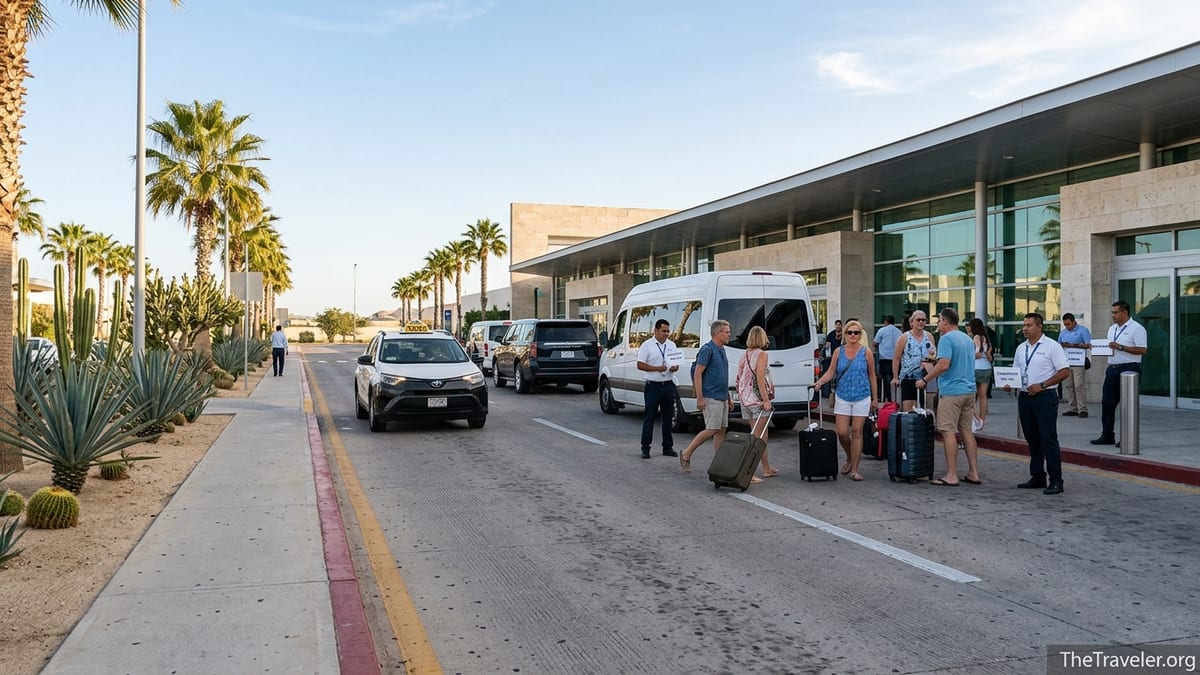
In both terminals, this interior hall is filled with desks and people in uniforms who appear official and will ask where you are staying or whether you need transportation. They are legitimate vendors, but their job is to sell timeshares, tours, and transfers that are often more expensive or less convenient than what you can arrange yourself. The simplest strategy is to walk straight through without stopping or making eye contact until you reach the sliding doors that lead outside. If you have pre-booked a transfer, your driver will not be in this hall; they will be waiting at the curb or in the designated transport zone outside with your name on a sign.
Transfers to Cabo San Lucas: Shuttles, Taxis and Private Cars
For most visitors staying in Cabo San Lucas, the big question is how to get from SJD to town, roughly a 40 to 50 minute drive away. Your three most common options are a shared shuttle, a private transfer, or an airport taxi. Prices vary by company and season, but recent examples give a realistic picture of what to expect.
Shared shuttles are the cheapest comfortable option for most travelers who do not want to navigate public buses. Several companies operate shared vans that group passengers headed to resorts along the Tourist Corridor and into Cabo San Lucas. Typical pricing falls in the range of about 20 to 30 US dollars per person one way from SJD to a hotel in downtown Cabo San Lucas or the marina area. Examples include shared shuttle services booked through well-known local operators that charge roughly 36 to 43 dollars per person round trip to Cabo San Lucas. In practice, you might pay around 22 dollars for a one-way spot on a shared van booked through a major tour platform.
Private transfers offer door-to-door service for your group only, which is particularly attractive for families or friends who do not want to make multiple resort stops. Recent rates for SJD to Cabo San Lucas hotels commonly run from about 80 to 120 dollars per vehicle one way for a standard private SUV or van, with higher-end or VIP options extending up toward 150 dollars or more depending on vehicle type and included amenities. Real traveler reports mention round-trip private transfer prices around 140 to 210 dollars for a group of four, including meet-and-greet service with a driver holding a sign just outside the terminal exit.
Authorized airport taxis, booked from official counters near the exit doors, generally sit between these two options in terms of price. You pay a regulated zone-based fare that depends on your destination. For Cabo San Lucas, it is common to see one-way taxi prices similar to or slightly below a private transfer for the same distance, often around 80 to 100 dollars per vehicle. The benefit is that you can decide after arrival and pay on the spot, but at very busy times there may be a short queue.
Transport for San José del Cabo and the Tourist Corridor
If you are staying in San José del Cabo or along the Tourist Corridor between the two towns, the logistics are a bit different and usually cheaper. San José del Cabo’s hotel zone is only 15 to 25 minutes from SJD, which reduces both travel time and cost. Shared shuttles from the airport to resorts in San José del Cabo regularly price out around the lower end of the typical range, while private transfers may fall closer to 60 to 90 dollars per vehicle, depending on distance and the company.
For example, a couple staying near the art district in San José might pay about 20 dollars each for a shared shuttle or book a private SUV for around 70 dollars one way. Travelers heading to Puerto Los Cabos, the marina area east of town, can expect similar figures and a drive time of roughly 30 minutes from the airport. These prices often include toll road usage if applicable, which shaves several minutes off the trip and offers smoother pavement than the local highway cutting through town.
Resorts in the middle of the Tourist Corridor, such as properties between Chileno Bay and Palmilla, fall in between San José and Cabo San Lucas in time and cost. From SJD, shared shuttles might be around 20 to 28 dollars per person, while private transfers for groups of four often run in the 80 to 120 dollar range round trip. Some higher-end resorts bundle airport transportation into their room or package rate, particularly at luxury developments, so it is worth checking whether your hotel already has a preferred transfer provider.
Public transportation is also an option for more adventurous or budget-focused travelers, particularly those heading to San José or the Corridor. Local buses and worker shuttles between San José del Cabo and Cabo San Lucas cost just a few dollars per ride and run frequently along the main highway. Many repeat visitors report paying roughly the price of a cup of coffee to ride the worker bus from San José to Cabo San Lucas, though buses can be crowded and lack luggage storage. This is best suited to backpackers or light packers who are comfortable with basic, sometimes standing-room-only conditions.
Taxis, Rideshare and Car Rental at SJD
Official airport taxis at SJD operate on a regulated system. Inside the arrivals area, close to the exit, you will see counters marked for taxi service. You tell the agent your destination, they quote a zone-based price, and you pay before receiving a ticket or slip that you then present outside to a dispatcher who assigns your vehicle. This approach avoids negotiation and provides a printed receipt, which many visitors prefer to haggling with curbside drivers. Do not be surprised if the quote to Cabo San Lucas is near or above 80 dollars; the distance and zone pricing make taxis significantly more expensive than they might be in a typical city.
Rideshare services have a complicated presence at SJD. Apps similar to Uber operate in Los Cabos, and many visitors use them successfully within Cabo San Lucas and San José del Cabo for getting to restaurants, beaches, or nightlife. However, using rideshare directly from the airport curb is often restricted or discouraged, and official airport regulations favor licensed taxis and transfer companies. Travelers who try to use rideshare from SJD commonly walk a short distance away from the terminal, sometimes to a nearby convenience store or along the access road, to meet their driver. This situation can change, so treat rideshare as a flexible backup rather than your only plan for leaving the airport.
Car rental is widely available at SJD, with major international brands and local agencies represented. Some companies have desks inside the terminal and shuttle you a few minutes away to pick up your vehicle. Others maintain lots across the highway and send small vans to collect passengers. When renting a car in Mexico, the main surprise for many travelers is the cost of mandatory insurance. While base rates can look low online, once you add required liability coverage and reasonable additional protection, the price often doubles or more. It is common to see weekly quotes that jump from 150 to 300 or 350 dollars at the counter.
Because of this, renting a car makes the most sense if you plan to explore beyond your resort: day trips to Todos Santos or La Paz, surf breaks up the coast, or multiple restaurant and beach outings beyond walking distance. If you mostly intend to stay at one resort with just one or two excursions, a mix of airport transfer and local taxis or rideshare usually works out cheaper and less stressful than driving yourself on unfamiliar roads.
Departures: Security, Timeframes and Airport Facilities
Departing from SJD is generally straightforward but can be slow when many flights leave around the same time. For international flights back to the United States or Canada, aim to arrive at least three hours before departure, especially on Saturdays and during holiday periods. For domestic flights within Mexico, two hours is usually sufficient, though if you are connecting to an international leg the same day, you may want extra cushion.
At the terminal entrance, security staff may briefly check your itinerary or ask which airline you are flying to direct you to the correct check-in area. Once you have checked bags and obtained boarding passes, you pass through security screening with carry-on luggage and then enter the departures concourse. Lines at security ebb and flow; sometimes you clear in 10 minutes, while at other times you may stand for half an hour or longer. Keeping liquids organized and laptops easily accessible speeds things up.
Inside the secure area at both terminals, you will find a mix of duty-free shops, souvenir stores, and food outlets. Options range from sit-down restaurants serving tacos and seafood to quick-service stands offering sandwiches, coffee, and pastries. Prices are higher than in town but not dramatically more than many North American airports. A typical coffee drink might run the equivalent of 3 to 5 dollars, while a simple meal could be 10 to 20 dollars per person. There are also small convenience-style shops selling snacks, water, sunscreen, and last-minute gifts like tequila and artisanal crafts.
For those who value extra comfort, airline lounges and independent lounges operate in Terminal 2, accessible with business-class tickets, certain credit cards, or paid day passes. They offer quieter seating, complimentary drinks, and light food. If your shared shuttle drops you off four hours before your flight and you anticipate a wait, budgeting for lounge access can make the time more pleasant, especially in peak afternoon heat.
First-Time Cabo Tips: Money, Safety and Common Mistakes
One of the most common first-time mistakes at SJD is stopping in the interior sales zone and accepting help from the first person who calls out to you. While these individuals are not scammers in the classic sense, they are sales representatives whose goal is to sign you up for a timeshare presentation, tours, or transportation packages that often come with strings attached. The simplest, safest strategy is to decline politely and keep walking until you are outside in the fresh air. Once you are curbside, it is much easier to think clearly and find your pre-booked driver or the official taxi desk.
Another frequent misstep is not arranging transportation in advance for late-night arrivals. While taxis and some transfer companies operate into the evening, the choice narrows after dark and last-minute prices can be higher. If you land after 9 p.m., especially on a weekday outside high season, having a confirmed private transfer or hotel shuttle waiting for you avoids unnecessary stress. Many visitors book online with established operators before departure and receive clear instructions to meet their driver just beyond the sliding doors, where they will be holding a sign with the passenger’s name.
In terms of money, many transfer services quote prices in US dollars and accept card payment in advance. At the airport, you will also see ATMs that dispense pesos, which are useful for tips and smaller purchases. It is generally better to withdraw cash from bank-branded machines inside the terminal than to use currency exchange kiosks that may offer weaker rates. Plan to tip drivers in pesos or dollars depending on what you have on hand; small denominations such as 50 to 100 pesos or a few dollars per person are appreciated for shared shuttles, while 5 to 10 dollars is appropriate for a private transfer to Cabo San Lucas with luggage handling.
For safety, SJD and the main highway routes to San José del Cabo and Cabo San Lucas are well-traveled and heavily used by tourists and resort staff. Authorized transport operators are licensed and insured, and the majority of trips are uneventful. As with any busy airport, keep your bag zipped, avoid leaving belongings unattended, and confirm that any driver who approaches you matches the name and company details in your booking. If something feels off, step back inside the terminal and speak with airport staff or choose a clearly marked taxi from the official stands.
The Takeaway
Arriving at Los Cabos International Airport for the first time can feel hectic, but it becomes much easier when you understand the basic layout, know that there are two main terminals, and expect the sales-focused arrivals hall just after customs. Plan ahead for how you will get from the airport to your hotel, whether that is a shared shuttle to a Cabo San Lucas resort, a private SUV to a San José del Cabo boutique property, or an official taxi booked at the counter for a last-minute decision.
Use realistic price expectations to guide your choice: around 20 to 30 dollars per person for shared shuttles, roughly 80 to 120 dollars per private vehicle to Cabo San Lucas, and taxi pricing that is set by zone rather than by meter. If you need a rental car, factor in the cost of mandatory insurance and decide whether you will truly use the vehicle enough to justify it. Above all, walk straight past the interior gauntlet of pitches after customs, step outside to find your transport, and give yourself enough time on departure day to navigate check-in and security without rushing.
With these practical details in mind, SJD becomes a manageable first stop rather than a source of confusion. Once you are out of the terminal and on the highway, the Sea of Cortez views, desert landscapes, and resort-lined coastline quickly replace the airport bustle, and your Cabo vacation can properly begin.
FAQ
Q1. Which terminal will I use when flying into Los Cabos (SJD)?
Most international flights from the United States and Canada use Terminal 2, while domestic Mexican flights and some regional routes use Terminal 1. Your airline and boarding pass will indicate the correct terminal.
Q2. How long does it take to get from SJD to Cabo San Lucas?
The drive from Los Cabos International Airport to central Cabo San Lucas typically takes 40 to 50 minutes by car or shuttle, depending on traffic and whether your vehicle uses the toll road or the regular highway.
Q3. What is the typical cost of a shared shuttle from SJD to Cabo San Lucas?
Recent examples show shared shuttle prices in the range of about 20 to 30 US dollars per person one way, or roughly 36 to 43 dollars per person for a round trip booked in advance to Cabo San Lucas resorts.
Q4. How much should I expect to pay for a private transfer from SJD?
For a standard private SUV or van from SJD to Cabo San Lucas, expect around 80 to 120 dollars per vehicle one way, with round-trip and VIP options costing more. Trips to San José del Cabo are usually a bit cheaper because the distance is shorter.
Q5. Are taxis at SJD metered or fixed price?
Airport taxis at SJD operate on fixed zone-based pricing rather than meters. You pay at an official counter inside the terminal based on your destination, then receive a ticket for a licensed taxi outside.
Q6. Can I use rideshare apps like Uber at Los Cabos Airport?
Rideshare services are widely used within Cabo San Lucas and San José del Cabo, but direct pickups at the airport curb are often restricted. Many travelers walk a short distance away from the terminal to meet rideshare drivers, so it is best to have a backup plan such as a pre-booked shuttle.
Q7. Is it worth renting a car at SJD for my Cabo trip?
Renting a car is worthwhile if you plan multiple day trips or want maximum independence, but mandatory insurance can raise the total cost significantly. If you mostly stay at one resort with a few excursions, pre-arranged transfers plus local taxis or rideshare usually work out simpler and often cheaper.
Q8. How early should I arrive at SJD for my departing flight?
For international flights back to the United States or Canada, plan to arrive about three hours before departure. For domestic flights within Mexico, two hours is typically sufficient, though extra time is wise on busy Saturdays and during holidays.
Q9. What should I do about the timeshare and tour sellers in the arrivals hall?
After customs you walk through a hall full of sales desks and staff offering help and “free” activities. They are legitimate but focused on selling timeshares and tours. The easiest approach is to decline politely and continue walking until you reach the exit doors to meet your pre-booked transport or find the official taxi area.
Q10. Do I need pesos at the airport, or can I use US dollars?
Many transfer companies quote prices in US dollars and accept cards or cash in dollars, and some shops also take dollars. However, having pesos is useful for tips, snacks, and small purchases, so using an ATM inside the terminal to withdraw pesos at the start of your trip is a practical idea.