


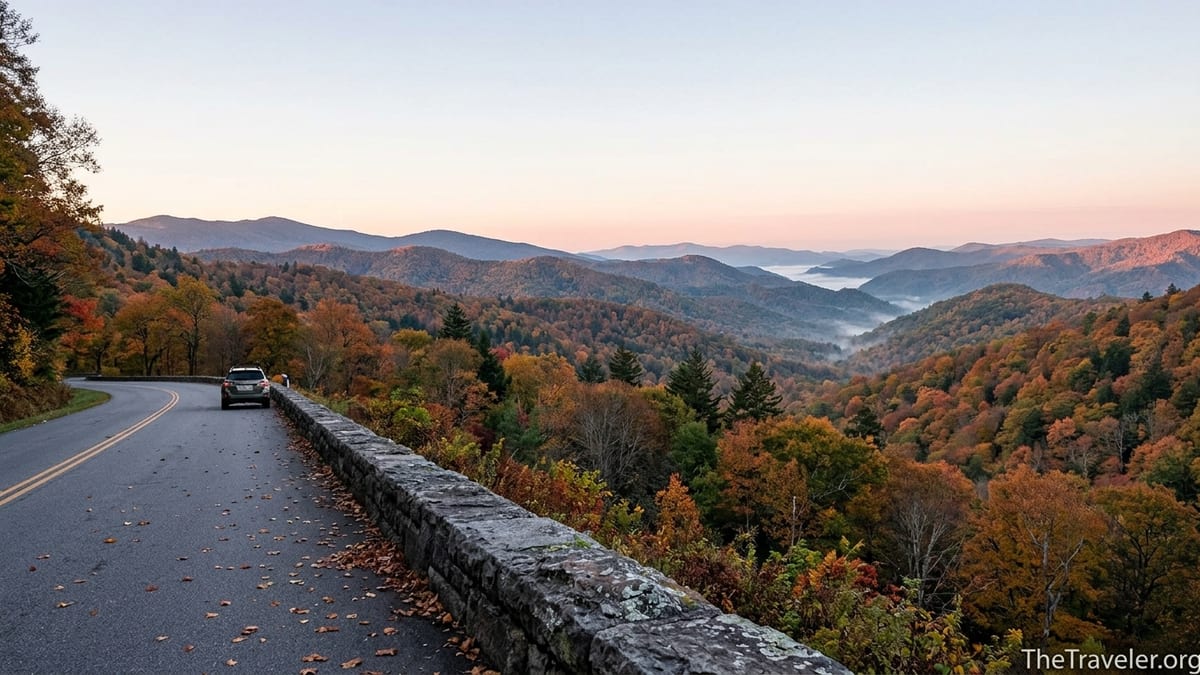
Newfound Gap Road is the classic Smokies drive: 31 winding miles over the crest of the Great Smoky Mountains, connecting Gatlinburg, Tennessee, with Cherokee, North Carolina. In fall, its ridgelines catch the first light over bands of red maples, golden birch, and lingering green spruce. Time it right and you can watch sunrise from a quiet overlook, then descend through glowing tunnels of color long before the tour buses arrive. This guide breaks down, step by step, how to plan a sunrise Newfound Gap Road drive in autumn that balances peak foliage, minimal traffic, and realistic logistics.
Get the latest updates straight to your inbox!
Why Newfound Gap Road Is One of the Best Sunrise Drives in the Smokies
Newfound Gap Road, the stretch of US 441 that crosses Great Smoky Mountains National Park between Gatlinburg and Cherokee, climbs to roughly 5,046 feet at Newfound Gap, the lowest drivable pass over the main Smokies crest. That elevation jump means you can move quickly between different climate zones, and in fall that translates into a long gradient of color. Mid-October often brings oranges and reds to the higher ridges while the lower coves are still green, so a single sunrise-to-late-morning drive can feel like traveling through multiple seasons.
Unlike short spur roads, Newfound Gap Road is a genuine cross-mountain traverse. The western side passes the Sugarlands Visitor Center and Chimneys Picnic Area, while the eastern slope rolls past the Oconaluftee Visitor Center and elk-filled meadows near Cherokee. With dozens of pullouts and formal overlooks, it offers both big-sky sunrise vistas and intimate side-hill views of the forest. Because the park is open 24 hours a day, you can legally be on the road well before first light, as long as weather and temporary closures allow.
In practical terms, Newfound Gap Road tends to be less of a "one-view-and-done" experience and more of a fluid drive where you can adapt to cloud cover, crowds, or fog. If Newfound Gap itself is socked in at dawn, you can usually find clearer conditions a few hundred feet lower. That flexibility is essential in autumn, when temperature inversions and fast-changing mountain weather can turn a perfectly clear forecast into ground-hugging mist.
Finally, the road is a rare example of high-elevation infrastructure in the region that is usually maintained year-round, weather permitting. Primary routes like Newfound Gap Road, Little River Road, and the Cades Cove Loop are top plowing priorities, so fall visitors typically only encounter closures during early snow or ice events. That reliability is a major advantage if you are planning a trip from out of state and can’t easily shift travel dates.
Choosing the Right Week: Foliage Timing and Crowd Patterns
Fall color in the Smokies is famously staggered by elevation. High ridges near Newfound Gap can see their first color shifts from late September, with more consistent reds and golds through much of October, and lingering pockets into early November depending on weather. Because year-to-year conditions vary, it is safest to think in terms of ranges rather than exact dates: early to mid-October for strong high-elevation color and mid- to late October for a broader mix of hues down the slopes.
If your goal is both sunrise and fewer crowds, you will want to balance foliage timing against visitor surges. October weekends are some of the busiest days of the year in Great Smoky Mountains National Park, and Newfound Gap can feel like a small parking lot village by late morning on Saturdays. Aim for weekdays whenever possible, especially Tuesday through Thursday. For example, a three-night stay from a Monday to Thursday in mid-October often means noticeably easier parking and less congestion at overlooks compared with a Thursday to Sunday stay.
School schedules and regional events also play a role. Fall break weeks for districts in Tennessee, North Carolina, Georgia, and Alabama can significantly spike traffic. Many families book cabins around Gatlinburg or Pigeon Forge and drive Newfound Gap Road as an all-day leaf-peeping outing. To sidestep that wave, consider the very beginning of October or the narrow window between Halloween and early November, when higher elevations can still hold good color but crowds are starting to thin, especially if the weather turns cool.
Because foliage "peak" is a moving target, use real-world signs rather than just prediction maps. In the week before your trip, check recent photos from local outfitters, lodges, and photographers based in Gatlinburg, Cherokee, and Bryson City. Many post daily or weekly images of Newfound Gap, the Oconaluftee Valley, and the higher ridges. Comparing shots over a few days will give you a better sense of whether color is ramping up or already past its best at the elevations you care about.
Where to Stay the Night Before: Positioning for an Easy Pre-dawn Start
For a sunrise drive, where you sleep the night before is as important as your camera. Staying within 20 to 30 minutes of one of the park entrances can mean an extra hour of rest and far less stress in the dark. On the Tennessee side, Gatlinburg and the Spur corridor between Gatlinburg and Pigeon Forge are the most convenient. Midrange hotels and motels in south Gatlinburg often advertise driving times of 5 to 10 minutes to the park boundary and about 25 to 35 minutes to Newfound Gap in normal traffic, which is realistic in the pre-dawn hours of a weekday.
Travelers who prefer cabins often look at properties in Chalet Village or along Ski Mountain Road. These rentals sit above Gatlinburg with partial mountain views and typically add 10 to 15 minutes of steep, winding residential roads to your morning drive. If you like the idea of walking out to a private hot tub after your sunrise run, choosing a cabin with easy access to US 441 can be worth the higher nightly rate, which in October can range widely from around 200 to 400 dollars per night depending on size and amenities.
On the North Carolina side, Cherokee is the logical base. Modest motels and casino-adjacent hotels along US 441 put you about 15 to 20 minutes from the Oconaluftee Visitor Center and around 40 minutes from Newfound Gap, again assuming light traffic. For a quieter small-town feel, Bryson City is another option, roughly 45 to 60 minutes from the Oconaluftee entrance depending on where you stay. That can work if you plan a more leisurely sunrise closer to the valley rather than at the gap itself.
Whichever side you choose, focus on practical details. Look for accommodations that offer 24-hour front desk access or keyless self-check-in so you can arrive late the evening before without stress. Verify whether you have a guaranteed parking spot on-site; in dense parts of Gatlinburg, relying on public garages can add 10 to 15 minutes of early-morning walking you might not want. And confirm if breakfast is included or if you will need to bring simple pre-dawn snacks like granola bars, fruit, and coffee from a gas station the night before.
Timing Sunrise: Drive Times, Parking Strategy, and Alternate Viewpoints
Newfound Gap itself is the most popular sunrise viewpoint on the road, with a broad parking area, stone overlook walls, and open views east and west over a sea of ridges. In fall, the lot can fill surprisingly early on clear weekend mornings. To give yourself both a parking buffer and time to walk around and adjust to the light, aim to arrive 45 to 60 minutes before official sunrise. From central Gatlinburg, that means leaving about 75 to 90 minutes before sunrise; from Cherokee, plan about 80 to 100 minutes, building in extra time for potential fog, slow drivers, or construction-related delays.
If Newfound Gap parking is full when you arrive, do not circle endlessly. Several pullouts within a mile or two in either direction offer excellent sunrise angles with far fewer people. For example, smaller paved overlooks just north of the gap facing toward Mount Le Conte can deliver delicate first light raking across the higher Tennessee ridges. To the south, pullouts on the Carolina side often see less foot traffic at dawn but still frame layered ridges catching the orange glow of the sun.
In some conditions, a slightly lower elevation viewpoint will actually outperform Newfound Gap. On chilly autumn mornings, temperature inversions can trap fog in the valleys while the ridges remain clear. If you encounter dense fog near the state line, consider dropping a few hundred feet to an overlook where you can watch the rolling cloud deck like a white ocean beneath the colored hills. Even simple gravel turnouts that are not signed overlooks can be magical if you park safely and stay completely off the travel lane.
Once the sun is up and the main wave of Newfound Gap sunrise watchers starts to disperse, resist the urge to bolt straight back to town. Instead, drive five to seven miles in each direction, pulling over where the forest light looks particularly good. Sharp curves lined with flame-colored sugar maples or long, gently descending stretches flanked by yellow birch make for beautiful, quieter photo stops between 8 and 10 a.m., before the late-morning sightseeing traffic stacks up.
Navigating Park Rules, Parking Tags, and Safety in the Dark
Great Smoky Mountains National Park is open 24 hours, but that does not mean you can park anywhere at any time without planning. Since the introduction of the park-wide parking tag system, any vehicle parked within the park for more than a very brief stop is required to display a valid tag. Short sunrise photo breaks at overlooks generally count as parking, so you should budget for the modest daily or weekly tag fee and purchase your tag in advance online or at a visitor center or automated kiosk the day before your drive.
US 441 through the park is one of the primary roads that officials strive to keep open year-round, but closures can occur in fall because of early snow, ice, or high winds at elevation. The park service posts day-of road status updates through its official channels, including recorded phone lines and social media. On the evening before your sunrise run, and again before you leave your accommodation, check the latest road report specifically for Newfound Gap Road; you will occasionally see early-morning closure notices that would otherwise catch you by surprise in the dark.
Driving before dawn on a twisting mountain road requires a conservative mindset. Black bears, deer, and wild turkeys regularly cross Newfound Gap Road in low light, especially in quieter shoulder hours. Drive at or below the posted speed limit, use low beams in fog, and pull into designated paved turnouts to let faster locals or service vehicles pass. If you are renting a car, double-check the headlights and defrosters the night before. In late October, frosty windshields at higher elevations are common even when the valleys feel mild.
Even on dry mornings, several hairpin curves on both sides of the gap can surprise drivers who are distracted by the scenery or their navigation app. Keep mobile devices stowed unless you are safely parked, and rely on a downloaded offline map because cell coverage is intermittent along the crest. Simple practical steps like wearing a headlamp when getting in and out of the car at dark overlooks, carrying a small flashlight, and dressing in reflective or light-colored outer layers can make you much more visible to other early arrivals.
Building the Perfect Sunrise-to-Late-Morning Itinerary
One effective way to experience Newfound Gap Road in fall without feeling rushed is to envision the morning in distinct phases: pre-dawn ascent, sunrise viewing, mid-morning descent, and a late-morning stop at a visitor center or short trail. For instance, a traveler staying in central Gatlinburg might leave town around 5:45 a.m. for a 7 a.m. sunrise, allowing about 30 minutes to drive from their hotel to the park boundary and up the curving grade to Newfound Gap with a buffer for slow-moving traffic or photo-tempting early glow in the sky.
After 45 to 60 minutes of sunrise viewing and photography at Newfound Gap or a nearby overlook, shift into a leisurely exploratory drive. If skies are clear, you might continue south toward Cherokee, stopping at a handful of turnouts and potentially detouring up Clingmans Dome Road later in the morning if the seasonal road is still open and conditions are dry. If clouds have rolled in, you may find that light filtering through fog lower on the slopes makes for more atmospheric images and solitude than the open ridges.
By mid- to late morning, plan a restorative break at either Sugarlands Visitor Center on the Gatlinburg side or Oconaluftee Visitor Center on the Cherokee side. Both usually open in the 8 to 9 a.m. range during the main season and offer restrooms, exhibits, and rangers who can advise on that day’s trail conditions and crowd levels. On the North Carolina side, the open meadows near Oconaluftee are also one of the most reliable places to see elk, especially in the cool hours after sunrise during fall rut.
From there, you can decide whether to extend your day with a hike, head back to town for brunch, or connect this outing with another scenic drive. Many visitors pair a Newfound Gap sunrise with an afternoon loop on the Foothills Parkway or a visit to the Roaring Fork Motor Nature Trail. Just remember that midafternoon traffic on main park roads and in Gatlinburg can become extremely slow on peak fall weekends, so a late lunch and an early return to your accommodation can be a more relaxing choice.
Gear, Clothing, and Photography Tips for Cold, Colorful Mornings
Temperatures at Newfound Gap can be 10 to 20 degrees Fahrenheit cooler than in Gatlinburg or Cherokee, especially before sunrise. On a late-October morning, that can mean valley temperatures in the upper 40s but mid-30s at the gap, sometimes with a stiff breeze. Pack in layers: a moisture-wicking base, a warm midlayer such as a fleece or light puffy jacket, a wind-resistant shell, and a hat and gloves you do not mind handling camera gear with. Even if you only plan to be out of the car briefly, standing still at a stone wall for 30 minutes of changing light can chill you quickly.
Footwear matters, too. Many visitors step out in street sneakers or sandals and quickly regret it on frosty pavement. Light hiking shoes or boots with good tread are ideal, especially if you decide to walk short sections of the Appalachian Trail from Newfound Gap or explore uneven ground at pullouts. Keep a small bag in the car with extra socks, a thermos of hot coffee or tea, and energy-dense snacks like trail mix or nut butter packets so you do not need to hunt for breakfast in town before your drive.
For photography, even casual smartphone shooters should think in terms of stability and simple composition. A compact travel tripod or a clamp that lets you secure your phone to the stone wall frees your hands to add layers or hold a hot drink while your device captures a time-lapse of the evolving colors. More advanced photographers might bring a DSLR or mirrorless camera with a wide-to-normal zoom lens in the 16 to 35 mm or 24 to 70 mm range. A moderate aperture, around f/8, typically gives enough depth of field to keep the layered ridges sharp while maintaining reasonable shutter speeds in low light.
Polarizing filters can deepen blue skies and cut haze once the sun is higher, but use them sparingly at sunrise, when they can create uneven dark bands in the sky if the sun is off to one side. Bracketing exposures or using your camera’s built-in HDR mode is useful in the high-contrast moments when the sun first breaks the horizon and the valleys remain shadowed. Most importantly, resist the impulse to chase every scenic turnout. Choose a few key spots, spend real time noticing how the light and fog shift, and savor the quiet that you woke up early to find.
The Takeaway
Planning a near-perfect Newfound Gap Road sunrise drive in fall is less about secret spots and more about thoughtful logistics. Base yourself close enough to an entrance that pre-dawn driving feels manageable. Choose a weekday in a flexible window of October or early November, and keep a close eye on real-world foliage reports rather than fixating on exact peak predictions. Purchase your parking tag ahead of time, double-check road conditions the evening before, and build in comfortable buffers for driving in the dark.
On the morning itself, give Newfound Gap a chance, but do not hesitate to adapt. If the parking lot is overflowing or fog hides the view, pull into one of the quieter nearby overlooks and let the changing light guide your next move. Dress for the colder ridge-top air, pack simple comforts like a thermos and gloves, and drive with a patient, safety-first mindset. The reward is a string of moments that feel worlds away from the crowds that swell the same road later in the day: first light over silent ridges, leaves glowing from within, and the feeling that, for an hour or two, the Smokies belong almost entirely to you.
FAQ
Q1. What time should I leave Gatlinburg or Cherokee for a Newfound Gap sunrise in fall? Plan to arrive at Newfound Gap 45 to 60 minutes before official sunrise, and allow 45 to 60 minutes of driving from Gatlinburg or Cherokee, plus a small buffer for slow traffic, fog, or unexpected photo stops.
Q2. Do I really need a parking tag for short sunrise stops at overlooks? Yes. The park’s parking tag requirement applies whenever you park in most designated areas, including overlooks, so purchase a daily or longer-duration tag before your sunrise drive and display it clearly in your vehicle.
Q3. Which side is better for a sunrise start, Gatlinburg or Cherokee? Both work well, but Gatlinburg has a denser range of lodging within a short drive of the park boundary, while Cherokee offers quieter access and easier connections to Oconaluftee Valley and elk viewing after sunrise.
Q4. What happens if Newfound Gap Road is closed by weather on my chosen morning? If Newfound Gap Road closes due to snow, ice, or high winds, you will need to delay or reroute your plans. Check the park’s official road status channels the evening before and again before leaving your accommodation so you can pivot to lower-elevation drives if needed.
Q5. Is it safe to drive Newfound Gap Road before dawn in the fall? It can be safe if you drive conservatively: keep your speed down, use headlights properly, watch for wildlife, avoid distractions, and pull into paved turnouts to let faster vehicles pass. If conditions feel beyond your comfort level, there is no shame in turning back.
Q6. How cold will it be at Newfound Gap at sunrise compared to the towns? Temperatures at Newfound Gap are often 10 to 20 degrees Fahrenheit cooler than in Gatlinburg or Cherokee, especially before sunrise. Always prepare with extra layers, a warm hat, and gloves, even if the valleys feel mild the night before.
Q7. Are there restrooms available early in the morning along Newfound Gap Road? Restrooms at visitor centers and some picnic areas operate on posted schedules that usually do not match pre-dawn hours. Expect to rely on facilities in town before you depart and plan to use park restrooms later in the morning once they open.
Q8. Can I combine a Newfound Gap sunrise with a short hike the same morning? Yes. Many travelers watch sunrise at or near Newfound Gap and then take a short walk along the Appalachian Trail, or drive to nearby trailheads such as those around Clingmans Dome Road if it is open and conditions are favorable.
Q9. Will I have cell service along Newfound Gap Road if I need navigation or updates? Cell coverage along Newfound Gap Road is patchy, with some stretches having weak or no signal. Download offline maps ahead of time and do not rely on receiving real-time updates while you are on the crest of the mountains.
Q10. How can I avoid the biggest crowds on my fall sunrise drive? Choose a weekday over a weekend, aim for earlier in October or the period just after Halloween, arrive well before sunrise, and be willing to use smaller nearby pullouts instead of only Newfound Gap’s main parking area when it looks crowded.