


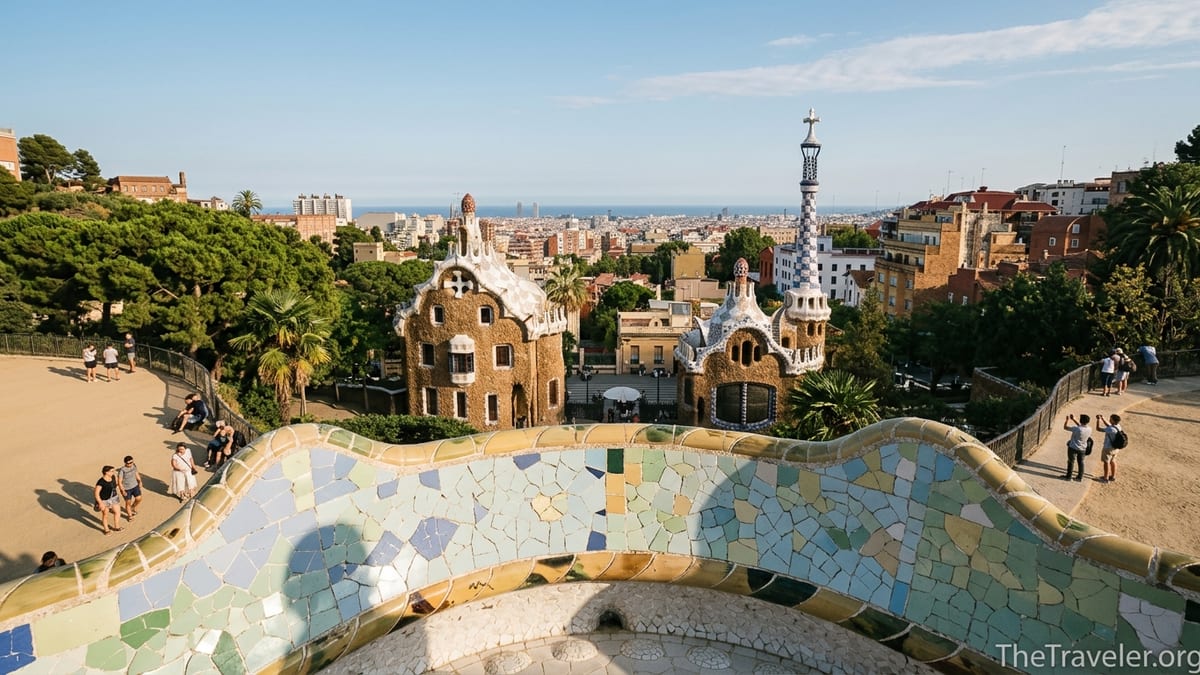
I thought I knew Park Güell long before I finally walked through its gates. Like many travelers, my mental image was a single view: the tiled serpentine bench curling around a terrace, a gingerbread gatehouse in the foreground, and the Sagrada Família in the distance. It was only when I actually climbed the hill, missed a turn, doubled back through a pine grove, and realized I was still inside the park that the truth hit me. The thing that surprised me most about Park Güell was its scale.
Get the latest updates straight to your inbox!
Park Güell Is Not Just a Terrace, It Is a Hillside District
Most visitors arrive expecting a compact monument, something the size of a city square. In reality, Park Güell spreads across a large swath of Carmel Hill on the northern edge of Barcelona, with the official site describing more than a dozen hectares of regulated monumental area embedded in a wider green zone. The uphill paths, forested margins, and multiple viewpoints make it feel less like a single attraction and more like a small, self-contained district built around Gaudí’s ideas.
You notice the scale even before you enter. Approach from the Alfons X metro station and the dedicated shuttle, and you see the park stretching above the low-rise Gràcia and Horta-Guinardó neighborhoods. Come by city bus on the 24 or V19 routes, now reinforced to handle visitor pressure, and you are dropped on a ridge road with entrances that seem far apart from each other. On a map they are just a few hundred meters apart. On the ground, especially in summer heat, each of those meters feels very real.
Once you pass the famous main gate at Carrer d’Olot, the park keeps expanding. Beyond the postcard staircase and the crowded lizard fountain, paths fan out underneath stone viaducts, spiral up dusty slopes between pines, and lead to largely unphotographed corners of the site. I remember turning away from the terrace, expecting to loop back to the exit in five minutes, and instead spending nearly half an hour wandering through colonnades and woodland before I reached another gate.
The numbers help to explain the feeling. In recent years the city has reported around 4.4 million people entering annually on timed tickets, while also capping hourly entries to protect the 12-hectare monumental core from the kind of overcrowding it once suffered. Standing on one of the upper panoramic paths, watching a continuous ribbon of people climbing through a landscape this large, it becomes clear how big Park Güell has to be to absorb that many visitors and still leave room for the squirrels and swallows that share the hillside.
The Monumental Zone Is Only the Beginning
Part of what makes the park’s scale so surprising is that the best-known images represent only a fraction of it. The monumental zone, the portion that requires a paid ticket and timed entry, contains the staircase, the mosaic dragon, the Hypostyle Hall with its forest of columns, and the tiled terrace with that famous undulating bench. All these are tucked into the lower slope, quite close together, which can create a false impression of compactness.
Walk a few minutes uphill and the mood changes completely. The neat mosaics and sculpted balustrades give way to rough stone viaducts, stepped dirt paths, and patches of Mediterranean scrub. This upper area, partly outside the ticketed perimeter, is where local runners cut through on early morning circuits and dog walkers choose quiet loops before the tour groups arrive. The contrast between the manicured monumental area and the more informal woodland accentuates the sense that you are moving through distinct zones inside one very large park.
On my own visit, I entered with a mid-morning ticket priced in the low double digits in euros, typical of recent years. For the first hour I felt hemmed in by tour groups clustering under the Hypostyle Hall ceiling to photograph its tiled medallions. Once I climbed away from the terrace, though, I found myself on a nearly empty path between tall agaves, with only a view of the sea to keep me company. The idea that this quiet hillside and that crowded staircase were part of the same space, governed by the same entry ticket, was a lesson in how layered Park Güell really is.
That layering shapes how time behaves inside the park. Many people budget just ninety minutes because that is how long they imagine a single terrace and staircase will hold their attention. In practice, by the time you have explored the monumental core, taken in the views from the higher cross at the Turó de les Tres Creus, and wound back down via one of the side paths, two to three hours can disappear almost without noticing. The park’s real scale is measured as much in time as in hectares.
Gaudí Designed for a Whole Garden City, Not a Photo Spot
The sheer size of Park Güell makes more sense when you remember that it was conceived not as an attraction but as a full residential garden city. Around 1900, Eusebi Güell commissioned Antoni Gaudí to plan an English-style hillside development of more than sixty houses spread over this terrain, connected by sweeping viaducts and framed by generous communal green spaces. Only a handful of homes were ever built, but the infrastructure and landscape for a much larger project were largely completed.
As you climb through the park, the imprint of that unfinished city is everywhere. The monumental staircase and its dragon were meant to welcome residents as much as guests. The Hypostyle Hall, now echoing with tour groups, was intended to function as a market hall for a living community above. The viaducts circling the slopes, with their cleverly integrated stone columns, were designed wide enough for carriages. When you stand beneath them, looking up at a tourist bus inching along the outer road, the original ambition becomes clear.
That failed residential plan is one reason the park feels so unexpectedly large. In the early 20th century, Gaudí and Güell reserved a whole hillside for an experiment in urban living that never materialized, and the city later turned much of that reserved space into public parkland. The terraces, plazas, and woodland that feel like extra space for visitors today were once the framework for a neighborhood that could have housed hundreds of people.
The garden-city dream also explains the presence of quieter residential pockets on the edge of the site. On my way out through the northern entrance, I passed a row of ordinary apartment buildings whose balconies looked directly onto Gaudí’s stonework. Residents have watched the park evolve from an underused local green space to one of Barcelona’s most heavily visited sites, and the lines of people filing up their once-quiet lanes are a daily reminder of how large the project was, both physically and historically.
Moving Through the Park Is a Small Urban Hike
Scale is felt in the body as much as in the eyes, and in Park Güell that means hills. The park climbs the flank of Carmel Hill, and even before you reach the entrances you are often dealing with steep neighborhood streets and flights of stairs. From the lower parts of Gràcia, the official walking route includes mechanical escalators that can sometimes be out of service, which adds another layer of unpredictability to the journey.
Inside, the main routes are well paved and generally manageable, but every shortcut seems to point upward. To reach the iconic cross at Turó de les Tres Creus you leave the tiled terrace behind and follow a winding path that feels more like a hiking trail than a city stroll. On a mild spring morning the climb is invigorating; in August afternoon heat, with limited shade between pines and the rockier sections above, it can feel surprisingly demanding.
On my own walk, I tracked more than four kilometers on a phone pedometer without ever leaving the park’s boundaries. That included a loop along the upper viaducts, a climb to the cross, and a descent on the far side that brought me out at a completely different neighborhood entrance along Carretera del Carmel. For a site that many visitors imagine as a quick photo stop, Park Güell requires the kind of footwear and pacing you might reserve for a half-day city hike.
The logistics surrounding the park reflect this too. Local authorities have reinforced bus routes that connect with the park and introduced a dedicated shuttle from the Alfons X metro station, partly to avoid having visitors trudge up residential streets unsuited to heavy foot traffic. Even so, travelers regularly underestimate how long it will take to navigate the internal slopes. Anyone with mobility challenges should build in extra time, use the flattest recommended approaches, and be ready for a space that is beautiful but not as compact or forgiving as many central-city parks.
The Crowd Management Only Makes Sense When You See the Whole Map
In recent years, Park Güell has become a laboratory for Barcelona’s attempt to balance tourism with local life. The city has progressively tightened timed-ticket controls, capped hourly entries to the monumental zone, and reserved certain early slots for local pass holders. Officials have reported a significant reduction in total visitor numbers compared with a decade ago, yet the raw figures still reach into the millions, which only a park of this size can accommodate.
As a visitor, you feel this management before you fully see it. Tickets are sold in half-hour blocks; security staff check QR codes at specific inner checkpoints; some pathways become one-way during peak hours. It can initially seem excessive for what you might think is a small Gaudí terrace. Once you have walked from the lower entrance up to the cross, then back down along a different axis, it becomes clear that the authorities are managing a complex, multi-level space rather than a single plaza.
The politics of this management spill over into the surrounding streets. City reports and local news have highlighted measures to limit annual ticket sales by several hundred thousand entries over the coming years, partly in response to neighborhood complaints about packed buses and always-busy sidewalks. Bus routes serving the park have been reinforced and traffic calming measures introduced, not because of the terrace itself, but because of the cumulative effect of millions of people passing through a hillside grid of narrow streets.
From a traveler’s perspective, this means that planning a visit to Park Güell is less about snagging a single photo slot and more about fitting into a calibrated flow through a large urban landscape. Buying tickets a few days ahead in popular months, aiming for early morning or late afternoon when the light is softer and temperatures lower, and budgeting time for queues at inner checkpoints all makes more sense when you picture the full area. The bigger you understand the park to be, the more realistic your expectations of lines, crowding, and moments of calm will become.
Beyond the Icons, the Park Keeps Unfolding
When you look at aerial images of Park Güell, what stands out is how much of the space remains un-memorialized by Instagram. The famous dragon, the mosaic bench, the fairytale gatehouses: these occupy relatively tight clusters near the main entrance. The rest of the park consists of zigzagging paths under stone arches, quiet clearings among olive and pine trees, and incidental viewpoints that frame chimneys and rooftops in ways no guidebook mentions.
Walking north from the terrace, for example, I passed beneath a viaduct whose roughly hewn columns blend seamlessly with the hillside. Above me, a handful of visitors paused in the shade, using the elevated walkway as a kind of natural balcony over the city. Moments later, following a sign less prominent than the mosaic tiles below, I found myself in a small, almost deserted grove where the only sounds were distant traffic and birdsong. Technically, I was still very much inside a world-famous World Heritage Site, yet the atmosphere felt like the edge of a rural village.
This discrepancy between iconic corners and underused spaces is part of what makes the park’s scale so striking. Very large attractions often have dead zones; in Park Güell, the “quiet” areas are still structurally rich. A simple retaining wall shows Gaudí’s trademark catenary curves. A shaded bench cut into the hillside bears small ceramic accents. Even the dirt paths, eroded by countless footsteps, reveal how the master plan anticipated heavy flows of people long before mass tourism existed.
For a traveler, the practical implications are simple. If you treat Park Güell as a quick stop to see a dragon and a skyline, you will mostly experience its busiest and most compressed spaces. If you give yourself another hour to wander beyond the icons, the park begins to breathe. Its real size reveals itself in the length of those unplanned detours and in the number of times you turn a corner and realize you are still, somehow, within Gaudí’s domain.
The Takeaway
Park Güell has become shorthand for one picture-perfect Barcelona view, but that shorthand does the place a disservice. What surprised me most when I visited was not the vividness of the mosaics or the originality of the architecture, though both live up to their reputations. It was how vast, layered, and physically demanding the park really is, and how that scale reshapes everything from crowd management to the daily routines of nearby residents.
Understanding the park’s true size changes how you plan your visit. It encourages you to book ahead not just for convenience but out of respect for a delicate hillside that now hosts millions of people a year. It suggests packing walking shoes, water, and generous time rather than treating the trip as a quick taxi-and-photo excursion. Most importantly, it invites you to step beyond the familiar terrace and let the paths, viewpoints, and quiet corners pull you up and around the hill.
Seen this way, Park Güell stops being a backdrop and becomes a whole environment: a failed garden city, a working neighborhood park, a UNESCO-listed cultural landscape, and a surprisingly extensive piece of urban nature all at once. Its scale is not just a cartographic fact; it is the organizing principle of the experience. The more you allow for that, the more the park rewards you, one turn in the path at a time.
FAQ
Q1. How big is Park Güell really?
The regulated monumental area covers roughly a dozen hectares on Carmel Hill, but the wider park and surrounding green slopes make it feel larger when you explore on foot.
Q2. How long should I plan to spend at Park Güell?
Most visitors are happiest with around two to three hours, which allows time for the ticketed monumental zone, a climb to at least one viewpoint, and some quieter wandering.
Q3. Is Park Güell very hilly?
Yes. The park is built on a steep hillside, with many sloping paths and some staircases. Expect short but frequent climbs rather than a flat, city-park stroll.
Q4. What is the best way to get to Park Güell from central Barcelona?
Many travelers use the metro to Alfons X and then the official shuttle bus, or take city buses such as the 24 or V19 that stop close to the entrances on the hill.
Q5. Do I need to buy tickets in advance?
For most of the year it is strongly recommended. Timed tickets to the monumental zone often sell out for popular hours, especially in spring, summer, and holiday periods.
Q6. Can I visit any part of Park Güell for free?
Yes. The upper woodland paths and some outer areas remain freely accessible, but the famous mosaic terrace, dragon staircase, and Hypostyle Hall are inside the paid monumental zone.
Q7. Is Park Güell suitable for people with limited mobility?
It can be challenging. There are some more level routes and ramps, but the overall site is steep and uneven, so it is important to consult accessibility information and plan carefully.
Q8. How crowded does Park Güell get?
At peak times the main terrace, staircase, and viewpoints can feel very busy even with entry caps in place. Early morning and late afternoon are usually more comfortable.
Q9. What should I wear and bring for a visit?
Comfortable walking shoes, sun protection, and water are essential, especially in warmer months. The size and slopes of the park make practical clothing more important than in flatter sites.
Q10. Is Park Güell worth it if I only care about the classic postcard view?
Yes, but its real value lies beyond the terrace. If you can spare the time and energy to explore further, the park’s true scale reveals a much richer experience.