


At first glance, Hadrian’s Villa in Tivoli can look like little more than a scatter of ruins on a sunbaked hillside east of Rome. Yet this former imperial retreat remains one of the most revealing windows into the Roman Empire at its height. Stretching across a landscape larger than many modern city centers, the villa was Emperor Hadrian’s personal laboratory for ideas about power, space, culture, and pleasure. For today’s traveler, it is not just a beautiful archaeological park but a key to understanding how Rome ruled, dreamed, and lived.
Get the latest updates straight to your inbox!
A Palace the Size of a Small City
Standing near the entrance of Hadrian’s Villa, it takes a moment to grasp the scale. The complex once sprawled across around 120 hectares in the hills near Tivoli, of which about a third is walkable today. Archaeologists estimate that in its prime the estate was larger than many Roman towns, with more than 30 monumental buildings, multiple bath complexes, formal gardens, and housing for a vast staff. Walking from the so‑called Maritime Theatre in the western sector to the grand Canopus pool can feel closer to crossing a campus than touring a single house.
This scale matters because it shows how imperial power translated into physical space. A typical elite Roman villa on the Bay of Naples might boast a seaside terrace and private baths. Hadrian’s villa multiplied those comforts on an imperial level, creating entire micro‑districts: a theater quarter, a library court, a bath quarter, even what looks like an internal “island retreat” inside the retreat. For visitors today, the distances between these zones are a tangible reminder that the emperor’s household functioned as a moving government, supported by hundreds of slaves, freedmen, guards, and specialists.
As you follow modern gravel paths that cut across the estate, each turn of the trail underscores how urban the complex really was. There were service roads, underground corridors for servants and supplies, and separate entrances for elite guests and staff. In effect, Hadrian designed a small city optimized around his needs and tastes. To understand the Roman Empire as a system centered on the emperor’s person, there may be no clearer physical expression than this hillside palace‑city outside Rome.
The site’s sheer size also helps explain why archaeologists are still making discoveries here. Recent campaigns in the Palazzo area have uncovered structures from an earlier Republican villa beneath Hadrian’s own buildings, revealing that the emperor did not start from nothing but expanded and absorbed an older aristocratic estate. That layered history makes every excavation trench at Tivoli a potential new chapter in the story of Rome’s ruling class.
Hadrian the Traveler: An Empire Compressed Into Stone and Water
Hadrian was known in antiquity as the “restless emperor,” a ruler who toured almost every province of his vast realm. His villa reads like a scrapbook of that travel. Literary sources note that he named different parts of the estate after places he had visited, from the Lyceum of Athens to the Egyptian city of Canopus. In several cases, the architecture does more than gesture: it attempts to evoke entire landscapes and cultures within the Italian countryside.
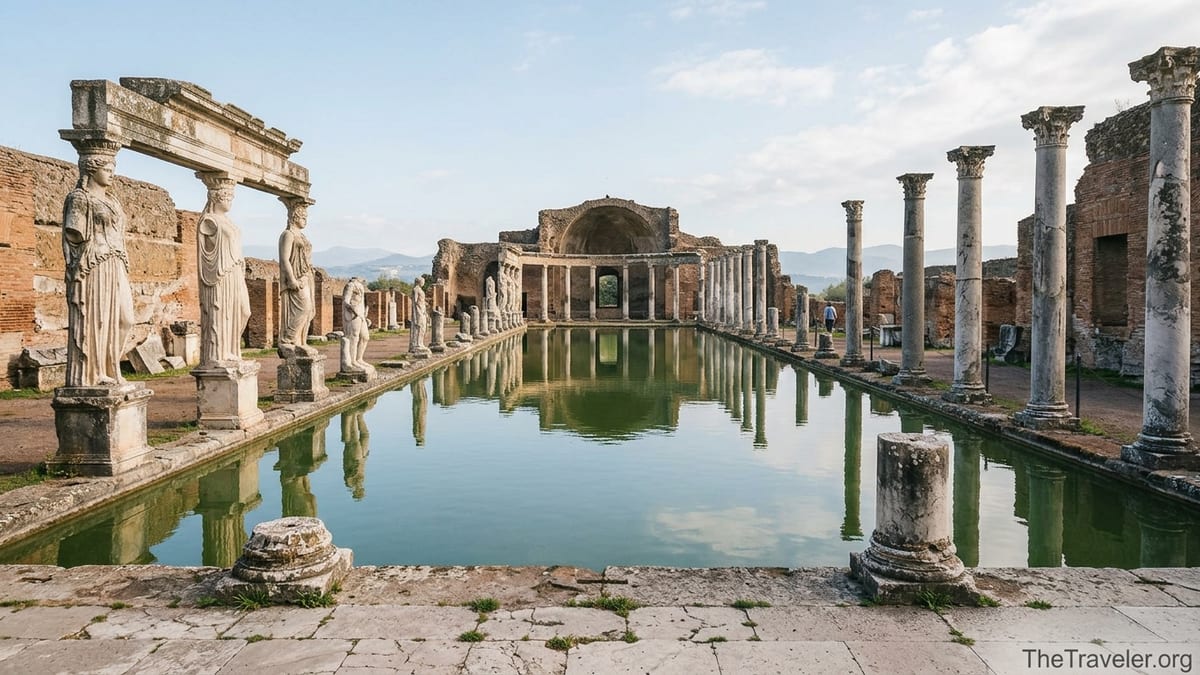
The most famous example is the Canopus, a long artificial canal lined with columns and statues, terminating in a domed hall often called the Serapeum. For a modern visitor, this is usually the first area that truly feels like a place, not just a ruin: reflected sky in the water, marble caryatids leaning over the pool, the broken curve of the dining grotto at the end. It is a carefully staged memory of Egypt, filtered through Greek and Roman taste. To walk here is to see how Hadrian turned his journeys along the Nile into a permanent, controllable experience at home.
Elsewhere, the villa’s Greek influences are unmistakable. Porticoed courtyards, pseudo‑Stoas, and open colonnades echo the gymnasia and philosophical schools Hadrian admired in Athens and Asia Minor. This is particularly visible in the courts traditionally labeled as libraries and academies, where long colonnades would have framed views of gardens and statues. Even if scholars debate the ancient names, the forms themselves speak: they show an emperor who wanted his residence to resemble the sacred and civic spaces of the Greek world he loved.
For travelers trying to understand how Rome saw its provinces, this eclecticism is crucial. The villa is not a neutral collage of styles; it is a statement that the empire’s cultures could be consumed, appropriated, and reordered in stone for imperial pleasure. When you walk from the Canopus to the more Roman‑looking bath complexes, you are retracing an ancient way of thinking in which Egypt, Greece, and Italy were all part of a single imperial mental map, centered on the emperor’s desires.
Architecture as a Mirror of Imperial Innovation
Hadrian’s Villa is also a laboratory for Roman architectural experimentation. The Romans were already masters of concrete vaulting and domes by the second century, but here those techniques are pushed and recombined in surprising ways. The famous Maritime Theatre, for instance, wraps a circular colonnade and moat around a small island villa. Bridges could once be rolled away to isolate the inner house, creating a private refuge within the larger complex.
Today the island stands as a ring of broken columns and a circular basin, but careful reconstruction allows visitors to imagine curved roofs, hidden staircases, and intimate rooms arranged around a central courtyard. It shows how Roman architects played with geometry and movement to create both spectacle and seclusion. For students of architecture, this one structure explains how Roman engineering allowed for circular plans, complex circulation, and fluid transitions between indoor and outdoor space.
Across the site, you see similar experiments: vaulted corridors that bend to follow the hillside, sunken cryptoporticoes where servants could move unseen, and surprising shifts in scale from huge audience halls to miniature garden pavilions. Many of these ideas would echo later in imperial palaces and even in Renaissance villa design, where architects consciously studied Hadrian’s work. When a 16th‑century cardinal built Villa d’Este just up the hill, with terraces, water features, and theatrical views across the Aniene valley, he was in dialogue with Hadrian’s long‑abandoned masterpiece below.
Modern researchers continue to refine our understanding of this architectural puzzle. Digital reconstructions, often featured in museum exhibits and online visuals, help fill in missing roofs and floors to show how light, water, and crowds would have moved through these spaces. For a traveler arriving with a phone or tablet, looking at one of these reconstructions while standing among the ruins can suddenly transform broken brick into living architecture. It is one of the most direct ways to feel how the Roman elite experienced built space at its most inventive.
Everyday Life Behind the Marble Facades
It is easy to be dazzled by the grand pools and colonnades, but Hadrian’s Villa also matters because it reveals the machinery behind imperial luxury. Excavations have brought to light service corridors, storage rooms, kitchens, and heating systems that rarely feature in romantic paintings of ancient Rome. These areas show how much work and infrastructure were required to keep an emperor comfortably housed in the countryside.
Take the bath complexes as an example. Behind the elegant halls where Hadrian and his guests would have soaked and socialized lay boiler rooms, furnaces, and networks of clay pipes. The hypocaust systems that once heated marble floors and pools are still visible in places, a reminder that Roman comfort depended on a continuous supply of fuel, water, and labor. When you stand on a raised metal walkway over the exposed underfloor heating pillars, you are looking at the ancient equivalent of a high‑end hotel’s mechanical level.
Housing for staff is another important piece of the puzzle. While the most visible quarters were for courtiers and favored guests, archaeologists have also identified simpler housing blocks and service zones that likely accommodated slaves, guards, and workers. The villa had to be self‑sufficient: it needed bakers, cooks, gardeners, bath attendants, scribes, and more. For modern visitors, this can shift the perspective from “Hadrian’s dream palace” to a complex community whose daily routines sustained imperial luxury.
New discoveries keep adding texture to this social picture. In recent years, digs have uncovered storerooms, decorative fragments, and evidence of earlier occupation phases underneath some of the grandest buildings. These finds suggest that even a site planned by an emperor evolved over time, responding to new needs, fashions, and personnel. Hadrian’s Villa was not a static palace but a living workplace and residence, where hundreds of ordinary people experienced the empire very differently from the emperor who gave the orders.
From Ruin to UNESCO: Why Conservation and Research Matter
By the time Renaissance travelers rediscovered Hadrian’s Villa in earnest, the complex had already been heavily quarried. Marble had been stripped, columns toppled, and many decorative sculptures carried off to villas and museums across Europe. That long history of reuse is part of why the site looks so shattered today, but it is also why the surviving remains are treated as a global heritage priority.
The designation of the villa as a UNESCO World Heritage Site in the late 20th century recognized not only its artistic and historical value but also its influence on later architecture and garden design. Conservation efforts now focus on stabilizing ancient walls, managing vegetation, and protecting fragile frescoes and mosaics that still cling to sheltered interiors. Visitors will often see fenced‑off areas or scaffolding in place, a sign that the site is still actively being studied and preserved rather than frozen as a static ruin.
Ongoing research can directly shape the visitor experience. For instance, when new excavation campaigns reveal previously unknown rooms or clarify the function of a building, interpretive panels and guide narratives are updated. A recent project in the Palazzo sector highlighted the remains of an earlier Republican villa beneath Hadrian’s additions, reframing the site as a palimpsest rather than a single creative act. For a traveler returning after a decade or more, Hadrian’s Villa can feel like a different place, with new paths opened and fresh stories to tell.
Conservation also influences how you move through the site. Some of the most fragile structures, such as underground passageways or narrow staircases inside the Maritime Theatre, may be closed or accessible only on special guided tours. While this can be frustrating for the curious visitor, it is part of ensuring the villa survives for future generations and future research. Understanding that balance between access and preservation is itself a lesson in how modern societies manage the physical legacy of ancient empires.
Experiencing the Villa Today: A Traveler’s Window Into the Empire
For a modern traveler based in Rome, Hadrian’s Villa is usually visited as a half‑day or full‑day trip to Tivoli, often combined with the Renaissance terraces of Villa d’Este. A typical visit might begin with a regional train or coach from central Rome, followed by a short bus or taxi ride to the villa’s entrance. Standard adult tickets are modestly priced by European heritage standards, and can be purchased on site or in advance during busier seasons. Once inside, you are largely free to wander, with basic maps available at the ticket office and more detailed guidebooks sold in the small bookshop.
The site’s size means that comfortable shoes, water, and sun protection are as important as your camera. In summer, temperatures can climb quickly, and much of the walking is in open sun. Many visitors choose to focus on a core loop that takes in the Maritime Theatre, the Canopus, one of the major bath complexes, and the so‑called Greek and Latin Libraries. Others dedicate most of a day to exploring quieter corners, where broken walls and fig trees create a more meditative atmosphere.
Hiring a licensed guide at the gate or joining a small‑group tour from Rome can add context that the ruins themselves do not immediately provide. A good guide will help you imagine missing roofs and frescoes, explain how the underground service corridors functioned, and point out details like reused columns or mismatched capitals that reveal how the villa was altered over time. For travelers deeply interested in Roman history, specialized archaeological tours occasionally include behind‑the‑scenes access to ongoing digs or closed sectors, subject to conservation constraints.
Perhaps the greatest reward, though, comes from allowing time simply to sit. Perching on a low wall overlooking the Canopus, with the hills of Lazio in the distance and the sound of cicadas rising in the heat, you can sense why emperors chose Tivoli as a retreat. At the same time, the palace’s scale and complexity remind you that even in apparent seclusion, Rome’s rulers were surrounded by the machinery of empire. Few sites in Italy so vividly combine scenic beauty, architectural ingenuity, and historical insight in a single afternoon’s walk.
The Takeaway
Hadrian’s Villa matters because it condenses the Roman Empire into a single, walkable landscape. It shows how imperial power expressed itself through architecture, how travel across the provinces reshaped elite taste, and how enormous behind‑the‑scenes labor sustained the comfort of one man and his inner circle. For historians and archaeologists, the site remains a source of new data about building techniques, social hierarchies, and cultural exchange in the second century.
For travelers, the villa offers something more immediate: the chance to experience the empire not as a chapter in a book but as a series of spaces you can cross on foot. Each courtyard, bath hall, and shaded portico hints at conversations once held in many languages, at decisions that affected distant provinces, at lives lived in the shadow of imperial favor. Watching the late afternoon light slide across the broken columns, you are standing in the afterimage of Rome at its most confident and cosmopolitan.
In that sense, Hadrian’s Villa still speaks directly to the present. It raises questions about how modern leaders use architecture and travel to project power, about how global cultures are collected and displayed, and about what traces our own age will leave in the landscape. The ruins at Tivoli are not just a relic of a lost world. They are a mirror, built in brick and marble, that helps us understand both the Roman Empire and ourselves.
FAQ
Q1. Where is Hadrian’s Villa and how far is it from central Rome?
Hadrian’s Villa is in Tivoli, a hill town east of Rome, roughly 30 kilometers from the city center. By public transport, most visitors travel by regional train or bus toward Tivoli, then connect with a local bus or taxi for the short ride from the town to the archaeological site.
Q2. Why is Hadrian’s Villa considered so important for understanding the Roman Empire?
The villa brings together architecture, art, engineering, and daily life on an imperial scale. Its mix of Greek, Egyptian, and Roman styles reflects how Hadrian saw his multicultural empire, while the service quarters and infrastructure reveal the labor and logistics required to support imperial luxury.
Q3. How much time should a visitor plan to explore Hadrian’s Villa?
Allow at least three hours for a basic circuit that includes the Maritime Theatre, Canopus, major bath complexes, and central courtyards. Travelers particularly interested in archaeology or photography often spend five to six hours, especially if combining the visit with a picnic or extended walks into quieter parts of the site.
Q4. What are the must‑see areas inside the villa complex?
Most visitors prioritize the circular Maritime Theatre, the long Canopus pool with its statues and grotto, at least one of the large bath complexes, and the central palatial area with its courtyards and colonnades. These zones together give a good sense of Hadrian’s taste for architectural experimentation, landscape design, and ritualized leisure.
Q5. Is it better to visit Hadrian’s Villa independently or with a guide?
Independent visits offer flexibility and quiet corners for reflection, especially if you bring a good guidebook or download a detailed map. A licensed guide, however, can decode many otherwise invisible details, such as heating systems, building phases, and symbolic references to provinces, making the experience more meaningful for travelers interested in history.
Q6. What should travelers wear and bring when visiting the site?
The site involves substantial walking over uneven ground with limited shade, so sturdy shoes, a hat, sunscreen, and a refillable water bottle are essential, particularly in late spring and summer. Light layers are useful in cooler months, when breezes across the open plateau can make temperatures feel lower than in central Rome.
Q7. Are there facilities such as food, restrooms, and seating inside the villa grounds?
Basic facilities, including restrooms and a small bookshop, are available near the entrance. Seating within the archaeological area is limited, so many visitors rest on low walls or shaded spots along the paths. It is practical to bring a simple snack or light picnic, though always follow on‑site rules about where food may be consumed.
Q8. Can children enjoy a visit to Hadrian’s Villa?
Yes, especially if the visit is framed as an outdoor exploration rather than a formal history lesson. Children often enjoy running along ancient corridors, spotting fragments of columns and mosaics, and imagining how the pools and baths once looked. Breaks for snacks and shade, along with a shorter route, help keep the experience enjoyable for younger travelers.
Q9. How does Hadrian’s Villa compare to sites like Pompeii or the Colosseum?
Pompeii is a full city frozen in time, and the Colosseum is a single monumental arena. Hadrian’s Villa, by contrast, is a sprawling countryside palace that blends domestic, ceremonial, and leisure spaces. It offers a more personal view of the imperial household and of how an emperor shaped his environment, rather than focusing on urban life or public entertainment.
Q10. Is Hadrian’s Villa still an active archaeological site?
Yes. Excavations and conservation projects continue in different sectors, sometimes uncovering earlier phases of occupation or clarifying how buildings were used. Visitors may see fenced‑off trenches, archaeologists at work in season, or newly interpreted areas, all of which underline that the villa is still yielding new information about the Roman world.