


On the map, the Dark Hollow Falls Trail in Shenandoah National Park barely registers as a challenge. A mile and a half round trip with roughly 440 feet of elevation gain sounds like a pleasant leg-stretcher between overlooks on Skyline Drive. In reality, this deceptively short path turned into one of the steepest, most demanding hikes of my visit, a lesson in how terrain and expectations matter just as much as distance.
Get the latest updates straight to your inbox!
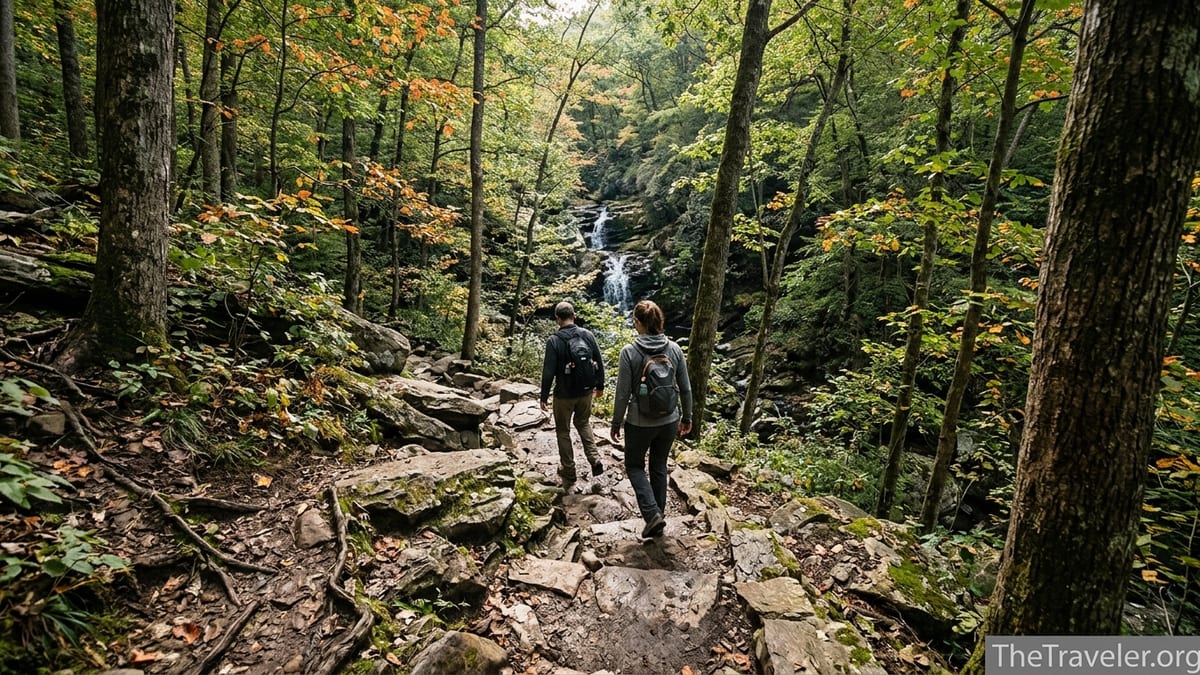
First Impressions: An "Easy" Waterfall Hike Off Skyline Drive
Dark Hollow Falls starts innocently enough from a parking area at milepost 50.7 on Skyline Drive, not far from the Big Meadows Lodge complex and campground. The trailhead sign describes a 1.4 to 1.5 mile out-and-back route, usually rated moderate, that descends to a 70-foot waterfall before climbing back to the road. At a glance, it sounds like the perfect stop on a day of scenic driving and short walks.
That impression is reinforced by the crowd. On a typical summer or fall weekend, you will see minivans lined up in the lot by 10 a.m., families unloading strollers that will soon be abandoned in car trunks, and visitors in canvas slip-ons and city sneakers. Many people treat Dark Hollow Falls as a casual add-on to a Skyline Drive sightseeing day rather than a serious hike, which is exactly the mindset I walked in with.
What those statistics and first impressions do not show is how concentrated the elevation loss and gain really are. Dropping roughly 440 feet in about three quarters of a mile means the trail often feels like a staircase carved into the mountain. The park service describes it as steep and rocky, and after only a few minutes of descending, that language no longer feels like boilerplate. It feels like a direct warning.
To put that into context, a longer Shenandoah hike like Hawksbill Summit may gain nearly a thousand feet over more than two miles. On Dark Hollow Falls, you tackle almost half that change in less than half the distance, and you do it on irregular stone and dirt rather than smooth switchbacks. The numbers are small. The grade is not.
The Descent: Rocky, Slick, and Harder on the Knees Than Expected
The trail immediately tilts downhill, narrowing to a rocky corridor shaded by tulip poplars and oaks. In early summer, the air is cool but damp, and the sound of the stream that feeds Dark Hollow Falls grows louder as you descend. Underfoot, the ground is a mix of compacted dirt, embedded rocks, and short, uneven stone steps that look like they were placed decades ago and allowed to settle naturally.
It is the sort of surface that seems manageable when you are fresh and full of anticipation. Then a drizzle starts or the previous night’s rain seeps from the moss-covered rocks, and every flat-looking stone reveals a thin sheen of water. Rangers frequently note that Dark Hollow Falls is one of those trails where people slip not because they are reckless but because they underestimate how wet and polished the rocks can get even on supposedly dry days.
On my visit, a mid-morning shower had passed through less than an hour before I started down. Within the first quarter mile, I watched a teenager in running shoes lose her footing on a seemingly benign, slightly sloped rock, landing hard but luckily uninjured. Her parents promptly slowed their pace and started insisting on three points of contact around every step, treating the trail more like a scramble than a stroll. A few turns later, another group debated turning back when they realized that the grade kept dropping and the footing was not going to smooth out.
Knees feel the descent early. Hikers with past joint issues often struggle more going down than coming up, and Dark Hollow Falls illustrates why. The trail drops steadily without many long, flat breaks, so you are braking with each step. Trekking poles, which looked excessive in the parking lot, suddenly appear wise as you plant them on either side of narrow stone steps. It is a short walk in terms of time, usually 20 to 30 minutes to the falls, but it demands concentration for nearly every foot of that distance.
At the Falls: Beauty, Crowds, and Risk at the Water’s Edge
When you finally arrive at the main viewpoint, Dark Hollow Falls delivers on its reputation. The water fans down a series of moss-covered ledges into a cool, shaded hollow, framed by rhododendron and ferns. In spring, when snowmelt and rains are at their peak, the cascade feels surprisingly powerful for a waterfall so close to the road. In late summer, it is more delicate but still photogenic, especially when dappled sunlight catches the spray.
The reward, however, comes with crowds. Because the trail is short, it attracts everyone from seasoned Appalachian Trail section-hikers to families making their only foray off Skyline Drive. On a fall weekend around peak foliage, it is common to see 40 or more people clustered around the viewpoint and the rocks beside the stream. Parents attempt to line their kids up for the perfect photo while other visitors angle smartphones and DSLRs for long-exposure shots of the water.
The rocks beside the falls are as slick as they look. Every year rangers in Shenandoah remind visitors not to climb onto the wet ledges, and Dark Hollow Falls is one of the places where that reminder is most warranted. I watched one hiker in smooth-soled fashion boots step off the main trail to pose closer to the cascade, sliding halfway to a pool before a friend caught her pack. They scrambled back with shaky legs and soaked pants, lucky to have only a bruised ego as a souvenir.
Despite the congestion and risk, the scene is undeniably captivating. On my visit, a pair of hikers who had just completed the much longer Rose River Loop, which connects to Dark Hollow via a fire road, lingered at the falls and admitted that this “little detour” felt more intense on the quads than some of the miles they had done earlier. Short did not mean easy for them either, which made me feel less alone in my miscalculation.
The Climb Back: Why the Return Trip Feels So Much Tougher
The real challenge of Dark Hollow Falls begins the moment you turn around. On this trail, you pay for every effortless downhill step. The grade that carried you quickly to the water becomes a relentless staircase the moment you head back toward Skyline Drive. There is no gentler return route from the main falls viewpoint; you must climb the same slope you descended.
Within the first few minutes, the parking lot feels much farther away than 0.75 miles. The trail’s steepest stretches arrive in short, punchy segments: a run of uneven stone steps, then a slightly smoother dirt ramp, then another rocky rise. People who breezed past me on the way down quickly shifted into what might be called Shenandoah’s universal uphill pace: 15 to 20 steps, then a pause to catch their breath and comment on how “this is steeper than it looked on the sign.”
It is here that the trail’s combination of elevation and humidity really becomes apparent. On summer days, the temperature along Skyline Drive may sit in the low 70s Fahrenheit, but down in the hollow, the still, moist air can feel heavier. I passed hikers who had clearly underestimated the exertion, carrying small bottled waters they finished halfway up. Others, prepared with 1-liter reusable bottles or hydration packs, fared noticeably better.
Shenandoah regulars often recommend tackling Dark Hollow Falls early in the day, both to avoid traffic on Skyline Drive and to climb in cooler air. When I started up shortly after noon, the difference in comfort between shaded pockets and exposed short stretches was striking. Even fit hikers were sweating heavily, and the trail’s reputation as a “short, steep leg-burner” felt entirely earned. By the time the trailhead sign came back into view, every step of that modest 440-foot gain felt fully accounted for.
Planning the Hike: Timing, Gear, and Realistic Expectations
If you treat Dark Hollow Falls like an easy roadside walk, the trail has a way of humbling you. If you plan for it as a true hike, it becomes far more enjoyable. One of the first practical considerations is timing. The lot at milepost 50.7 is not huge, and Shenandoah’s own materials note that Dark Hollow is one of the park’s most popular waterfall trails. On busy weekends from late spring through mid-fall, arriving before 9 a.m. or closer to late afternoon often means less competition for parking and a bit more breathing room on the trail.
Footwear may be the single most important gear decision. Hiking boots are not strictly required, but sturdy shoes with real traction make a dramatic difference on the wet, uneven surface. Trail runners with grippy soles are a popular choice among experienced visitors, while smooth-bottomed sneakers and sandals frequently show up in the slip-and-stumble stories park staff share. If the forecast mentions recent rain or thunderstorms, assume the rocks will be slick and choose footwear accordingly.
Water and pacing matter more than the distance suggests. For a fit adult, 500 to 750 milliliters of water can be enough for the round trip in mild weather, but in the heat of July or August, many hikers will be happier carrying a full liter. Parents hiking with children often pack small daypacks with snacks and extra layers, since the hollow can feel cooler even when the climb back up leaves everyone sweating. Treating the outing like a genuine hike rather than a casual overlook stop encourages smarter preparation.
Finally, build in enough time. The official hiking time is often listed around one to one and a quarter hours, but that estimate does not account for extended breaks at the falls, photo stops, or slower family groups. Visitors who rush to pack Dark Hollow in as a quick stop before a dinner reservation at Big Meadows Lodge or in nearby Luray often find themselves power-hiking the return, missing much of the scenery that makes the hollow special.
Who This Trail Is For, and When to Consider Alternatives
Despite its challenges, Dark Hollow Falls remains a fantastic choice for many visitors, especially those who want a dramatic waterfall without committing to a half-day trek. If you are reasonably active, comfortable on uneven terrain, and prepared for a sustained uphill finish, this trail rewards the effort with one of Shenandoah’s most iconic views. It can be a particularly good fit for travelers who are short on time but still want an immersive forest experience within a 90-minute window.
However, it is not ideal for everyone. The park specifically prohibits pets on this trail, which surprises some visitors who are road-tripping with dogs along Skyline Drive. Families in that situation often pivot to the nearby Rose River Loop or the fire road leading from Fishers Gap Overlook, both of which allow leashed pets and still offer waterfall scenery, albeit on longer routes. Likewise, visitors with balance issues or significant knee problems may find the steep grade of Dark Hollow’s rocky steps unnerving.
There are also seasonal considerations. In winter, snow and ice on the trail can transform already slick rocks into genuine hazards, and sections of the park road sometimes close entirely. In early spring, swollen streams and muddy slopes make trekking poles, microspikes, or both a wise addition. During fall foliage season, the crowds swell dramatically, and first-time hikers may prefer less congested alternatives like South River Falls or Doyles River Falls, which spread people out over longer distances.
If you do decide Dark Hollow is not the right fit, Shenandoah offers ample substitutes that match different comfort levels. Easy meadow walks near Big Meadows, accessible overlooks along Skyline Drive, and moderate summit trails such as Stony Man or climbs from the Pinnacles area provide sweeping Blue Ridge views without the same concentration of steep, rocky descent and ascent. Recognizing where Dark Hollow Falls fits on that spectrum helps you choose trails that align with your expectations and ability.
Practical Logistics: Getting There, Fees, and Nearby Stops
Reaching Dark Hollow Falls is straightforward once you are inside Shenandoah National Park. The trailhead parking lot sits along Skyline Drive’s central district, roughly a 90-minute drive from the Washington, D.C. suburbs in light traffic. Most visitors enter through either the Thornton Gap Entrance Station near Luray or the Swift Run Gap Entrance Station off U.S. 33, then follow Skyline Drive to milepost 50.7, watching for signs indicating Dark Hollow Falls parking on the east side of the road.
As with all of Shenandoah, access requires an entry fee or a valid park pass. Many visitors opt for the America the Beautiful annual pass if they plan to pair Shenandoah with other nearby national park sites during the year. Once inside, facilities in the central district make Dark Hollow an easy half-day anchor: Big Meadows Lodge, Big Meadows Wayside, and the campground are all within a short drive, offering meals, restrooms, and lodging or camping. A typical day might combine a morning hike to Dark Hollow Falls, an afternoon picnic in Big Meadows, and sunset at an overlook such as The Point or Hazeltop.
Parking at the Dark Hollow lot itself is generally free beyond the park entry fee, but space is limited. When the lot fills, rangers occasionally encourage visitors to choose other nearby hikes rather than parking along Skyline Drive, where shoulders are narrow and sightlines are sometimes short. On busy fall weekends, planning a backup hike can prevent disappointment if you arrive to find every formal space occupied.
Because mobile service varies along Skyline Drive, it is wise to download or photograph a park map in advance and note mileage markers for both your starting point and your destination. Dark Hollow’s location near the center of the park makes it convenient to combine with other short hikes, like the Story of the Forest Trail or a stroll through the Big Meadows area, but that convenience depends on having at least a basic sense of where you are along the 105-mile length of Skyline Drive.
The Takeaway
Dark Hollow Falls proves that distance alone tells you very little about how a trail will feel under your boots. On paper, it reads like an easy interlude between scenic overlooks. On the ground, its tight concentration of elevation gain and loss, rocky footing, and slick, shaded steps combine to create a far more demanding experience than many visitors expect.
If you arrive ready for a genuine hike, with solid footwear, enough water, flexible timing, and an honest appraisal of your fitness, Dark Hollow Falls is one of the most rewarding short trails in Shenandoah National Park. The waterfall is beautiful in all seasons, the forest feels close and immersive, and the sense of accomplishment at the top of that final climb is real. Treat the trail with the same respect you would grant a longer mountain route, and it will likely become a highlight of your Skyline Drive itinerary instead of the surprise workout you spend the rest of the day recovering from.
FAQ
Q1: How long does it really take to hike Dark Hollow Falls?
Most visitors should plan 60 to 90 minutes for the round trip, including time for photos and short rest breaks on the climb back up.
Q2: Is Dark Hollow Falls suitable for young children?
It can be, but only if adults are prepared to supervise closely. The trail is steep, the rocks can be slippery, and there are drop-offs near the falls.
Q3: Can I bring my dog on the Dark Hollow Falls Trail?
No. Pets are not allowed on this specific trail, although several nearby routes, such as the Rose River area, do allow leashed dogs.
Q4: What kind of shoes should I wear for this hike?
Sturdy shoes with good traction, such as hiking boots or trail running shoes, are strongly recommended because the trail is steep, rocky, and often wet.
Q5: When is the best time of day to hike Dark Hollow Falls?
Early morning or late afternoon usually offer fewer crowds, cooler temperatures, and easier parking compared with the busy midday period.
Q6: Is the trail accessible in winter?
The trail is generally open year-round, but snow and ice can make the rocks extremely slippery. Conditions vary, so check with park staff before heading out.
Q7: Do I need any special permits to hike Dark Hollow Falls?
No special trail permit is required. You only need to pay the regular Shenandoah National Park entrance fee or hold a valid park pass.
Q8: Are there restrooms or water at the trailhead?
Facilities and water are not always available at the Dark Hollow parking area itself, so it is wise to use services at Big Meadows or another developed area first.
Q9: Can I swim or wade at the base of Dark Hollow Falls?
Wading and swimming are discouraged because of cold water, slippery rocks, and safety concerns. Most visitors enjoy the falls from designated viewpoints along the trail.
Q10: What other hikes pair well with Dark Hollow Falls in one day?
Many travelers combine Dark Hollow with a meadow walk near Big Meadows, a short summit hike like Stony Man, or a longer waterfall route such as Rose River Falls.