


More news on this day
A new generation of autonomous AI travel agents is quietly dismantling the traditional path from inspiration to booking, compressing what used to be a weeks-long research process into a handful of conversational prompts and automated transactions.
Get the latest news straight to your inbox!
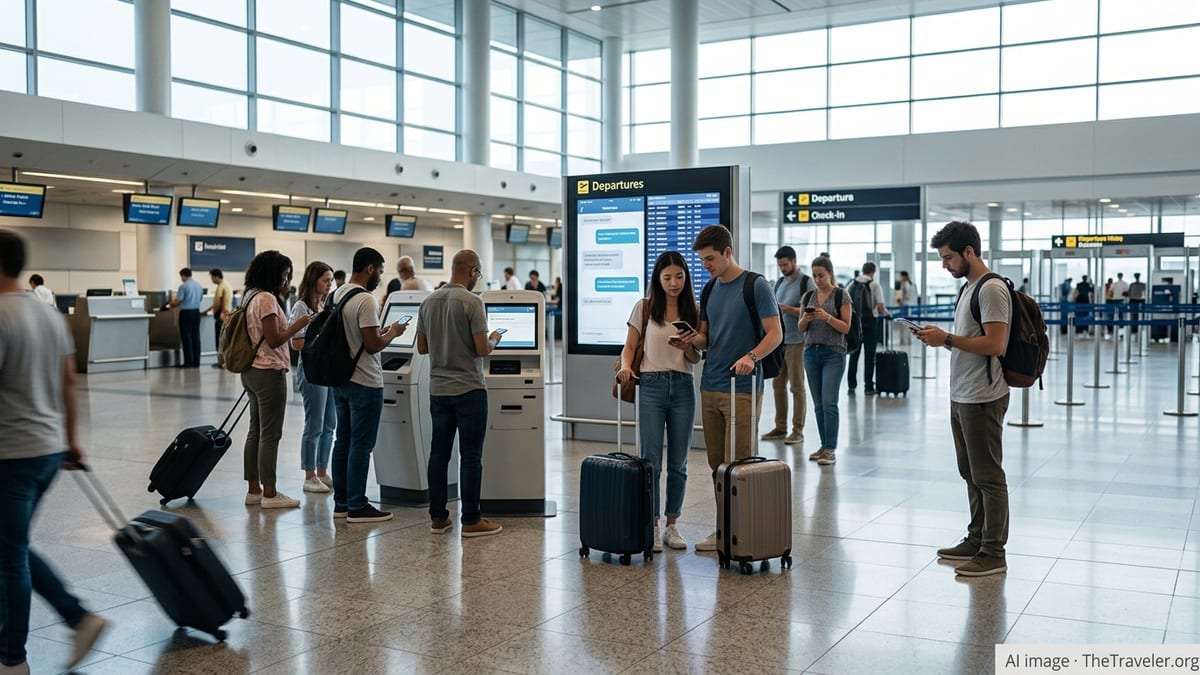
From linear funnel to compressed journey
For decades, digital travel marketing has revolved around a familiar funnel: search, compare, decide, then book. Consumers jumped between search engines, metasearch sites, online travel agencies and review platforms before finally committing to flights and accommodation. Recent research and industry reports now indicate that this sequence is fragmenting as AI systems move from passive recommendation engines to active agents that can plan and execute trips end to end.
Consulting and industry outlooks for 2025 describe a sharp rise in travelers using generative AI at multiple stages of their journeys, from early inspiration to in-destination assistance. Several reports note that AI-sourced traffic and interactions are growing much faster than traditional search and referral channels, while the share of traffic from classic organic and paid search is projected to shrink in the next few years. In effect, AI becomes the discovery and comparison environment, collapsing multiple funnel steps into a single interface.
Market analyses focused on customer acquisition in travel argue that by 2026 a significantly larger share of digital traffic will originate in AI environments rather than conventional search pages. This acceleration is already forcing brands to reconsider how they appear in front of travelers, since many interactions now begin inside a chat window or agent interface instead of a browser search box or app home screen.
Academic work on trip-planning behavior reinforces this picture, suggesting that while travelers still value control and transparency, they are increasingly willing to offload repetitive research and itinerary optimization to AI tools, especially when these tools are embedded inside platforms they already use.
AI agents move from helper to decision-maker
In the early wave of travel chatbots, AI mostly acted as a conversational skin over existing search and booking flows. The latest generation of agentic systems goes further, chaining together multiple tasks such as searching inventory, comparing options, applying loyalty rules and then executing bookings or changes without repeated user input.
Online travel brands and technology providers are racing to deploy these capabilities. Publicly available information shows that large online travel agencies have launched or expanded AI trip planners and service agents that can manage booking changes and disruptions in a single interaction. Global distribution and corporate travel platforms are rolling out multi-step agents that coordinate flights, hotels and ground transport on business itineraries, often with minimal manual intervention once preferences and constraints are set.
Startups are also pushing the model forward. AI-native travel companies are positioning themselves as full-service agents that assemble complex itineraries from scratch, based on conversational briefs, and then monitor prices and disruptions in the background. Multi-agent research prototypes from the academic community have demonstrated that coordinating specialized agents for routing, pricing and preference-matching can outperform single-model systems on complex, open-ended planning tasks, which provides a technical foundation for more capable commercial products.
At the same time, some major platforms are taking a more incremental path. Certain accommodation marketplaces, for example, have prioritized AI for customer support and host tools first, with executives publicly suggesting that full autonomous trip planning remains a longer-term goal. That divergence highlights ongoing uncertainty about how fast consumers will embrace agents that handle not just advice but also payment and liability.
Consumers trust AI more, but not completely
Consumer research in the United States and Europe points to a steady normalization of AI in travel planning, though trust remains uneven. Recent surveys from travel research firms suggest that roughly one third of travelers in key markets already use AI tools to plan or enhance trips, describing the shift as a mainstream rather than niche behavior. Separate technology trend studies show usage of AI for travel planning in the United States nearly doubling between 2024 and 2025, even if absolute numbers are still lower than for traditional channels.
Other polling paints a more cautious picture. YouGov data for 2025 indicates that only around three in ten U.S. travelers say they are comfortable using AI for trip planning, with a sizable share explicitly uncomfortable. Some younger cohorts that were initially the most enthusiastic show a slight decline in comfort levels year over year, suggesting a reality check as people encounter the limitations of current tools.
Academic research into AI-assisted trip planning highlights a gap between what these systems can theoretically offer and what travelers feel they actually receive. Studies framed around concepts such as affordance-actualization report that users value speed and convenience but remain wary of errors, lack of transparency and generic recommendations. Work on anthropomorphism and privacy concerns in AI travel planners also finds that while humanlike interaction can improve engagement, perceived data risks and uncertainty about how recommendations are generated still hold some travelers back.
Industry observers note that these mixed attitudes are shaping adoption patterns. Many travelers appear comfortable using AI for inspiration, idea filtering and basic logistics, but still prefer to finalize high-stakes bookings through brands and channels they recognize, particularly when trips are expensive or complex.
Platforms scramble to stay inside the agent
The rise of AI agents threatens the visibility and economics of established travel intermediaries. If consumers delegate search and comparison to general-purpose agents that pull in inventory from multiple sources, the traditional contest for search rankings and paid placements on familiar platforms could give way to a new battle to become the default supplier behind those agents.
Hospitality and distribution analysts already describe leading online travel agencies as evolving into AI-powered marketing platforms that influence not only how hotels and experiences are discovered but also how prices and loyalty incentives are presented inside AI environments. Opinion pieces in travel trade publications warn that a small number of AI ecosystems could end up controlling the practical travel funnel, deciding which brands surface in response to a traveler’s conversational request.
To avoid being sidelined, major booking platforms are embedding AI agents directly into their own apps and partnering with external AI providers. These integrations are designed to ensure that when a traveler asks a general-purpose AI to plan a trip, the resulting actions still route through familiar booking rails and payment systems operated by existing players. For hotels, airlines and destinations, this dynamic requires investment in structured data, flexible pricing and direct connectivity so that their inventory remains visible and attractive inside agent-mediated journeys.
Industry research on customer acquisition suggests that as AI-sourced traffic rises from low single digits toward a more material share of bookings, brands that rely heavily on performance marketing in search environments may face higher costs and reduced control. Many are experimenting with loyalty ecosystems, membership models and direct engagement strategies that can coexist with AI agents rather than compete head-on for the same search queries.
New risks around bias, reliability and regulation
As AI agents assume a greater role in steering travel demand, concerns about bias and reliability are drawing more attention. A growing body of academic work argues that generative AI travel planners can exhibit different and in some cases more opaque biases than traditional recommender systems, affecting which destinations and providers are highlighted. These biases can stem from training data, prompt design or commercial constraints on which partners an agent is allowed to book.
Field experiments in online travel environments show that subtle differences in how AI-generated suggestions are framed can influence user engagement and purchase intent, raising questions about where to draw the line between helpful personalization and undue persuasion. Researchers emphasize the need for clear disclosures, controllable filters and mechanisms that allow travelers to interrogate or override AI decisions.
Operational reliability is another open issue. Studies and industry tests have documented that current large language model agents still struggle with complex, multi-step tasks under real-world constraints, from understanding fare rules to handling schedule changes across multiple providers. While error rates have improved, the combination of financial stakes, cross-border regulations and time sensitivity in travel makes even occasional failures costly.
Regulators are beginning to examine how existing competition, consumer protection and data rules apply when AI systems effectively become new gatekeepers for demand. Commentators in travel and hospitality media argue that without updated oversight, a small cluster of AI platforms and large intermediaries could entrench their positions, further compressing the funnel and limiting choice for smaller suppliers.
What a collapsed funnel means for travelers
The practical experience for travelers in this new landscape is a planning process that feels faster and more conversational, but also more mediated. Instead of juggling dozens of tabs, a traveler might describe their preferences once and receive a complete, bookable plan within minutes, with the same agent monitoring delays, rebooking options and local recommendations during the trip.
At the same time, experts in digital behavior caution that convenience can mask a loss of visibility into trade-offs. When an AI agent chooses a specific hotel or airline, it is often difficult for users to see the full universe of alternatives or understand the commercial relationships that may influence rankings. Some travelers respond by using multiple agents or pairing AI suggestions with manual checks on metasearch sites and supplier apps, effectively rebuilding a more traditional funnel on their own terms.
For the industry, the collapse of the travel funnel does not eliminate competition, but relocates it. The most critical battles are shifting upstream, toward owning the interface where intent is expressed and downstream, toward controlling the rails where transactions are executed. In between, agentic AI is rapidly becoming the connective tissue, promising frictionless journeys while challenging long-standing assumptions about how travelers discover, evaluate and ultimately choose their next trip.