


Ask frequent UK beachgoers which stretches of sand feel “nothing like Britain” and you will start hearing the same names again and again. From Cornish coves that look ripped from the Mediterranean to Hebridean bays that could pass for the Caribbean, there are corners of the British coastline where the water seems impossibly turquoise, the sand improbably soft and white, and the scenery startlingly exotic. The weather may still be British, but for a few golden hours on a calm day, these beaches can make you forget you are anywhere near home.
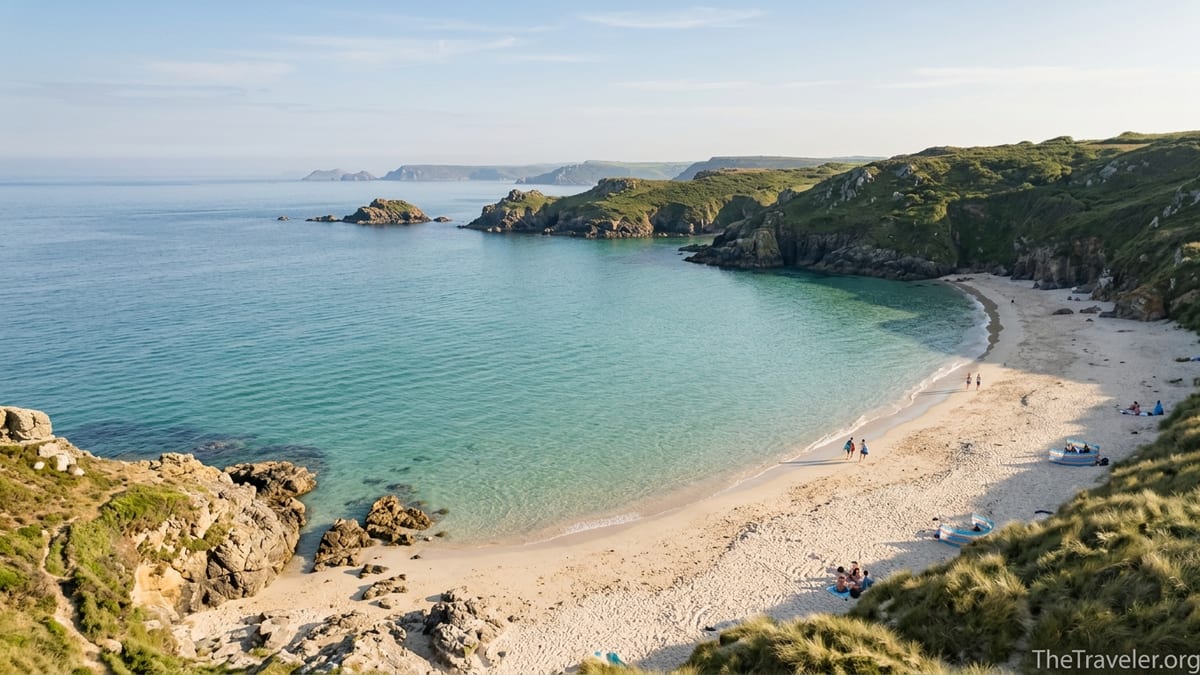
Kynance Cove, Cornwall: Turquoise Drama on the Lizard
Kynance Cove on Cornwall’s Lizard Peninsula is perhaps the most frequently cited example when travelers talk about UK beaches that do not feel remotely British. On a sunny, still day, the cove’s chalky white sand and searing turquoise water are framed by dark red and green serpentine rock stacks that resemble a far warmer coastline. Guidebooks and travel features regularly compare the colour of the sea here to tropical destinations, and the National Trust car park above the cove now fills early on peak summer days as word continues to spread.
Most visitors arrive by car, paying a modest day rate for parking, then follow a cliff path that winds down through heathland before the cove opens up in front of them. At high tide, Kynance is a pocket of sand hemmed in by rock, while at low tide it transforms into a much larger beach linked to Asparagus Island by firm sand. Shallow pools and narrow sea caves add to the sense that you have wandered into a film set somewhere in southern Europe, reinforced by the cove’s frequent appearances in prestige television dramas and big-budget movies.
What keeps Kynance feeling “un-British” for many is not only the colour of the water but also how dramatically the light bounces off the pale sand and polished rock. On a calm August afternoon, swimmers wade into water clear enough to see every stone underfoot, while paddle boarders glide along the cliff line beside visiting seals. Yet practicalities remain thoroughly British: you will still be queueing for pasties, tea and coffee at the small seasonal cafe, checking tide times carefully to avoid being cut off, and packing layers for when the temperature drops quickly after the sun dips behind the cliffs.
If you want to lean into the illusion of being somewhere further south, time your visit outside school holidays and aim for the early evening on a warm June or September day. The crowds thin dramatically, the sea often holds onto summer warmth, and the sun sets at an angle that bathes the cliffs in gold. Many repeat visitors combine Kynance with a circular walk to Lizard Point, picking a sheltered spot above the beach to sit with a picnic while looking out over water that seems, in the right light, far too blue to belong to Britain.
Pedn Vounder & Porthcurno, Cornwall: A Slice of the Mediterranean
Further west in Cornwall, Pedn Vounder and neighbouring Porthcurno are frequently described by travelers as beaches that could easily be in Greece or southern Italy. The sand here is a soft, pale gold, the water takes on a luminous green-blue hue on clear days, and the granite cliffs rise steeply around the bay in a way that feels closer to the Ionian coast than to the stereotypical British seaside. Photographs of Pedn Vounder at low tide, with a broad sandbar stretching into shallow water, have gone viral enough that first-time visitors often remark that they “cannot believe this is the UK” when they finally see it in person.
Reaching Pedn Vounder requires more commitment than simply strolling down from a car park. Travelers park near Treen village and follow a coastal path before descending a steep, rocky path and scrambling down onto the sand. The beach is backed by high dunes and has no facilities, which adds to the wild, slightly secret atmosphere. It is also known for a relaxed approach to clothing, with topless sunbathing and occasional naturism, something that catches out visitors who arrive expecting only a standard family beach.
Porthcurno, just around the headland, offers a gentler introduction to this pocket of Cornish coastline. A more straightforward path leads down through lush greenery to a broadly accessible beach with lifeguard cover in summer and a small cafe close by. Above it, the open-air Minack Theatre is carved into the cliff, producing a setting for summer performances that looks, from certain angles, like an amphitheatre on a Mediterranean island. Sit on the terraces as the sun drops and you will see the sea turn an electric blue that bears little resemblance to the grey chop many associate with the English Channel.
The illusion of being abroad is strongest here on long, hot days when the air is still and the Atlantic behaves more like an inland sea. Families set up low beach tents, couples float offshore on inflatable rings bought in nearby Penzance, and the queue at the car park ticket machine grows steadily by late morning. Yet, as ever in the UK, conditions can change quickly. A stiff breeze or rolling Atlantic swell will turn the same beaches rugged and wild, so savvy travelers check local forecasts and come prepared to swap a planned swim for a cliff walk if the weather does not cooperate.
Luskentyre & Seilebost, Isle of Harris: Hebridean Caribbean
On the Isle of Harris in Scotland’s Outer Hebrides, Luskentyre and Seilebost frequently leave visitors insisting that they must be in the Caribbean, at least until the wind picks up. These sweeping bays of white, almost sugar-fine sand curve around shallow, glass-clear water that shifts from pale turquoise to deep teal with every passing cloud. When the tide is low and the sun is out, the interlocking patterns of sandbars and lagoons look uncannily like aerial shots of tropical archipelagos often seen in long-haul travel brochures.
What surprises many first-time travelers is the scale of the place. Luskentyre’s main beach stretches for several kilometres, and on many days you may share it with only a handful of dog walkers or a scattering of campervans parked off the single-track road. Standing at the water’s edge, you look across to uninhabited islets and the North Harris hills rising behind you, with hardly any built development in sight. The absence of the usual British seaside infrastructure only reinforces the sense that you have somehow slipped into a remote, far-flung destination.
Getting to Harris itself involves a bit of a journey, usually a ferry from Skye or the mainland to Tarbert followed by a short drive. Accommodation ranges from small guesthouses and self-catering cottages to simple campsites that fill quickly in summer. Prices vary, but many visitors book months in advance for July and August, while shoulder-season stays in May, early June or September can be more affordable and, crucially, quieter. Those who come prepared for all weathers, including waterproofs, warm layers and midge repellent, are rewarded on good days with some of the most striking coastal scenery in Europe.
Because the water is so clear, activities like wild swimming, paddle boarding and photography are particularly rewarding when the conditions line up. It is not uncommon to see hardy swimmers wading in wearing full wetsuits, while others are content to walk barefoot in the shallows and watch the play of light across the sand. The illusion of the Caribbean is at its strongest in still, sunny weather when the hills cast soft reflections and the sea lies almost glass-flat. Yet most travelers who fall in love with Luskentyre mention the contrast: the knowledge that this fragile, luminous landscape shares its latitude with parts of Labrador, and that its beauty is inseparable from the changing Atlantic weather that shapes it.
Barafundle Bay & Three Cliffs Bay, Wales: Hidden Mediterranean Coves
On the south coast of Wales, the Pembrokeshire and Gower peninsulas contain beaches that regularly appear in surveys of UK spots that feel more Mediterranean than British. Barafundle Bay in Pembrokeshire is reached by a gentle cliff-top walk from a National Trust car park near Stackpole Quay, and the first glimpse through a gap in the old stone wall is often described as a “wow” moment. Below, a perfect crescent of sand is framed by dunes and limestone cliffs, giving the bay a symmetry and intimacy that visitors frequently compare to small coves in Mallorca or Sardinia.
Once you climb down the steps and reach the sand, the atmosphere is distinctly uncommercial. There are no buildings on the beach itself, no promenade or amusement arcades, and any snacks or drinks need to be carried in with you. On a warm day, families set up simple windbreaks, groups of friends unpack cool boxes, and beach games unfold across the gently sloping sand. The water, while rarely as warm as the Mediterranean, often appears a luminous green thanks to the pale seabed and the relative shelter of the bay from strong currents.
On the Gower Peninsula, Three Cliffs Bay offers a different but equally striking alternative to the classic British seaside scene. Here, a river winds its way through salt marsh and dunes before meeting a broad bay guarded by three jagged limestone peaks. At low tide, the beach stretches out in a broad sweep that feels more like the Atlantic coasts of France or northern Spain than South Wales. Many visitors stay in nearby holiday parks or small guesthouses around the village of Parkmill, making the bay an easy walk for sunrise or sunset.
Practicalities here are important. Both Barafundle and Three Cliffs involve walking from car parks that can fill quickly on busy weekends, and the paths can be steep or uneven in places. Sensible footwear for the approach, plenty of water, and an understanding of the tides will make the day more enjoyable. For those willing to put in a little effort, the reward is a beach experience that, at its best, combines the look of the Mediterranean with the quieter, more low-key feel of rural Wales.
Camber Sands & West Wittering, South-East England: Big-Sky Beach Escapes
On England’s south-east coast, Camber Sands in East Sussex and West Wittering in West Sussex both inspire visitors to say that they do not feel like Britain, albeit in different ways. Camber Sands is famous for its huge dune system and a wide, flat beach that seems to go on forever at low tide. Stand here on a clear summer evening and the combination of golden sand, shallow rippled water and big skies can look surprisingly like parts of northern France or the Low Countries, especially when lines of brightly coloured kitesurfing sails carve across the horizon.
For Londoners, Camber is one of the most accessible “escape” beaches, reachable by train to nearby Rye and a short bus or taxi ride onwards. That convenience means it can be crowded on peak weekends, with beach kiosks doing a brisk trade in ice creams, cold drinks and simple snacks. Prices are broadly comparable to other southern resorts, with day parking often reaching into double digits on the busiest days. Yet step a few hundred metres away from the main access points and the beach quickly feels more spacious, and on cooler days outside school holidays you may find yourself sharing long stretches of sand with only dog walkers and a handful of photographers chasing the light.
West Wittering, at the entrance to Chichester Harbour, offers a different kind of escape. Here, large areas of the beach are backed by salt marsh and protected dunes, and strict parking controls mean that access is carefully managed in summer. Many visitors prebook a space, pay a premium price to secure it, and then spend the entire day on the sand. On the best days, the gently shelving water, pale sand and rows of pastel beach huts combine to create a scene that recalls upmarket European resorts, though the surrounding harbour and distant Isle of Wight keep the geography firmly rooted in southern England.
Both beaches are popular with watersports enthusiasts. At Camber, strong onshore winds draw kitesurfers from across the region, while West Wittering’s more sheltered waters appeal to paddle boarders and families learning to windsurf. The key to enjoying either place is timing: early starts or weekday visits in June or September often deliver quieter conditions and softer light, increasing the sense that you have discovered a slice of coastline that belongs somewhere beyond Britain’s borders.
Newborough Beach, Anglesey: Pine Forests and Mountain Backdrops
On the island of Anglesey in North Wales, Newborough Beach surprises many visitors with a landscape that feels rather un-British. Here, a broad strip of sand meets a dense belt of coniferous forest on one side and, on clear days, striking views of the Snowdonia mountains on the other. Walk through the scented pines as sunlight filters between the trunks, emerge onto the open beach and glance across at the peaks rising beyond the Menai Strait, and it is easy to imagine you have been transported to some meeting point of Scandinavian forest and Atlantic coastline.
The beach itself runs for several kilometres, making it well suited to long, contemplative walks at any time of year. Families base themselves near the main car park, where basic facilities and picnic tables provide a natural hub, while more solitary visitors often head towards the tidal island of Ynys Llanddwyn. At very low tide it is possible to walk around much of the island’s shoreline, discovering small coves, rocky outcrops and the atmospheric ruins of a chapel, with views stretching across to the mountains on the mainland.
Entrance and parking charges help fund the site’s management, including the upkeep of trails through the forest and dunes. Many travelers choose to arrive early, paying for a full day and bringing everything they need in a cool box or backpack. The mix of habitats means you can spend the morning sheltered among the trees, the afternoon on the open sand, and the evening watching the sunset over the water, all without moving your base far. On calm summer days, the play of light across the sand, forest and mountains creates a visual drama that feels unique in the UK.
Although the water here rarely reaches the temperatures of the Mediterranean, wetsuited swimmers, kayakers and paddle boarders are a common sight in good conditions. Horse riders are sometimes seen cantering along the firmer sand near the waterline outside peak hours. For travelers used to the clichés of British seaside resorts, the combination of pine-scented air, wide clean sand and mountain backdrop is often a revelation, prompting the familiar refrain: “If someone dropped me here without telling me, I would never guess this was Wales.”
Practical Tips for Chasing “Un-British” UK Beaches
Seeking out UK beaches that feel nothing like Britain involves more than simply picking the right name on a map. Conditions on the day play a huge role in whether Kynance Cove looks Mediterranean blue or moody and slate-grey, whether Luskentyre glows like the Caribbean or hides under low cloud. Travelers who consistently find the coastline at its most exotic tend to be flexible, checking weather forecasts and tide times before committing to a particular beach, and willing to swap plans if conditions change.
Timing is crucial. Shoulder seasons such as late May, June and early September often strike a sweet spot of lighter crowds, reasonable accommodation prices and a higher chance of settled weather. In Scotland and northern England, April and early May can bring crisp, clear days before the midge population builds up, while September can offer surprisingly warm sea temperatures after a good summer. Weekdays almost always feel less hectic than weekends in popular spots, amplifying the sense that you have stumbled onto a hidden, foreign-feeling cove rather than a crowded local hotspot.
Equipment also shapes your experience. A decent wetsuit can turn a bracing five-minute dip into a relaxed half-hour swim, making it easier to appreciate clear water that visually rivals beaches far closer to the equator. Lightweight windbreaks or small beach tents help create a pocket of calm on breezier days, while polarized sunglasses reveal the true colours of the sea and sand. Simple items such as a dry bag for valuables, a thermos of hot drinks outside high summer, and a compact first aid kit are the kind of practical touches that seasoned UK coastal travelers carry almost without thinking.
Finally, remember that these special environments are fragile. Many of the beaches that feel least like Britain are within national parks, Areas of Outstanding Natural Beauty or similar designations. That means sticking to marked paths to avoid trampling dunes, taking all rubbish away with you, and being cautious with disposable barbecues or glass on the sand. Supporting local businesses, from cafes and small shops to independent accommodation, helps the communities that steward these landscapes. In return, you get the rare pleasure of standing on a shoreline that looks like it belongs thousands of miles away, yet lies within a train ride or ferry journey of home.
FAQ
Q1. Which UK beach most often gets compared to the Caribbean?
Luskentyre on the Isle of Harris is frequently likened to Caribbean beaches because of its white sand, shallow turquoise water and remote, unspoiled setting on clear days.
Q2. Where in the UK feels most like the Mediterranean?
Travelers most often point to Cornish spots such as Kynance Cove, Pedn Vounder and Porthcurno, where pale sand, turquoise water and steep cliffs resemble small coves in Greece or southern Italy in the right weather.
Q3. Are these beaches actually warm enough for swimming?
Sea temperatures around much of the UK are cooler than typical holiday destinations, but in late summer they can feel comfortable for short swims, especially with a wetsuit. Many regulars swim from around June to September, with hardy locals in the water for much longer.
Q4. Do I need a car to visit these more exotic-feeling UK beaches?
A car makes access much easier, particularly in Cornwall, Wales and the Hebrides. However, some locations such as Camber Sands, West Wittering and parts of Pembrokeshire and Gower can be reached using a mix of train, bus and taxi if you plan ahead.
Q5. When is the best time of year to see UK beaches at their most “un-British”?
Late spring and early autumn often provide a good balance of quieter crowds, softer light and reasonable odds of settled weather. For the strongest tropical illusion, target sunny, still days between late May and early September and keep your plans flexible.
Q6. Are these beaches suitable for families with young children?
Many are, but some require steep or uneven access and have limited facilities. Porthcurno, Camber Sands and West Wittering are generally more family-friendly, while Pedn Vounder and parts of Harris and Anglesey suit families comfortable with longer walks and more basic infrastructure.
Q7. How busy do these beaches get in summer?
On hot weekends and school holidays, popular spots such as Kynance Cove, Barafundle, Camber Sands and West Wittering can become very busy, with car parks filling by late morning. Visiting early or late in the day, or choosing midweek dates, can transform the experience.
Q8. Are there lifeguards on these beaches?
Some of the more popular beaches have seasonal lifeguard cover, particularly in Cornwall and parts of Wales and southern England. Others, especially more remote Scottish and Welsh bays, are unpatrolled, so swimmers need to be cautious and aware of local conditions.
Q9. What should I pack for a day at a UK beach that feels like abroad?
In addition to usual beach items, pack layers for sudden weather changes, a light waterproof, sturdy footwear for paths, plenty of water, sun protection and, if you plan to swim, a wetsuit or at least a warm change of clothes.
Q10. Can I rely on public facilities like cafes and toilets at these beaches?
Facilities vary widely. Some beaches have cafes, toilets and nearby shops, while others offer nothing at all on the sand. It is wise to check ahead and assume that more remote or wild-feeling beaches will require you to bring everything you need and take all waste away with you.