


More news on this day
Thunderstorms sweeping across the Chicago area this week triggered a ground stop at O’Hare International Airport, forcing air-traffic managers to briefly halt many flights and contributing to more than 700 delays as storm cells passed over one of the nation’s busiest hubs.
Get the latest news straight to your inbox!
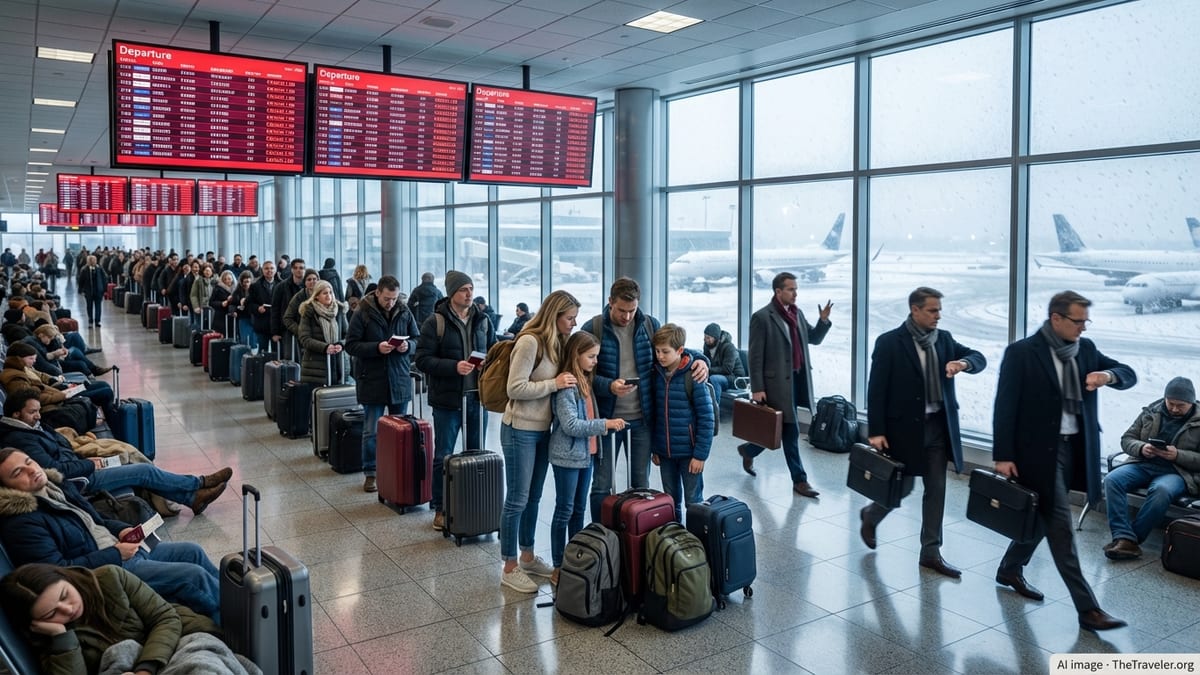
Fast-Moving Storms Disrupt One of the Nation’s Busiest Hubs
According to published Federal Aviation Administration advisories and local media coverage, a line of thunderstorms moved into the Chicago region during the late afternoon and early evening, reducing visibility, bringing strong winds and cloud-to-ground lightning, and prompting air-traffic managers to order a ground stop for flights bound for O’Hare. The storm activity coincided with a busy travel window, when afternoon bank departures and evening arrivals typically overlap.
Flight-tracking data cited in multiple reports shows that as the ground stop took effect, average departure delays at O’Hare climbed to roughly an hour or more, with some outbound flights held at origin airports for several hours while the worst of the weather passed. Arrivals also slowed significantly as controllers spaced aircraft farther apart in the storm cells and temporarily reduced the number of active arrival streams into the airport.
By the time the restrictions began to ease, cumulative disruption had become substantial. Aggregated tracking tallies pointed to well over 700 delayed flights associated with the thunderstorm event and subsequent recovery period, affecting both domestic and international routes that rely on O’Hare as a central connecting point.
Ground Stop Orders and How They Work
Publicly available FAA guidance describes a ground stop as a traffic-management tool used when conditions at an airport or in surrounding airspace deteriorate so quickly that standard delay programs are not sufficient. During a ground stop, departures bound for the affected airport may be held on the ground at their origin, and in some cases flights already in the air can be diverted or placed in holding patterns until conditions improve.
In this latest incident, advisory data indicates that the ground stop at O’Hare was tied directly to thunderstorms moving through the area, with the probability of extension listed as medium during the height of the storms. Once radar indicated that the most intense cells were shifting away from key arrival and departure corridors, restrictions began to transition to more conventional ground-delay programs, which meter arrivals at set rates to prevent runway and taxiway congestion.
Industry analysts note that while ground stops are comparatively rare compared with routine weather delays, they are more likely at large hub airports such as O’Hare where runway use is highly choreographed and even brief runway closures can sharply reduce capacity. Thunderstorms are a particular challenge because they may combine low ceilings, wind shear, and lightning, all of which can affect both airborne operations and ramp activity.
Ripple Effects for Travelers Across the Network
The sheer scale of O’Hare’s operation means that a localized weather event can quickly take on national dimensions. Flight schedules compiled for the day of the storm show more than a thousand arrivals and departures planned at the airport, with major network carriers using O’Hare as a central connecting point for itineraries across the Midwest, East Coast, West Coast, and international destinations.
As the ground stop and follow-on restrictions took hold, the growing backlog of delayed flights began to cascade across the system. Downline airports reported late arrivals, missed connections, and aircraft arriving out of sequence for their next scheduled legs. In addition to the more than 700 delayed flights tied to O’Hare, carriers faced secondary disruptions such as crews timing out under federal duty rules and aircraft being displaced from their planned overnight locations.
Travelers reported waiting on aircraft at outstations as departure times were repeatedly pushed back, as well as long lines at customer service desks as passengers rebooked missed connections. While many flights ultimately departed later in the evening or early the following morning once the storms cleared, some itineraries were cancelled outright when recovery windows closed or when overnight curfews and crew limits came into play.
Weather, Summer Demand and a Tight System
The thunderstorm-related ground stop comes at a time when summer travel demand is already stretching the air transport system. Recent government data for 2026 highlighted weather as a leading driver of flight delays nationwide, with convective storms in the Midwest and East frequently cited in air-travel consumer reports. O’Hare, as a high-volume connecting hub located in a region prone to rapid storm development, features prominently in many of those statistics.
Operational planning documents and industry commentary point to a combination of factors that can magnify the impact of a single weather event. High load factors leave fewer open seats to accommodate disrupted travelers, while tight aircraft and crew rotations mean a delay in one city can quickly affect flights hundreds or thousands of miles away. When a major hub like O’Hare experiences a ground stop, the knock-on effects can take a full day or more to unwind.
Airlines have attempted to blunt some of the impact by issuing weather waivers ahead of forecast storms, allowing travelers to change flights without standard penalties, and by adjusting schedules when confidence in severe weather forecasts is high. Even so, sudden thunderstorm development can still outpace those efforts, forcing real-time restrictions such as the ground stop that unfolded over Chicago.
What Travelers Can Expect After a Ground Stop
Once a ground stop is lifted, operations at airports such as O’Hare do not immediately return to normal. Traffic managers typically shift to carefully calibrated arrival and departure rates designed to keep runways busy without overwhelming gates and taxiways. Airlines focus first on operating flights that have already boarded or are carrying large numbers of connecting passengers, while also repositioning aircraft and crews to restore their broader schedules.
Travel experts note that for passengers, this often means continued delays even after weather has visibly improved. Flights may depart out of order, and luggage can take longer to reach baggage claim as ramp operations work through accumulated backlogs. Travelers on evening flights in particular may find that disruptions spill into the following day if their aircraft or crew is no longer available due to earlier knock-on effects.
Publicly available guidance generally encourages travelers to monitor their flight status through airline apps and airport information displays during active weather events, and to be prepared for last-minute gate changes or rebooking. For those with flexible plans, avoiding tightly timed connections through major hubs during periods of forecast thunderstorms can reduce the risk of becoming caught in the kind of large-scale disruption triggered by the latest ground stop at O’Hare.