


More news on this day
Severe thunderstorms over south-east England on Saturday have thrown operations at London’s Gatwick and Heathrow airports into turmoil, with hundreds of flights delayed or cancelled and some passengers facing waits of up to 11 hours.
Get the latest news straight to your inbox!
Hundreds of Services Hit as Storms Sweep South-East England
Published coverage from UK media and aviation data platforms on 27 June indicates that both Gatwick and Heathrow have seen widespread disruption as intense thunderstorm cells crossed the region. The storms, arriving after a spell of hot weather, have brought frequent lightning and heavy downpours that have sharply reduced the rate at which flights can safely take off and land.
Figures cited by broadcasters drawing on flight-tracking services show that more than 400 flights at Gatwick were delayed through Saturday, with close to 100 cancellations. At Heathrow, nearly 600 services were reported delayed and more than 100 cancelled, affecting tens of thousands of travellers across European, transatlantic and domestic routes.
Publicly available information from the UK’s air traffic control provider and airport operational boards suggests that restrictions put in place during the most intense phases of the storms have created long backlogs. With both airports operating close to capacity on busy summer weekends, even short suspensions and reduced arrival rates have cascaded into hours-long holds on the ground and in the air.
Passenger updates issued by Heathrow in recent weeks have repeatedly advised travellers to check directly with airlines for the latest status on departures and arrivals. On Saturday, those warnings took on new urgency as travellers encountered rolling delay estimates and last-minute gate changes across both hubs.
Lightning, Safety Protocols and Tight Capacity Amplify Delays
Meteorologists describe the current storm pattern over south-east England as highly unstable, with rapid development of towering thunderclouds capable of producing intense lightning and localised downpours. When lightning is detected in the immediate vicinity of an airport, ground operations such as fuelling and baggage loading are often paused for safety reasons, contributing to growing queues of aircraft waiting to depart.
Operational guidance and climate risk assessments for Heathrow note that poor weather can force runway closures or reduced spacing between aircraft, leading directly to flight disruptions and financial impacts for airlines. Industry material also highlights that lightning activity can temporarily halt ramp work, compounding delays even after a storm cell has moved away from the field.
The disruption is particularly acute at Heathrow and Gatwick because both airports run near their maximum declared capacity for much of the day. When thunderstorms force controllers to slow the arrival and departure flow, there is limited slack in the schedule to recover lost time. Aircraft and crews that are delayed on early rotations can quickly find themselves out of position for later flights, resulting in further cancellations.
Travel analysis published in recent months has repeatedly underlined how fast disruption can accumulate at busy European hubs when adverse weather coincides with staffing and air traffic control constraints. Saturday’s events fit that pattern, with the thunderstorms acting as a trigger for wider network congestion stretching beyond London to other airports on shared routes.
Passengers Face Long Queues, Missed Connections and Overnight Stays
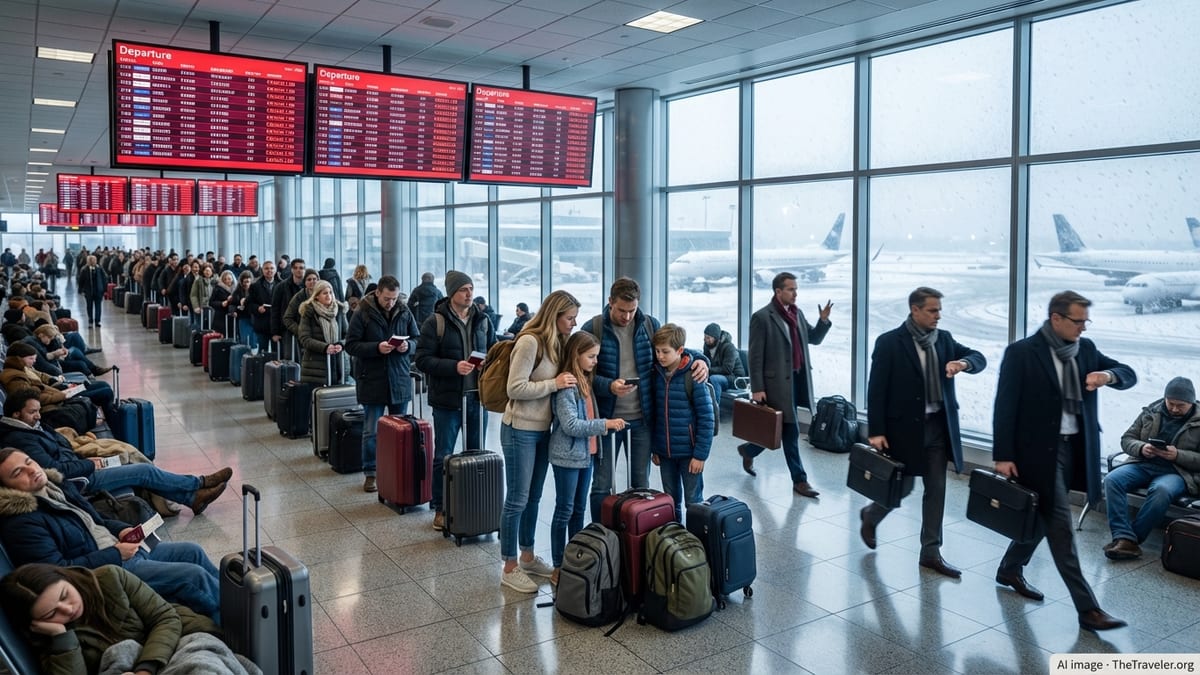
Images and reports circulating across news outlets and social platforms on Saturday show long lines at check-in desks and security lanes at both airports, as well as crowded departure lounges with passengers waiting for updated departure times. Some travellers have described waiting many hours on board aircraft or in gate areas while new take-off slots were arranged.
European and long-haul connections through Heathrow appear to have been particularly exposed, with passengers reporting missed onward flights after inbound services arrived several hours behind schedule. At Gatwick, where short-haul operators run dense turnarounds to holiday destinations, the combined effect of ground holds and restricted arrival flows has meant that delays on morning departures have spilled into late-evening rotations.
Previous disruption episodes documented by travel industry outlets this year show that when delays stretch into the late evening, some passengers end up requiring overnight hotel stays or rerouting through alternative hubs. With thunderstorms forecast to linger into the night and operational backlogs already sizable, airlines serving Heathrow and Gatwick face a challenging task in repositioning aircraft and crews for Sunday’s schedules.
Advisories from airport and airline channels encourage customers to arrive with additional time, keep contact details updated in booking profiles and use official apps or websites to track gate information. For those already abroad and flying into London, monitoring departure boards at origin airports has also become critical, as rolling disruption in the UK can ripple outward during peak travel periods.
Knock-On Effects for European Networks and Summer Travel Plans
The storms over London come at a time when many European carriers are already experiencing tight summer operations following earlier bouts of weather and air traffic control disruption in 2026. Aviation analysts quoted in recent weeks have pointed to lingering staffing gaps, constrained airspace on key routes and strong demand for leisure travel as factors that leave little margin when severe weather strikes.
Thunderstorm systems can be especially disruptive for air traffic because they affect multiple phases of flight. Strong vertical currents, wind shear and lightning risk make it more difficult to maintain normal arrival and departure rates, while convective cells lining major corridors can force aircraft to take longer diversionary routes, consuming additional fuel and time.
Recent case studies from other European hubs have underscored how a single day of storms can lead to widespread cancellations and delays, with aircraft and crews out of position for subsequent days. The situation unfolding at Gatwick and Heathrow on 27 June is raising concerns that similar recovery challenges could emerge, especially if further storm activity continues over the weekend.
Travel commentators note that the timing is particularly sensitive for families and holidaymakers starting school-break trips, as well as business travellers heading into the final week of June. With many flights already heavily booked, finding spare seats for re-routed passengers may prove difficult on some popular routes.
What Stranded Travelers Can Do Now
Consumer guidance published by regulators, airports and compensation specialists recommends that passengers affected by weather-related disruption take several immediate steps. Checking flight status frequently, using airline apps where possible, is seen as essential, as is confirming that the carrier has up-to-date contact details to send notifications about rebooking options or schedule changes.
For those stuck at Gatwick or Heathrow on Saturday, publicly available advice suggests keeping all receipts for essential expenses such as meals, local transport and accommodation. While eligibility for financial compensation often depends on whether a delay is judged to be caused by extraordinary circumstances like severe weather, airlines remain responsible for care and assistance when passengers are stranded for extended periods.
Travel-rights organisations and government resources also encourage travellers to familiarise themselves with European and UK regulations on delays and cancellations. During complex events where weather interacts with wider operational issues, it can take time for airlines to determine individual entitlements, but clear documentation of the disruption generally helps when submitting claims or refund requests.
With forecasts indicating that unsettled conditions could persist into Sunday, passengers due to travel through Heathrow or Gatwick in the coming hours are being urged in public advisories and media coverage to monitor conditions closely, allow extra time to reach the airport and prepare for the possibility of further schedule changes as the aviation system works to recover.