


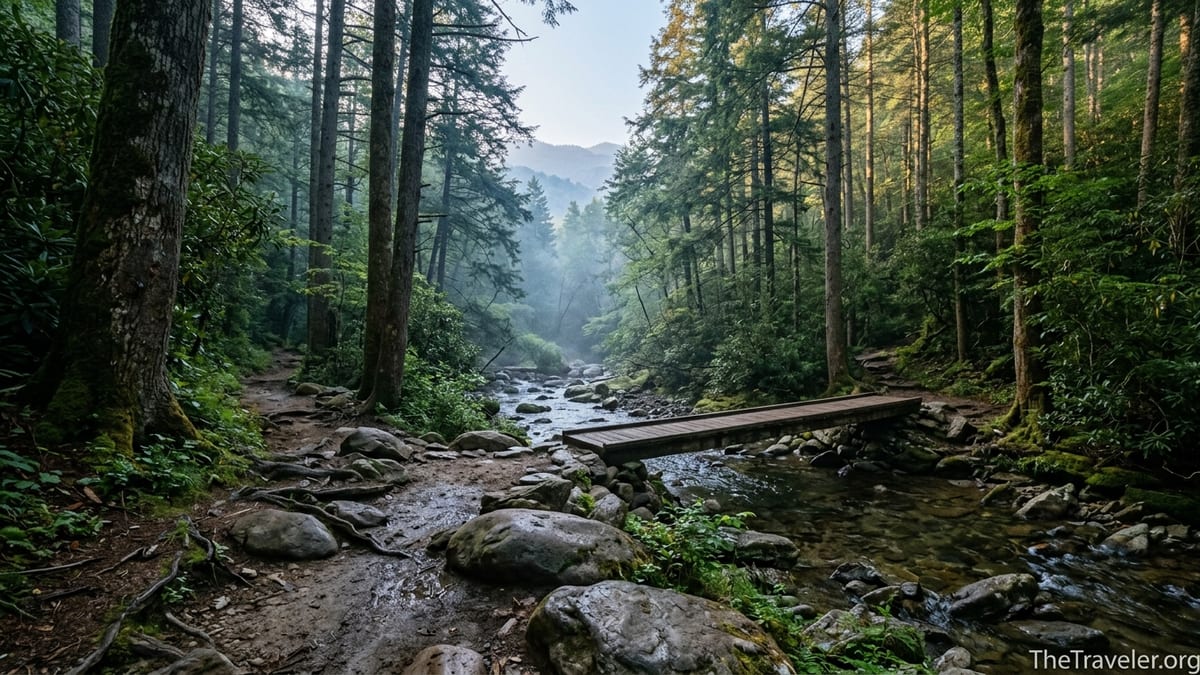
Alum Cave is one of the most popular hikes in Great Smoky Mountains National Park, rewarding hikers with creek crossings, stone staircases, dramatic bluffs and long views toward the Tennessee valleys. It is also one of the first trails to feel packed on busy days. With a bit of planning around season, day of week and hour of the day, you can turn a potentially hot, crowded slog into a cool, quiet, photogenic hike that feels closer to the wild Smokies of your imagination.
Get the latest updates straight to your inbox!
Know Your Trail: What Makes Alum Cave So Popular
The Alum Cave Trail climbs from Newfound Gap Road to a towering rock overhang called Alum Cave Bluffs, about 4.6 miles round trip. The National Park Service describes it as a moderately strenuous hike with stairs, steep sections, slick rocks and roots, and narrow passes such as Arch Rock. It is not a cave in the technical sense but a massive 75-foot overhanging bluff that stays dry underneath even on rainy days. The combination of waterfall-fed creeks, old-growth forest and a dramatic payoff in a relatively short distance is exactly why this hike draws such heavy visitation.
From the trailhead, the path follows Alum Cave Creek and Styx Branch in cool, shaded forest before climbing through Arch Rock and on toward Inspiration Point, an outcrop around 4,700 feet that looks across to Little Duck Hawk Ridge on clear days. Above that, you reach the sand-colored bluff itself, with views out over the ridges and valleys of the central Smokies. Many hikers stop here, but the trail continues as the primary route to Mount Le Conte, one of the park’s signature summits. Because it serves both casual day hikers and overnight guests at LeConte Lodge, Alum Cave sees a steady stream of people for much of the day in peak season.
The trailhead sits off Newfound Gap Road between Sugarlands Visitor Center and Newfound Gap. This road is the park’s main spine, and traffic from nearby Gatlinburg and Cherokee funnels directly past the parking area. On busy weekends the lot often fills early in the morning, and drivers circle or park along the road shoulder when they cannot find a space. The park now requires a daily or longer parking tag for any vehicle staying more than 15 minutes, which means nearly every Alum Cave hiker needs to plan for the tag as well as the timing of their arrival.
All of this popularity would not matter if you were hiking a wide fire road, but Alum Cave’s narrow switchbacks, creek bridges and rock stairs mean that heavy foot traffic can slow you to a stop in choke points. To enjoy the scenery instead of the back of the next hiker’s backpack, it pays to understand how crowds and weather ebb and flow through the year and through the day.
Best Seasons for Cooler Weather and Clearer Views
Great Smoky Mountains National Park is famous for its humidity and haze in midsummer, with July and August consistently ranking as peak visitation months. Around the Gatlinburg side of the park, high temperatures in those months regularly reach the 80s Fahrenheit at lower elevations, and the air on popular valley trails can feel muggy by late morning. While Alum Cave climbs to over 4,500 feet, making it cooler than downtown Gatlinburg, it is still noticeably warm and humid during peak summer afternoons, especially in exposed sections around the bluff.
If your goal is cooler hiking and better long-distance views, spring and fall shoulder seasons are your friend. From about mid-April through early June, daytime highs near the Newfound Gap corridor often land in the 60s and 70s Fahrenheit, with cool mornings in the 40s or 50s. This is also when the park’s famous wildflowers, including trillium, foamflower and violets, appear along creekside stretches of Alum Cave and neighboring trails. The water levels in Alum Cave Creek tend to be healthy from spring rains, so the small cascades you pass on the way to Arch Rock are at their most photogenic.
Autumn, roughly late September through early November, offers the best combination of crisp air and long-range visibility. Local tourism sources consistently highlight October as the prime foliage month in the Smokies, with color typically peaking at higher elevations in mid-October and sliding down toward the valleys through late October and early November. On a clear October morning, the views from Inspiration Point and the bluff itself often stretch across layered blue ridges under a sharp, transparent sky that is rare in hazy midsummer.
Winter can bring superb clarity and solitude, but it is far less predictable. Newfound Gap Road occasionally closes temporarily after snow or ice, and Alum Cave’s steep, rocky sections become hazardous when coated in ice. The bluff is notorious for falling icicles in cold weather, which the Park Service specifically warns hikers about. If you are experienced with winter hiking, equipped with traction devices and flexible on timing, a calm, cold day in January or February can be magical. For most visitors, however, spring and fall provide a safer, more comfortable way to combine cool weather and good visibility.
Timing Your Day: Beating Heat, Fog and the Parking Rush
On most days between late spring and late fall, the single smartest move you can make is to start your Alum Cave hike early. Local cabin companies and hiking blogs in the area routinely advise arriving at the trailhead by 5 to 6 a.m. on peak weekends if you want guaranteed parking. Hikers on busy holiday periods like Memorial Day report that even 8 a.m. can be too late for a straightforward parking spot, with drivers circling or parking down the road.
From a weather perspective, an early start lets you climb the lower, more humid part of the trail while air temperatures are still cool. In June, for instance, it is common for dawn temperatures along Newfound Gap Road to sit in the 50s Fahrenheit even if the afternoon will push into the upper 70s or low 80s. You can often complete the 4.6-mile round trip to the bluffs and back before the hottest part of the day. This is especially important for families with children or older hikers who may feel heat stress more quickly on the uphill return from Alum Cave.
Morning timing also helps with visibility. The Smokies’ name comes from natural haze created by moisture and organic compounds released by forests. In summer, that haze builds through the afternoon, sometimes blending with low clouds or thunderstorms that roll over the crest. By starting near sunrise, you increase your odds of clear views from Inspiration Point and Alum Cave before moisture thickens later in the day. In shoulder seasons, mornings can sometimes be foggy in the valleys but crystal clear at mid-elevations once the sun burns through, which means an early drive up Newfound Gap Road may take you from gray to brilliant blue skies in a matter of minutes.
If sunrise starts are not your style, a late-afternoon start can also work in longer daylight months, particularly in May, June and early July when sunset is late. Arriving around 3 or 4 p.m. on a non-holiday weekday often means some hikers have already vacated parking spaces, and temperatures begin to edge downward. You will need to be honest about your hiking pace and bring headlamps so you are not descending in the dark. For many moderately fit hikers, though, this timing yields a quieter trail, cooler air and golden-hour light falling across the bluffs and ridges.
Picking the Right Month for Fewer People on the Trail
Annual visitation statistics show that Great Smoky Mountains National Park is the most visited U.S. national park by a wide margin, drawing well over 10 million visits per year. Within that big number, patterns are still clear. July tends to be the single busiest month, followed closely by June and October. Holiday periods such as Memorial Day, the Fourth of July and mid-October weekends can feel particularly congested on popular trails such as Alum Cave, Laurel Falls and Chimney Tops.
To balance crowds and conditions, many local guides and repeat visitors point to late April and early May, as well as mid-September, as sweet spots. In late April, wildflowers are in bloom, creeks are lively and daytime highs are comfortable. Schools are still in session in most parts of the United States, and family summer vacation traffic has not yet arrived at full force. A Wednesday morning Alum Cave hike in the last week of April or first week of May, for example, is typically far quieter than a Saturday in June, even though temperatures can be quite similar.
Mid-September offers a different flavor of shoulder season. Summer crowds thin after Labor Day, yet the first half of the month still often feels summery, with warm afternoons and pleasantly cool mornings. Foggy dawns are common in the valleys around Gatlinburg and Cherokee, but by the time you reach the Alum Cave parking area much of the early fog may have lifted. On a typical mid-September weekday, you may still want to arrive by 7 or 8 a.m. to secure parking, but you are far less likely to encounter the shoulder-to-shoulder trail traffic that characterizes mid-October Saturdays at peak foliage.
If your schedule is fixed around peak times, such as a family vacation in mid-July or a fall break during peak color in October, you can still improve your experience with careful timing. Build your Alum Cave day around an early pre-breakfast hike, and save roadside stops like Newfound Gap or Clingmans Dome for later in the day when everyone else is already on the trails. Even in the busiest months, the simple act of starting two to three hours earlier than most visitors can make the difference between jostling at every creek crossing and enjoying stretches of relative quiet.
Using Shuttles, Parking Tags and Nearby Towns to Your Advantage
Logistics matter on Alum Cave days, particularly now that the park requires parking tags for most vehicles and the trailhead lot fills quickly. As of 2026, day-use parking tags are sold at visitor centers and various kiosks, and you can purchase them in advance online. They are relatively inexpensive, but rangers do ticket vehicles parked longer than 15 minutes without a valid tag. If you are staying in Gatlinburg, Pigeon Forge or Cherokee, it is wise to pick up your tag the evening before your hike and place it in your vehicle, so you can drive straight to the trailhead before dawn without detours.
Crowds have also fueled the growth of private shuttle services in the Smokies region. Several outfitters and cabin rental companies now operate early-morning shuttles that run guests from Gatlinburg or Pigeon Forge to trailheads like Alum Cave and Newfound Gap. These services typically cost a modest per-person fee and let you avoid the stress of hunting for a parking space in the half-light. They are especially useful during holiday weekends, when local drivers report needing to arrive as early as 5 a.m. to park at Alum Cave with their own vehicles.
Your choice of base town also affects your ability to time the hike. Staying in south Gatlinburg or along Newfound Gap Road, for example, cuts your morning drive time compared with lodging further out in Sevierville or Pigeon Forge. A cabin ten or fifteen minutes from the park entrance allows you to leave at 5:30 a.m., reach the Alum Cave lot around 6 a.m., complete your hike by late morning and still return to town for brunch. In contrast, staying 45 minutes away in a large resort complex may push your departure so early that it becomes unrealistic for your group.
After the hike, traffic patterns matter too. Newfound Gap Road can slow significantly on weekend afternoons as day visitors stop at overlooks and pullouts. By front-loading your hiking and leaving the higher-elevation corridor by midday, you reduce your odds of sitting in a long line of cars with hot brakes on the descent toward Gatlinburg. The same logic applies in reverse if you are based in Cherokee on the North Carolina side; an early start and early exit typically make for a calmer drive.
Weather Microclimates and Safety on the Alum Cave Trail
Elevation changes on Alum Cave create rapid shifts in temperature and conditions. The trailhead sits around 3,800 feet, while Alum Cave Bluffs are above 4,800 feet and Mount Le Conte’s summit, farther up the same path, rises above 6,500 feet. Air temperatures commonly drop a few degrees for every 1,000 feet of climbing, so you may feel a noticeable difference between the parking area and the bluff, especially in spring and fall. A morning that starts in the low 50s Fahrenheit at the trailhead can feel closer to the 40s in shaded sections near the top.
Moisture adds another layer. Creek crossings and shaded coves trap cool, damp air well into late morning, while open stretches near Inspiration Point and the bluff can feel surprisingly warm on sunny afternoons. Afternoon thunderstorms are a regular feature in summer, often developing with little warning. Planning to be off the higher, more exposed parts of the trail by midafternoon reduces your risk of encountering lightning, heavy downpours or rapidly forming fog banks.
In colder months, ice is a serious concern. The Park Service specifically warns visitors to watch for falling icicles and icy footing around Alum Cave in winter conditions. Water seeping from the bluff freezes into long icicles that can shed without warning when temperatures rise. Even when the main Newfound Gap Road is open and clear, shaded trail sections, stone stairs and footbridges can harbor hard ice that makes falls more likely. If you are visiting between late November and early March and are committed to hiking Alum Cave, it is wise to carry traction devices that fit over your boots and to be flexible enough to turn around if conditions deteriorate.
Because weather can shift quickly in the Smokies, always check the latest forecast posted at Sugarlands Visitor Center or on the National Park Service website before your hike. Pay attention to wind speeds at higher elevations as well as temperature and precipitation. A seemingly small difference, such as a forecast of 45 degrees and breezy versus 55 and calm at Newfound Gap, can translate into a dramatically different experience on a damp, shady section of trail near the bluff.
The Takeaway
Alum Cave is popular for good reason: it offers some of the best scenery in Great Smoky Mountains National Park within a half-day hike. That popularity does not have to mean crowds, heat and parking frustration if you time your visit with care. Aim for shoulder seasons like late April, early May or mid-September for comfortable temperatures and manageable visitation, and consider weekday hikes whenever you can.
On the day itself, build your plan around an early start. Reaching the trailhead near sunrise dramatically improves your chances of finding a space, hiking in cool air and enjoying clearer views from Inspiration Point and the bluffs. If early mornings are not realistic for your group during peak periods, look into shuttle options that remove the stress of parking and allow you to focus on the trail.
Finally, respect the Smokies’ changeable weather and the Alum Cave Trail’s terrain. Pack layers for elevation changes, stay alert for thunderstorms or ice, and be willing to turn around if conditions exceed your comfort level. With those precautions and some thoughtful scheduling, you can experience Alum Cave as it is meant to be seen: in cool air, under crisp skies, with more birdsong than small talk carrying through the trees.
FAQ
Q1. What is the best month to hike Alum Cave for cooler weather and fewer crowds?
Late April, early May and mid-September usually offer a good balance of cool temperatures, decent visibility and lighter trail traffic compared with peak summer and fall foliage weekends.
Q2. How early should I arrive at the Alum Cave trailhead to get parking?
On busy weekends from late spring through fall, aim to arrive between 5 and 7 a.m. Weekdays and shoulder-season dates may allow a slightly later start, but earlier is almost always better.
Q3. Is summer a bad time to hike Alum Cave?
Summer brings heat, humidity and the heaviest crowds, especially in June and July, but an early-morning or late-afternoon start can still make for an enjoyable hike if that is when you can visit.
Q4. When are fall colors best on the Alum Cave Trail?
Fall color at higher elevations near Alum Cave often peaks in mid-October, with vivid foliage typically continuing downslope into late October and sometimes early November, depending on the year.
Q5. Can I hike Alum Cave in winter for better views and fewer people?
Yes, but only if you are prepared for winter conditions. Expect possible ice on the trail, falling icicles from the bluff, and occasional temporary road closures after snow or storms.
Q6. Do I really need a parking tag for an early-morning hike?
Yes. The park requires a valid parking tag for most vehicles staying more than 15 minutes at trailheads like Alum Cave, regardless of the time you arrive or how early you start.
Q7. Are shuttle services worth it for Alum Cave?
For holiday weekends and peak months, shuttles can be very helpful. They reduce parking stress, let you start earlier without driving in the dark as far, and can be cost-effective for small groups.
Q8. What time of day usually has the clearest views from Alum Cave?
Morning typically offers the best mix of cooler temperatures and clearer air, before humidity and natural haze build. Early to midmorning hours often have the sharpest long-range views.
Q9. How long does the Alum Cave hike take for an average hiker?
Most moderately fit hikers complete the 4.6-mile round trip to Alum Cave Bluffs in about 3 to 4 hours, including time for short breaks and photos, assuming normal trail and weather conditions.
Q10. Is Alum Cave suitable for kids or newer hikers if we choose a cool, less crowded time?
Yes, many families hike to Alum Cave, especially in cooler months and early in the day. The trail is still steep and rocky in places, so give yourselves extra time and bring plenty of water and snacks.