


Ask regulars in Great Smoky Mountains National Park which trail they return to most and Alum Cave comes up again and again. What begins as a straightforward creekside walk off Newfound Gap Road somehow turns into the hike people compare everything else to. They plan sunrise starts around it, bring visiting friends to it, and use the Alum Cave Bluffs as a personal benchmark for fitness, seasons and even life milestones. There are longer, higher and tougher trails in the Smokies, but few inspire the same low-key obsession.
Get the latest updates straight to your inbox!
A Trail That Feels Like the Smokies in Miniature
Part of Alum Cave’s pull is that it feels like a highlight reel of the Smokies in a single outing. From the trailhead, you cross Walker Camp Prong and Alum Cave Creek on a series of log bridges, with cold, clear water rushing just below your boots. Within the first half mile, the path is walled in by mossy boulders and tulip poplars, with that dense, damp forest smell many hikers associate with their very first visit to the park. For travelers based in Gatlinburg or Cherokee looking for “one classic hike,” this variety makes Alum Cave an easy recommendation.
As the trail climbs, the character changes quickly. After about 1.3 miles, you reach Arch Rock, where stone stairs lead you through a narrow natural tunnel in the rock itself. A little farther on, the forest thins as you approach Inspiration Point near mile 2, a rocky outcrop with a sudden, wide view into the rugged valley below. By the time you step under the Alum Cave Bluffs around 2.3 miles, the trail has served up creeks, old-growth forest, rock formations and vistas, all in a relatively moderate out-and-back.
This “greatest hits” quality matters in practice. Many visitors only have one full day inside the park, and Alum Cave lets them feel like they have sampled what makes the Smokies special. Families staying at cabins in Pigeon Forge or motels in Gatlinburg often choose Alum Cave because it fits neatly between a late breakfast and an early dinner, yet still feels like a real mountain day. That satisfying ratio of effort to reward is one big reason people end up hiking it again on their next trip.
Alum Cave also serves multiple skill levels. Some hikers turn around at Arch Rock for an easier 2.8 mile round-trip, while stronger hikers press on to the bluffs or even continue all the way to Mount Le Conte for a demanding 10-plus mile day. Within one carload you might have grandparents stopping at the bluffs and adult children pushing to the summit, all sharing the same trailhead and early stretches. That flexibility keeps the trail in the rotation for groups whose abilities change year to year.
The Drama of the Alum Cave Bluffs
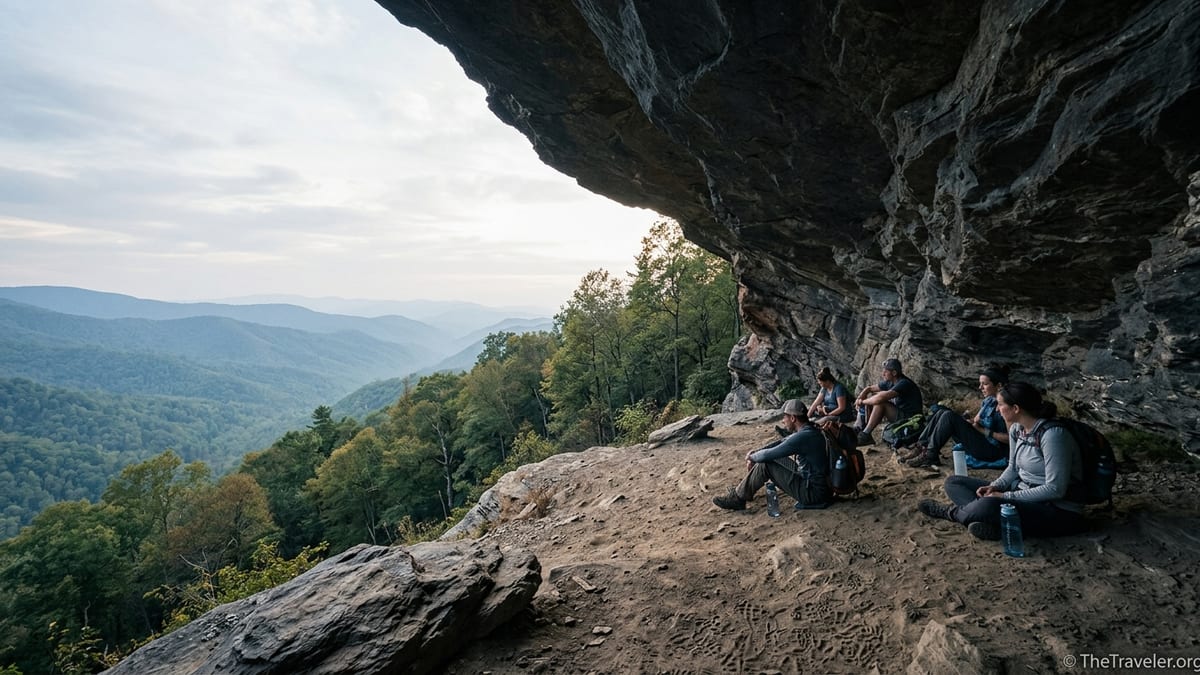
Despite its name, Alum Cave is not a traditional cave but a massive concave bluff, a rock shelter carved into the mountainside. When you step under the overhang, the ground abruptly becomes dry and dusty, even while the air and soil just outside can feel damp. Hikers often describe a strange sense of stepping into another climate, which feels even more striking in a national park famous for its humidity and frequent fog.
The bluff itself soars more than 80 feet above the trail, forming a kind of natural amphitheater. Many visitors pause here for a long break, spreading out along the base of the wall with snacks or simple trail lunches picked up earlier in Gatlinburg. The view from the back of the shelter, looking out across the valley through a frame of rock, photographs particularly well in softer morning light when the ridges are layered with blue haze. It is common to see people sitting quietly here for 20 or 30 minutes, which is not typical behavior at smaller viewpoints where hikers tend to snap a photo and move on.
That lingering changes how people remember the place. A couple celebrating an anniversary may share coffee from a small thermos under the bluffs at sunrise in late October, watching the first light hit the ridges. A solo hiker visiting in early spring might shelter there from a passing shower, listening to the sound of rain hitting the bluff’s lip while the ground beneath them stays bone dry. These kinds of moments, attached to a very specific physical space, are what bring people back in different seasons and stages of life.
There is also a sense of achievement tied specifically to reaching the bluffs. The first 2.3 miles from the trailhead involve about 1,200 feet of elevation gain, which is enough to feel accomplished without being a full-day sufferfest. For visitors new to mountain hiking, being able to point to that vast rock face and say “I made it there” becomes a memorable benchmark. Later, when they return to the Smokies, many want to see how much easier it feels the second or third time.
The Gateway to Mount Le Conte
For serious hikers, Alum Cave’s hold often has more to do with what lies beyond the bluffs. Continue uphill another 3.2 miles and you reach the summit area of Mount Le Conte, one of the park’s signature peaks and home to the rustic LeConte Lodge. The full route via Alum Cave is roughly 11 miles round-trip and gains more than 2,700 feet, placing it firmly in strenuous territory. Yet because the first half of the hike is shared with casual visitors bound for the bluffs, many people are introduced to the idea of hiking Le Conte while they are still deciding whether to push on.
This is how an obsession often starts. Someone hikes to Alum Cave on a spring break trip and hears another group talking about staying overnight at the lodge, which typically books up months in advance and must be reached on foot. On a future visit, they train specifically for Le Conte, maybe adding local hill workouts back home or shorter Smokies hikes like Rainbow Falls or Chimney Tops earlier in the week. Alum Cave becomes their launch pad into more ambitious goals, not just a one-off viewpoint.
Even day hikers who turn around at the bluffs sometimes return years later specifically to continue all the way to Mount Le Conte. The steep, narrow traverses with cable handrails above the bluffs, the way the forest shifts into spruce-fir as you climb, the feeling of emerging near the lodge cabins and vistas like Cliff Tops all become part of an extended Alum Cave story. Ask around campgrounds such as Elkmont or Smokemont and you will often hear people refer to “doing Alum” as shorthand for the entire Le Conte day.
On a practical level, Alum Cave’s position on Newfound Gap Road makes logistics simpler for those Le Conte ambitions. Travelers staying in Gatlinburg, for example, can reach the trailhead in about 25 to 30 minutes in normal traffic. Authorized shuttle companies from nearby towns routinely drop hikers at the Alum Cave parking area in the early morning and pick them up later in the day, which is particularly useful for those who prefer not to drive mountain roads in the dark. This accessibility lowers the barrier to planning repeat hikes that build on one another.
History, Geology and Stories in the Rock
Part of what hooks detail-oriented hikers on Alum Cave is the sense that the trail has layers of history underfoot. Long before vacationers arrived, the area around Alum Cave was known for minerals. In the 1800s, crews mined the bluff for epsom salts and alum, which were used in everything from medicine to leather tanning. Later, during the Civil War era, the minerals became valuable for making gunpowder. Traces of that industry are still present in subtle ways, from old worksites to place names, and local guides often weave those stories into their trail descriptions.
The rock itself tells a story, too. The bluff is not a simple wall but a complex formation of dark slate and other sedimentary layers that have been slowly undercut by erosion. Sharp-eyed hikers notice the way water seeps and stains the rock in streaks, or how the cliff face seems to lean out over the trail in some sections. Along the approach, Arch Rock stands as a separate geological curiosity: a naturally formed arch that hikers climb through by way of narrow stone steps and a built handrail, one of the most photographed features on any Smokies trail.
When hikers discover these details on a first trip, many feel compelled to return with more time and curiosity. It is common to hear people say that on their second or third hike they spotted old inscriptions, unusual lichen patches or small side paths to better lookouts that they had completely missed the first time. Some enthusiasts keep personal photo collections of the same rock faces in different seasons, using Alum Cave almost as a living field notebook for their interest in geology and natural history.
For travelers with kids or teenagers, the tangible history can be a hook. Parents often frame Alum Cave as both a hike and a living classroom, pointing out how the bluff provided shelter, how mining altered the area, and how modern restoration projects stabilized the trail beginning in 2015 to protect it from erosion. That mix of story and scenery can make an impression that pulls families back during future school breaks.
Seasons, Light and the Changing Mood of the Trail
Many hikers who fall in love with Alum Cave talk about collecting it in different seasons. In April and May, the lower sections of trail are bright with new green leaves and spring wildflowers tucked into the banks along the creek. By early June, rhododendron and mountain laurel begin to bloom higher up, turning the approach to Inspiration Point into a corridor of white and pink. Summer mornings can be cool and misty along the water, then warming quickly as you climb toward the bluffs.
Autumn, though, is when the obsession often deepens. Starting in early to mid October, color creeps up the valley, with maples and birches below the trailhead turning brilliant red and yellow. Viewed from the Alum Cave Bluffs, the hillsides can appear quilted with color in good foliage years, and hikers who catch that combination of clear air and full color tend to talk about it for years afterward. Many book repeat trips for the same week in October, hoping to hit the timing just right again.
Winter changes the trail’s character entirely. On cold mornings, icy patches form on the rocks and wooden steps, especially past Arch Rock, and experienced hikers often carry traction devices like microspikes to keep their footing. Icicles can hang from the overhang of Alum Cave itself, sometimes several feet long, catching low sunlight against the dark rock. For some locals, a careful winter ascent to the bluffs is a yearly ritual precisely because it feels so different from the crowded, leafy days of July.
Light also plays a part in the trail’s appeal. Early starters see the valley gradually brighten as they climb, while evening hikers sometimes time their return so that the last light filters through the trees along the creek. Photographers who visit repeatedly learn how the angle of sun plays off the textures of the bluff, or how fog in the valley looks from Inspiration Point after a front has moved through. Chasing these subtly different conditions is another way the trail becomes more than a one-time outing.
Community, Ritual and the Culture Around Alum Cave
Beyond scenery, Alum Cave functions as a kind of informal meeting place for Smokies regulars. Arrive before sunrise in peak season and you may find dozens of cars already in the parking lot, headlamps bobbing as hikers organize gear and chat in hushed voices. Trail runners warming up for a fast push to Le Conte, families unloading daypacks, and photographers adjusting tripods all share the same few hundred yards of trail before naturally spreading out. Over time, people who visit annually start to recognize this rhythm and even specific types of fellow hikers.
For cabin owners and seasonal workers in nearby towns, Alum Cave often becomes a personal gauge of fitness and time. Some aim to hike to the bluffs once a month when the road is clear, tracking how long it takes them to reach Inspiration Point or how steady their breathing feels on steeper stretches. Others set informal rituals, such as a New Year’s hike to Arch Rock or a birthday ascent to the bluffs with a favorite snack. Because the hike is challenging but approachable, it lends itself well to these repeatable traditions.
Online, Alum Cave comes up regularly in trip-planning threads and social media posts about the Smokies. Travelers asking “If I can only do one moderate hike near Gatlinburg, what should it be?” frequently receive enthusiastic replies pointing them to Alum Cave. Those recommendations often include personal anecdotes: a first-ever mountain hike, a proposal under the bluffs, a meaningful conversation on the way back down the creek. As more people show up because of those stories and then share their own, the trail’s reputation feeds on itself.
The park’s own management decisions reinforce Alum Cave’s central role. The trail has benefited from substantial restoration work to improve drainage and footing, and it is regularly mentioned in official materials as one of the park’s premier day hikes. Authorized shuttle operators list Alum Cave among their standard stops, and ranger programs sometimes reference the trail when discussing safe hiking, changing weather and the importance of staying on established paths. When a park treats a place as emblematic of its hiking experience, visitors tend to follow.
Planning Your Own Alum Cave Hike
For travelers who find themselves curious about Alum Cave after hearing the hype, a bit of planning can make the first experience more enjoyable and safer. The trailhead sits along Newfound Gap Road between Gatlinburg, Tennessee, and Cherokee, North Carolina, and parking is limited to a defined lot and designated pullouts. Because Great Smoky Mountains National Park now requires a parking tag for vehicles left more than 15 minutes, most visitors either purchase a daily tag for a modest fee or opt for a longer-duration tag if they plan to explore multiple days. Tags are sold at visitor centers such as Sugarlands and Oconaluftee and at some auto-pay kiosks, but not at every trailhead, so it is wise to arrange one before driving up to Alum Cave.
Arriving early is key in busy months, particularly from late spring through fall weekends and holiday periods. It is not unusual for the main lot to be close to full by mid-morning in October, for example, which is why some hikers now book seats with authorized shuttle companies out of Gatlinburg, Pigeon Forge or Cherokee. These services typically operate seasonally from around March through October and drop hikers directly at popular trailheads such as Alum Cave, eliminating parking stress and reducing traffic congestion on the mountain road.
On the trail itself, conditions can change quickly with elevation and weather. Even in summer, the air along the creek can be cool in the morning, while temperatures near the bluffs later in the day may feel significantly warmer. Pack layers, rain protection and more water than you think you will need, particularly if you might decide on the spur of the moment to continue beyond the bluffs toward Mount Le Conte. Simple trail food like sandwiches, nuts and fruit from local grocery stores or Gatlinburg outfitters can turn the break under the bluff into an impromptu picnic.
Finally, set reasonable expectations. The 4.6 mile round-trip to Alum Cave Bluffs involves a sustained climb that can feel demanding for those not used to elevation gain, and the higher sections of trail can be narrow with drop-offs. Take breaks as needed, yield courteously on tight spots, and remember that turning around at Arch Rock or Inspiration Point is still a successful day. One reason so many people become attached to Alum Cave is that it treats them well at every level of confidence and ambition, from first-timers to seasoned Smokies hikers.
FAQ
Q1. How long is the Alum Cave Trail and how difficult is it?
The hike from the trailhead to Alum Cave Bluffs and back is about 4.6 miles round-trip with a steady climb that many people rate as moderate. Continuing on to Mount Le Conte via the same trail creates an 11 mile round-trip that most hikers consider strenuous.
Q2. How long does it typically take to hike to Alum Cave Bluffs?
Most visitors allow 3 to 4 hours for the round-trip to Alum Cave Bluffs, including time for photos and a snack break under the overhang. Very fit hikers may move faster, while groups with children or frequent stops should plan on the longer end of that range.
Q3. Do I need a parking reservation or permit for the Alum Cave trailhead?
You do not need a timed reservation, but you do need a valid Great Smoky Mountains National Park parking tag if your vehicle will be parked for more than 15 minutes. Daily, weekly and annual tags are available at visitor centers and some automated kiosks.
Q4. When is the best time of year to hike Alum Cave?
Alum Cave can be hiked year-round, but late spring through fall is most popular for milder temperatures and longer daylight. October draws many hikers for fall foliage, while winter offers quieter trails and dramatic ice formations for those prepared for cold and potentially icy conditions.
Q5. Is Alum Cave suitable for children and beginners?
Many families hike at least part of Alum Cave, especially to Arch Rock or Inspiration Point, but the trail does include roots, rocks and some steeper sections. Beginners should take their time, wear sturdy footwear and turn around wherever the group still feels comfortable and energetic for the return.
Q6. Can I bring my dog on the Alum Cave Trail?
No. Dogs are not allowed on most Smokies hiking trails, including Alum Cave, with the exception of trained service animals that meet specific federal guidelines. Visitors with pets can instead use the Gatlinburg or Oconaluftee river trails, where leashed dogs are permitted.
Q7. Are there restrooms or water sources on the trail?
There are typically restroom facilities at or near the trailhead, but no toilets or treated water along the trail itself. Hikers should arrive with full water bottles or hydration reservoirs and plan to pack out all trash.
Q8. Do I need special gear to hike Alum Cave?
In fair summer weather, most hikers use sturdy walking shoes or light hiking boots, a small daypack, water, snacks and basic rain protection. In colder months, especially when ice is possible, traction devices that slip over boots and warm layers are strongly recommended.
Q9. How crowded does Alum Cave get and how can I avoid the worst of the traffic?
As one of the most popular trails in the park, Alum Cave can be very crowded on weekends and during peak seasons. To avoid the heaviest traffic, start at or shortly after sunrise, consider hiking on weekdays, or use an authorized shuttle so you are not limited by parking availability.
Q10. Is it safe to hike Alum Cave in bad weather?
Conditions such as thunderstorms, high winds, heavy rain or winter ice can make sections of the Alum Cave Trail hazardous, especially past the bluffs. If the forecast looks poor, it is safer to postpone your hike or turn around early rather than continuing into more exposed, slippery terrain.