


Landing at Tocumen International Airport in Panama City can feel hectic, especially if you arrive late at night after a long flight. Knowing exactly how to get from the terminal doors into a safe, fairly priced taxi can make the difference between a smooth start and a stressful first impression of Panama. This guide explains how official airport taxis work, what you can realistically expect to pay to major hotel areas, how late-night arrivals are handled, and how to steer clear of informal drivers who may overcharge or operate without proper authorization.
Get the latest updates straight to your inbox!
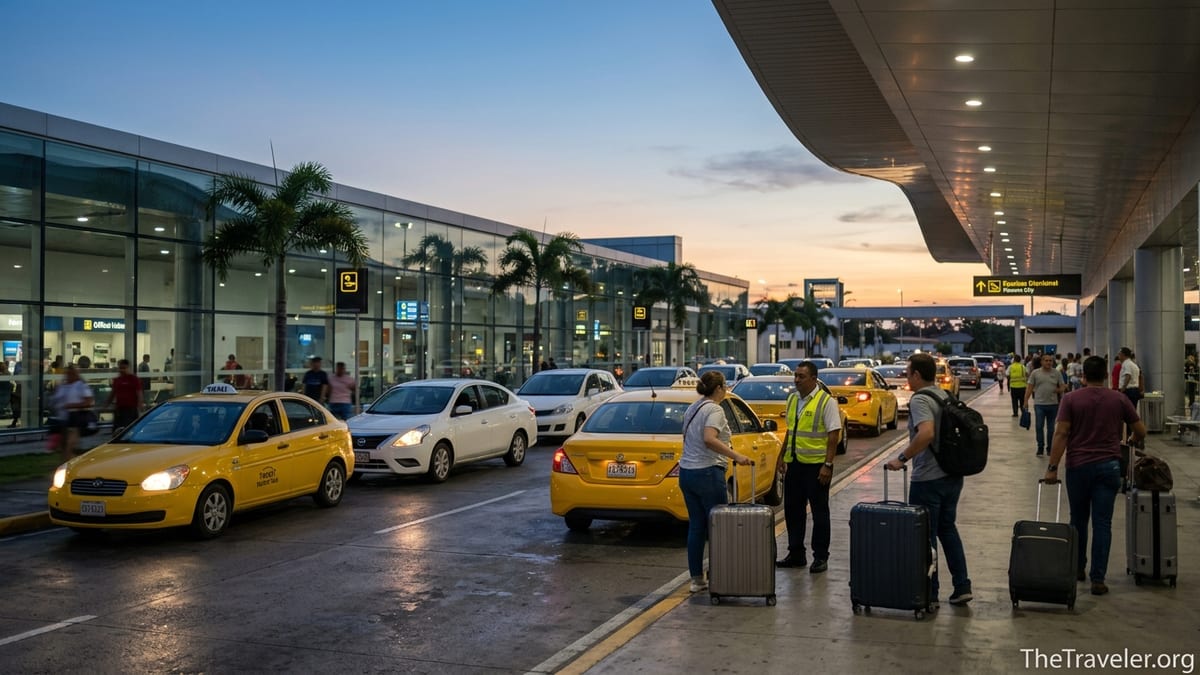
How Taxi Service Works at Tocumen International Airport
Official taxi service at Tocumen International Airport is organized, but it may look confusing if you are used to metered cabs. Instead of hailing any car outside, you are expected to use the authorized tourism taxis that operate under agreements with airport and transport authorities. At Tocumen, these are typically yellow or clearly marked tourist taxis that work with a fixed tariff table by destination zone rather than a running meter. You do not negotiate in the parking lot; you confirm or are quoted your price before getting into the car, usually at a small stand or directly with the driver just past customs and baggage claim.
Authorized taxis operate 24 hours a day, in line with the airport’s role as a major regional hub with many late-night and early-morning arrivals. Even after the last daytime buses or free shuttles stop, you will still find licensed taxi drivers waiting on the ground transport level outside arrivals. The flow is simple: clear immigration, collect your luggage, walk out through customs, then follow signs for taxis or ask an airport staff member to point you toward the official taxi queue. Uniformed airport staff are used to this question and will typically direct you away from the drivers who approach you in the public area.
Unlike some airports where taxis may compete aggressively at the curb, Tocumen’s official taxis are supposed to line up in a dedicated area and take passengers in order. In practice, you may still be approached inside the terminal by individuals offering a ride, especially at busy times. Treat anyone who walks up to you unsolicited as a potential informal driver and either decline politely or say that your hotel is sending a car. When in doubt, walk to the clearly signed taxi area where multiple similar-looking vehicles are waiting, rather than following a single person away from the flow of other travelers.
For travelers staying at well-known business hotels or tourist properties, drivers usually know the names and locations by heart: for example, “Hotel Riu Plaza,” “Waldorf Astoria Panama,” or “American Trade Hotel” in Casco Viejo. If your accommodation is a smaller guesthouse or an apartment rental, save the address in Spanish and a pin on your phone ahead of time so you can show it to the driver. Panama City traffic can be dense during rush hour, and having a clear destination minimizes misunderstandings and detours.
Understanding Fares, Zones and What You Should Expect to Pay
Taxi fares from Tocumen are based on a zone system rather than a meter. The official tariffs published by airport and transport authorities set approximate flat prices for different parts of the city, such as central Panama City, the banking district along Avenida Balboa, or historic Casco Viejo. These zone fares are reviewed periodically, but in practice many drivers quote rounded figures in US dollars, which is the everyday currency used in Panama alongside the balboa. The exact amount may vary slightly depending on the number of passengers, type of vehicle and whether highway tolls are included.
As a practical benchmark, travelers typically report paying in the region of 25 to 35 US dollars for a standard taxi from Tocumen to central hotel areas in Panama City, such as El Cangrejo, Obarrio, Avenida Balboa or Punta Paitilla. Trips to hotels in the historic Casco Viejo district may be around the same range or slightly more, especially late at night or with heavy traffic. If you are sharing the taxi with other passengers, some drivers will add a small supplement per person, while larger minivans or “coaster” style vehicles used by tour groups can cost more but are economical when filled.
The most important step is to agree the total cost before you get into the taxi. At Tocumen, the tariff for your destination should be confirmed verbally or shown on a printed table. If you are quoted a price that feels significantly higher than these typical ranges to central hotel zones, respond calmly and ask if that is the official airport rate or whether it includes extras like tolls. For example, if one driver quotes 50 dollars to a hotel on Avenida Balboa without explanation, you are not obliged to accept. You can step back to the line and wait for another driver who respects the standard zone fare.
Keep in mind that there can be legitimate reasons for a higher fare. If you are traveling to more distant areas such as Panama Pacifico on the other side of the canal, resort complexes toward Playa Bonita, or residential neighborhoods far from the tourism and business corridors, your fare will understandably be higher than to the downtown hotel belt. Very late-night arrivals, especially after midnight, may also come with a modest surcharge that drivers often justify by lower return traffic and safety considerations. Nonetheless, you should still be able to get a clear, fixed figure upfront rather than an open-ended estimate.
Authorized Taxis vs Ride-Hailing and Private Transfers
Once you step into arrivals at Tocumen, you essentially have three realistic options for getting into the city without using public buses: an official airport taxi, a ride-hailing service booked via app, or a pre-booked private transfer. Each option has its own rhythm and price range. Official taxis are the most visible and require no advance preparation. Ride-hailing apps such as Uber and similar regional platforms often operate in Panama City, but at various moments they have faced regulatory tension, particularly around the airport. As a result, drivers may prefer to meet you in the parking lot or on the departures level rather than the main arrivals curb.
If you choose a ride-hailing app, expect to pay roughly comparable or slightly lower prices than official taxis during off-peak times, with the advantage of seeing an estimated fare on your phone and having the trip recorded. However, dynamic or surge pricing can push the app fare close to or even above the official taxi rate at busy hours, such as around evening bank commuter traffic or when multiple long-haul flights arrive together. Drivers might message you asking you to walk to a more discreet pick-up spot to avoid conflicts with taxi operators. If you are tired, carrying several suitcases or traveling with small children, this extra walk and coordination in the tropical heat might not be worth a modest saving.
Pre-booked private transfers, arranged through your hotel or a reputable transfer company, are the most predictable but rarely the cheapest. These services set a fixed, pre-paid price, often in the same band as a higher-end taxi fare, and a driver meets you in arrivals holding a sign with your name. Private transfers can be a good choice for families with multiple bags, late-night solo travelers who value a guaranteed pickup, or business travelers who need a receipt and predictable service. Many of the better city hotels near Via España, Calle 50 or Avenida Balboa either run their own shuttles at set times or can book an established partner transfer service that tracks your flight.
For many visitors, a straightforward approach works well: take an official taxi into the city on arrival, then use a mix of taxis and ride-hailing apps afterwards when you are more rested and have your local bearings. This way, you avoid navigating app pick-up points on your first night while still being able to take advantage of any cheaper app fares for later journeys, such as trips to the Albrook bus terminal, the Amador Causeway, or shopping malls like Multiplaza and Albrook Mall.
Safety, Scams and How to Avoid Informal Drivers
From a personal safety perspective, authorized airport taxis at Tocumen are generally considered safe for travelers, including solo visitors and families arriving late at night. The more common risk is financial: paying more than necessary or dealing with a driver who inflates the fare after arrival. Informal drivers who approach you in the terminal or immediately outside the doors may offer “good prices” or insist that the official taxis are “finished for the night.” In reality, these unsolicited offers are almost always a red flag. At best, you may end up paying far more than the official tariff. At worst, you could be getting into an unregulated vehicle with no recourse if something goes wrong.
A simple rule for Tocumen is to initiate the taxi interaction yourself. Walk to the official taxi area or approach a taxi counter where available, instead of following the first person who says “Taxi, my friend.” Keep your luggage with you and do not allow anyone to wheel your bags away toward a car unless you have already agreed on the price and confirmed that the vehicle is part of the authorized airport fleet. Formal airport taxis usually have visible identification, such as a company name and license numbers, rather than a plain private car with no markings. If the price being pushed feels vague or the driver is reluctant to answer direct questions about cost, politely step back.
Another protection is to keep small bills in US dollars handy. Trying to pay a 25 to 30 dollar fare with a 100 dollar bill at one in the morning is an unnecessary complication. Some scam attempts in other Latin American airports involve insisting that the large bill is counterfeit or claiming that change is unavailable, pressuring the traveler to accept an unfavorable settlement. At Tocumen, using official taxis and having roughly exact cash helps you avoid this scenario. Panama is highly dollarized, and 5, 10 and 20 dollar bills are widely accepted by drivers.
Finally, trust your instincts about the vehicle and driver. The general foreign-travel advice given by several governments for Panama is to favor known companies, hotel-arranged vehicles or ride-hailing apps over unmarked street taxis elsewhere in the country. Around Tocumen specifically, if a taxi looks poorly maintained, if seat belts do not work or if the driver appears impaired, you are within your rights to decline and take the next car in line. A brief moment of awkwardness is a small price to pay compared to spending 30 to 40 minutes in a vehicle where you feel uncomfortable.
Late-Night Arrivals, Luggage and Dealing With Delays
Tocumen functions as a major connection hub for flights across the Americas, and a significant number of long-haul flights arrive late at night or very early in the morning. Landing at 23:30 or 01:00 is common, and many first-time visitors worry whether taxis will still operate or if the situation becomes less safe after dark. In practice, official taxis run 24 hours, and you will almost always find cars waiting, although the line may be shorter and you may wait a few extra minutes while drivers finish runs into the city and return to the airport.
If your flight is delayed and you emerge into the arrivals hall well after midnight, stay inside the terminal while you orient yourself. Use the time to withdraw cash from a bank ATM inside the secure area, buy a bottle of water, and double-check your hotel’s address. When you are ready, walk directly to the taxi area without lingering outside with your bags. Late at night, there may be fewer airport staff on duty, but security presence is still visible, and there will typically be other passengers heading to taxis at the same time. If you feel uncertain, you can ask an airline representative at the arrivals exit to point you toward the official taxi rank.
In terms of luggage, official taxis at Tocumen are used to handling big suitcases and long-haul passengers. Standard sedans can usually fit two large checked bags and two carry-ons in the trunk and back seat. If you are traveling as a family of four with multiple large suitcases, consider requesting a larger vehicle or minivan. Some drivers will spontaneously suggest a bigger vehicle when they see your luggage load, sometimes for a small increase on the standard fare. A typical real-world example would be a family of four landing from North America with four checked bags and four carry-ons having the option to upgrade to a minivan for a modest surcharge so nothing needs to be crammed on laps.
Should you arrive to discover that your checked luggage has been delayed, resolve that issue with your airline before leaving the terminal. Official taxi drivers are used to passengers who have spent an extra hour at the baggage office and will not be surprised if you come out later than scheduled. You are under no pressure to rush into a car offered by someone inside the hall simply because they overheard your luggage problem. When you are finally ready to leave, go straight to the normal taxi area and take the next authorized taxi in the queue.
Hotel Areas, Example Journeys and When a Transfer Makes Sense
Most first-time visitors to Panama City stay in a few well-defined hotel zones that are easy for taxi drivers to recognize. The modern business and shopping belt around Via España, Calle 50 and El Cangrejo includes hotels such as Riu Plaza Panama, Marriott Executive Apartments and Global Hotel Panama. Further along the waterfront, the Avenida Balboa and Punta Paitilla area has high-rise hotels with bay views, while Casco Viejo offers smaller boutique properties in restored colonial buildings like the American Trade Hotel and Hotel Central. From Tocumen, all of these zones are considered standard destinations and fall within a similar fare band.
As concrete examples, a solo traveler arriving in the late afternoon and heading to a hotel in El Cangrejo might pay around the mid-20s in US dollars for an official taxi in normal traffic. A couple landing on an evening flight and going to a boutique hotel in Casco Viejo could expect something in the 25 to 35 dollar range, potentially a bit more if a late-night surcharge applies or traffic diversions are in place along the Cinta Costera. A group of three or four friends staying at a waterfront hotel on Avenida Balboa may get a similar flat fare for the vehicle, which then becomes quite economical when split among several people.
There are situations where pre-booking a transfer can be worthwhile. If you are arriving with surfboards, diving equipment or unusually large items, a standard sedan may not be ideal, and a private transfer company can guarantee a van with enough space. Likewise, if you are arriving with elderly relatives or young children close to midnight and want to minimize uncertainty, booking a driver who will wait with a name sign inside arrivals can be reassuring. Hotels in Panama City’s main visitor corridors are used to these requests and often work with the same few transfer companies that know the routes well and factor in tolls and waiting time.
However, many travelers who arrive during daytime hours find that an official taxi is perfectly adequate and only marginally less convenient than a pre-booked transfer. The drive from Tocumen into central Panama City typically takes around 25 to 40 minutes depending on traffic, using the Corredor Sur toll road when possible. From the passenger’s perspective, the experience is much the same whether you are in a branded airport taxi or a pre-arranged vehicle: you sit back, watch the skyline of Panama City emerge, and are dropped at the lobby of your hotel.
The Takeaway
Using taxis at Tocumen International Airport is straightforward once you understand the zone-based fare system, how official taxis operate and what typical prices look like for central hotel areas. Authorized taxis provide a reliable 24-hour connection between the airport and Panama City, and they are generally safe when you take basic precautions like agreeing the fare in advance and avoiding informal offers. For many visitors, a simple strategy works best: use an official taxi from the airport on arrival, then rely on a mix of taxis, ride-hailing apps and hotel-arranged cars for the rest of your stay as you become more familiar with the city.
If you remember a few core principles, you will avoid the most common problems. Do not accept unsolicited taxi offers inside the terminal or just outside the doors. Always confirm a clear total price before you get into the car, keeping typical ranges in mind for trips to central hotel zones. Keep small bills handy, and favor vehicles that are clearly marked as official taxis or booked through trusted channels. Whether you arrive at midday or at two in the morning, these habits will help you step out of the airport, into a taxi and on to your hotel in a calm, confident way.
FAQ
Q1. Are taxis from Tocumen International Airport safe at night?
Yes, official airport taxis are generally considered safe at night, and they operate 24 hours. The main risk is overpaying, so use the official taxi area, avoid unsolicited offers and agree the fare before you get in.
Q2. How much should I expect to pay from Tocumen to downtown Panama City?
Most travelers report paying in the range of about 25 to 35 US dollars for a standard taxi from Tocumen to central hotel areas such as El Cangrejo, Obarrio, Avenida Balboa or Casco Viejo, depending on traffic, time of day and the exact address.
Q3. Do Tocumen airport taxis use meters?
No, taxis serving Tocumen typically use a zone-based flat fare system rather than meters. The price is tied to your destination area, so confirm the total cost for your specific hotel before you depart.
Q4. Can I use Uber or other ride-hailing apps from Tocumen?
Ride-hailing apps do operate in Panama City, and some travelers use them from the airport, but there have been regulatory tensions. Drivers may ask you to meet them in the parking lot or on the departures level rather than directly at arrivals, which can be less convenient if you are tired or carrying a lot of luggage.
Q5. Is it better to pre-book a private transfer or just take a taxi?
For most daytime arrivals, an official taxi is enough and usually cheaper. Pre-booked private transfers make sense if you are arriving very late, traveling with young children or elderly relatives, carrying bulky sports equipment or simply prefer to have a driver waiting for you with a sign.
Q6. How do I avoid taxi scams and informal drivers at Tocumen?
Ignore unsolicited offers from individuals who approach you inside the terminal or just outside the doors, and instead walk to the official taxi area. Always confirm a clear total fare before you get in, keep small bills handy, and choose clearly marked taxis rather than unmarked private cars.
Q7. Are there extra charges for luggage or additional passengers?
Some drivers may apply modest supplements for extra passengers or very large amounts of luggage, especially if a larger vehicle is needed. Ask directly whether the quoted fare includes all passengers, bags and any highway tolls so there are no surprises on arrival.
Q8. Will taxi drivers know my hotel if it is not a big chain?
Drivers are very familiar with major hotels in areas like El Cangrejo, Calle 50, Avenida Balboa and Casco Viejo. If you are staying at a smaller guesthouse or apartment, have the exact address written in Spanish and a map pin on your phone to show the driver.
Q9. What should I do if my flight is delayed and I arrive after midnight?
Stay inside the terminal while you get cash, water and your hotel details sorted, then go directly to the official taxi area when you are ready. Authorized taxis operate through the night, although you may wait a little longer between cars than during the day.
Q10. Can I pay the taxi with a credit card?
Some taxis and private transfers accept cards, but many drivers still prefer cash in US dollars. Do not rely on being able to pay by card at the curb; instead, withdraw or bring enough cash to cover your airport transfer and keep it in smaller bills.