


Toronto Pearson International Airport is one of North America’s busiest hubs, a place where a two‑hour layover can feel either effortless or nerve‑wracking depending on how well you understand the rules. Whether you are connecting from Vancouver to Montréal, London to New York, or Dallas to Calgary, knowing how customs, baggage, and terminal transfers work at Pearson can make the difference between a smooth connection and a missed flight.
Get the latest updates straight to your inbox!
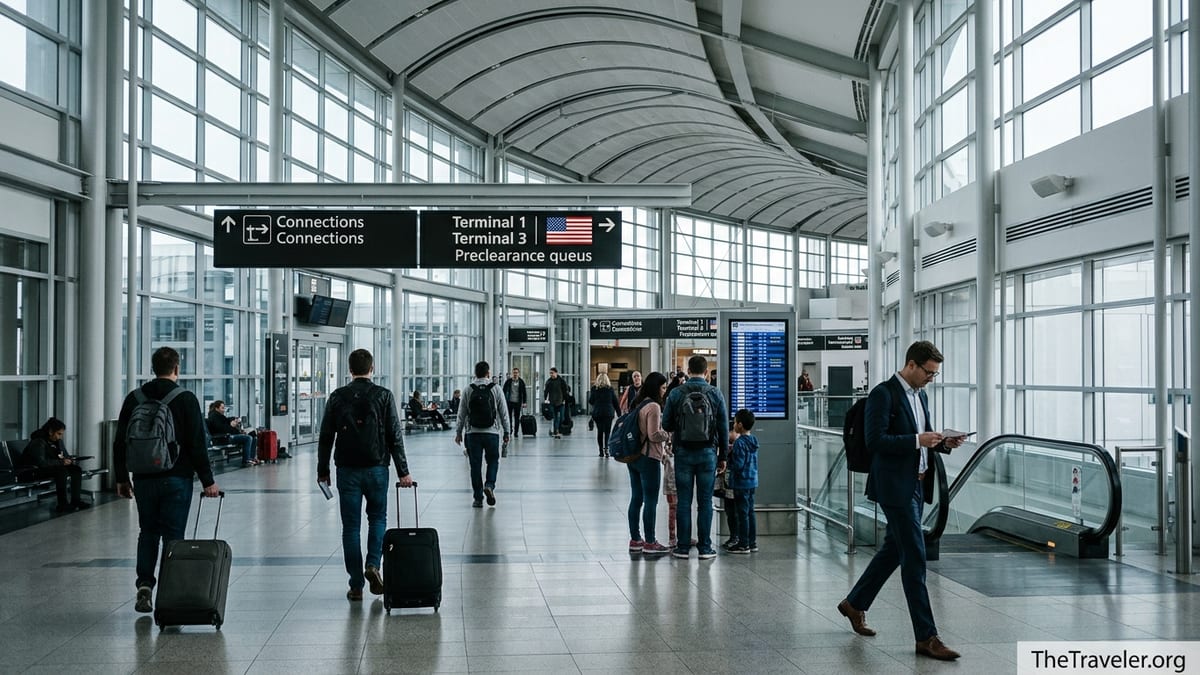
Understanding Toronto Pearson’s Terminals and Flight Types
Toronto Pearson has two passenger terminals: Terminal 1 and Terminal 3. Both handle a mix of domestic, international, and U.S. transborder flights, but airlines tend to cluster by alliance. Air Canada and most Star Alliance partners generally use Terminal 1, while WestJet, Porter (for most Pearson flights), Air Transat, Flair and many other carriers use Terminal 3, along with many SkyTeam and Oneworld airlines. That means a London–Toronto flight on Air Canada will almost always arrive in Terminal 1, while a similar London–Toronto flight on Air Transat will arrive in Terminal 3.
The terminal you use matters because it determines where you clear Canadian customs, how you recheck bags, and whether you will need to use the airport’s Terminal Link train to make your connection. For example, a traveller flying Frankfurt–Toronto–Calgary entirely on Air Canada will likely stay in Terminal 1 for both flights. Someone flying Paris–Toronto on Air France and then transferring to a WestJet domestic flight will typically arrive in Terminal 3 and remain there for the connection.
Importantly, “domestic,” “international,” and “transborder” at Pearson describe which formalities you must clear, not just where you are flying. Flights within Canada are domestic. Flights between Canada and the United States are “transborder” because they involve U.S. Customs and Border Protection preclearance in Toronto. All other foreign destinations are treated as international flights. A full understanding of how these categories interact with your ticket is essential for planning your connection time.
Before you travel, it is worth checking your booking confirmation or airline app to see which terminal each flight uses at Pearson and whether your bag is tagged to your final destination. Many airlines now display terminal and gate information as soon as schedules are finalized, which can help you visualize the connection and prepare mentally for the walk or train ride ahead.
Domestic Connections: Within Canada via Toronto Pearson
For travellers connecting within Canada, Toronto Pearson is usually straightforward. If you fly from Calgary to Toronto and then onward to Halifax, you will arrive and depart from domestic gate areas. On a single ticket with the same airline or alliance, your checked baggage is typically tagged through to your final Canadian destination, so you will not need to collect it in Toronto. You simply follow “Connections” signs, walk or shuttle to your new gate area, and pass through security screening if required.
However, there are nuances. If your itinerary crosses terminals, such as a WestJet flight from Vancouver to Toronto Terminal 3 connecting to an Air Canada flight to St. John’s in Terminal 1, you will need to change terminals. In this case, after leaving your arriving gate area, you follow the signs for the Terminal Link train. The ride itself is only a few minutes, but you should allow time to walk from your arrival gate to the train platform and then from the train to your next gate. Travellers with short domestic connections of about 60 minutes should move directly to their next departure area rather than stopping at shops or restaurants.
Another practical detail is security. On many domestic to domestic connections within the same terminal you stay “airside,” which can mean no additional security check. But if you exit into the public arrivals hall or cross between certain secure and non‑secure zones, you will have to pass through security again. For example, a traveller who mistakenly follows the “Baggage Claim” and “Arrivals” signs instead of “Connections” may find themselves outside of security and need to be re‑screened, eating up precious minutes of connection time.
In real terms, a 1 hour 15 minute domestic connection on a single ticket at Pearson is usually workable for able‑bodied travellers, especially when both flights use the same terminal. Families with small children or travellers with reduced mobility should consider 90 minutes or more, as boarding for many Canadian domestic flights begins 30 to 40 minutes before departure and Pearson’s gate areas can involve long walks.
International Connections: Arriving From Abroad Into Canada
International arrivals at Toronto Pearson are where many first‑time visitors feel anxious, because they must clear Canadian customs and immigration before continuing. If you arrive from Europe or Asia and connect onward to another Canadian city, your first entry point into Canada is Toronto, so you must present yourself to the Canada Border Services Agency. In most cases, you will fill out a customs declaration digitally, either via an Advance CBSA Declaration before travel or at a kiosk in the arrivals area, then join the line for passport inspection.
On a through ticket, your checked baggage is often tagged to your final destination but must still be seen by Canadian authorities. In practice, this may mean collecting your suitcase from the carousel after immigration and placing it on a dedicated “connections” belt a short distance away, or in some cases simply confirming baggage information before it moves automatically through the system. For example, a passenger flying London–Toronto–Winnipeg on Air Canada generally picks up the bag after customs in Terminal 1, walks a short distance to a transfer belt area, drops the bag, and follows “Connections” signs to domestic departures.
Recent initiatives at Pearson and other Canadian hubs have begun to streamline some international‑to‑international transits for eligible passengers, allowing them to skip an in‑person border inspection and proceed directly to their next international departure. This “free flow” model applies only in specific circumstances and still requires correct documents and a confirmed onward ticket within a set timeframe, so you should not assume it will apply to your trip. Instead, check your airline’s guidance and Pearson’s connection tools shortly before you travel to see what process will apply to your particular routing.
For international arrivals connecting to another international flight, such as São Paulo–Toronto–Frankfurt on a single ticket, the exact process will depend on your airlines and terminals. Some passengers remain airside and follow “International Connections” signs without reclaiming baggage. Others will need to clear Canadian border formalities even if they are not staying in Canada. This is one of the scenarios where booking separate tickets can cause the most stress, because you may be forced to enter Canada, collect luggage, re‑check at a different check‑in area, and go through security again, all on a tight schedule.
U.S. Preclearance Connections: Flying to or via the United States
Toronto Pearson hosts full U.S. Customs and Border Protection preclearance facilities. This means that if you are flying from Toronto to a U.S. city, you typically clear U.S. immigration and customs in Toronto rather than on arrival. For connecting passengers, this has a major benefit: once your flight lands in the United States, you arrive as a domestic passenger and can walk directly to your next U.S. gate much like a local traveller.
In practice, connecting to the U.S. at Pearson can involve several steps. Imagine you are flying from London to Toronto to New York on a single ticket. You arrive from London, clear Canadian entry formalities as directed, and then proceed to a dedicated connection corridor marked for U.S. departures. There, you pass through security screening consistent with U.S. standards and then line up at the U.S. preclearance hall where CBP officers inspect your passport and ask standard entry questions. Only after finishing this process do you proceed to the transborder gate area for boarding.
For travellers starting their journey in Canada, such as a Calgary–Toronto–Chicago itinerary, you generally arrive as a domestic passenger, remain behind security in Terminal 1 or Terminal 3 depending on the airline, and then follow signs to “U.S. Connections” or “U.S. Departures.” Security screening may be repeated using U.S. rules, followed by the preclearance queue. Trusted traveller programs such as NEXUS and Global Entry can speed this step for eligible passengers, but lines at busy times can still be significant.
Because of these additional steps, minimum connection times to or via the United States are usually longer than for domestic connections. A 90‑minute connection for a domestic–U.S. or international–U.S. itinerary in Toronto is possible when everything runs smoothly and you know the airport layout, but many frequent travellers prefer 2 to 3 hours, especially during peak morning and late afternoon bank times when dozens of U.S. flights depart in waves.
Terminal Transfers and Moving Around the Airport
Many itineraries at Toronto Pearson keep you in the same terminal. For example, a Montréal–Toronto–Vancouver trip on Air Canada normally uses Terminal 1 for both legs, while a Winnipeg–Toronto–Cancún trip on WestJet often stays within Terminal 3. Yet millions of passengers each year have to move between terminals during a connection, especially those using different airlines or alliances on a single ticket, or those on self‑planned, separate tickets.
The main way to transfer between Terminal 1 and Terminal 3 is the Terminal Link train, a free automated people mover that connects both terminals with parking garages and a nearby station for off‑site lots and hotels. The train ride between the terminals is only a couple of minutes, and it runs frequently. In a realistic scenario, though, you should allow 15 to 20 minutes from gate to gate just for walking, waiting for the next train, and finding your way. Travellers with strollers, heavy luggage, or reduced mobility should assume a bit more time, especially during busy periods when elevators and escalators can be crowded.
Within each terminal, walking distances can be substantial. Terminal 1 in particular has long concourses serving domestic, international, and U.S. gates. It is not unusual to walk 10 to 15 minutes at a brisk pace from a far domestic gate to an international or transborder gate within the same building. Pearson operates in‑terminal shuttles and offers assistance for passengers who request it in advance or at dedicated help points, which is especially helpful for tight connections for people who cannot comfortably walk long distances.
A practical example illustrates how this feels in real time. A traveller arriving from Edmonton into Terminal 1 with a 1 hour 35 minute connection to Orlando could land at a domestic gate at the far end of the pier, walk ten minutes toward the central hub, descend to the transborder area, clear U.S. security and preclearance, and then walk another five to ten minutes to the gate. In this scenario, there might be 60 minutes between aircraft doors opening and the next boarding call, a window that narrows quickly if the arriving flight is slightly delayed.
If you have to change terminals on a self‑transfer, such as arriving from Lisbon to Toronto Terminal 1 on TAP Air Portugal and then flying Toronto–Calgary from Terminal 3 on WestJet on a separate ticket, factor enough time to clear Canadian customs, collect luggage, exit to arrivals, find the Terminal Link, ride to the next terminal, check in again, recheck bags, and go through security. In practice, experienced travellers often allocate at least 3 hours for such do‑it‑yourself transfers at Pearson to reduce stress and avoid expensive missed flights.
Baggage Rules, Customs, and How They Affect Your Layover
What happens to your checked luggage during a connection at Toronto Pearson depends heavily on how your ticket is structured. On a single through ticket, such as Sydney–Vancouver–Toronto–Ottawa entirely with one airline group, bags are usually tagged to the final destination. Airline baggage systems and Pearson’s own handling processes coordinate so that, after customs if required, your bag is redirected to the correct belt or loading area for your next flight without you having to re‑check it at a public counter.
At Canadian ports of entry, though, customs rules can still require you to interact with your bags. For many international arrivals, passengers collect their suitcases from a carousel immediately after immigration, walk them past customs officers, and then place them onto designated transfer belts for onward flights. If you are connecting from a non‑U.S. international flight to a U.S. transborder departure via preclearance, your bags may be routed through separate security and customs checks behind the scenes, and in some cases you may be asked to identify your luggage visually or via tag number before it is loaded.
The situation is very different on separate tickets. If you booked your own combination of airlines, such as an inexpensive European low‑cost carrier into Toronto followed by a separately purchased domestic ticket, you will almost certainly need to enter Canada fully, collect your checked bags at the public baggage claim, then re‑check with the second airline at the regular departures level. This means going through security from scratch, and if the second leg is to the United States, completing full U.S. preclearance. In this scenario, even a 2‑hour layover can feel tight if the arriving flight is delayed or immigration lines are long.
To reduce uncertainty, ask the agent at your original departure whether your bags are tagged to the final destination and whether you will need to reclaim them at Pearson. Many airlines also display baggage routing on the tag itself, with routing codes such as “FRA‑YYZ‑YVR” printed alongside your name. If the tag ends at Toronto, you know you must pick up your suitcase there. Always keep the small baggage receipt stickers, usually attached to your boarding pass, as they are vital for tracing a delayed bag if something goes wrong during the connection.
How Much Time Do You Really Need? Minimum Connection Times
Airlines and airports publish minimum connection times, often called MCTs, which represent the shortest legally bookable connection under normal conditions. If a ticket is sold on one booking reference and meets the MCT, the airline or its partners generally assume responsibility for rebooking you if a delay causes a missed connection. At Toronto Pearson, MCTs differ by type of connection: domestic to domestic, domestic to international, international to domestic, and so on, and they can vary by airline, terminal, and time of day.
For many domestic to domestic or domestic to international connections within the same terminal, Pearson’s MCT can be around 50 to 60 minutes, which you will see embodied in airline schedules that sell such itineraries. For international to domestic or international to U.S. transborder connections, MCTs are usually significantly longer to account for customs, immigration, and security screening. It is not uncommon to see official minimums in the range of 75 to 90 minutes or more, especially during peak periods, though exact numbers are set by airlines and airport coordination and may change over time.
These official minimums describe what is possible, not always what is comfortable. A connecting itinerary that barely meets MCT can succeed when everything runs smoothly: the arriving flight lands on time, the aircraft reaches the gate quickly, and queues at immigration and security are short. In reality, operational delays, weather, and congestion can easily consume a 20‑minute buffer. That is why many seasoned travellers deliberately choose layovers longer than the minimum, particularly for critical trips like long‑haul flights, business meetings, or connections that involve entering Canada from overseas.
As a rule of thumb for Toronto Pearson, many travellers find 1 hour 15 minutes workable for simple domestic connections, around 1 hour 30 to 2 hours for domestic to international within the same terminal, and 2 to 3 hours more comfortable for international or transborder connections that involve customs and immigration. If you are travelling with small children, have mobility challenges, or are unfamiliar with large hub airports, erring on the side of a longer connection can turn a stressful sprint into a manageable walk.
Real‑World Layover Scenarios at Toronto Pearson
To make all these rules more concrete, it helps to walk through a few common scenarios. Consider a traveller flying from New York LaGuardia to Toronto and on to Calgary on a single ticket with a major Canadian airline. The first flight arrives at Terminal 1 as a U.S. precleared arrival, meaning customs formalities were already handled at LaGuardia or another U.S. gateway. The traveller steps off the plane, walks along a corridor reserved for connections or arrivals, and follows signs to domestic departures. Because no immigration processing is required on arrival, a 1 hour 20 minute layover often feels comfortable in this case.
Now imagine a student flying from Delhi to Toronto with a connection to Montréal booked on one ticket through an airline alliance partner. They land in Terminal 1, join the line for Canadian immigration, and answer questions about study permits and entry documents. After immigration, they collect their checked suitcase from the assigned carousel, present it to customs, and then drop it on the transfer belt clearly marked for onward connections. From there, they move through a dedicated “Connections” corridor that includes security screening before re‑entering the domestic gate area. If lines are long, a 2 hour layover can feel tight but workable when everything is organized.
Finally, picture a leisure traveller who booked a discounted ticket from Lisbon to Toronto on one carrier and a separate ticket from Toronto to Vancouver on another, with a 3 hour 10 minute gap between flights. On arrival in Toronto, they must clear immigration, wait at the general baggage carousel for their suitcase, and then walk out into the public arrivals hall. From there, they follow signs to the Terminal Link train if the next flight uses a different terminal, take the train, locate the correct check‑in counter upstairs, join the check‑in line to re‑tag the bag, and then clear security from scratch. If the arriving flight is delayed by an hour, the effective layover shrinks fast. In such self‑transfer situations, 4 hours or more is often a safer buffer at Pearson.
In each of these examples, the key factors are the type of ticket (single through ticket or separate bookings), the terminals involved, and whether customs or preclearance are required. Toronto Pearson’s signage, connection guides, and staff can help you on the day, but planning your layover with these real‑world timelines in mind is the most reliable way to protect your trip.
The Takeaway
Connecting at Toronto Pearson need not be intimidating. Understanding the airport’s two‑terminal layout, the role of customs and immigration, and the differences between domestic, international, and U.S. preclearance flights will help you set realistic expectations for how long your layover should be. When flights are on a single ticket and within the same terminal, official minimum connection times can work, especially for domestic itineraries. Once border formalities, terminal transfers, or separate tickets enter the picture, giving yourself extra time is almost always the wiser choice.
In practical terms, that means reading your itinerary carefully before you fly, noting which terminal each segment uses, and confirming whether checked bags are tagged to your final destination. It also means treating tight international and U.S. connections at Pearson with caution, especially at busy times of day, and accepting that a slightly longer layover can be the cheapest form of travel insurance.
Toronto Pearson continues to refine its connection processes with improved signage, digital tools, and partnerships with airlines and border agencies. Yet the fundamentals remain the same: follow “Connections” signs, keep documents and baggage tags handy, and move efficiently from gate to gate. With a bit of preparation and realistic planning, even complex multi‑leg journeys through Canada’s busiest airport can be surprisingly smooth.
FAQ
Q1. Do I need to pick up my checked bags during a connection at Toronto Pearson?
In many cases on a single ticket, your checked bags are tagged to your final destination, but you may still need to briefly collect and re‑drop them after customs on international arrivals. On separate tickets, you almost always need to collect your baggage, exit to arrivals, and re‑check with the next airline.
Q2. How long should I allow for a domestic‑to‑domestic connection at Pearson?
If both flights are in the same terminal on one ticket, many travellers find around 1 hour 15 minutes workable. For families, those unfamiliar with the airport, or travellers with reduced mobility, 90 minutes or more offers a more comfortable margin.
Q3. Is a 60‑minute international‑to‑domestic connection too tight at Toronto Pearson?
It can be, especially during busy periods. Although some itineraries are sold with official minimum connection times around that range, customs, immigration, and possible baggage re‑drop can quickly consume an hour. Many travellers prefer at least 90 minutes to 2 hours for this type of connection.
Q4. What happens if my first flight is late and I miss my connection?
On a single through ticket that respects the airline’s minimum connection times, the operating carrier usually rebooks you on the next available flight at no additional fare, subject to availability. With separate tickets, you may have to buy a new ticket if you miss the onward flight.
Q5. How do I transfer between Terminal 1 and Terminal 3 at Pearson?
The main link between terminals is the free Terminal Link train, which runs frequently and takes only a few minutes between Terminal 1 and Terminal 3. You should still allow at least 15 to 20 minutes from gate to gate to account for walking, waiting for the train, and wayfinding.
Q6. When and where do I clear U.S. customs if I am flying to the United States via Toronto?
U.S. Customs and Border Protection preclearance is located at Toronto Pearson. You clear U.S. immigration and customs in Toronto before boarding your flight. When your plane lands in the United States, you arrive as a domestic passenger and can go straight to your next gate or exit.
Q7. Is it safe to book separate tickets for connections at Toronto Pearson?
It is possible but riskier. With separate tickets, you must usually clear immigration, collect bags, change terminals if needed, re‑check, and clear security again within your layover. Many experienced travellers allow at least 3 to 4 hours for such self‑planned connections to reduce the risk of missed flights.
Q8. Are connection procedures the same in Terminal 1 and Terminal 3?
The basic principles are the same in both terminals, but the exact routes, signage, and facilities differ. Terminal 1 is generally used by Air Canada and Star Alliance airlines, while Terminal 3 serves many other carriers, so your connection experience may vary depending on your airline and whether you are flying domestic, international, or transborder.
Q9. What documents should I have ready for a connection through Toronto Pearson?
You should have a valid passport, any required visas or permits, boarding passes for all flight segments, and your customs or immigration declarations where applicable. Keeping baggage receipts handy is also useful if your checked bag needs to be traced during a tight connection.
Q10. Are there services to help with tight connections or mobility issues at Pearson?
Yes. Airlines and the airport can arrange assistance such as wheelchairs or in‑terminal shuttles for passengers who request help in advance or upon arrival. If you know you have a short connection or mobility challenges, contact your airline before travel so they can note your needs and coordinate support at Toronto Pearson.