


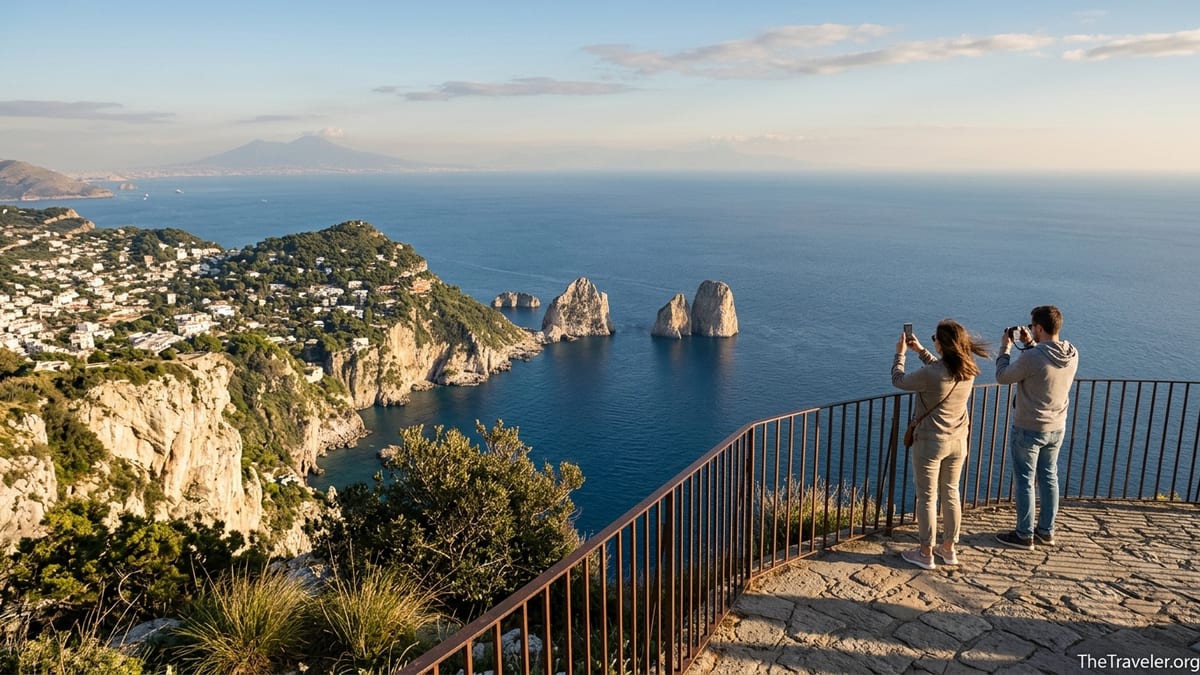
Monte Solaro is Capri’s cloud-catching summit, a 589-meter limestone peak that lifts you above the Faraglioni sea stacks, Marina Grande, and the blue sweep of the Bay of Naples. For photographers and view-chasers, this is the island’s ultimate vantage point. Whether you ride the classic chairlift from Anacapri or hike up through lemon groves and pine woods, planning your visit well makes the difference between jostling for space on a terrace and having the sky and sea almost to yourself.
Get the latest updates straight to your inbox!
Understanding Monte Solaro: Capri’s High Balcony
Monte Solaro rises roughly 589 meters above sea level, forming the highest point on Capri and the backdrop to Anacapri, the quieter of the island’s two main towns. From the summit you can usually see the Faraglioni rocks off Capri’s southern coast, the Sorrento Peninsula, the Bay of Naples with Mount Vesuvius, and on clear days even the distant outline of the Calabrian mountains. The result is a full 360-degree panorama that feels like Capri laid out in miniature at your feet.
The mountain is made of pale, sun-bleached limestone, which reflects light and creates dramatic contrast in photographs, especially in the soft hours just after sunrise or before sunset. Low shrubs, wildflowers, and pockets of pine and oak add texture and color in the foreground, giving depth to wide-angle landscape shots. Around the summit terraces you will also find old stone walls and rust-colored railings that make useful leading lines in your compositions.
Because the air is cooler and breezier at this height than down at sea level, Monte Solaro can provide welcome relief on hot summer days. In spring and early autumn it is often the most comfortable part of the island in the afternoon, making it a good place to linger over a drink at the small bar by the upper chairlift station while waiting for the light to soften for late-day photography.
The mountain’s nickname among locals, sometimes translated as “cloud catcher,” hints at another photographic opportunity. On days when a bank of low cloud wraps around the summit, especially in the shoulder seasons, you can capture moody, atmospheric images that are very different from the typical bright-blue Capri postcard.
Reaching Monte Solaro: Chairlift, Hike, or Both
Almost everyone starts their Monte Solaro visit in Anacapri’s Piazza Vittoria. From Capri’s main marina, Marina Grande, you can take a public bus up to Anacapri in around 15 to 20 minutes, or a taxi in roughly 10 to 15 minutes depending on traffic. Buses run frequently during the main season, and almost all visitors heading to Monte Solaro will step off at the Anacapri stop a short walk from the square, then follow the stairs up to the chairlift station.
The chairlift is the classic way up. It typically runs from mid-morning, around 9:30, until late afternoon, with later closing times on some summer evenings. A return ticket generally costs a little over 10 euros, with a single ride priced slightly lower. Tickets are sold at the booth right beside the lower station, and you simply queue, sit on a single-seat chair as it passes, and let it carry you up over tiled rooftops, vegetable gardens, and pine trees. The ride takes about 12 minutes and is slow enough to photograph Anacapri below without feeling rushed.
If you prefer to hike, there is a signed trail starting near Anacapri that climbs through woods and rocky terrain to the top. Most fit walkers take around one to one and a half hours to reach the summit, gaining roughly 250 to 300 meters in elevation. The path is often stony and uneven, so proper walking shoes help, and you should avoid the hottest midday hours in July and August. A popular strategy is to ride the chairlift up for the views and then hike down in 45 to 60 minutes along the shaded track, stopping at viewpoints such as the small crucifix at La Crocetta partway down.
Many visitors combine all three elements of Capri’s transport web in a single outing: morning ferry from Naples or Sorrento to Marina Grande, bus to Anacapri, chairlift up to Monte Solaro, and then a hike down before ending the day back in Capri town or on a boat tour. If you are arriving on the island only for a few hours, such as during a cruise call, a simple loop of taxi or bus to Anacapri, chairlift up and back, and taxi or bus return to the port can fit comfortably into a three-hour window if queues are not extreme.
Timing Your Visit for the Best Light and Fewer Crowds
Monte Solaro’s views are impressive at any time of day, but photographers will find the quality of light varies dramatically between the harsh mid-afternoon sun and the gentle tones of early morning or late afternoon. When the chairlift is operating from mid-morning, an ascent on the first chairs of the day often means quieter terraces and soft light that still has some direction, ideal for picking up texture in the limestone peaks and highlighting the curves of the coastline.
In summer, late afternoon is equally rewarding. The sun begins to drop toward the Sorrento Peninsula, casting long shadows across Anacapri and warming the color of the cliffs to soft gold. If the chairlift offers extended hours on certain evenings, photographers who time their ride so they are descending just as the sun sets can often capture a sequence of changing light over the Faraglioni before the last chairs depart. Always check current times locally, since hours can shift with the season and weather.
Midday can still work for photographs focused more on the sea than the sky. The famous Capri blue is strongest in overhead sun, so if you frame tightly on the turquoise water around the Faraglioni and the white wakes of passing boats, or use foreground rock and shrub detail to shield blown-out highlights, you can still produce striking images. Polarizing filters help reduce glare and deepen color, particularly when you are aiming your camera roughly 90 degrees to the direction of the sun.
For crowd-averse visitors, your best bet is to ascend when ferries are less frequent. On busy summer days, day-trippers from the mainland tend to reach Anacapri between late morning and early afternoon. Arriving at the chairlift right at opening time, or in the last hour before it closes, usually means much shorter lines. In shoulder months like April, May, late September, and October, you often find ample space on the summit terraces even in the middle of the day, especially if a light haze keeps some visitors down at beach level.
Top Viewpoints and Photo Ideas at the Summit
The main terrace immediately beside the upper chairlift station is where most first-time visitors stop, and with reason. From here you get a classic postcard view looking southeast toward the Faraglioni rocks, Capri town perched on its ridge, and the open sea beyond. Wide-angle shots in the 16 to 24 millimeter range on a full-frame camera will capture the sweep of coastline, while a standard zoom around 35 to 70 millimeters lets you pick out details like the funicular track from Marina Grande or the patterns of villas and gardens on the slopes below.
Walk a few steps around the summit, however, and you will find additional vantage points that offer different moods and compositions. Looking north and northeast, you can frame Mount Vesuvius rising beyond the Bay of Naples, often with a light haze softening its outline. Turning west, the coastline of the Amalfi and the islands of Ischia and Procida may appear on the horizon. These views are especially beautiful in late afternoon when the sun backlights the haze and creates layered silhouettes of headlands receding into the distance.
Close to the terraces and along the short paths near the fenced edges, you can use low-growing shrubs, weathered rocks, and sections of railing as compositional anchors. A common technique is to focus on a gnarled patch of vegetation or a limestone outcrop in the foreground, then let the Faraglioni and the sea sink gently out of focus in the background at a wide aperture such as f/2.8 or f/4. This works especially well for travelers shooting on mirrorless cameras or fast prime lenses around 35 or 50 millimeters.
Smartphone photographers will find the summit equally rewarding. Most modern phones have ultra-wide lenses that exaggerate perspective and work well when you place the cliff edge or railing in the lower third of the frame. Using the built-in HDR modes helps handle high-contrast scenes where white buildings and bright sea can otherwise clip to pure white. If you are shooting people, encourage them to stand slightly off-center, facing the view, to create more natural, candid-feeling portraits against the landscape.
Hiking Routes and Quiet Corners for Atmospheric Shots
Beyond the main terraces, Monte Solaro has several short paths that lead to quieter spots and more intimate views. One of the most rewarding is the route toward Cetrella, a small area on the southern slope known for its hermitage and a simple church nestled into the rock. Even if you do not go all the way down, walking part of this path quickly takes you away from the busiest viewpoints and into a landscape of pines, low scrub, and scattered limestone boulders. The trail’s natural curves and occasional stone steps provide strong visual lines that draw the eye through your frame.
The descent path toward Anacapri begins just below the summit area and winds down through woods that filter the light into soft patches and shafts, particularly in late afternoon. This is an excellent setting for more atmospheric, story-driven images, such as a companion walking ahead with dappled light on their shoulders, or the contrast of dark tree trunks with bright glimpses of sea beyond. Because the trail is moderately steep and uneven, you should keep one hand free, use a small cross-body camera bag, and stop moving whenever you frame a shot, rather than trying to shoot while walking.
Intermediate walkers can extend their outing by linking Monte Solaro with other Anacapri viewpoints such as the Belvedere della Migliara, a clifftop lookout reached by a separate path from town. One common itinerary is to hike up to Monte Solaro from Anacapri in the morning, descend by chairlift or on foot after enjoying the summit, have lunch in Anacapri, and then walk out toward the Migliara terraces for late-afternoon views of the Punta Carena lighthouse and the open sea. Each location offers distinct angles and light, giving photographers a varied set of scenes in a single day.
If the weather turns hazy or clouds gather around the summit, do not assume your photographic prospects are lost. Low cloud moving across the cliffs can create dramatic, almost monochrome images with strong contrast between dark rock and white mist. Trees half-lost in fog and brief openings that reveal a slice of turquoise sea below can be more visually interesting than a completely clear sky. In such conditions, prioritize fast shutter speeds and higher ISO settings to freeze swirling cloud and maintain detail.
Practical Tips for Shooting Comfortably on Monte Solaro
Monte Solaro’s exposed summit can be breezy even when the streets of Capri feel calm. For a comfortable visit, bring a light windbreaker or scarf, especially in spring and autumn, and a hat that secures well so it does not blow off near the railings. In high season, the sun is strong and unfiltered at this altitude, so sunscreen, sunglasses, and plenty of water are important, particularly if you plan to hike up or down rather than ride both ways on the chairlift.
For camera gear, a simple setup works best. A mirrorless or DSLR body with a standard zoom lens in the 24 to 70 millimeter range covers most compositions, with a lightweight wide-angle zoom if you enjoy dramatic perspective. Tripods are rarely practical at the busiest terraces and may get in the way of other visitors, but a small folding travel tripod can be useful if you are there in the quieter shoulder seasons and want to experiment with long exposures of moving clouds. Extra batteries matter more than extra lenses on a full-day outing, as you are unlikely to find convenient charging points on the summit.
On the chairlift, secure your camera or phone with a wrist strap or neck strap so you do not have to grip it tightly throughout the 12-minute ride. Many travelers simply keep their main camera in a bag while riding and rely on their smartphone for quick shots of rooftops and terraced gardens passing below. If you do want to photograph with a larger camera from the moving chair, choose a reasonably fast shutter speed such as 1/500 second to keep images sharp despite the gentle motion.
Finally, remember that Monte Solaro is a popular shared space. Stepping a half-meter away from the most obvious railings often opens up fresh compositions while freeing room for others at the main viewpoints. If you are working with tripods or posing friends for portraits, keep sessions short at busy times, then move to quieter corners for more extended shoots. A spirit of patience and courtesy nearly always pays off in better experiences and, indirectly, better photographs.
The Takeaway
Monte Solaro is more than just Capri’s highest point; it is the island’s natural viewing platform, where village roofs, rugged cliffs, and deep-blue sea fan out in every direction. Experiencing it well means choosing how you want to reach the top, whether by the leisurely swing of the chairlift over Anacapri’s gardens, the steady rhythm of a hiking trail through pine woods, or a mix of both to suit your energy and time.
For photographers, timing and location are everything. Soft morning and late-afternoon light, a willingness to walk beyond the busiest terrace, and an eye for foreground textures and human moments will reward you with images that go beyond the familiar postcard. For everyone else, a relaxed drink on the summit terrace, a simple stroll between viewpoints, and the quiet sense of floating above one of Italy’s most storied coastlines make Monte Solaro an essential chapter in any Capri visit.
With a bit of planning around chairlift hours, bus connections, and the day’s weather, you can transform a quick photo stop into a highlight memory: the moment when Capri’s cliffs, harbors, and sea lanes aligned beneath you in a single sweeping view.
FAQ
Q1. How long do I need to visit Monte Solaro for views and photos?
Most travelers are satisfied with 1.5 to 2 hours at Monte Solaro, including chairlift rides up and down and time on the summit terraces. If you want to explore side paths, take many photos, or hike one way, plan on 3 to 4 hours door to door from Marina Grande.
Q2. Is the chairlift to Monte Solaro safe for people with a fear of heights?
The chairlift runs relatively close to the ground for much of its 12-minute route and moves at a gentle pace. Many people who are mildly uncomfortable with heights manage it without trouble, especially by focusing on the view rather than looking straight down. Those with severe vertigo may prefer to hike or limit themselves to lower viewpoints around Anacapri.
Q3. Can I hike up and take the chairlift down, or vice versa?
Yes, you can combine hiking and the chairlift in either direction. Many visitors ride the chairlift up when they are fresh and use the downhill trail back to Anacapri, which takes around 45 to 60 minutes. Others hike up early, before it gets hot, and then descend by chairlift to save their knees.
Q4. What should I wear for a visit to Monte Solaro?
Wear sturdy, closed-toe shoes if you plan to hike or wander beyond the main terraces, as paths are rocky and uneven. Even if you only take the chairlift, comfortable walking shoes, a light layer for wind, sunglasses, and sunscreen make the visit more enjoyable. In shoulder seasons, a light jacket can be useful at the breezy summit.
Q5. Are there facilities at the top of Monte Solaro?
At the summit you will find a small bar or café where you can buy drinks and simple snacks, along with seating areas and terraces facing different directions. Toilets are usually available near the upper chairlift station. There is no large restaurant or extensive shopping, so bring water and anything special you may need.
Q6. Can I bring a small child on the chairlift?
Children are allowed on the chairlift, and younger children often ride on a parent’s lap when regulations permit, but the chairs are single seats with a simple safety bar. Because the bar can be lifted easily, guardians should think carefully about how still and calm their child will be for the 12-minute ride. Families with very active or nervous children sometimes choose the hiking trail instead.
Q7. What is the best season for photography on Monte Solaro?
Spring and autumn are particularly good for photography, with softer light, fewer crowds, and often clearer air after rain. In summer you benefit from long days and intensely blue sea, especially at midday, though haze and heat are more common. Winter can offer crisp, empty terraces when the weather cooperates, but chairlift schedules may be shorter and conditions more changeable.
Q8. Do I need advanced camera gear to capture good photos?
No, a recent smartphone is enough to capture excellent images from Monte Solaro. Its ultra-wide lens and HDR modes handle the sweeping views and bright sea well. Dedicated cameras offer more flexibility with lenses and depth of field, but composition, light, and timing matter more than equipment.
Q9. How crowded does Monte Solaro get in peak season?
In July and August, late morning and early afternoon can see lines for the chairlift and busy terraces, especially when multiple ferries arrive from the mainland. Even then, walking a little away from the main platforms or visiting right at opening or in the last hour of operation usually gives you more space. Shoulder months are noticeably calmer.
Q10. Is Monte Solaro worth visiting on a hazy or cloudy day?
Yes, provided visibility is not completely closed in, hazy or partly cloudy days can be very atmospheric. Soft light avoids harsh shadows, and clouds can add drama and depth to your images. If the summit is fully in cloud with no view at all, it may be better to wait for a break in the weather or focus on lower-level sights in Capri and Anacapri.