


More news on this day
Emergency crews, including air ambulance teams and specialist incident units, rushed to a serious collision between two passenger trains near Bedford on Friday, leaving at least one person dead, dozens injured and rail travel in and out of London severely disrupted.
Get the latest news straight to your inbox!
Major Incident on Busy Corridor North of London
Publicly available information indicates that the crash occurred on the afternoon of 19 June 2026 on the Midland Main Line, a heavily used route linking towns and cities in the East Midlands with London St Pancras. Two southbound services are reported to have been involved, with early rail tracking data suggesting that one train ran into the rear of another a short distance south of Bedford.
Images and descriptions shared in British media coverage and on social platforms show a large emergency response, with multiple fire engines, ambulances, police vehicles and at least one air ambulance operating around a section of track close to open countryside. Passengers described a sudden, violent impact that threw people forward inside carriages and left windows shattered and interior fittings damaged.
Initial reports indicate that one person has died and that there are multiple serious injuries, though the full extent of casualties remains under assessment. Dozens of people have been treated at the scene or transported to regional hospitals, according to information referenced in national news coverage.
The collision has been classified as a major incident, triggering established rail emergency protocols that bring together railway staff, emergency services and specialist investigators. The priority through Friday evening has been casualty care and the safe evacuation of passengers from the damaged trains and surrounding area.
Passengers Evacuated as Services Halted Around Bedford
The crash has caused immediate and extensive disruption to rail travel between the East Midlands and London. Trains on the affected stretch of line have been halted while responders work on site, and services operated by companies using the route have been cancelled, diverted or terminated short of their destination.
Accounts from passengers who were on board the trains describe a controlled but lengthy evacuation, with some people walking along the track to reach a safe assembly point under the guidance of railway staff and emergency crews. Those with minor injuries have been assessed near the scene, while others have been taken away by ambulance for further treatment.
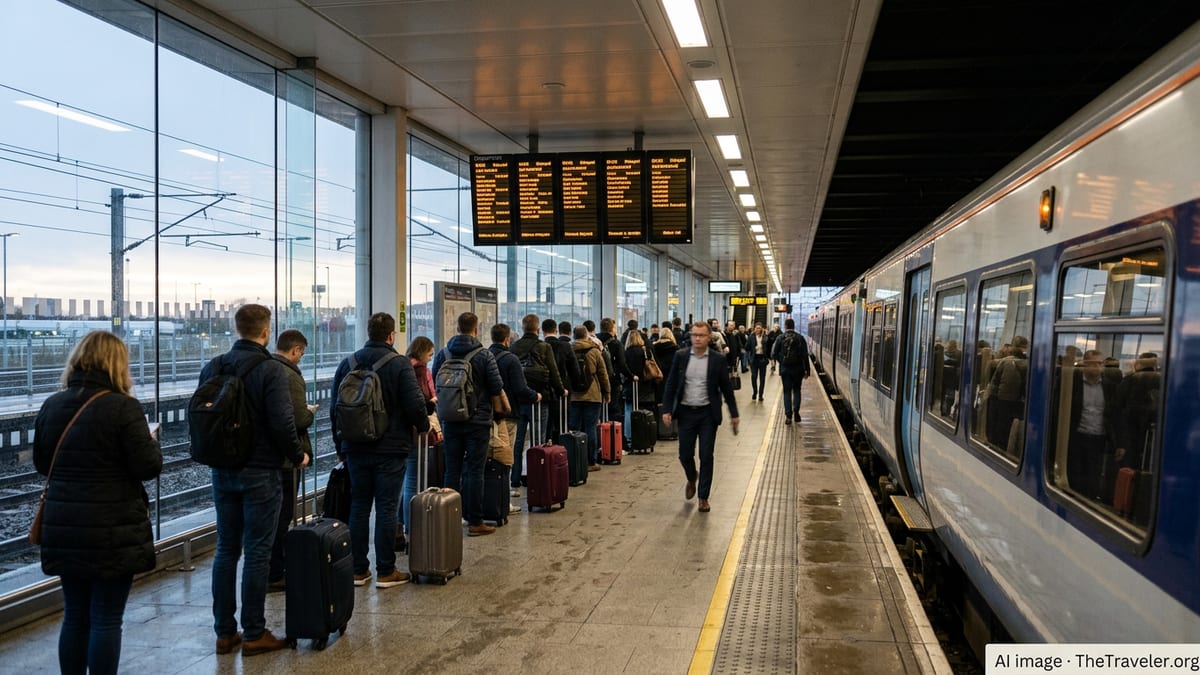
Travelers heading to and from London St Pancras face significant delays and crowding as operators attempt to reroute services and manage stranded passengers. Those already at stations along the route have been advised through public announcements and journey planners to seek alternative options or delay their journeys where possible.
Reports from the wider network show knock‑on effects reaching beyond Bedford, as trains and crews are displaced from their planned diagrams. Late afternoon and evening commuters across the region, including leisure travelers and visitors, are experiencing disruption, with some north–south flows temporarily shifting to other main lines where capacity allows.
Early Focus on How Two Modern Passenger Trains Collided
While it is too early for any definitive explanation, attention has quickly turned to how two modern passenger trains could collide on a main line that is equipped with contemporary signalling and safety systems. Rail commentators and rail industry enthusiasts referencing live data have suggested that one train may have run into the back of another that was either stopped or moving more slowly on the same track.
Some analysis shared in public forums refers to the possibility of a signal being passed at danger, or an issue involving train protection systems. At this stage, however, these remain unconfirmed scenarios and will be subject to detailed technical investigation by the specialist accident investigation body and the rail infrastructure manager.
Modern British intercity and regional trains are designed with energy‑absorbing structures at the ends of vehicles to reduce the impact forces on passenger areas in the event of a collision. Early images show a badly damaged cab on one of the trains, with carriages remaining upright, which suggests that crashworthiness features may have played a role in limiting the scale of structural damage along the train.
Investigators are expected to examine onboard data recorders, signalling logs and maintenance records, as well as the configuration of the signalling system in the area. They will also consider operating procedures, staff training and any recent changes to timetabling or infrastructure that might have influenced how the incident unfolded.
Rail Safety Context and What Comes Next for Travelers
The United Kingdom’s rail network is widely regarded as having strong overall safety performance, with high‑profile collisions relatively rare compared with the volume of services operated each day. When serious incidents do occur, they typically prompt extensive reviews and, over time, changes to equipment, procedures or infrastructure designed to reduce the likelihood of a similar event.
For travelers, the immediate concern is how long the disruption will last. Based on previous major incidents on busy main lines, closures for recovery and investigation can continue for many hours and sometimes into the following day, depending on the complexity of removing damaged rolling stock and repairing any infrastructure. Track, signalling equipment and overhead power lines all need to be inspected and, if necessary, replaced or repaired before normal operations resume.
Rail companies are using journey planners, station announcements and social media feeds to provide updates. Passengers planning trips between London and destinations such as Bedford, Luton, Wellingborough, Leicester, Nottingham and Corby are being advised through public information channels to check services carefully, consider alternative routes, and allow extra time for their journeys.
Travelers holding advance tickets may find that operators put temporary arrangements in place, such as accepting tickets on different routes or modes, or relaxing restrictions on specific train times. Those with accommodation or onward connections booked for the evening face potential changes to their plans and may need to liaise with hotels, airlines or other providers as the rail picture becomes clearer.
Longer‑Term Questions for a Vital Rail Corridor
Beyond the immediate emergency response and short‑term travel chaos, the Bedford collision raises wider questions about resilience on one of England’s most important rail arteries. The Midland Main Line not only links major regional centres with London but also supports commuter flows, airport access and leisure travel for both domestic and international visitors.
As investigations progress, there is likely to be scrutiny of whether further enhancements to train protection systems, signalling redundancy or operational procedures are needed on intensively used sections of track where fast and stopping services share the same corridor. Rail industry analysts often point to the challenge of balancing capacity, speed and safety on infrastructure that is asked to carry growing numbers of trains.
For the travel and tourism sector, the incident highlights the importance of contingency planning for rail‑dependent itineraries. Tour operators, corporate travel planners and independent travelers alike may look again at how they build flexibility into schedules, particularly on days when networks are under strain due to accidents, infrastructure failures or severe weather.
In the days ahead, more clarity is expected on the sequence of events, the condition of those injured and the timetable for restoring full services. For now, a stretch of track just north of London has become the focus of national attention, with emergency crews, investigators and rail workers continuing their efforts to stabilise the scene and get passengers moving again.