


More news on this day
British police and emergency services are responding to a serious collision involving two passenger trains near Bedford, north of London, that has left at least one person dead, multiple people injured and caused major disruption on one of the main rail corridors into the capital.
Get the latest news straight to your inbox!
Collision on busy route into London
Initial reports indicate that the incident occurred on Friday afternoon on the Midland Main Line, a key route linking towns and cities in the East Midlands with London St Pancras. Two southbound services are reported to have been involved near the town of Bedford, with one train believed to have struck the rear of another on the approach to the London-bound line.
Publicly available tracking data cited in news coverage points to the collision involving a service from Corby and another from Nottingham, both heading toward St Pancras at the time of impact. Early images shared on social media appear to show one train unit partially embedded in the rear of another, with visible damage to several carriages and some vehicles off the tracks.
Reports from the scene describe a large emergency response across the rail corridor and surrounding roads, with access routes temporarily restricted to allow specialist teams to reach the line. Helicopter footage broadcast by UK outlets shows multiple emergency vehicles positioned along the railway and in adjacent fields, underscoring the scale of the response.
Rail operators are advising passengers to avoid travel on affected routes while the situation is assessed. Services on both long distance and commuter lines into London are expected to face extended disruption as the extent of damage to trains and infrastructure becomes clearer.
Casualties and emergency response
According to national and regional media coverage, at least one person has died in the collision and a significant number of passengers have sustained injuries of varying severity. Some reports refer to serious injuries among those on board, while others describe passengers being treated for fractures, cuts and shock on or near the trackside.
Images and video from the scene show paramedics working along the length of the train, with triage areas apparently set up close to the line. Air ambulance helicopters, road ambulances, fire appliances and specialist incident units have all been deployed, reflecting the classification of the event as a major incident in local reporting.
British Transport Police, working alongside local police forces, are leading the initial response on the railway itself, with cordons in place to keep the area clear for rescue and recovery operations. Nearby residents have reported sirens and low-flying helicopters throughout the afternoon as additional resources arrived.
Hospitals in the region have been placed on heightened alert to receive casualties, according to statements cited in national broadcaster updates. Rail passengers on unaffected sections of the network are being advised to check for updates and to allow additional time for their journeys, as knock-on delays build across interconnected routes.
Travel disruption for rail passengers
The collision has triggered significant disruption for travelers across the north–south corridor into London, a route heavily used by both long distance and commuter services. Rail companies have warned that trains may be cancelled, diverted or significantly delayed for the remainder of Friday and potentially into the weekend.
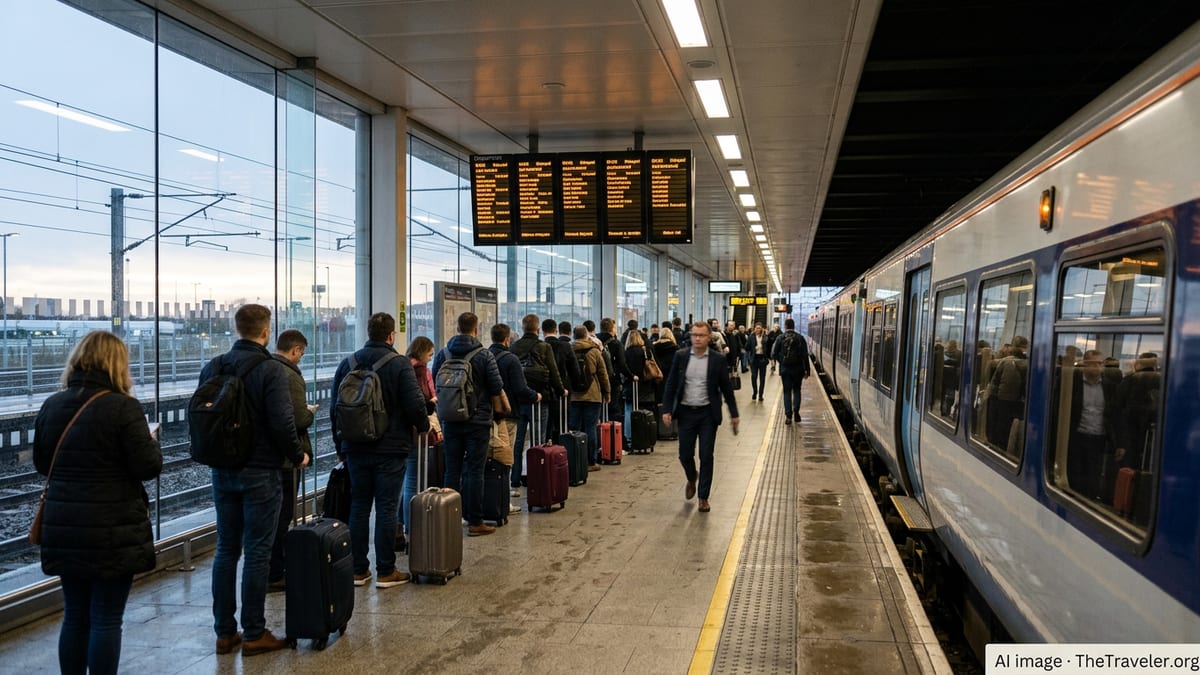
Some services are reported to be terminating short of London or being rerouted where capacity allows, while others are being held at stations further north to prevent congestion around the affected stretch of line. Passengers have described crowded concourses and departure boards filled with cancellations at key hubs as the disruption ripples through the network.
Replacement road transport options are expected to be limited in the immediate aftermath, given both the scale of demand and the need to keep access roads clear for emergency vehicles. Travelers are being encouraged by rail operators and national rail information services, as reported by local media, to postpone non-essential trips or seek alternative routes.
For international visitors arriving into or departing from London, the disruption adds a layer of complexity to onward travel plans, particularly for those relying on timed connections to and from major airports or cross-channel services. Travel advisors are recommending that passengers allow additional margins for transfers and keep abreast of updates from rail information platforms and broadcasters.
Early focus on signalling and safety systems
While it is too early for any definitive explanation, early technical discussion in specialist rail forums and commentary cited in news reports has focused on how two trains came to occupy the same section of track on a modern, signalled main line. Some informed observers have suggested that one train may have been brought to a halt by its onboard protection equipment, with the following service colliding with it, although this remains unconfirmed and subject to formal investigation.
Britain’s rail network is equipped with multiple layers of train protection and signalling technology designed to prevent exactly this kind of incident. These include systems that automatically apply brakes if a signal is passed at danger or if a train exceeds permitted speed. Recent railway safety reports have highlighted both the strengths of these systems and the importance of continued investment and maintenance, especially on heavily trafficked routes into major cities.
Published coverage notes that the Rail Accident Investigation Branch is expected to conduct a detailed inquiry into the circumstances of the collision, examining potential factors such as signalling performance, train protection systems, track conditions and operational procedures. Investigators typically also review driver actions, communications records and the way information was shared between control centers and train crews.
For frequent rail users and industry professionals, the Bedford incident will prompt renewed scrutiny of how existing safety layers interact under unusual fault conditions, and whether additional safeguards or procedural changes might further reduce the risk of rear-end collisions on busy main lines.
Implications for rail travelers and industry
The collision comes at a time of heightened attention to rail safety worldwide, following several high profile incidents on passenger networks in recent years. For travelers, the Bedford crash is likely to raise fresh questions about how rare such events are on busy European main lines and how effectively rail systems protect passengers when failures occur.
Statistical data cited in transport safety reviews typically ranks rail travel among the safest modes of mass transport, particularly when measured per passenger kilometre. Even so, incidents of this kind have an outsized impact on public confidence, especially when images of damaged carriages and large scale emergency responses circulate widely on broadcast and social media platforms.
For the rail industry, the crash will likely accelerate ongoing work on resilience planning, emergency coordination and passenger communications. Operators and infrastructure managers across the network may draw lessons from the way this incident unfolded, including how quickly trains were stopped elsewhere on the line, how information flowed to passengers, and how alternative routes were activated.
As formal investigations progress in the coming days and weeks, more precise detail is expected to emerge on what occurred on the line south of Bedford on Friday afternoon. Until then, travelers across the region face continued disruption, while rail professionals and passengers alike await a clearer picture of how such a serious collision unfolded on one of the country’s most important rail approaches to London.