


More news on this day
One person has died and 89 people were reported injured after two passenger trains collided near Bedford on Friday, bringing a major rail corridor to a standstill and drawing a large emergency response from across the region.
Get the latest news straight to your inbox!
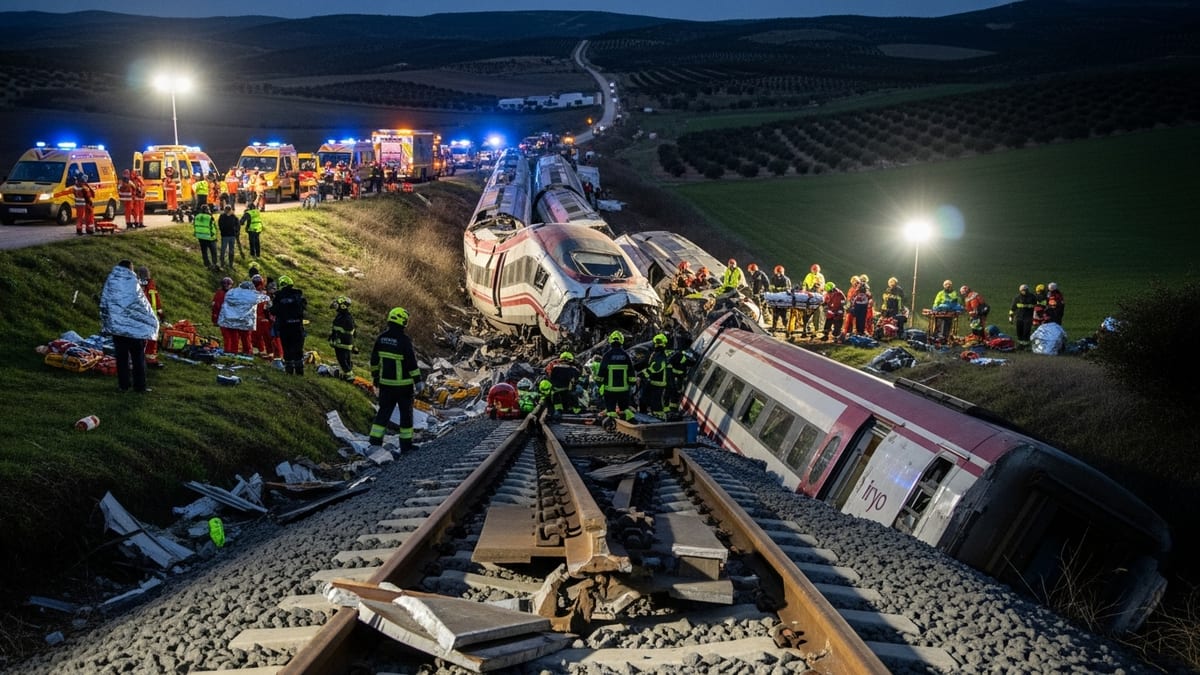
Collision on busy route north of London
Publicly available information indicates that the collision occurred in the early evening on 19 June 2026 on the main line between Bedford and Luton, a critical stretch of the Midland route linking the East Midlands with London St Pancras. Both trains were travelling south toward the capital when they came into contact near the village of Elstow, a short distance outside Bedford.
Reports from rail tracking data and passenger accounts suggest that one high-speed East Midlands Railway service struck the rear of another train ahead of it, resulting in a violent jolt that threw passengers from their seats. Images and video shared on social media show significant damage to the leading cars of one train and emergency crews working alongside the tracks.
The collision led to an immediate suspension of services on the affected section of line. Rail operators began diverting or terminating trains short of the incident, while replacement road transport was arranged to move stranded passengers between Bedford, Luton and other nearby stations.
Published coverage describes the incident as one of the most serious passenger rail crashes in the United Kingdom in recent years, occurring on a corridor normally known for intensive commuter and intercity services rather than major accidents.
Casualties and emergency response
According to multiple news reports, one person died in the crash and 89 others were injured, with at least 11 of those injuries described as very serious. Passengers travelling on the affected trains have recounted scenes of chaos inside the carriages, with some people reportedly suffering broken bones, head wounds and other trauma as they were thrown against seats and interior fittings.
Ambulance, fire and police services from Bedfordshire and surrounding areas responded in large numbers, supported by air ambulances and specialist hazardous incident teams. Visual evidence from the scene shows a line of emergency vehicles positioned near the tracks, along with lighting towers set up to allow rescue work and casualty assessment to continue after sunset.
Publicly available information indicates that injured passengers were triaged at the scene before being transported to hospitals in Bedford, Luton and potentially further afield for specialist care. Others were treated for minor injuries and shock before being transferred onward to complete their journeys.
Rail accident investigators have also been confirmed at the site to document the condition of the trains, track and signalling equipment, as well as to gather data from onboard recorders and interview key personnel.
Impact on rail services and stranded travellers
The crash has caused major disruption for travellers across the East Midlands and southern England, with all lines through the area initially closed while emergency and investigation teams worked on site. Services operated by East Midlands Railway and other operators using the corridor have been cancelled or heavily delayed, affecting journeys between London, Luton, Bedford, Wellingborough, Kettering, Corby, Leicester, Nottingham and Sheffield.
Rail operators introduced shuttle services on unaffected parts of the route, coupled with rail-replacement buses and taxis to bridge the gap around the crash site. Passengers described crowded scenes at stations such as Bedford and Luton, where information boards showed widespread cancellations and revised timetables.
For travellers heading to or from London’s St Pancras station, journey times extended significantly, with some advised to re-route via alternative main lines serving King’s Cross, Euston or Marylebone. Those planning airport connections, including services branded for Luton Airport, faced further uncertainty as they sought last-minute alternatives.
Travel industry observers noted that, although Britain’s rail network is accustomed to handling infrastructure failures and signal problems, a serious collision of this nature has a more prolonged impact, as safety checks and forensic inspections of the site must be completed before normal service can resume.
Early questions over how the crash occurred
With both trains reported to have been travelling in the same direction on a modern, intensively signalled main line, early public discussion has focused on how such a collision could have taken place. Commentators with experience of the rail network have highlighted that systems such as modern signalling, train protection technology and strict operating rules are designed to prevent one train from striking another.
Initial analysis shared in transport forums and specialist coverage has suggested a low to moderate speed impact, based on the pattern of visible damage and the fact that many passengers were able to walk away. However, the severity of injuries and the fatality underline that even relatively low-speed collisions can have serious consequences, particularly for those in the front cars.
The Rail Accident Investigation Branch is expected to examine a range of potential factors, including train positioning, signalling data, driver actions, braking performance and any technical issues affecting the rolling stock or infrastructure. Investigators routinely produce a detailed timeline of events in such cases, though formal findings typically take many months to be published.
Until that process is complete, transport specialists caution against firm conclusions, noting that recent decades have seen the introduction of layers of protection on Britain’s railways that have significantly reduced the number of major accidents.
Safety record and implications for future travel
Despite the gravity of the Bedford crash, publicly available statistics show that passenger rail remains one of the safest ways to travel in the United Kingdom. Serious collisions between in-service passenger trains are now relatively rare events, and when they do occur they attract intense scrutiny from regulators, operators and the travelling public.
Analysts suggest that the findings of the forthcoming investigation could influence future decisions on train design, signalling upgrades and operating procedures on busy mixed-traffic routes. In particular, attention may focus on crashworthiness features at the front of modern high-speed units and on safeguards designed to prevent rear-end collisions.
In the short term, travellers planning rail journeys through Bedfordshire and the East Midlands are being advised, through public transport information channels, to check service updates, allow extra time and be prepared for last-minute changes while the line remains partially closed or running at reduced capacity.
For many regular passengers, the incident is likely to be a sobering reminder that, while major train crashes are uncommon in the UK, their impact on those caught up in them is profound and often long-lasting. The Bedford collision is expected to remain a significant point of reference in discussions about rail safety and operational resilience in the years ahead.