

More news on this day
A fresh wave of disruption at Doha’s Hamad International Airport has triggered severe travel chaos across the Gulf transit network, as at least 13 flight cancellations in a single operational window disrupted long-haul connections and left passengers scrambling for alternatives across multiple continents.
Get the latest news straight to your inbox!
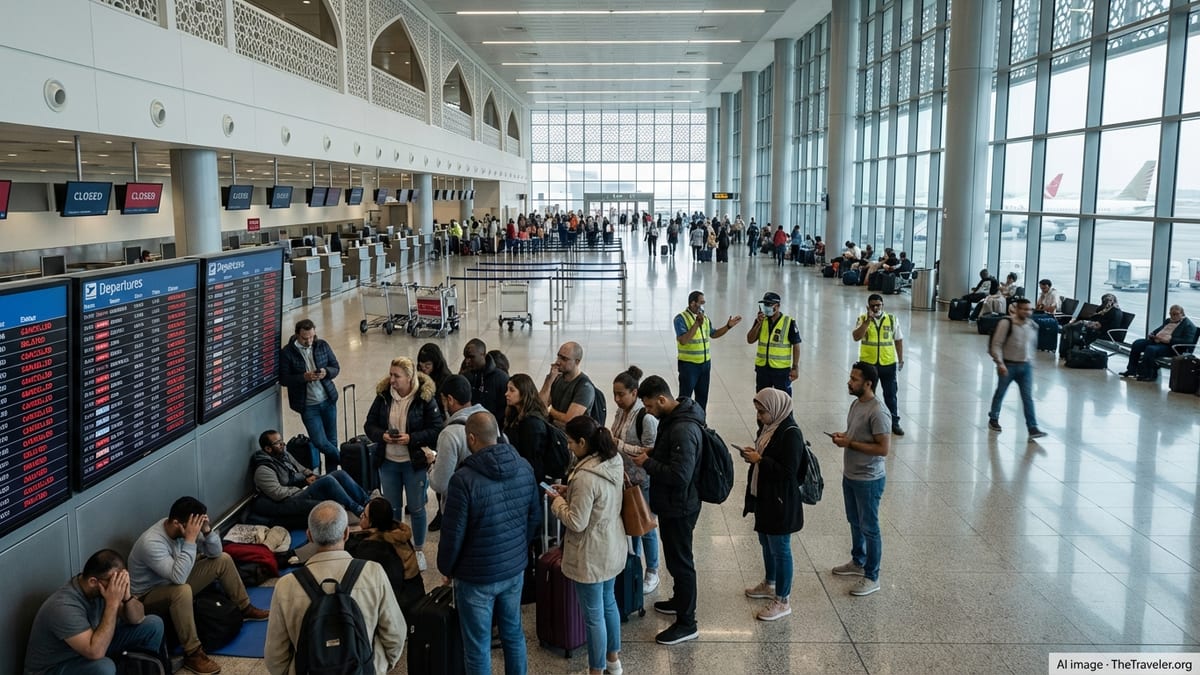
Fresh Turmoil at a Key Gulf Transit Hub
Hamad International Airport, a cornerstone of global long-haul connectivity, has already been operating in a fragile environment after months of regionwide airspace restrictions and schedule reshuffles. Recent travel-advisory material and operational assessments describe flight operations at the Doha hub as still affected by wider Gulf security conditions, with airlines adjusting frequencies and routings in response to evolving risks and constrained air corridors.
Against this unsettled backdrop, monitoring of flight-status boards and published tracking data indicates that at least 13 departures and arrivals linked to Hamad International were cancelled within a compressed period, amplifying knock-on disruption across the Gulf. The affected services include a mix of regional shuttles and long-haul sectors, meaning the impact extends far beyond Qatar’s borders into Asia, Europe and Africa via broken transfer chains.
The cancellations come even as Qatar Airways prepares a broader summer ramp-up, with recent network updates outlining plans to serve more than 150 destinations from mid-June. Industry observers note that this apparent contradiction between expansion and localised disruption underlines the operational tightrope carriers are walking as they attempt to rebuild capacity through a still-volatile Middle East airspace environment.
Travel-risk briefings circulated in recent weeks have repeatedly highlighted Hamad International as a major hub where residual instability remains possible, even when regional skies are technically open. The latest wave of cancellations appears to confirm that assessment, with operational resilience still vulnerable to sudden strains on aircraft, crew and routing options.
Regional Security Tensions Feed Operational Instability
While no single trigger has been publicly identified for the latest cluster of cancellations at Hamad International, it unfolds against a backdrop of escalating security tensions and sporadic attacks elsewhere in the Gulf. In early June, reporting on regional security detailed strikes on Kuwait, including damage to airport facilities, underscoring the vulnerability of aviation infrastructure across the northern Gulf and the potential for rapid spillover into broader airspace management.
Earlier analytical reporting by aviation and risk consultancies has traced how temporary airspace closures and missile overflight concerns have repeatedly forced carriers to adjust flight paths, concentrate traffic into narrowed corridors and, in some cases, suspend links to a dozen or more Middle Eastern cities at a time. That pattern reduces operational flexibility for hub carriers such as Qatar Airways, raising the likelihood that stress in one part of the network will translate into cancellations at critical nodes like Doha.
Travel-advisory documents circulated in March and April already flagged Hamad International as experiencing residual disruption related to these security dynamics, even as most Gulf states moved to reopen their skies. The picture that emerges is not of a single dramatic closure, but of ongoing instability where schedules can be maintained on many days, yet quickly unravel when weather, crew availability or routing restrictions intersect.
This environment helps explain why a discrete event involving 13 cancellations at Hamad International can have an outsized effect on the Gulf transit system. With limited slack in aircraft rotations and crew rosters, airlines have less room to absorb disruptions, turning localised issues into network-wide shocks.
Long-Haul Transit Passengers Bear the Brunt
The most immediate victims of the cancellations at Hamad International are transit passengers who rely on Doha as a connecting bridge between Europe, Africa, Asia and Australasia. Previous incident analyses of disruptions at the airport have documented how thousands of through-passengers can be stranded when a wave of cancellations hits a bank of long-haul arrivals and departures, leaving travellers effectively marooned in the terminal while downstream connections evaporate.
Similar patterns are now emerging again. Publicly available accounts from recent months describe passengers facing missed onward flights, overnight delays and rebookings that extend itineraries by more than a full day. When cancellations affect both inbound and outbound sectors, some travelers are left without straightforward re-routing options, particularly on heavily used Asia–Europe corridors that are already constrained by broader regional tensions.
Complicating matters further, the latest instability at Hamad International coincides with the ramp-up to peak summer travel for Gulf carriers. With load factors already high and spare seats limited, the scope for re-accommodating disrupted passengers onto alternative services is narrower than in low season. That dynamic risks creating a cascade in which each cancellation not only strands existing travelers but also squeezes options for those booked on subsequent days.
For many passengers, Hamad International’s role as a transfer hub means that cancellations in Doha translate into missed connections at secondary destinations, from regional spokes in South Asia to major cities in East Asia, Europe and Africa. As a result, the immediate effect is felt across multiple airports and jurisdictions, straining hotel capacity, visa arrangements and ground-transport links far beyond Qatar itself.
Shockwaves Across the Wider Gulf Transit Network
The disruption in Doha is reverberating across other Gulf hubs that form the spine of intercontinental travel between Europe, Asia and Africa. In recent weeks, airports in Dubai, Abu Dhabi, Kuwait City, Dammam and Baku have all experienced notable bouts of cancellations and severe delays attributed to the same web of security concerns, airspace bottlenecks, crew shortages and knock-on congestion.
Travel coverage from April and May chronicled days when dozens of Gulf-bound flights were grounded simultaneously, as carriers like Saudia, Kuwait Airways, Gulf Air, flydubai and others trimmed schedules or rerouted aircraft. On several occasions, monitoring of delay statistics showed cancellations in the high teens or low twenties across multiple hubs in a single day, illustrating how sensitive the region’s network has become to any operational shock.
Analysts note that Hamad International’s importance amplifies the effect of disruptions there. As a primary hub for connections to secondary cities across Asia and Africa, even a modest number of cancellations can sever links relied upon by migrant workers, business travelers and tourists alike. When these cancellations coincide with instability at other Gulf gateways, the result can be a patchwork of broken itineraries that is difficult for passengers and airlines to repair quickly.
Some Gulf carriers have attempted to mitigate the turbulence by temporarily shifting operations to alternative airports or by consolidating services, yet the cumulative effect remains one of diminished reliability. For travelers, the pattern of repeated, rolling disruptions across multiple Gulf hubs translates into a persistent level of uncertainty when planning itineraries that depend on the region’s traditional role as a seamless bridge between continents.
What Travelers Can Expect in the Coming Days
With the situation at Hamad International evolving amid a broader regional context of intermittent airspace tension, industry observers expect further short-notice schedule changes to remain possible in the immediate term. While there is no indication that Doha faces a prolonged shutdown, the recent cluster of 13 cancellations illustrates how quickly the operational picture can change, even when airspace is technically open and airlines are publicly signaling expansion.
Travel-advisory providers are urging passengers with upcoming connections through Hamad International or other Gulf hubs to monitor their bookings closely and to remain flexible about routings and timings. In practice, that may mean accepting longer layovers, alternative transit points or date changes in exchange for greater certainty that a trip can be completed without extended stranding.
Airlines, for their part, are seeking to balance the commercial imperative to restore capacity with the operational need to maintain buffer room in fleets and crew rosters. Recent operational updates from major Gulf carriers highlight ongoing efforts to rebuild networks while explicitly warning that schedules remain subject to alteration due to regulatory, safety or other factors beyond their control.
For now, travelers using Hamad International and the wider Gulf transit system face a more complex and unpredictable landscape than in previous years. The latest wave of cancellations in Doha, culminating in 13 flights scrubbed in rapid succession, underscores that the region’s vaunted connectivity is still in a fragile, transitional phase, where even localized disruption can ripple rapidly across continents.