


More news on this day
The Transportation Security Administration marked its 25th anniversary on November 19, 2026, using the milestone to highlight a technology-heavy roadmap that it says will gradually change how passengers move through U.S. airport checkpoints.
Get the latest news straight to your inbox!
A 25-year milestone tied to a new strategy
TSA was created after the Aviation and Transportation Security Act passed in the aftermath of the September 11, 2001 attacks, federalizing passenger and baggage screening at U.S. airports. The agency formally marked its 25th anniversary on November 19, 2026, with a national press release that looked back on its origins while pointing ahead to a more automated checkpoint experience.
In parallel, TSA Administrator David P. Cummins launched the Horizon 25 Strategy on August 24, 2026, describing how the agency plans to accelerate the use of emerging technologies and adjust its partnerships with airports and private operators as it enters its second quarter-century. The strategy documents and associated public remarks emphasize both security outcomes and passenger throughput as key goals.
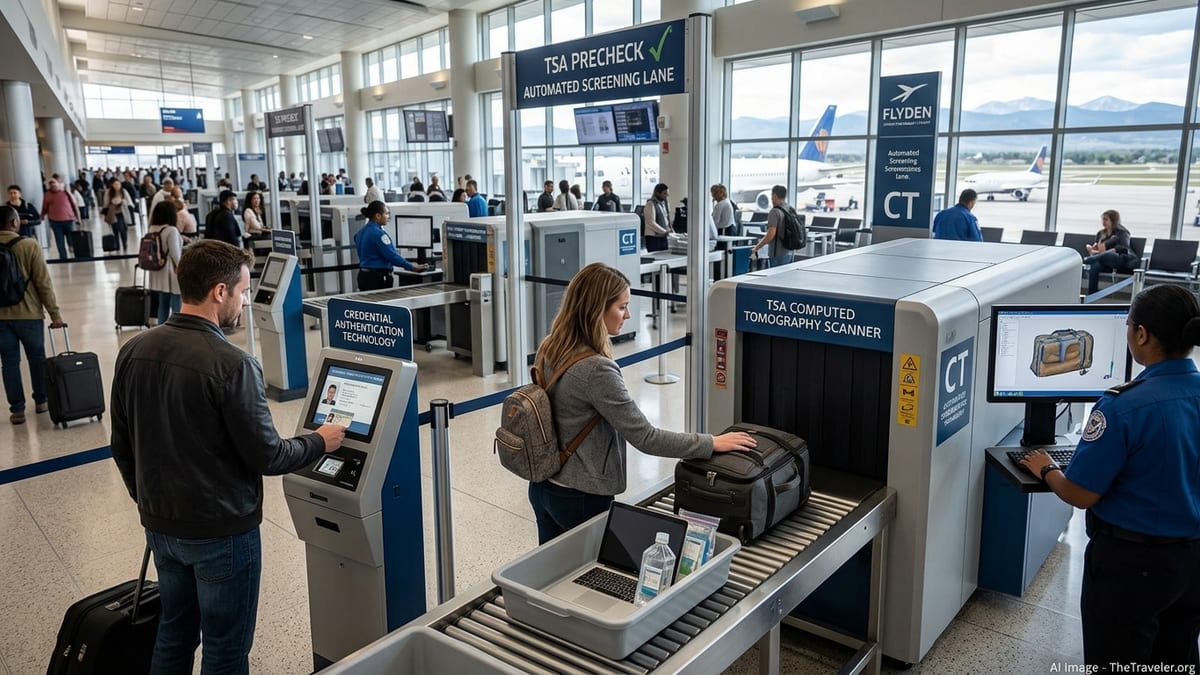
TSA has also refreshed its public-facing "emerging technology" information, which spells out the main systems it is buying or piloting: computed tomography scanners for carry-ons, Credential Authentication Technology units for ID checks, automated screening lanes and new concepts developed under the Department of Homeland Security’s Screening at Speed program.
CT scanners: 3D views and fewer unpacked bags
Computed tomography scanners, already common in medical imaging, are at the center of TSA’s checkpoint plans. Unlike traditional X-ray machines that produce 2D images, checkpoint CT units generate 3D views of carry-on bags that officers can rotate on-screen, supported by automated detection algorithms. TSA procurement documents describe CT as its most impactful carry-on screening technology and link it to longer-term plans to rely more on automation for threat detection.
For travelers, the key change at a growing number of checkpoints is that CT lanes often allow laptops and standard-size liquids to stay in carry-on bags instead of being removed to separate trays. TSA’s own materials describe this as an eventual goal rather than a guaranteed feature at every CT site, and airports can apply local rules, so passengers may still be asked to separate items at some locations using the same technology.
Rollout is still partial. TSA has awarded multiple large contracts for CT units and integrated automated screening lanes, and the systems are now visible in some major hubs, but planning documents indicate that achieving full nationwide coverage at current funding levels could take well into the 2030s or beyond. Travelers should not assume their departure airport has CT equipment until they see it in the checkpoint or receive specific guidance from the airport or airline.
Digital ID checks, automated lanes and emerging e-gates
Alongside CT, TSA is expanding Credential Authentication Technology machines that scan a passenger’s ID and electronically confirm both identity and flight details. TSA describes CAT as a "security game changer" because it can verify identification documents, check reservation data and confirm Secure Flight vetting status in near real time, reducing the need for manual comparison of IDs and boarding passes.
In practice, this means that at more checkpoints passengers now insert or present their ID at a kiosk-like device instead of handing it to an officer along with a paper or mobile boarding pass. At some sites, CAT units are paired with cameras to capture a live facial image and compare it to the ID photo, a process TSA says is voluntary and that travelers can opt out of, although the underlying verification of the document remains mandatory for screening.
Automated screening lanes, often integrated with CT units, add parallel divestiture stations, automatic bin feeds and returns, and larger bins designed to hold more items. According to TSA procurement and innovation program summaries, the goal is to keep passengers loading bins even while others are being screened, which can shorten waits when lanes are fully staffed.
Separate from government-owned systems, biometric e-gates are beginning to appear at a small number of domestic checkpoints through partnerships between TSA and private operators. At San Diego International Airport, for example, CLEAR and TSA have deployed biometric e-gates for CLEAR+ members that allow enrolled travelers to verify their identity at a gate and proceed directly to bag and walkthrough screening without stopping at a staffed ID podium. This model is limited to specific airlines, lanes and membership programs and is not yet available systemwide.
Self-service screening pilots and what remains experimental
TSA and the Department of Homeland Security’s Science and Technology Directorate have been working for several years on pod-based self-service screening concepts for PreCheck passengers under the Screening at Speed program. Official DHS project descriptions outline multi-pod lanes where travelers would follow on-screen instructions to conduct much of the process themselves, with officers overseeing multiple pods and intervening only when the system flags an issue.
An early version of this idea has already been tested in the field. TSA piloted a self-service checkpoint concept for PreCheck travelers at Harry Reid International Airport in Las Vegas, allowing volunteers to move through stations with video guidance in place of the traditional officer-directed sequence. Public information about the Las Vegas trial and DHS technical documents indicate that these systems remain experimental and are not scheduled for broad deployment.
Looking ahead, DHS material also references a longer-term vision of compact self-service pods that could fit several stations into the footprint of a single conventional lane. These pods are still under development, with no confirmed timeline, funding package or list of future airports. Travelers should view them as a preview of what checkpoints might look like in a decade or more rather than a feature they can expect to encounter soon.
What travelers should expect over the next decade
For now, the practical impact of TSA’s 25th-anniversary technology push will be highly uneven from airport to airport. A traveler might encounter integrated CT and automated lanes with CAT-based ID checks at one major hub, then find conventional X-ray, manual ID verification and standard bins at a smaller regional airport on the same trip. Even within a single terminal, some lanes may be upgraded while others remain unchanged.
Horizon 25 and associated TSA investment plans suggest that more U.S. travelers will see CT scanners, CAT units and automated lanes over the next five to ten years, with incremental gains in speed when staffing and passenger volumes align. At selected airports, biometric e-gates or self-service elements may further streamline the ID or screening process for enrolled travelers or PreCheck members, though participation in those pilots will remain optional.
Passengers planning trips in the coming years should continue to follow current TSA packing rules and arrive with enough time for conventional screening, regardless of what new equipment might be present. Before flying, it is worth checking airport or airline guidance for notes on new checkpoints or pilot programs, but until TSA’s 25th-anniversary technology roadmap is fully funded and implemented, the safest assumption is that familiar procedures still apply unless local instructions clearly indicate otherwise.