


More news on this day
Canada has extended temporary Ebola-related border and aviation measures through November 27, 2026, effectively obliging airlines around the world to screen and sometimes refuse boarding to passengers with recent travel to the Democratic Republic of the Congo (DRC), while Canadians and permanent residents face tightened quarantine rules on arrival.
Get the latest news straight to your inbox!
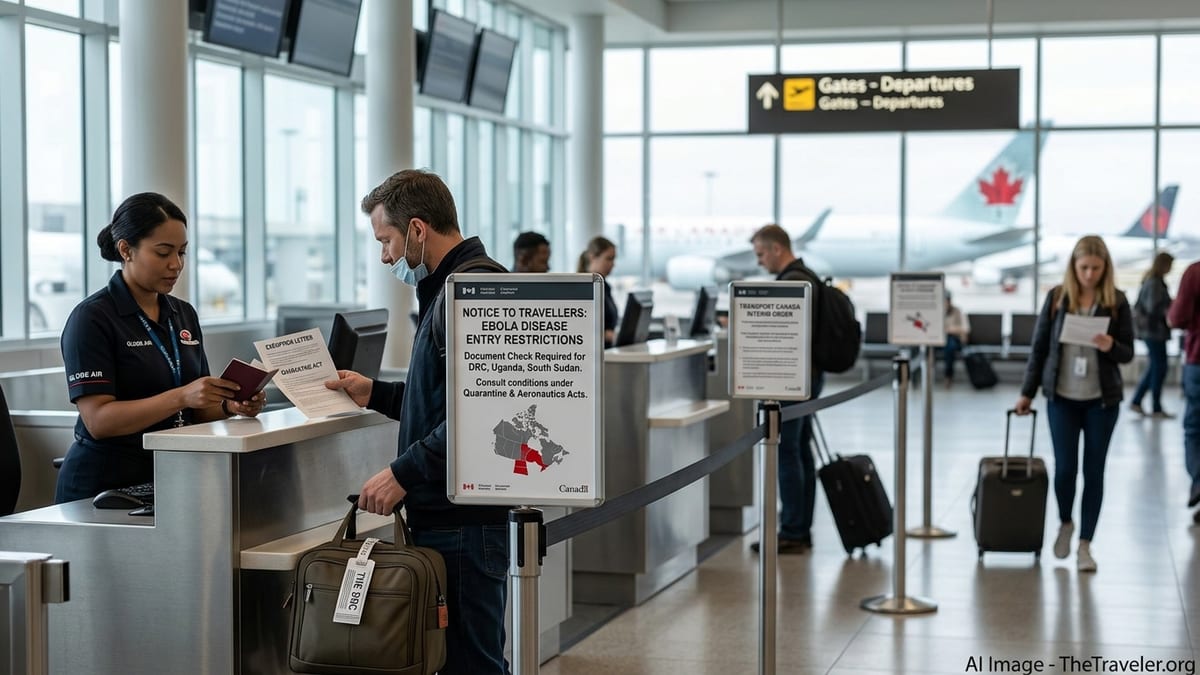
Linked orders under Canada’s Quarantine and Aeronautics Acts
The federal response is built around two instruments: an emergency order under the Quarantine Act and a Transport Canada interim order under the Aeronautics Act. The Minimizing the Risk of Exposure to Ebola Disease in Canada Order, 2026, first brought into force on May 31 and most recently extended to 23:59 EDT on November 27, 2026, restricts entry to Canada for certain travellers who have been in the DRC, Uganda or South Sudan within the previous 21 days, while carving out defined exemptions for some humanitarian, medical and essential-service roles.
In parallel, Transport Canada has issued an Interim Order to Prevent Certain Persons from Boarding Flights to Canada Due to Ebola Disease, No. 2, which applies to Canadian and foreign air operators alike. The interim order requires carriers to deny boarding to foreign nationals who have spent any time in the DRC during the 21 days before departure to Canada, unless they hold documentation confirming an exemption under the Quarantine Act order.
Together, the two instruments mean that entry is constrained both at the airline check-in counter and at the Canadian border itself. The government continues to stress that the measures are temporary and targeted, aimed at reducing the chance that an infected traveller reaches Canada, while maintaining that the overall risk to people in Canada remains low.
Airlines pressed into frontline screening roles
Because the Transport Canada interim order binds “private operators and commercial air carriers” serving Canada, its reach extends well beyond Canadian airlines. Any carrier operating a Canada-bound service, regardless of its home country, must assess whether passengers have been in the DRC within the previous 21 days and, if so, whether they are foreign nationals without a valid exemption letter.
For airline staff, the practical effect is a new layer of document checks at booking and check-in, on top of visas, electronic travel authorizations and standard advance passenger information requirements. Carriers that board ineligible passengers risk regulatory enforcement, so many are updating internal guidance and training to flag recent DRC, Uganda or South Sudan travel histories and to recognise exemption letters issued under Canadian rules.
Some operators, including large Canadian carriers, have published travel advisories warning customers that even approved visas or valid tickets do not guarantee boarding if the passenger’s recent travel history triggers the Ebola-related restrictions. Travellers with complex itineraries through multiple African hubs are being advised to verify that their routing and documentation meet Canadian requirements before beginning their trips.
Who can still travel to Canada and on what conditions
The core restriction falls on foreign nationals who have been in the DRC within the last 21 days. In most cases they cannot board flights to Canada and, if they reached a land or marine border instead, would still be covered by the Quarantine Act order that bars entry absent a qualifying exemption. The measure also affects certain foreign nationals whose last country of residence on immigration applications is listed as the DRC, Uganda or South Sudan, whose travel to Canada remains paused.
Canadian citizens, permanent residents and some narrowly defined exempt groups can still travel to Canada after recent time in the affected countries, but they face stringent health-control conditions. Current federal public health instructions state that asymptomatic travellers who have been in the DRC, Uganda or South Sudan within the preceding 21 days are required to quarantine for 21 days on arrival, follow active monitoring protocols and in some cases remain within reasonable distance of designated assessment or test-and-hold centres throughout their quarantine period.
For travellers, this can influence route planning and choice of destination within Canada. Some may be routed through or advised to remain near airports where specialised facilities and provincial public health teams are prepared to handle higher-risk cases, while discretionary trips that would involve onward domestic travel during the quarantine period may be discouraged or deferred.
Context: Bundibugyo Ebola outbreak and U.S. comparison
Canadian officials link the measures directly to the ongoing outbreak of Ebola disease caused by Bundibugyo virus in the DRC, which the World Health Organization has determined continues to constitute a public health emergency of international concern. WHO’s most recent risk assessment, issued in mid-November 2026, keeps the risk at very high within the DRC, with continued concern about cross-border spread, even as the risk to countries with stronger health systems remains lower.
Canada’s approach is not unique in North America. The United States has also adopted emergency travel measures that rely on a 21-day presence rule for outbreak-affected countries and direct covered travellers through a limited set of designated airports where enhanced screening and follow-up are available. Recent U.S. Federal Register notices confirm that CDC orders restricting the arrival of certain non-citizens with recent travel in the DRC, and until recently Uganda and South Sudan, remain in force and continue to use a 21-day lookback tied to the incubation period of Ebola disease.
For airlines operating transatlantic and trans-African routes, this means navigating overlapping but not identical requirements on both sides of the border. A passenger’s eligibility to board or their required routing can change depending on whether the final destination is in Canada, the United States or another country with its own Ebola-related rules, making accurate data on recent travel histories and clear communication with passengers critical.
What travellers should check as November 27 approaches
The current Canadian orders are explicitly time limited. Official Public Health Agency of Canada advisories, immigration notices and travel health updates all state that the Ebola-related temporary border measures are in effect until November 27, 2026, at 23:59 EDT, with the government retaining the option to extend them again, amend them or allow them to lapse depending on the evolving outbreak and WHO advice.
Because past extensions have been announced relatively close to expiry dates and sometimes involved technical updates to exemptions and quarantine instructions, travellers planning trips after late November are being urged to recheck Canadian government travel health notices and airline advisories shortly before departure. This is particularly important for anyone who has recently been in the DRC, Uganda or South Sudan, or who is transiting through regional hubs where itineraries can inadvertently fall within the 21-day exposure window.
Until new decisions are published, the working assumption for travellers and carriers is that the current regime remains in place, with no blanket ban on flights from Africa but with targeted restrictions based on recent presence in specific Ebola-affected countries. Those with upcoming journeys involving Central or East Africa should build in extra time for health-related questioning at check-in and on arrival, and should be prepared for quarantine or monitoring requirements if their travel history falls within the Canadian or U.S. Ebola control rules.