


More news on this day
Four major outbound markets for France tourism – the United States, United Kingdom, Canada and Australia – have all updated their travel advice in late October and early November 2026 to underline the impact of ongoing demonstrations and transport strikes, tightening language around protest-related risks while keeping their overall advisory levels for France unchanged.
Get the latest news straight to your inbox!
What has changed in the latest advisories
The U.S. Department of State reissued its France and Monaco travel advisory on 21 October 2026, maintaining the country at Level 2: Exercise Increased Caution. The text now explicitly points to unrest and industrial action, warning that demonstrations and strikes can occur in major cities and around key transport hubs, and advising travellers to avoid protest areas and follow instructions of local authorities.
Canada’s Travel Advice and Advisories service last updated its France page on 6 November 2026. The overall level remains “Exercise a high degree of caution,” but officials flagged a regular text update to the Safety and security section to add more detailed references to demonstrations and strikes and their potential to disrupt travel and create localized safety risks.
Australia’s Smartraveller also refreshed its France advisory on 6 November 2026, keeping the country at “Exercise a high degree of caution.” The latest update notes that demonstrations and protests continue across France, sometimes at short notice, and reminds travellers that security conditions can deteriorate quickly and that advice levels may change if the situation worsens.
UK guidance and separate US security alert
In the United Kingdom, the Foreign, Commonwealth & Development Office updated its France travel advice on 5 November 2026. The overall level has not changed, but the Safety and security section now stresses an increased likelihood of demonstrations, political gatherings and marches across France, occasionally with limited notice. The FCDO notes that protests can turn confrontational and that police may use crowd-control measures.
Alongside the standing travel advisory, the United States also issued a separate security alert through its mission in France in late October. That message highlighted the risk of violent protests around specific planned demonstration dates, pointed to earlier unrest that had involved looting and property damage, and urged U.S. citizens to steer clear of protest routes, keep identity documents with them and monitor local media for real-time updates.
Taken together, the four governments are not telling citizens to cancel trips to France. Instead, they are converging on stronger wording around the potential for some events to become violent and for sudden disruption in busy urban areas, especially on days when unions and student groups call for nationwide action.
How protests and strikes can affect trips
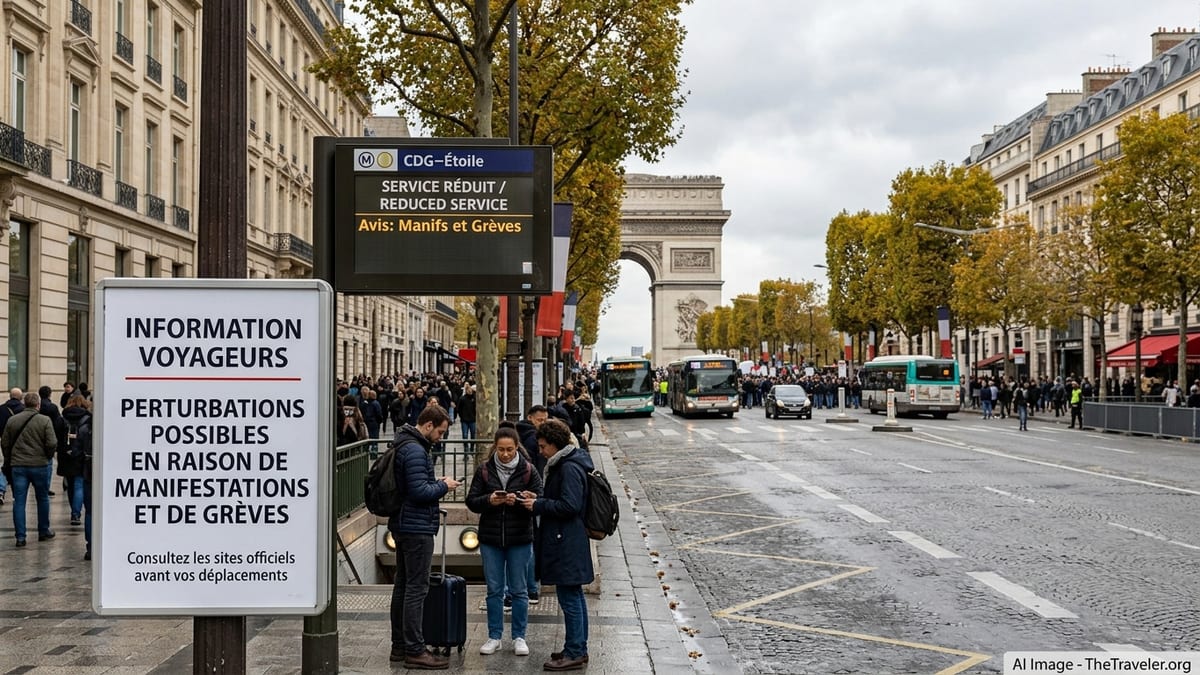
The updated advisories underline that the main impact for visitors is likely to be disruption rather than a blanket loss of access to attractions or cities. Demonstrations are currently concentrated in larger urban centres such as Paris, Lyon and Marseille, and in some regional capitals, but can also occur in smaller towns. On declared protest days, authorities have at times deployed large numbers of police and restricted access to certain squares or boulevards.
Industrial action and solidarity walkouts can affect multiple transport modes at once. Union announcements and local notices indicate that rail services, including SNCF mainline trains and regional TER services, may run on reduced timetables on strike days. In the Paris region, RER and Metro lines can see partial closures, longer intervals between trains or last-minute station shutdowns near protest routes.
Advisories also flag knock-on effects at airports and on major roads. Ground handling or air traffic control strikes may lead to flight delays or cancellations, while road demonstrations and slow-rolling vehicle convoys can cause traffic jams on ring roads and key motorway approaches. Travellers connecting between airports and city centres, or between mainline rail stations, may need to allow significantly more time than usual when industrial action has been announced.
What travellers should do differently now
Because none of the four governments has raised France to a higher advisory tier or issued a broad “do not travel” warning, the change for most tourists is in how they plan and manage their time rather than whether to go at all. Travellers are being encouraged to monitor local news and official channels more closely in the days before and during their trip, checking for announced strike dates and large-scale marches in the cities they plan to visit.
Visitors already in France are advised to avoid joining demonstrations and to stay away from large crowds where possible, even if gatherings initially appear peaceful. The guidance reflects recent experience in which many protests remained orderly but some events, particularly in October, saw clashes with police and damage to shops and street furniture once night fell.
On practical planning, the new wording suggests building extra slack into travel days. That can mean allowing more time for airport transfers when a transport strike is scheduled, having a backup route in case a Metro or RER station is closed, confirming train departures on operator apps rather than assuming normal service, and being prepared to walk short distances if buses or trams are diverted away from demonstration areas. Travellers should also keep essential documents and medications with them in case they are delayed while moving around large cities.
What to check before you travel
Given how quickly protest calendars and industrial action plans can evolve, all four governments stress that conditions and wording may change at short notice. Anyone planning a trip to France in the coming weeks should review their national foreign ministry or state department advisory pages, along with any security alerts from embassies or consulates, shortly before departure and again during the trip.
Rail operators, local transport authorities and major French airports typically publish strike timetables and disruption notices a few days in advance, although exact impacts are sometimes only clear on the day itself. Monitoring these sources alongside local news outlets can help travellers decide whether to adjust sightseeing plans, move key reservations away from known protest days or reschedule tight same-day connections.
As the autumn 2026 unrest continues to evolve, the main message from the latest advisories is that France remains open to visitors, but that travellers should approach upcoming trips with a higher level of situational awareness, flexible timing and a willingness to adapt plans around demonstrations and strikes.