


More news on this day
As Americans lock in fall and early-winter itineraries, the U.S. Department of State has refreshed travel warnings that emphasize a more volatile global security picture, including the risk of sudden flight disruptions and shifting local conditions in certain regions.
Get the latest news straight to your inbox!
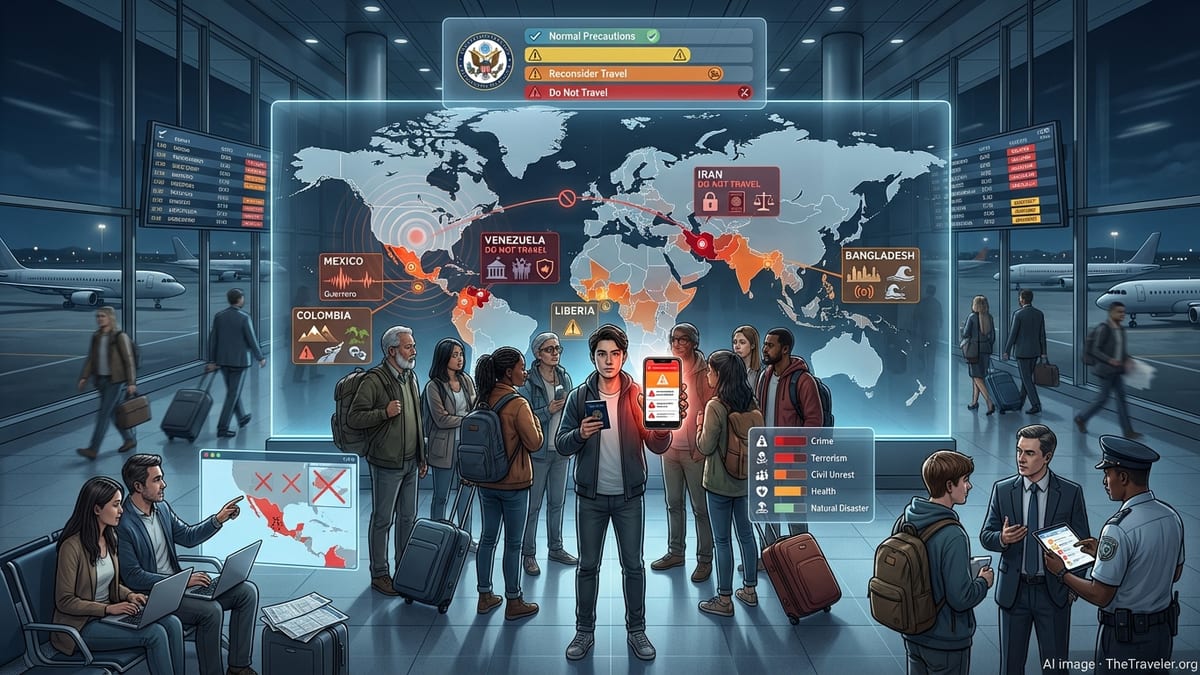
Worldwide caution underscores risk of rapid disruption
The State Department’s most recent worldwide caution, last updated July 22, 2026, advises U.S. citizens to exercise increased caution globally and flags heightened tensions in the Middle East as a key driver of uncertainty for international travel planning.
Publicly available information on the alert points to practical knock-on effects for travelers, including the possibility of periodic airspace closures, last-minute flight cancellations, and changes to airline schedules. The warning also notes that U.S. diplomatic facilities, including outside the Middle East, have been targeted in the past, and that groups supportive of Iran may target U.S. interests and locations associated with Americans worldwide.
For travelers, the immediate takeaway is that “normal” trips may still face abnormal disruption. Even if a destination is not the focus of a warning, itineraries that transit major hubs in the region can be affected by route changes, curtailed service, or rerouting that triggers missed connections and unexpected overnight stays.
Country advisories show where risk levels remain elevated
Alongside the worldwide caution, the State Department’s country-by-country advisories continue to reflect a wide range of risk levels, from Level 1 “Exercise Normal Precautions” to Level 4 “Do Not Travel.” The advisory index also shows that multiple destinations received updates in late August and early September 2026, underscoring that guidance can change quickly.
In the Middle East, several advisories remain at Level 3 “Reconsider Travel,” a designation that does not ban travel but signals a materially higher risk environment. Qatar, for example, is listed at Level 3 as of August 28, 2026, with the advisory centered on armed-conflict risk and the ongoing threat of drone and missile attacks from Iran, plus disruptions to commercial flights following the onset of hostilities between the United States and Iran on February 28, 2026.
Israel is also listed at Level 3 as of August 26, 2026, with publicly posted details highlighting terrorism and unrest concerns and specifying areas where the guidance indicates travelers should not go, including zones near the Gaza Strip and parts of the north. The advisory also reflects that the security environment can change quickly and that airline service may be affected.
Elsewhere, Level 4 “Do Not Travel” advisories remain in place for destinations where conditions are assessed as life-threatening or where the U.S. government’s ability to provide emergency assistance may be extremely limited. Haiti is listed at Level 4 as of July 10, 2026, with the advisory citing risks including crime, kidnapping, unrest, and limited health care, and describing severe constraints on movement for U.S. government personnel.
China and consular limits: what “Level 2” can still mean
Not all updated guidance centers on armed conflict. Some advisories emphasize legal and consular realities that can affect routine trips, including business travel and family visits.
China is listed at Level 2 “Exercise Increased Caution,” with a date issued of September 4, 2026. The advisory points to concerns including arbitrary enforcement of local laws, the use of exit bans, and the risk of unjust arrest or detention, and it also notes limitations on the ability to provide emergency consular services in some regions.
For travelers, Level 2 destinations can still involve meaningful planning changes. That can include considering what devices and data are carried, whether travel plans involve sensitive professional activity, and whether backup communication and documentation options are in place if a trip becomes complicated by local legal processes.
Air travel planning is now part of safety planning
In several advisories tied to regional tensions, aviation reliability has become a central part of travel risk. The Qatar advisory, for example, references the presence of FAA notices affecting the region and frames this as a civil-aviation risk factor travelers should take seriously when planning routes and contingencies.
For upcoming travel, this shifts the checklist beyond traditional safety guidance. Travelers may want to build itineraries with longer connection buffers, minimize “last flight of the day” connections, and consider refundable or flexible fare options when routing through areas where airspace restrictions or operational pauses can emerge with little notice.
It also places a premium on having a self-sufficient contingency plan. Public guidance in recent advisories encourages travelers to have a plan to depart in an emergency that does not depend on U.S. government help, an important distinction in destinations where consular movement can be constrained by security conditions.
STEP enrollment and destination-specific alerts are being emphasized
As warnings and advisories evolve, the State Department continues to direct travelers toward its Smart Traveler Enrollment Program, a free service that provides email updates and alerts from U.S. embassies and consulates abroad and helps consular staff contact travelers or their emergency contacts during a crisis.
STEP is designed to deliver destination-specific security alerts, health and weather notices, and Travel Advisory updates tied to a traveler’s registered itinerary. The State Department also notes that travelers can subscribe without registering a full travel plan, and that group enrollment options exist for organizers enrolling multiple travelers on a single trip.
For travelers heading abroad in the coming weeks, the most actionable approach is to pair the worldwide caution with a close read of the country advisory for every stop on the itinerary, including layovers. Conditions and operational realities can diverge sharply from one destination to the next, and the State Department’s updates indicate that the “latest” guidance is increasingly time-sensitive.