


More news on this day
UAE aviation leaders are overhauling flight paths, schedules and fleet plans as prolonged regional tensions and airspace restrictions force airlines to redraw the traditional east–west corridors across the Middle East.
Get the latest news straight to your inbox!
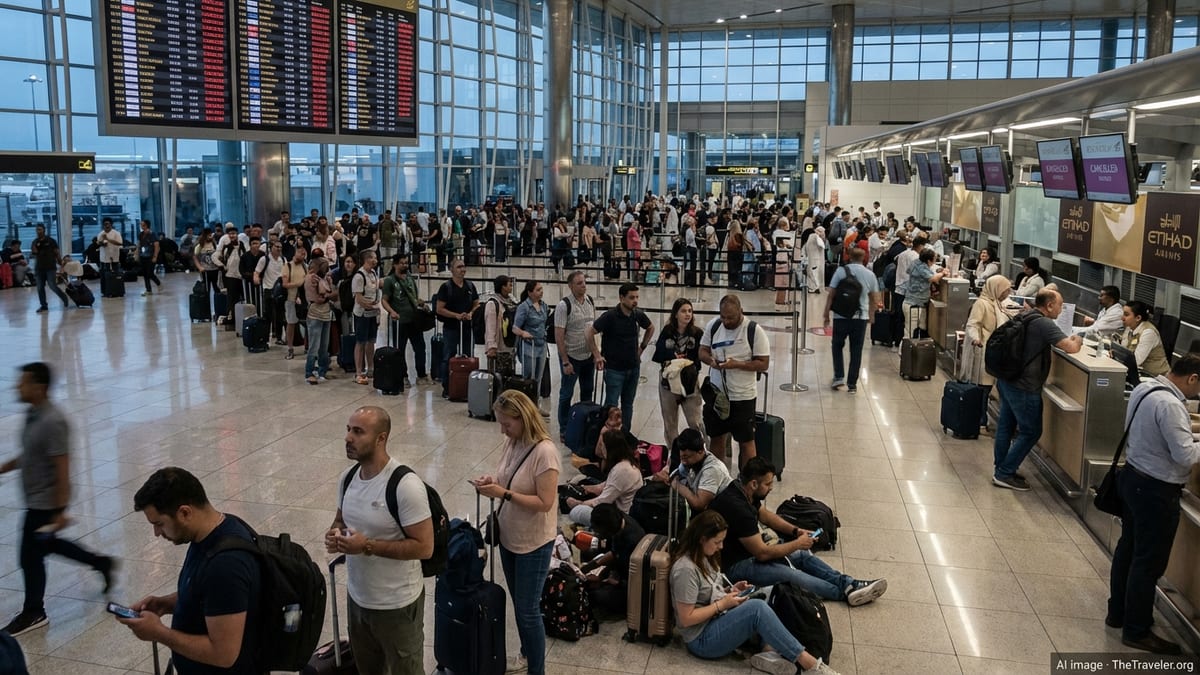
Redrawn Corridors and Longer Westbound Flights
Publicly available flight tracking data and industry coverage show that airlines flying from the United Arab Emirates to Europe and North America are increasingly routing south over Saudi Arabia and, in some cases, further west before turning toward their destinations. These patterns aim to avoid high‑risk skies while maintaining commercially viable links between Asia, Africa and Europe.
Reports indicate that these revised routings are extending scheduled flight times on many westbound services from Dubai and Abu Dhabi. Analysis by regional media highlights that journeys to key European capitals and North American gateways can now take noticeably longer than pre‑crisis schedules, even when departure and arrival airports remain unchanged.
Network planners are balancing these operational detours with fuel burn, crew duty limits and aircraft availability. Timetables are being re‑timed to protect connection banks at hubs in Dubai and Abu Dhabi, helping preserve one‑stop itineraries for passengers even as the underlying tracks become more circuitous.
At the same time, schedules on eastbound routes to India and much of South and South East Asia are reported to be less heavily affected, allowing UAE carriers to lean on these short and medium‑haul markets to sustain network connectivity and revenue.
Hub Strategy: Dubai and Abu Dhabi Adjust Throughput
Dubai International Airport data for the first quarter of 2026 shows a double‑digit decline in passenger volumes compared with the previous year, reflecting the sharp disruption to regional airspace during March. Yet the same disclosures underline that Dubai continues to handle a substantial share of global transfer traffic, reinforcing its role as a central hub despite temporary constraints.
Airport authorities in Dubai state that they are aligning runway and terminal capacity with evolving airspace conditions, gradually restoring movements as restrictions ease. Parallel investment at Dubai World Central, which is earmarked for a major long‑term expansion, is positioned as a structural response to anticipated demand growth once the regional situation stabilises.
In Abu Dhabi, publicly available information from Etihad Airways and airport operators points to a focus on carefully rebuilding frequencies on core routes while protecting connectivity to strategic markets in Europe, Asia and the Gulf. By sequencing the return of capacity and leveraging corridor approvals from the UAE’s aviation regulator, the capital is aiming to keep disruption for transfer passengers within manageable limits.
Both hubs are also relying on established ground‑handling and intermodal logistics capabilities to protect cargo flows, an increasingly important revenue source as passenger demand fluctuates and routings are redrawn.
UAE Carriers Pivot Networks, Fleets and Partnerships
Despite the challenging backdrop, Emirates reported record profit and revenue for the 2025–26 financial year, according to its latest annual results. The group attributes this to sustained global demand, disciplined capacity deployment and continuing investment in fleet renewal, including the progressive introduction of Airbus A350 aircraft on regional and medium‑haul routes.
The airline’s public fleet and network plans show that A350s are being layered onto existing schedules to optimize fuel efficiency and maintain competitive product standards on routes facing longer flight times. Emirates is also advancing retrofit programmes across its A380 and Boeing 777 fleets, indicating a long‑term commitment to hub‑and‑spoke operations out of Dubai even as near‑term schedules are adjusted.
Etihad Airways is pursuing a different, but complementary, strategy centred on a growing portfolio of new destinations and codeshare agreements. Company announcements detail additional routes planned across Europe, Central Asia and the Caucasus through 2025 and 2026, along with new partnerships in North East Asia that feed traffic into Abu Dhabi. These moves are intended to diversify traffic flows and reduce over‑reliance on any single corridor.
Flydubai, which has built a network spanning more than 100 destinations, continues to report strong passenger growth while acknowledging reduced schedules during peak disruption periods. Public updates describe targeted frequency cuts, selective storage of aircraft and a focus on high‑yield and resilient markets, with new routes such as Bangkok designed to deepen access to South East Asia.
Cargo Resilience and Supply Chain Realignment
Industry analysis from the International Air Transport Association shows that Middle Eastern airlines account for about a tenth of global passenger traffic and a smaller, but strategically important, share of dedicated cargo capacity. The closure of key airspace segments has therefore had outsized effects on global supply chains, particularly on time‑sensitive flows between Asia and Europe.
UAE operators are responding by increasing belly‑hold cargo capacity where passenger services remain viable and by fine‑tuning freighter schedules to exploit alternative corridors. Etihad Cargo, for example, has outlined plans for expanded winter belly‑hold capacity, adding more destinations across Europe, Asia, Africa and the Americas to maintain uplift options for shippers.
Logistics providers tracking the region report periodic tightening on certain trade lanes, especially where rerouting adds distance and reduces effective capacity. Forwarders are adapting by redistributing volumes through Gulf hubs, shifting some consignments to alternate gateways in the wider region, and making greater use of multimodal solutions that connect maritime and air networks around the Arabian Peninsula.
The emphasis on cargo resilience is reinforcing the UAE’s role as a logistics crossroads. Even as airlines adjust passenger schedules, investments in automated cargo facilities and digital platforms at Dubai and Abu Dhabi are intended to lock in long‑term competitive advantage.
From Short‑Term Disruption to Long‑Term Realignment
Economic assessments of the wider Middle East crisis describe the 2026 Iran conflict as the most significant shock to regional aviation since the pandemic, with temporary closures affecting airports that together handle a sizable share of global air traffic. Flight cancellations, detours and capacity reductions have produced ripple effects across airline alliances and interline agreements.
Yet the same analyses highlight that carriers are gradually shifting from emergency responses toward structural network redesign. For UAE airlines, this includes re‑evaluating the balance between transfer and point‑to‑point traffic, expanding into secondary cities that sit outside the most affected airspace, and using new aircraft types to keep unit costs in check on longer routings.
Published commentary from aviation specialists points to a broader realignment of global air flows, with some non‑Middle Eastern airlines adding capacity on alternative long‑haul corridors to compensate for reduced connectivity through the Gulf. In this evolving landscape, the UAE’s combination of deep aviation expertise, infrastructure investment and flexible commercial strategies is positioning its carriers to remain central players in a reshaped global network.
For travellers, the near‑term reality is longer journeys on some routes, higher fares in certain markets and more frequent schedule changes. For the UAE aviation sector, the current period is accelerating trends toward fleet modernization, diversified partnerships and a more agile approach to route planning that is likely to define the region’s role in global travel for years to come.