


More news on this day
Flight disruption across key Gulf aviation hubs is continuing to affect thousands of passengers worldwide, as Dubai, Abu Dhabi, Doha and other regional airports restart only limited services following weeks of intermittent airspace restrictions, operational bottlenecks and conflict-related disruptions.
Get the latest news straight to your inbox!
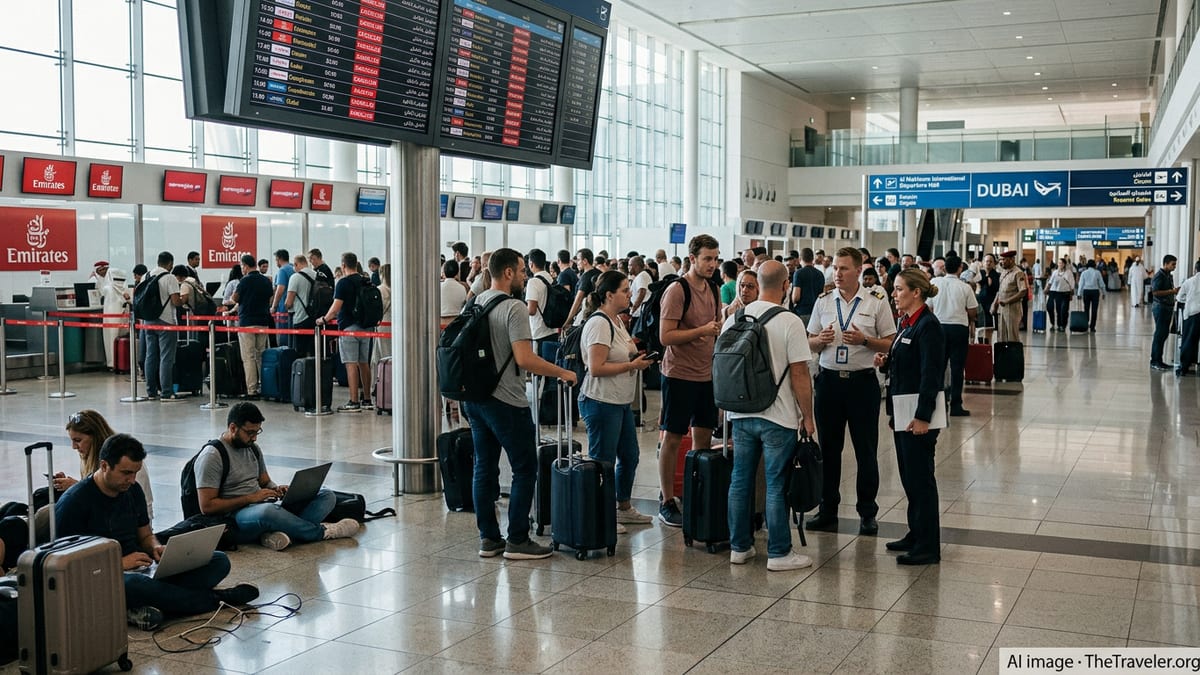
Gulf Transit Corridor Under Strain
The Gulf region’s role as a central transit corridor between Europe, Asia and Africa has magnified the impact of the latest disruption. Publicly available traffic and advisory data for late February through May 2026 show repeated periods of curtailed operations at Dubai International, Abu Dhabi’s Zayed International and Doha’s Hamad International airports as airspace capacity has been reduced or partially closed at various points.
Reports indicate that at the height of recent closures, flight activity at some Gulf hubs dropped sharply compared with normal levels, with cancellations and diversions affecting both passenger and cargo services. Schedules that had only recently recovered from earlier shocks are again being redrawn, leading to rolling delays, missed connections and extended layovers for travelers crossing the region.
Industry analyses highlight that these hubs handle a substantial share of global east–west connecting traffic, meaning disruptions in the Gulf quickly cascade into Europe, Asia, Africa and North America. Airlines are now attempting to balance safety considerations, evolving airspace guidance and commercial pressure to restore their long-haul networks.
Travel risk advisories updated through May 2026 describe Dubai and Abu Dhabi as operational but with constrained capacity and schedules still subject to sudden change, while Hamad International in Doha is reported to be running well below typical throughput as carriers phase services back in.
Airlines Restart Limited Services For Stranded Travellers
Major Gulf-based carriers, including Emirates, Etihad Airways, flydubai and Qatar Airways, have begun restarting a restricted set of services through their home hubs as airspace controls ease and routings stabilize. According to recent operational updates and trade coverage, many of these flights prioritize passengers who were stranded during earlier shutdowns and partial closures.
In Dubai and Abu Dhabi, publicly available airline notices show that repatriation-style services and a reduced schedule of regular flights are being used to gradually clear backlogs. Seat availability on these departures is tight, with priority often given to travelers whose original journeys were disrupted, followed by new bookings as capacity allows. Some long-haul routes are operating at reduced frequency, with wide gaps between departures compared with pre-crisis timetables.
In Doha, Qatar Airways has resumed select long-haul and regional services after earlier suspensions linked to regional airspace restrictions. Reports indicate that the airline is focusing on re-establishing critical trunk routes to Europe and Asia while retaining flexibility to adjust timings and routings in response to any renewed constraints. Travelers connecting through Doha are being advised by travel providers to monitor their bookings closely and prepare for last-minute schedule changes.
Despite the restart, capacity remains far below normal across the main Gulf hubs. Industry assessments suggest that airports such as Dubai International are operating at significantly reduced movement levels compared with typical peak-season volumes, limiting the ability of airlines to accommodate all displaced passengers quickly.
Knock-on Effects Across Global Networks
The current phase of disruption is not confined to carriers based in the Gulf. International airlines from Europe, Asia and beyond have been rerouting or scaling back services to the region as they navigate conflict-related risk assessments and airspace advisories. Flight-tracking data and airline statements compiled in recent days show reduced frequencies or temporary suspensions on some routes into Dubai, Doha, Abu Dhabi and other Gulf cities.
Some carriers have chosen to avoid key Gulf hubs altogether for the time being, shifting connecting traffic via alternative airports in Europe, Central Asia or the Indian Ocean. This has increased journey times on certain Europe–Asia and Asia–Africa itineraries, with travelers in some markets facing longer travel days and more complex itineraries.
Logistics providers and cargo customers are also feeling the strain. Freight industry briefings describe delays to time-sensitive shipments and reduced uplift capacity on key lanes that normally rely heavily on belly-hold space through the Gulf. Additional flying time on rerouted services has implications for fuel burn and payload limits, further constraining available capacity.
For individual travelers, the most visible effects are extended layovers, missed onward connections and unexpected overnight stays. Travel insurers and corporate travel managers are advising clients to maintain flexible itineraries, allow extra buffer time for connections and remain prepared for abrupt changes even once a journey is underway.
Weather, Security And Capacity Constraints Converge
While the latest wave of disruption is closely tied to regional security tensions and intermittent airspace closures, recent months have also highlighted how other factors can quickly compound pressure on Gulf hubs. Earlier in 2026, dense fog episodes and isolated operational issues across the United Arab Emirates and neighboring states led to diversions, holding patterns and ground delays, creating knock-on delays that lasted well beyond the initial weather events.
Airport and aviation analyses published in the first half of 2026 emphasize that the Gulf’s tightly banked hub schedules leave little margin for extended interruptions. When combined with security-related restrictions and broader staffing or technical challenges, even short suspensions of arrivals and departures can trigger large backlogs that take days to unwind.
Recent business and infrastructure briefings point to elevated jet fuel costs, heightened insurance considerations and congested terminal operations as additional headwinds. Together, these factors have made it harder for airlines and airports to flex capacity quickly in response to sudden closures or reroutings, prolonging the recovery phase after each disruption.
As a result, aviation planners increasingly frame the Gulf as a region where multiple layers of risk need to be managed simultaneously, from geopolitics and airspace management to weather volatility and ground-handling resilience. Travelers see the outcome of this complexity in the form of unpredictable departure times and longer journey durations.
What Travellers Can Expect In The Coming Weeks
Published advisories as of late May 2026 suggest that airspace restrictions around the United Arab Emirates and neighboring states are easing compared with the peak of the crisis, but that the situation remains fluid. Capacity at Dubai, Abu Dhabi and Doha is gradually increasing, yet remains below normal for this time of year, and airlines are signalling that it will take time to normalize schedules.
Travel agencies and risk consultancies are broadly advising passengers with existing bookings through the Gulf to check flight status frequently in the 24 hours before departure, ensure that contact details are up to date with airlines and consider allowing more generous connection windows than usual. Where possible, flexible tickets and comprehensive travel insurance are being recommended to help manage last-minute changes.
For stranded travelers still waiting to move, the gradual restart of services is a welcome development but not an immediate solution. With many flights prioritizing rebooked passengers from earlier cancellations, some travelers may face several days’ delay before securing an onward seat, particularly on heavily trafficked long-haul routes linking Europe, the Indian subcontinent, Southeast Asia and Australasia.
Looking ahead, aviation industry commentary indicates that a full return to pre-crisis traffic flows through Dubai, Doha, Abu Dhabi and other Gulf hubs will depend on a sustained period of regional stability, clearer forward guidance on airspace availability and the ability of airlines to restore aircraft and crew rotations. Until those conditions are firmly in place, travelers transiting the Gulf can expect a travel environment that is improving, but still marked by disruption risk.