


More news on this day
Air travel across Asia is facing another sharp bout of disruption as operational data points to 496 flight cancellations and 2,642 delays concentrated around key hubs in China, Hong Kong, the United Arab Emirates and Japan, entangling carriers including Royal Jordanian, Air India, Qatar Airways and several regional partners.
Get the latest news straight to your inbox!
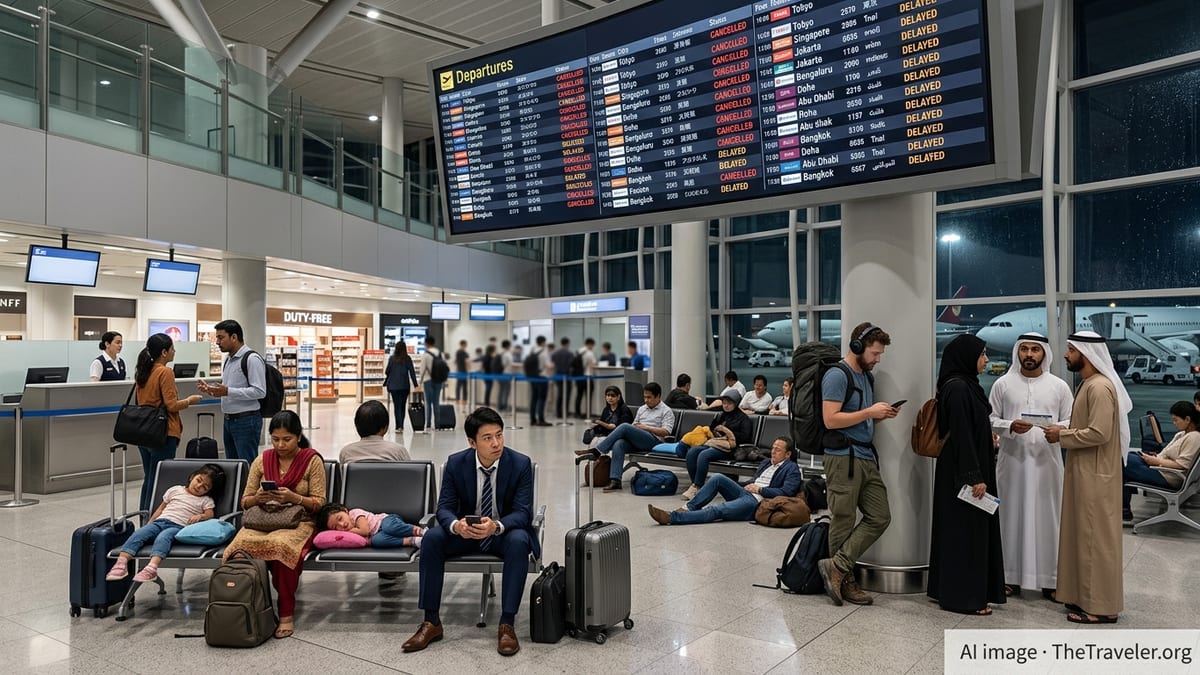
Major Asian Hubs Log Hundreds of Cancellations
Publicly available airport departure boards and flight-tracking dashboards indicate that the latest wave of disruption is centered on large regional hubs such as Guangzhou Baiyun, Hong Kong International, Dubai International and Tokyo’s airports, with additional knock-on effects at secondary gateways across East and South Asia. The combined snapshot shows 496 cancelled services alongside more than 2,600 delayed departures and arrivals over recent days.
Operations in mainland China appear to be under particular strain. Recent tallies from civil aviation registries and aviation news coverage highlight at least several dozen cancellations and hundreds of delays in and out of Guangzhou, Chengdu, Shanghai and Nanjing in a single day, illustrating how fast congestion can build when schedules are already tight. These chokepoints are rippling outward into regional networks that connect to Hong Kong, Southeast Asia and Japan.
Japan’s major airports are also appearing more frequently in disruption summaries, especially on routes linking Tokyo with Hong Kong and key Chinese cities. Schedule data and recent tracking for Japan bound services show growing levels of delay on heavily trafficked business and leisure corridors, even when outright cancellations remain more limited than at some Chinese hubs.
Across the region, the pattern reflects a fragile balance between capacity and demand. With aircraft and crews stretched across long-haul and regional rotations, even localized weather or airspace restrictions can quickly translate into widespread cancellations and rolling delays for passengers far from the original trigger point.
Middle East Conflict and Airspace Rerouting Amplify Disruptions
The turbulence in Asia’s skies is closely intertwined with wider operational challenges stemming from the conflict in the Middle East and airspace restrictions over parts of Russia and the Gulf region. Factbox coverage from international outlets such as Reuters describes how airlines outside the Gulf have been forced to reroute flights between Europe and Asia, avoiding key corridors and increasing pressure on alternative routings.
These changes add time, fuel burn and complexity to long-haul services that feed into Asian hubs like Dubai and Doha, which in turn connect onward to India, Southeast Asia, Hong Kong and Japan. Travel industry reporting in recent weeks has linked these reroutes to longer block times, tighter aircraft utilization and greater vulnerability to delay when storms or congestion strike already busy airports.
In Hong Kong, the operational picture is further complicated by adjustments on long-haul and regional routes linked to Dubai and Riyadh. According to published coverage summarizing airline statements, the Hong Kong based carrier Cathay Pacific has repeatedly extended suspensions of passenger services to Dubai, now running through at least late August, while also managing cargo schedule changes on Middle East routes. Each fresh extension removes additional capacity from a corridor that previously provided important connectivity between Asia and Gulf hubs.
For passengers, the combined effect is a web of indirect impacts. A rerouted long-haul service arriving late into a hub like Dubai or Doha can cause missed connections into Asia, while suspended or reduced frequencies limit rebooking options once a cancellation occurs. The result is an environment where relatively contained disruptions in one region reverberate across multiple time zones.
Royal Jordanian, Air India, Qatar Airways and Others Caught in the Crossfire
The rolling disruption has not been confined to Asian carriers. Published operational snapshots and airline travel alerts show that airlines based in the Middle East, Europe and India are frequently present in cancellation and delay tallies affecting Asian corridors, including services operated by Royal Jordanian, Air India, Qatar Airways and their regional partners.
Qatar Airways’ publicly available travel alerts emphasize that its schedules remain subject to change across the network, including Asian destinations, as the carrier navigates evolving regulatory and operational constraints. Meanwhile, the airline’s newsroom updates highlight an ongoing effort to rebuild and expand its global schedule through mid 2026, a task made more complex by shifting airspace access and intermittent congestion at key hubs.
Air India’s recent media notes on West Asia operations illustrate how quickly conditions can change. In March and April, the airline moved from extensive suspensions at Gulf airports to a phased restoration of scheduled and ad hoc services at Dubai and several other points in the United Arab Emirates and wider region. While many of those routes are once again active, the earlier suspensions and subsequent resumptions add further variability to an already strained network.
Royal Jordanian, which relies on connections between Amman, the Gulf and Asian cities, is exposed whenever hubs like Dubai, Doha or major Indian and Chinese airports experience prolonged disruption. Flight-tracking snapshots show the carrier appearing among the delayed and occasionally cancelled flights routed through Gulf and South Asian airports, indicating how third-country airlines can be swept into regional turbulence they do not control.
Guangzhou, Dubai and Tokyo Highlight Systemic Weaknesses
The latest figures underscore how quickly operational stress accumulates when multiple major hubs experience pressure at the same time. At Guangzhou Baiyun, aviation industry reporting points to dozens of cancellations and more than 90 delays in a single operational day, driven by a mix of weather, airspace management and terminal capacity constraints. Once those disruptions begin, crew duty limits and aircraft rotation requirements amplify the impact.
Dubai International, one of the world’s busiest intercontinental hubs, remains central to the story. Even as some airlines restore frequencies, lingering schedule cuts and route suspensions to and from Dubai continue to limit flexibility for carriers trying to reroute passengers around disruptions in other parts of the network. Constraints at Dubai intersect directly with the needs of Air India, Royal Jordanian, Qatar Airways and numerous Asian carriers that depend on the airport as a transfer point.
Tokyo’s airports, particularly Haneda and Narita, are also under scrutiny as airlines adjust to shifting demand and airspace restrictions on long-haul routes to Europe and the Middle East. Recent schedule updates show carriers fine tuning frequencies and timings on Japan services, which can leave less slack in the system when adverse weather or congestion in East Asia forces ground stops or holding patterns.
These pressures are playing out as airlines push to capture strong post pandemic demand with high load factors and lean scheduling. The combination leaves limited spare capacity to recover from irregular operations, helping to explain why a disruption tally running into hundreds of cancellations and thousands of delays can accumulate in a relatively short period.
Passengers Face Longer Journeys and Limited Options
For travelers, the immediate consequences of the current disruption are longer travel times, missed connections and, in many cases, overnight stays near congested airports. Media coverage and social media postings from affected passengers across Hong Kong, Guangzhou, Dubai and Tokyo describe crowded terminals, extended boarding delays and frequent last minute gate and timing changes.
Travel industry analysts note that some airlines are easing change and refund conditions during periods of sustained disruption, especially on routes touching the Middle East and busy Chinese hubs. Policy updates published by carriers in recent months have included fee waivers for rebooking or rerouting on affected sectors, though the availability of alternate seats remains limited when whole waves of flights are cancelled.
The broader picture suggests that volatility may persist through the peak summer travel season. With geopolitical tensions continuing to affect airspace availability and Asian hubs working close to capacity, aviation experts expect further pockets of heavy disruption, even if not all will be as pronounced as the current sequence producing nearly 500 cancellations and thousands of delays.
For now, passengers heading through Guangzhou, Hong Kong, Dubai, Tokyo and other busy nodes are being advised by travel providers to monitor flight status closely, allow additional connection time where possible and be prepared for last minute changes as airlines such as Royal Jordanian, Air India, Qatar Airways and their regional counterparts continue to navigate a complex and shifting operating environment.