


More news on this day
Hundreds of travellers have been left stranded or facing extensive waits across Australia and New Zealand as a fresh wave of disruption hits services operated by Virgin Australia, Qantas, Air New Zealand, Sounds Air and other carriers, with live tracking data and operational reports pointing to 411 delays and 21 cancellations concentrated on the region’s busiest corridors.
Get the latest news straight to your inbox!
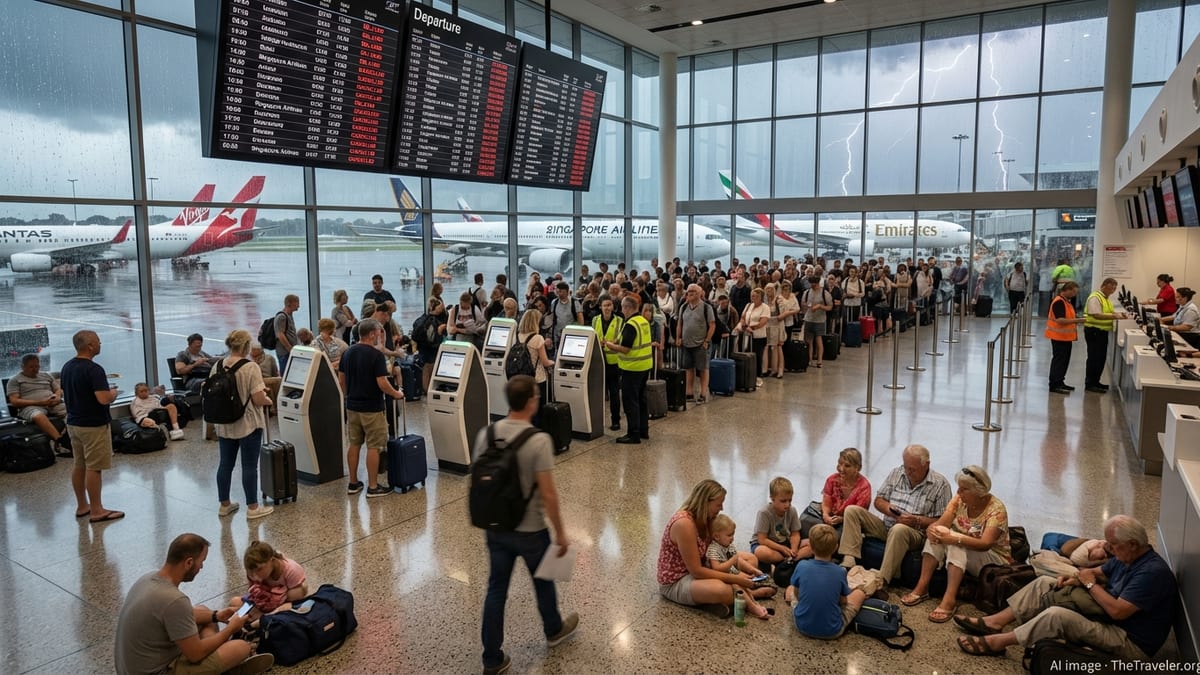
Major Hubs from Melbourne to Wellington Under Strain
Operational data and live flight boards viewed on 26 May indicate that disruption is spread across multiple major airports, including Melbourne, Sydney, Wellington and Christchurch, with secondary cities feeding into the same network also affected. The bulk of the delays are appearing on dense domestic corridors such as Melbourne to Sydney and Brisbane, alongside trans-Tasman routes linking Australia’s east coast with New Zealand’s main gateways.
Reports indicate that airlines under the Qantas Group banner, Virgin Australia, Jetstar, Air New Zealand and regional operator Sounds Air are all showing elevated numbers of late departures and arrivals. While the majority of services are eventually operating, the scale of disruption is large enough that passengers on connecting itineraries are missing onward flights and facing long queues for rebooking and accommodation.
The day’s pattern follows earlier disruption events across the Australia–New Zealand market in recent months, where a high concentration of late-running services over short time windows has led to visible congestion at check in, security and boarding gates. Observers note that these intense spikes in irregular operations tend to expose how little slack exists in tightly scheduled fleets serving short-haul routes.
At Wellington and Christchurch, public arrivals and departures boards show pressure on links to Melbourne and Sydney, routes that are crucial for both business and leisure traffic. Regional connections operated by carriers such as Sounds Air feed into these trans-Tasman services, compounding the impact when even a small number of flights fall significantly behind schedule.
Virgin Australia, Qantas and Air New Zealand Feature Prominently
Among the airlines most visible in today’s disruption are Virgin Australia and Qantas, which together dominate domestic capacity in Australia and operate a significant share of trans-Tasman flying, alongside Air New Zealand. Publicly available performance statistics for these carriers already highlight that short-haul sectors between major hubs such as Sydney, Melbourne and Brisbane are more vulnerable to rolling delays than many longer routes.
Published on-time performance summaries for trans-Tasman sectors show that services connecting Melbourne with Wellington, Christchurch and Queenstown regularly exhibit modest cancellation rates but fluctuating punctuality, with Qantas, Air New Zealand, Jetstar and Virgin Australia all affected to varying degrees over recent reporting periods. Industry analysts point out that even when cancellation percentages remain low, clusters of delays can quickly overwhelm airport and airline recovery plans.
Current disruption patterns mirror those trends, with aircraft arriving late into hubs and then turning around behind schedule, pushing delays deeper into the day. Observers following flight-tracking feeds describe a familiar scenario in which early knock-on effects accumulate, especially on shuttle-style services between Melbourne and Sydney that operate at high frequencies with limited spare capacity.
Air New Zealand and Sounds Air, key players in the New Zealand domestic and regional market, are also appearing in disruption tallies, particularly on links that support trans-Tasman connections via Wellington and Christchurch. For passengers attempting to bridge regional centres with Australian capitals on single itineraries, even a short delay on a feeder sector can prove enough to break carefully timed connections.
Travellers Face Missed Connections, Long Queues and Rebookings
For travellers on the ground, the numerical count of 411 delays and 21 cancellations translates into hours in terminal seating, rebooking lines and customer service chats. Social media posts and traveller forums monitored on 26 May describe scenes of lengthy queues at transfer desks in Melbourne and Sydney, as well as frustration among passengers in Wellington and Christchurch who have seen departure times repeatedly pushed back in small increments.
Passengers connecting between international and domestic services, particularly at Sydney and Melbourne, appear to be among the most affected. When trans-Tasman flights arrive behind schedule, travellers often face additional processing time at international terminals before reaching domestic gates, making tight connections vulnerable. Delays on frequent-shuttle domestic legs can then ripple outward as displaced travellers move onto later departures.
In some cases, cancellations are forcing overnight stays or lengthy daytime waits, especially where routes operate only a few times per day. Reports from consumer-rights platforms note that accommodation and meal support policies vary between airlines, leaving some passengers reliant on travel insurance or out-of-pocket spending when disruptions are attributed to factors outside airline control.
Travel advisers observing the situation recommend that passengers build longer layovers into itineraries involving Australia–New Zealand connections, particularly when travelling through congestion-prone hubs or during peak holiday and business travel periods. They also highlight the importance of monitoring airline apps and airport displays closely on the day of travel, as rolling delays can change quickly.
Underlying Pressures on the Australia–New Zealand Flight Network
Recent reporting on the region’s aviation sector points to a mix of structural and operational pressures that can set the stage for disruption spikes of the kind seen today. Staff availability, aircraft maintenance windows, air traffic control constraints and weather patterns across the Tasman all shape how resilient schedules are when something goes wrong.
Australia’s major hubs, including Sydney and Melbourne, operate under capacity and noise restrictions that limit how much additional flying can be slotted in to recover during busy peaks. When delays mount, there is often limited scope to add recovery flights or significantly resequence departures and arrivals without creating further congestion.
In New Zealand, official on-time performance statistics published over recent months show that while average cancellation rates on key trans-Tasman routes remain relatively modest, punctuality can vary considerably by route, carrier and season. Routes such as Melbourne to Wellington and Melbourne to Christchurch have historically displayed pockets of weaker performance, reflecting the interplay of weather, airspace constraints and tight aircraft rotations.
Industry commentators note that carriers such as Qantas, Virgin Australia and Air New Zealand have been rebuilding networks after the pandemic while managing global aircraft delivery delays and maintenance demands. This environment leaves limited spare aircraft and crew to absorb irregular operations, meaning that a single disruption event, such as a late inbound aircraft or short-lived weather system, can trigger the kind of multi-hub disruption now affecting hundreds of travellers.
What Passengers Can Expect in the Coming Days
Given the scale of today’s disruption and the tightly interlinked nature of domestic and trans-Tasman operations, observers suggest that residual delays could linger into subsequent days as airlines work to reposition aircraft and crews. Even if headline cancellation numbers remain contained, recovery flying and schedule adjustments can result in revised departure times and swapped aircraft types on certain routes.
Travellers booked on Virgin Australia, Qantas, Air New Zealand, Sounds Air and associated partners are being advised by consumer and travel information outlets to keep a close watch on booking channels for schedule changes. Same-day notifications through airline apps, text messages and email remain the most common ways for passengers to learn about re-timings or rebooked connections.
Analysts following the region’s aviation sector expect that further scrutiny will fall on on-time performance across Australian and New Zealand carriers in the months ahead, particularly on the high-frequency city pairs and trans-Tasman services that are central to business and tourism flows. The latest episode of 411 delays and 21 cancellations reinforces concerns that, despite traffic recovery, operational resilience on these short-haul networks remains fragile when confronted with even relatively contained disruption triggers.