


More news on this day
UAE airports remain busy today as airlines balance regional security advisories, lingering disruption on select routes and late-running inbound services, while most flights continue to operate broadly on schedule.
Get the latest news straight to your inbox!
Regional advisories keep pressure on UAE schedules
Published coverage indicates that UAE carriers are still operating against a backdrop of extended airspace risk warnings for parts of the Gulf, which remain in place through late September. The European Union Aviation Safety Agency has kept its conflict-zone bulletin active for the region, citing continued risk factors linked to tensions between the United States and Iran. These advisories do not close UAE airspace but contribute to more conservative routing and contingency planning.
Reports from UAE-based outlets over recent days describe a pattern of intermittent delays and cancellations on services touching higher-risk corridors rather than a blanket shutdown of flights. Airlines have focused disruptions on a limited number of departures and arrivals, particularly on routes that cross or skirt airspace highlighted in international notices. Schedules on many trunk routes to Europe, Asia and the Middle East are still operating, but with timings that can change at short notice.
At the same time, passenger demand into Dubai, Abu Dhabi and Sharjah remains high as residents return from summer holidays and regional business travel picks up. This heavier traffic means that even modest disruptions can have a cascading effect across the day, especially where aircraft and crew are tightly scheduled. Travellers are being urged by published advisories to treat departure times as dynamic rather than fixed.
To manage this volatility, the UAE aviation regulator has already outlined procedures for airport capacity management during periods of disruption. Guidance issued this year describes how air traffic control can temporarily pause departures from certain regional airports bound for affected UAE hubs, in order to prevent excessive airborne holding and keep arrival flows stable when conditions deteriorate.
Dubai: mixed picture for Emirates and flydubai passengers
Real-time boards for Dubai International Airport today show a mostly steady flow of arrivals and departures, with a minority of long-haul and regional services running late or marked as cancelled. Publicly available data points to a small cluster of cancellations around certain Asian and long-haul arrivals, alongside some delays on inbound services from Eastern Europe and South Asia due to upstream disruption and congestion.
Emirates, as Dubai’s largest carrier, continues to operate the bulk of its global network. Recent news coverage highlights earlier days this month when some Emirates flights experienced knock-on delays linked to regional tensions and congestion at partner airports, but the majority of today’s flights are still shown as operating. Where issues arise, they tend to involve schedule adjustments of under a few hours or aircraft swaps, which may not always be visible until close to departure.
Flydubai’s live status feed for today reflects a similar pattern of targeted disruption rather than widespread issues. Several early-morning flights from cities such as Alexandria, Saint Petersburg and Minsk are showing adjusted arrival times, with delays ranging from under an hour to a few hours, while many other flights remain on time. This suggests that operational challenges are concentrated on specific legs affected by air traffic flow measures or upstream delays at origin airports.
For travellers using Dubai International, the practical takeaway is that flight status can diverge from printed itineraries with limited notice. Passengers are advised, in publicly available guidance, to check their airline’s app or website repeatedly on the day of travel, monitor airport departure and arrival boards, and allow extra time at the airport in case security or check-in queues lengthen when multiple flights bunch together.
Abu Dhabi: Etihad and partner airlines adjust amid disruptions
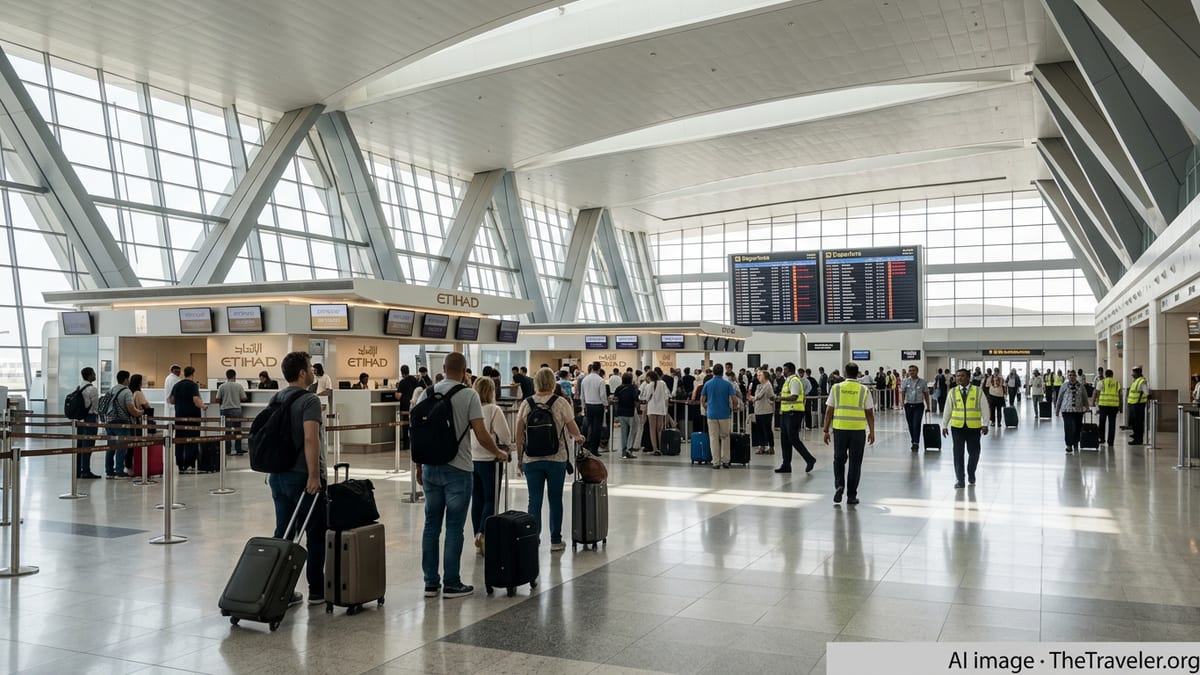
In Abu Dhabi, Zayed International Airport has seen more concentrated disruption over recent days, according to regional news reports. Coverage from earlier this month described noticeable delays to both arriving and departing services, particularly on Etihad routes spanning Europe, Asia and regional Middle Eastern destinations. Air Arabia Abu Dhabi and certain low-cost carriers have also seen selected flights affected.
Today, online tracking tools show Etihad flights operating across much of the network, including regional services to nearby hubs, but some routes remain vulnerable to delay where they intersect congested or sensitive airspace. Recent flight-history records for routes such as Abu Dhabi to Tel Aviv, for example, show arrivals that are modestly late rather than cancelled, illustrating how schedules are being maintained with minor time slippage.
Abu Dhabi’s role as a transfer hub means any delay on incoming long-haul services can quickly flow through to onward connections, even if the original disruption began outside the UAE. This is especially relevant for morning and late-evening banks of flights, when multiple widebody arrivals are due within a short window. Travellers connecting through Abu Dhabi are therefore more exposed to missed or compressed connection times when inbound flights run behind schedule.
To mitigate this risk, passengers are encouraged by airline advisories and travel agents to keep an eye on the minimum connection time on their itineraries and to opt for slightly longer layovers where possible. Those already en route should pay attention to gate information screens and mobile notifications, as airlines sometimes pre-emptively rebook tight connections during periods of rolling delay.
Sharjah and Air Arabia: targeted route changes and close monitoring
Sharjah International Airport, a key base for Air Arabia, continues to handle high volumes of regional and South Asian traffic. Flight-tracking services for today show Air Arabia operating core routes between Sharjah and major cities such as Delhi and Bangkok, with largely regular timings. Some flights are recorded as departing or arriving a few minutes off schedule, and a small number have been running later on previous days, reflecting typical peak-season variability rather than systemic disruption.
However, Air Arabia services into and out of conflict-adjacent corridors remain under particular scrutiny. Flight-status tools flag that routes between Sharjah and European destinations, as well as certain Middle Eastern capitals, are operating in an environment where nearby airspace is subject to international risk advisories. The presence of these warnings can lead to longer routings, altitude restrictions or stricter air traffic flow measures, any of which may add unplanned minutes to a journey.
For travellers flying on Air Arabia from Sharjah today, the key consideration is not solely whether a flight is marked on time, but also whether inbound aircraft are arriving punctually from previous legs. By checking the status of the inbound sector, passengers can gain a more realistic picture of when boarding is likely to begin. Airline and airport apps, as well as third-party trackers, provide this information for many high-frequency routes.
Given Sharjah’s popularity with cost-conscious travellers and residents from across the region, airport facilities can become crowded when multiple flights bunch due to minor delays. Passengers are therefore advised in consumer travel guidance to arrive well ahead of check-in closure times, particularly for evening departures to South Asia and the Middle East.
Practical steps for UAE-bound and transiting passengers today
Across Emirates, Etihad, Air Arabia and flydubai, today’s overall picture is one of largely functioning schedules with pockets of disruption driven by regional security dynamics, weather patterns and air traffic congestion. Recent weather statements from UAE meteorological authorities have also highlighted early-morning fog and high temperatures, adding another layer of potential complexity for airport operations at Abu Dhabi, Dubai and other fields.
Publicly available travel advice consistently stresses that passengers should not rely on static paper or email itineraries during such periods. Instead, travellers are encouraged to enable push notifications in airline apps, verify their flight number against the latest airport boards, and recheck status shortly before leaving for the airport. Those with flexible plans may want to consider rebooking away from heavily affected corridors if their route has shown repeated disruption in recent days.
For connecting passengers, monitoring not just the onward flight but also the incoming aircraft is especially important today. If an inbound service shows a significant delay, it is prudent to anticipate a knock-on effect on the onward leg, even if the airline has not yet adjusted the departure time. In some cases, airlines may proactively reroute or re-accommodate passengers to alternative connections when it becomes clear that original timings cannot be met.
Finally, travellers should keep all contact details up to date in their bookings, as airlines and travel agents increasingly rely on SMS and email alerts to communicate last-minute changes. With conditions in the wider region still fluid, staying informed and building extra time into journeys remains the most effective strategy for anyone flying with Emirates, Etihad, Air Arabia or flydubai today.