


More news on this day
Passengers flying from the UAE today are being urged to check their flight status frequently, as Emirates, Etihad Airways, Air Arabia and flydubai operate most services but continue to adjust schedules in response to renewed tensions between the United States and Iran.
Get the latest news straight to your inbox!
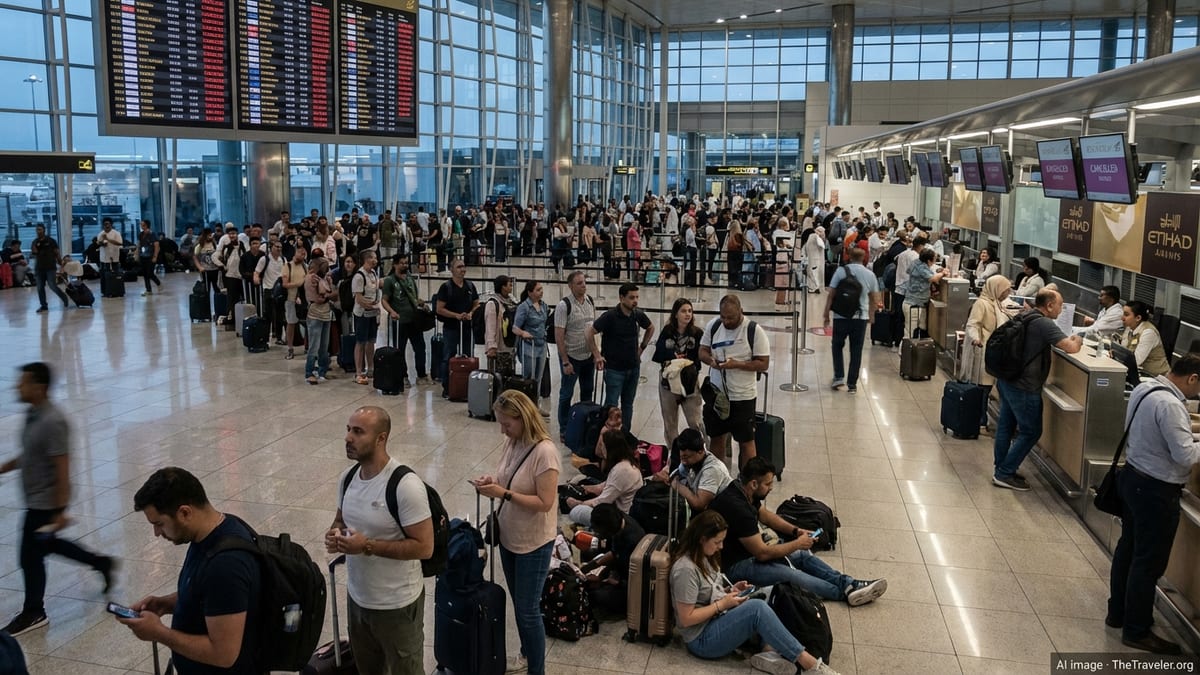
Mixed picture at UAE hubs as disruptions continue
Published updates on September 4, 2026 indicate that flights at Dubai International, Abu Dhabi’s Zayed International and Sharjah International airports are largely operating, although with pockets of disruption on selected routes. Data compiled from regional coverage suggests close to 20 services involving UAE airports have been cancelled or significantly delayed since September 3, following a fresh round of US strikes on Iran and retaliatory actions that heightened regional risk assessments.
Dubai International remains busy, with live tracking data showing hundreds of movements and only a small number of outright cancellations today. Independent statistics from a global flight-tracking platform point to five cancellations and more than 300 delays at Dubai International alone, underscoring that the primary impact for most travelers is extended waiting times rather than suspended flights.
Abu Dhabi’s Zayed International Airport continues to operate, with an official travel advisory noting that Etihad is still flying to dozens of destinations worldwide while monitoring developments. Airport departure boards show a normal spread of early morning and mid-day services, but with irregular delays on some key regional and long-haul routes.
Sharjah, the main base for Air Arabia, is also operating, though recent days have seen cancellations and delays on select Gulf and regional services. Reports from regional media highlight that Air Arabia flights to Bahrain and Kuwait have been among those most affected, while other rotations on the same routes remain in place.
Emirates and flydubai adjust timetables but keep most flights running
Publicly available information shows that Emirates and flydubai have largely maintained their schedules from Dubai, even as they adjust timings on selected services in response to evolving airspace and operational considerations. Coverage from UAE-based outlets describes a “mixed picture” for travelers, with some routes operating close to time and others pushed back by anywhere from 30 minutes to several hours.
Recent reporting lists a number of Emirates arrivals into Dubai from major European hubs that are operating but landing later than scheduled. Flights from Manchester, London Gatwick, London Heathrow, Dublin, Amsterdam, Rome, Bologna, Lisbon and Lyon have all been cited with revised arrival times, illustrating how knock-on effects in European or regional airspace are reverberating through the Dubai hub.
For flydubai, several regional routes have experienced notable disruption. Services from Moscow, Jeddah, Astana, Bishkek, Minsk, Addis Ababa, Damascus, Abha and Baghdad have been singled out in recent travel advisories for late arrivals into Dubai. In at least one case – a service from Entebbe – coverage notes a cancellation, while other flights on the same airline’s network continue as planned. Some departures, such as a Dubai to Neom service, have operated with multi-hour delays.
Despite these challenges, schedule data and route trackers continue to show many Emirates and flydubai flights leaving Dubai close to their planned departure times. Travel industry reporting emphasizes that operations across both carriers remain broadly intact, with the main impact for outbound passengers being the risk of rolling schedule changes rather than large-scale shutdowns.
Etihad and Air Arabia see concentrated delays on regional routes
Etihad Airways, based at Abu Dhabi’s Zayed International Airport, appears to be among the more heavily affected carriers in terms of delays, according to a detailed breakdown published by regional media. Affected services include flights to and from a range of key markets such as Moscow, Islamabad, Delhi, Karachi, Ahmedabad, Peshawar, Chennai, Colombo, Nairobi, London Heathrow, Lisbon, Phuket, Bangkok and Manchester.
These disruptions are largely reflected in longer-than-usual arrival or departure times, rather than blanket cancellations. One widely cited example is Etihad’s EY213 from Delhi to Abu Dhabi, which local coverage notes as arriving close to an hour behind schedule. Other services have faced similar or longer delays, particularly on routes that cross or skirt sensitive airspace.
Air Arabia operations at Sharjah and from Abu Dhabi have also been touched by the turbulence in regional flight planning. Reports indicate that Air Arabia cancelled flights G9107 to Bahrain and G9068 and G9124 to Kuwait on Thursday and Friday, while other services to the same destinations remained active. Additional Air Arabia routes to cities such as Tbilisi and Tashkent have been highlighted for delays of roughly an hour or more.
Industry commentary points out that these patterns are consistent with airlines proactively thinning capacity or altering routings on selected services most exposed to potential airspace restrictions, while preserving the bulk of their scheduled networks from UAE hubs.
Why flights are disrupted and what passengers should do
The current wave of schedule changes is closely tied to renewed military tensions between the United States and Iran, which have led to heightened caution around specific flight paths in the wider region. Airspace advisories and individual airline risk assessments can prompt re-routing, longer track miles, revised departure times, or in some instances the temporary suspension of particular services.
Flight tracking and airport statistics underline that, as of this morning, disruptions remain targeted rather than system-wide. Dubai International’s tally of five cancellations but hundreds of delays, for example, suggests that airlines are prioritizing schedule integrity by operating flights with revised times where feasible, instead of cancelling large numbers of services outright.
Given the fluid situation, passengers flying today on Emirates, Etihad, Air Arabia or flydubai are strongly advised to confirm their flight status before leaving for the airport. Each carrier provides real-time information through its website and mobile applications, and airport portals for Dubai, Abu Dhabi and Sharjah also host continuously updated departure and arrival boards. Travelers connecting through third-country hubs are being encouraged by travel advisories to pay close attention to emails, SMS messages and app notifications about any last-minute changes.
Airport welfare and passenger-care policies at UAE hubs clarify that if a flight is cancelled or significantly delayed, airlines are expected to assist with rebooking and, in some cases, accommodation or other support. Travel advisories for Abu Dhabi emphasize that if visas expire due to delays or cancellations, passengers with valid bookings are to be assisted with onward travel arrangements where possible.
Outlook for the coming days
As of the latest updates this morning, there is no indication that UAE airports are planning broad closures or large-scale groundings of commercial services. Official tourism and airport portals in Abu Dhabi describe Zayed International Airport as open and operational, with Etihad maintaining a broad global network. Dubai Airport’s live information pages, while intermittently experiencing technical issues, continue to list flights for today and tomorrow, signaling an expectation of continued operations.
Regional media reporting, however, stresses that schedules across the Gulf and the wider Middle East remain subject to change at short notice. Some airlines serving the UAE from other countries, including European carriers, have temporarily suspended selected flights to Dubai through today as they evaluate risks and alternative routings. These decisions can feed through into arrival and departure boards, even where UAE-based carriers are still flying.
For travelers, this means that flexibility and close monitoring of itineraries remain essential. Passengers with non-urgent travel are being encouraged in public advisories to consider voluntary changes where permitted by fare rules, while those with immediate travel needs are urged to build in additional time for check-in, security and possible queues at transfer desks.
Industry analysts note that the pace of any normalization will depend largely on how quickly airspace constraints ease and whether there are further escalations in regional tensions. For now, UAE-based airlines appear focused on maintaining as much of their scheduled flying as possible, while making tactical adjustments on a route-by-route basis.
Khaleej Times: Nearly 20 UAE flights delayed or cancelled after renewed US-Iran attacks
The National: UAE travel advisory on Dubai and Abu Dhabi airport delays
FlightAware: Live Dubai International delay and cancellation statistics