


Cape Town International Airport is the main gateway to South Africa’s Western Cape, yet arriving passengers are often unsure how taxi services work outside the terminal. With metered cabs, e-hailing apps and a mix of official and unofficial drivers competing for business, it helps to know exactly where to go, what you are likely to pay and how to stay safe. This guide walks you through the authorised taxi ranks at Cape Town Airport, realistic fare expectations in 2026, payment options and practical tips for late arrivals and avoiding unsolicited approaches in the arrivals hall.
Get the latest updates straight to your inbox!
Understanding Taxi Options at Cape Town International Airport
Cape Town International Airport operates as a single central terminal building with domestic and international wings, and a shared arrivals level where all public transport options converge. Outside this level you will find authorised metered taxis at the official rank, e-hailing pickups via apps such as Uber and Bolt and a small number of prebooked shuttle services that meet passengers with a name board. Each option is regulated differently, which is why prices and pickup procedures can vary even for the same journey into the city.
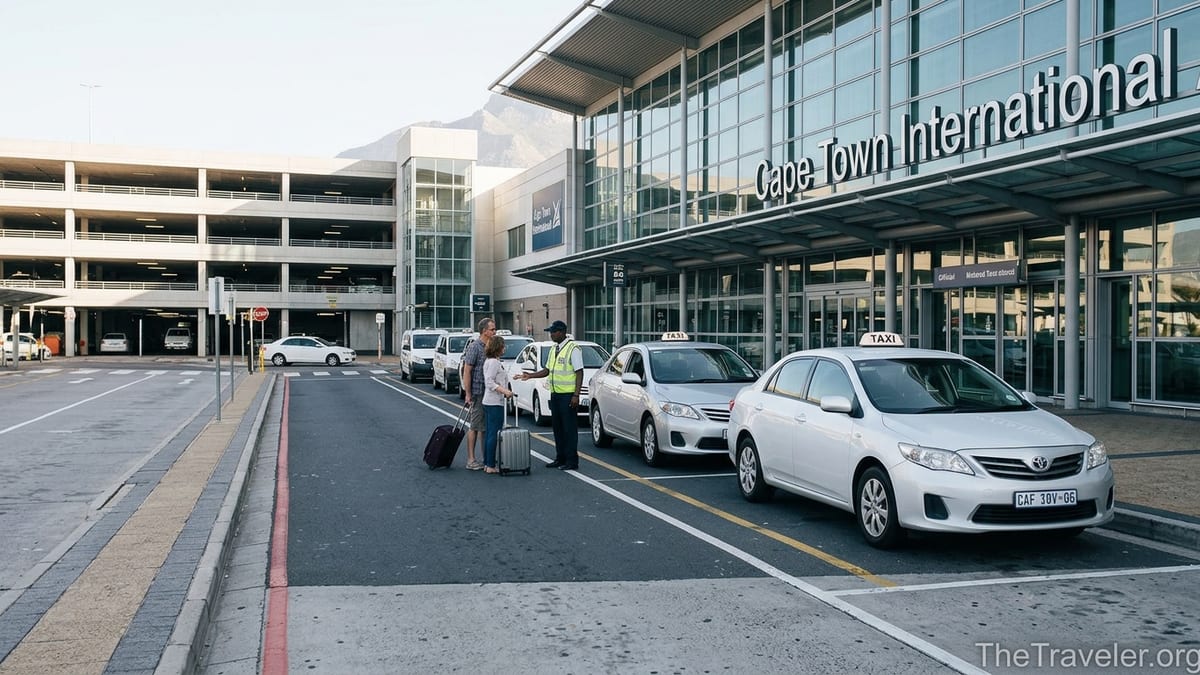
Authorised metered taxis at Cape Town Airport are generally branded with roof lights and decals and queue at a dedicated lane next to the main transport plaza and parking structures. These vehicles hold operating licences issued under Western Cape mobility regulations, which include checks on the driver and vehicle. In practice, visitors will see a sign for "taxis" as they exit the glass doors from arrivals, with uniformed staff at a central booking desk directing travellers to the next car in the line.
Alongside the metered taxis, e-hailing rides booked through Uber or Bolt are widely used by locals and visitors. These services rely on drivers using their own vehicles but require an operating licence slot in Cape Town, making them part of the formal transport mix rather than a fully informal service. Prices are usually quoted upfront in the app, which many travellers prefer to negotiating with a driver after a long flight.
There are also private transfer companies and guesthouse shuttles that operate on a prebooked basis. For example, a boutique hotel in Gardens might arrange a sedan transfer for around R450 to R550 at night and include the charge on your room bill. While these services can be slightly more expensive than an app ride, they offer the reassurance of having someone waiting with your name on arrival and can be a good option for families with children or lots of luggage.
Where to Find the Authorised Taxi Ranks
Once you clear customs or baggage claim at Cape Town Airport, all passengers funnel into the central arrivals concourse. To reach the official taxi rank, walk straight ahead through the sliding glass doors that lead outside toward the transport plaza. You will see multi-storey car parks in front of you and, typically, a line of white or silver sedans and minibuses in a clearly marked lane reserved for metered taxis.
The authorised taxi operation is usually coordinated from a central kiosk or desk in the arrivals hall, often branded as "Airport Authorised Taxis" or similar. Staff at this desk can quote you an approximate fare for standard routes such as the city centre, V&A Waterfront or Sea Point, record your destination and radio the next available driver. This system reduces haggling at the vehicle and ensures that a record exists of which taxi you have taken.
Travelers arriving into the domestic wing will find signs pointing to taxis shortly after the baggage carousels, while international passengers tend to exit slightly closer to the transport plaza itself. In both cases, the safest approach is to ignore anyone who intercepts you inside the building and instead follow the official signage until you can see the rank and its supervising staff. If you are unsure, the airport information desk in the arrivals hall can confirm the route and point out the correct doors to use.
For passengers who have mobility issues or heavy luggage, it is worth knowing that trolleys can be pushed all the way to the kerb beside the metered taxi lane. Drivers at the front of the queue are accustomed to helping load suitcases into the boot and will generally do so before you get in, giving you a moment to confirm the fare and destination before the vehicle pulls off.
Typical Taxi Fares and How Pricing Works
Cape Town does not use a single citywide tariff for metered taxis, so prices are set by company and, in some cases, by individual driver. That said, there are common ranges that repeat across operators for standard routes from the airport. In 2026, a typical authorised metered taxi fare from Cape Town International Airport to the central business district or V&A Waterfront, a distance of roughly 20 kilometres along the N2, usually falls somewhere between about R350 and R600 depending on traffic, time of day and the size of vehicle.
To translate that into real scenarios, a solo traveller landing at 11:00 on a weekday and taking a standard sedan to a hotel on Bree Street might be quoted around R380 to R450. The same route in Friday evening peak traffic or after midnight, particularly in a larger vehicle that can accommodate surfboards or multiple large suitcases, can edge closer to R550. Journeys to suburbs further out, such as Constantia, Bloubergstrand or Somerset West, climb accordingly and can reach R700 or more, so always ask for a ballpark figure before you accept the ride.
Many metered taxis at the airport technically have meters, but some drivers prefer to quote a fixed price once they know your destination. There is nothing inherently wrong with a fixed fare, and for visitors it can be helpful to know the exact total before departure. The key is transparency: the driver or desk should state clearly whether the meter will run or whether you are agreeing a set price, and that figure should include all standard charges, with only an optional tip added at the end.
If you are comparing this with an e-hailing app, it is common to find an UberX or equivalent from the airport to the city quoted at roughly R220 to R350 when traffic is light, sometimes less in off-peak hours. During high demand, app surge pricing can push that closer to metered taxi levels, particularly around major events or late-night flight banks. For many travellers, the small premium for a metered taxi at the rank is worthwhile when they do not have local mobile data or prefer to pay in cash.
Paying in Cash or by Card
South Africa remains a largely card-friendly destination and Cape Town Airport is no exception. Most authorised metered taxis serving the airport accept major credit and debit cards, particularly Visa and Mastercard, using mobile point-of-sale devices. However, card facilities are not universal and occasionally a machine may be offline, so you should always confirm payment options before setting off.
As a practical example, a couple arriving from London might withdraw R1000 from an airport ATM and then choose an authorised taxi that confirms it accepts cards. At the end of a R420 ride to a hotel in Green Point, they may choose to pay by card through the handheld terminal and then leave a small tip in cash, such as R30 to R50, for the driver. This approach gives the reassurance of a card transaction while still recognising service in a way most local drivers appreciate.
If you expect to pay cash only, it is sensible to carry small denominations. Giving a driver a R500 note for a R360 fare can lead to awkward delays while they search for change. Airport ATMs usually dispense R100 and R200 notes, so consider making a small purchase, such as a bottle of water, to break larger bills before heading to the rank. Having at least one R50 and a few R20 notes makes settling both the fare and a tip much easier.
Foreign currency such as US dollars or euros is not normally accepted for taxi rides in Cape Town, even at the airport, and exchange rates offered informally by drivers tend to be unfavourable. For that reason, always assume you will pay in South African rand. If you have prebooked a hotel transfer, check in advance whether the cost will be charged to your room or taken directly by the driver by card or cash on the day.
Arriving Late at Night or in the Early Morning
Many international flights into Cape Town land late in the evening or early in the morning, particularly those from Europe and the Middle East that are timed as overnight services. The official taxi rank continues to operate during these hours, although the queue of waiting vehicles may be shorter than during the day. You should still exit the terminal, head directly to the designated taxi area and use the staffed desk if it is open, rather than accepting offers from individuals inside the building.
A typical late-arrival scenario might involve touching down at 23:30, clearing immigration around midnight and reaching the arrivals hall when many shops have closed. Even at that hour, you can usually expect to find at least a handful of metered taxis outside. Night-time fares to the city can carry a modest premium compared with daytime rates, reflecting both lower demand and safety considerations for drivers, so a trip that might cost R380 in mid-afternoon could be closer to R450 or R500 after midnight.
For travellers arriving alone or unfamiliar with South Africa, prebooking a transfer for very late or very early flights can provide additional peace of mind. Several reputable shuttle operators based in the city will schedule pickups to coincide with international arrivals, track your flight for delays and send the driver’s name and vehicle details in advance. In practice, this might mean paying R500 to R600 for a prearranged sedan to a central hotel, compared with R350 to R450 for a metered cab hailed on the spot, but with the comfort of seeing your name on a sign as you exit.
Whichever option you choose for a late arrival, keep standard precautions in mind. Stay within well-lit public areas of the terminal if you need to wait, avoid leaving luggage unattended while you check your phone and, once in the vehicle, keep valuables out of sight and doors locked, particularly during the highway segment on the N2 into town.
Safety Tips and Avoiding Unsolicited Drivers
Cape Town Airport has visible security and policing, but like most busy transport hubs it attracts opportunistic touts. Shortly after leaving the baggage area, you may be approached by individuals offering "cheap taxi" or "private car" services, sometimes claiming that official taxis are very expensive or that the bus service is not running. For your safety and to avoid disputes over fares, it is advisable to decline these offers politely and walk on to the authorised rank or your booked pickup point.
One common scenario reported by visitors involves a driver quoting a low flat price in the arrivals hall, for example R250 to the city, then increasing it mid-journey by claiming that tolls, luggage or night surcharges were not included. Another risk is getting into an unlicensed vehicle that is not properly insured or roadworthy. To minimise these risks, only use taxis from the official rank, e-hailing rides confirmed in your app or transfers booked in advance through your hotel or a known operator.
When using e-hailing services, always double-check the car’s registration plate and the driver’s name against what appears on your phone before you get in. If anything does not match, cancel the ride in the app and request another. Do not accept offers from drivers who say they are "Uber" or "Bolt" but insist on being paid cash without using the platform. The whole point of these apps is that your trip is tracked and the fare is processed electronically, giving you a record if something goes wrong.
Inside any taxi, keep your hand luggage and valuables within reach rather than in the boot, lock the doors and close windows when passing through slower traffic sections near the city. Avoid displaying large amounts of cash or high-end electronics openly. These are basic precautions that locals also follow and, combined with using authorised services, they make airport transfers in Cape Town relatively straightforward and uneventful for most visitors.
Practical Examples: From Airport to Key Cape Town Areas
To put the advice into context, consider a few typical journeys. A business traveller landing at 09:00 on a Tuesday might take an authorised metered taxi from the airport to a hotel near the Cape Town International Convention Centre. After confirming the fare at the kiosk, they could expect a quote in the region of R380 in light to moderate traffic, with a travel time of around 25 to 35 minutes. Paying by card on arrival and adding a R40 tip would bring the total close to R420.
A family of four arriving from Frankfurt at 21:30 and heading to an apartment in Sea Point might opt for a prebooked minivan transfer rather than squeezing into a single sedan at the rank. A realistic 2026 quote for that kind of private shuttle could be R650 to R800, reflecting both the extra space and late-evening timing. For them, the convenience of a named driver waiting with a sign and a guaranteed larger vehicle often outweighs the additional cost compared with two smaller taxis or an app ride.
Independent travellers on a tighter budget might prefer to use an e-hailing service. For instance, two backpackers landing mid-afternoon, with local SIM cards already active, could request an UberX from the designated e-hailing pickup zone. The app might show a fare estimate between R230 and R320 to a hostel in Observatory, with the exact price depending on current traffic and demand. Even if surge pricing pushes that higher during peak commuter hours, the app will disclose the total before they confirm the ride.
For destinations beyond the immediate city, such as Stellenbosch or Franschhoek in the winelands, costs rise accordingly. A metered taxi from the airport to Stellenbosch, roughly 30 to 40 kilometres away, is commonly quoted at R700 or more, while dedicated winelands transfer companies may charge similar or slightly higher rates but include waiting time if you are delayed at baggage claim. In these cases, booking ahead is strongly recommended to ensure availability and a clear understanding of the fare structure.
The Takeaway
Getting from Cape Town International Airport into the city is straightforward once you know where to find the official taxi services and what sort of fares to expect. Authorised metered taxis operate from a clearly signed rank just outside the arrivals area, usually coordinated through a central desk that can quote approximate prices and assign a driver. For most central destinations, expect to pay somewhere in the mid-hundreds of rand, with variations for time of day, traffic and vehicle size.
Whether you choose an authorised metered taxi, an e-hailing app ride or a prebooked private transfer, the basics of a safe journey are similar. Walk past unsolicited offers inside the terminal, verify vehicles and drivers against official channels, agree on the fare structure before departing and keep doors locked and valuables out of sight. With these simple habits, your first ride from the airport becomes a routine part of your trip instead of a source of stress.
By having a realistic sense of Cape Town taxi prices, knowing how to pay and planning ahead for late arrivals, you can start your visit on the right foot. The airport’s transport facilities may be busy, but they are designed with clear separation between authorised services and informal touts, and most visitors complete the trip without incident. A little preparation goes a long way toward making that first drive along the N2, with Table Mountain coming into view, an enjoyable introduction to the city rather than a logistical challenge.
FAQ
Q1. Where is the official taxi rank at Cape Town International Airport?
The authorised taxi rank is outside the main arrivals level, next to the transport plaza and parking structures. Follow the "taxis" signs from baggage claim, pass through the sliding glass doors and look for the supervised lane of metered taxis and the central booking kiosk.
Q2. How much does a taxi from Cape Town Airport to the city centre usually cost?
For a standard authorised metered taxi to the central business district or V&A Waterfront, most travellers in 2026 can expect to pay roughly R350 to R600, depending on traffic, time of day and vehicle size.
Q3. Do airport taxis in Cape Town accept credit cards?
Many authorised metered taxis at the airport accept major cards using handheld terminals, but not all. Always ask the driver or the taxi desk before you leave the rank, and carry some cash as a backup in case the card machine is offline.
Q4. Is it safe to arrive late at night and take a taxi from the airport?
The official taxi rank continues operating overnight, and using it is generally considered safe. Stick to well-lit public areas, avoid unsolicited offers inside the terminal, confirm your fare before departure and keep doors locked and valuables out of sight during the drive.
Q5. Are Uber and Bolt allowed to pick up passengers at Cape Town Airport?
Yes. Uber, Bolt and similar e-hailing services operate legally in Cape Town, including at the airport. After booking through the app, follow the instructions to the designated pickup area, then match the car’s registration and driver details with what is shown on your phone before getting in.
Q6. Should I book an airport transfer in advance or use the rank on arrival?
For daytime and early evening arrivals, walking to the official taxi rank and taking the next authorised cab is usually sufficient. For very late or early-morning flights, families with children or trips to distant suburbs or the winelands, prebooking a private transfer can provide extra certainty and ensure an appropriate vehicle.
Q7. How do I avoid taxi scams or being overcharged?
Use only the authorised taxi rank, reputable e-hailing apps or prebooked transfers arranged through your accommodation. Decline offers from unsolicited drivers in the terminal, confirm whether your fare is metered or fixed before you set off and clarify that the quoted price includes all standard charges, with any tip left at your discretion.
Q8. Can I pay in foreign currency such as US dollars or euros?
Airport taxis in Cape Town expect payment in South African rand and generally do not accept foreign notes. Avoid informal exchange arrangements with drivers, as the rates are rarely favourable. Use an ATM or currency exchange in the terminal to obtain rand before heading to the rank.
Q9. Is tipping expected for taxi drivers from the airport?
Tipping is not mandatory but is widely practiced. If you are satisfied with the service, adding around 10 percent of the fare or rounding up to the nearest convenient amount in rand is considered appropriate and appreciated by most drivers.
Q10. What should I do if I feel unsafe or have a problem with a taxi?
If you feel uncomfortable before departure, do not get into the vehicle and instead return to the rank staff or information desk to request another taxi. If an issue arises during the trip, ask the driver to stop in a safe, public place and, if necessary, contact local police or airport security. For e-hailing rides, you can also report concerns through the app, which keeps a record of your journey and driver details.