


The EU’s Entry/Exit System, or EES, is now part of the travel landscape for British holidaymakers heading to Europe. It is an electronic system that records when non-EU, non-Schengen "third-country" nationals enter and leave the Schengen area and replaces routine passport stamping with a digital log plus, in most cases, biometric checks such as fingerprints and a facial image. As British citizens are now treated as third-country nationals for Schengen travel, EES matters every time you cross the external border of the Schengen zone, including by air and sea. For UK-based cruise passengers, though, how and when you actually meet EES depends heavily on the pattern of your itinerary.
Get the latest updates straight to your inbox!
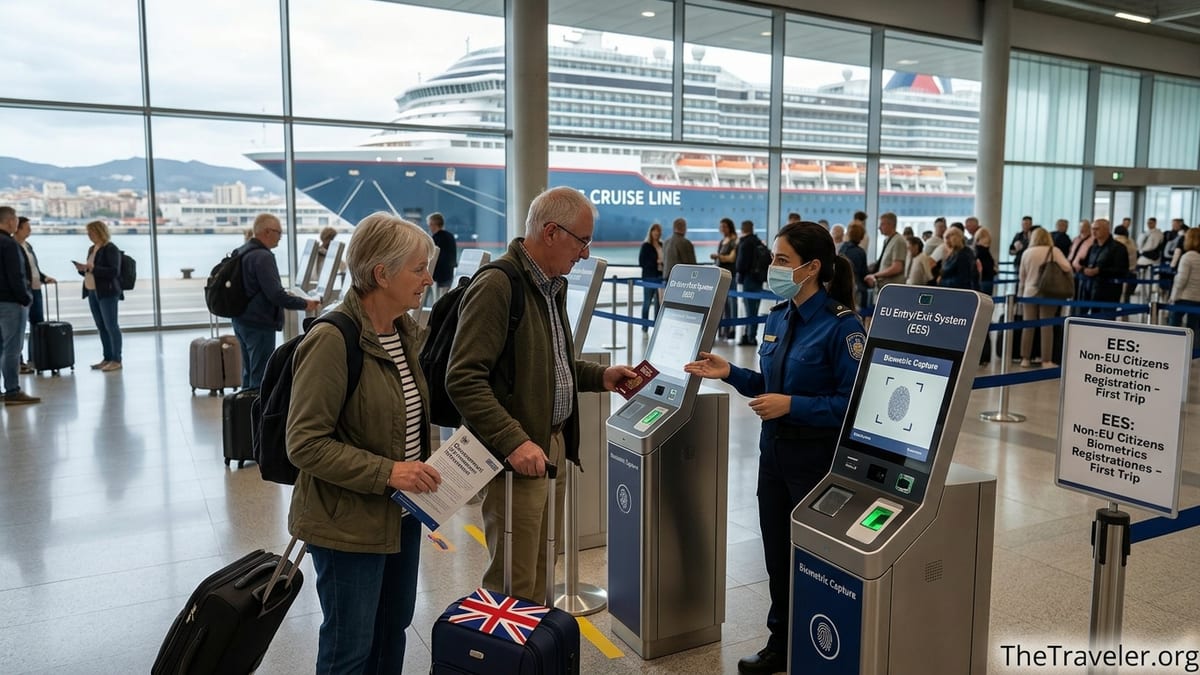
What EES Is and Why It Matters for UK Cruise Passengers
The EU Entry/Exit System is a shared European database designed to automate border checks at the external borders of the Schengen area. For most British leisure travelers it has replaced manual passport stamping at airports, ferry ports and certain land crossings with an electronic entry and exit record, plus biometric capture on a first trip after EES went live. According to current UK government guidance, there is no separate form to complete and no fee to pay; EES happens when you physically reach the Schengen border checkpoint.
In practice, that first encounter with EES can mean a few extra minutes at a kiosk or staffed booth while your fingerprints and photograph are taken and linked to your passport details. After that, later trips should be faster as your data are already stored and border guards only need to confirm each new entry and exit. Industry bodies and airport groups have reported that queues have been longer than usual at some European airports during the early phases of EES, especially at peak holiday periods, which is why UK authorities and airlines are advising passengers to allow additional time at departure and arrival.
For cruise passengers, the picture is more nuanced. Official material aimed at UK transport operators and travel companies stresses that most cruise guests on roundtrip voyages from British ports will be "largely unaffected" by EES, while fly-cruise passengers and those starting or finishing cruises in the EU are more likely to go through the full process. As of late November 2026, the Department for Transport’s toolkit and FAQs for operators, alongside foreign travel advice from the FCDO and information from European border agencies, all emphasise that implementation details can vary by country and port and continue to evolve. Any article or brochure about EES should therefore be read as time-stamped guidance, not a once-and-for-all rulebook.
The key point for UK cruise travelers is to understand where the "external border" of Schengen is on their specific trip. If your journey involves a UK airport and a Schengen airport, or a UK cruise terminal and a Schengen cruise terminal or ferry-like facility, your EES interaction will almost always happen at that first Schengen border crossing. Cruise-only itineraries that simply touch Schengen ports as day calls, without you ever officially entering or leaving the zone in your own right, are treated differently.
UK roundtrip ocean cruises with Schengen day calls only
The most common pattern sold to the UK market is the classic roundtrip cruise from Southampton or another British port with a series of European day calls, then a return to the same UK port. Current Department for Transport cruise FAQs, shared with UK operators in 2025 and still referenced in 2026 communications, state that passengers who embark and disembark in the UK and remain with the ship on day visits to Schengen ports will not normally need to complete EES entry or exit checks for those calls. In these scenarios, you are typically treated as an in-transit passenger under arrangements agreed between the cruise line and local border authorities.
In practical terms, that usually means you go ashore using your cruise card and passport as requested by the line, but you do not join a full border queue or attend an EES kiosk in the terminal solely for a short port call. Instead, immigration formalities are handled between the ship and the port authorities, using passenger manifests and targeted spot checks where required. Spanish and Italian port authorities, for example, describe dedicated cruise terminals where non-EU travelers may be processed when they are actually entering or leaving the Schengen area, but in many cases day-call passengers from a UK roundtrip sailing simply move through the terminal into the city without a separate EES registration.
There are, however, important caveats. If you plan to leave the ship permanently at a Schengen port partway through a nominal UK roundtrip, then continue your journey by air, rail or road, the official UK cruise FAQ notes that you are likely to be processed under EES when you disembark or at your onward border checkpoint. In other words, choosing to "step off" a UK roundtrip in, say, Lisbon or Barcelona and then fly home means your legal status changes from in-transit passenger to a traveler entering Schengen on your own account. That is when the full entry procedure, including EES, normally applies.
Because ports and border police have some flexibility in how they organise facilities, and infrastructure is still being upgraded in light of EES, travelers should not assume that all European day calls will feel identical. Some large ports have installed self-service EES kiosks in their cruise terminals, while others are relying on mobile equipment or manual workarounds. As of November 2026, UK government materials emphasise that passengers should follow the instructions of their cruise line and local officials on the day and that arrangements may be refined over time as systems bed in.
Repositioning and open-jaw cruises starting in the UK and ending in Schengen
Repositioning or open-jaw cruises that start in a UK port and end in a Schengen port are increasingly popular, for example a Southampton to Barcelona voyage with passengers flying back to the UK. For these sailings, British nationals almost always encounter EES close to the end of the itinerary rather than at departure in the UK. The Department for Transport’s industry FAQ explains that travelers who disembark a cruise within the Schengen area and travel onwards to another destination, including back to the UK, will need to complete EES registration when leaving the ship or at their onward border control point.
In practice, this can work in one of two main ways. Some ports treat disembarkation as the moment of entry into Schengen. In those cases you leave the ship, pass through a border control area in the cruise terminal where your passport is checked and your EES record created, and then continue to collect luggage or join onward transport in the city. Other ports, especially where the terminal is close to a busy international airport, may rely on EES processing at the airport instead. There your first formal entry into Schengen for that trip is recorded when you arrive by coach or taxi to check in for your flight, and your exit is logged when you depart back to the UK or elsewhere.
This variety means cruise passengers should pay close attention to pre-departure documentation. Several major cruise lines now note in their booking conditions or pre-cruise information that non-EU guests on voyages ending in the EU will need to clear immigration at the first Schengen port of entry or at the final airport, and that this may involve biometric checks. European port authorities similarly advise that non-EU nationals entering or leaving the Schengen area by sea are subject to EES, with facilities located either in the cruise terminal building or in associated border-control zones. If your itinerary ends in one Schengen country and you then connect to another Schengen state before flying home, your EES entry is usually at the first country and your exit at the last.
Because EES records your days in the Schengen area against the 90-in-180 rule, repositioning cruises can matter for anyone planning an extended European trip. Even if you felt you "only" transited a terminal, the system will log the date of your first entry into Schengen at disembarkation or the airport. If you intend to stay on in the region, that day typically counts towards your allowance, something regular cruisers and long-stay travelers should bear in mind.
Cruises starting in Schengen with UK fly-in passengers
The second big pattern for British holidaymakers is the fly-cruise, where you travel by air from the UK to board a ship at a European home port such as Barcelona, Civitavecchia (for Rome), Piraeus (for Athens) or Venice’s alternative cruise facilities. For these itineraries, your EES interaction almost always happens at the airport on arrival. Airlines and UK government guidance both stress that there is no EES application to complete before travel; instead, you present your passport at Schengen border control in the usual way and are directed to a kiosk or officer where your first EES registration is carried out.
Airports have been among the busiest testing grounds for EES. Trade bodies reported queues of two to three hours at some major hubs in spring and summer 2026, particularly at peak times, although many countries have since introduced additional staff, pre-registration options for certain travelers, and temporary relaxations of full biometric capture to keep lines moving. For British cruise passengers arriving on typical weekend flights, the main implication is the need to build in extra buffer time between landing and ship embarkation. Cruise lines often recommend arriving at least a day before departure, which is a useful cushion if EES queues are longer than expected.
Once you have entered Schengen via the airport, you normally travel domestically to the port without further border checks. Cruise departure formalities at the terminal remain focused on security screening and cruise documentation rather than immigration. When your voyage ends at a Schengen port and you fly back to the UK, your EES exit is then recorded at the airport as you leave the zone. If your cruise finishes outside Schengen, for example in a UK or non-EU port after a Mediterranean season, your exit from Schengen may have been logged at the last Schengen port you visited before sailing onward.
Because implementation can differ by country, UK travelers should always check both the FCDO foreign travel advice for the state where they will fly in and out, and the information issued by the port or cruise line. Some carriers and ports explicitly flag that non-EU passengers may have to provide fingerprints and a photo at automated kiosks, while others simply remind travelers to allow more time at border control. As of November 2026, official UK guidance continues to highlight that although EES is now standard, temporary local measures and exceptions can be applied during busy periods or technical disruptions.
River cruises and smaller-ship itineraries with Schengen flights
European river cruises and small-ship itineraries aimed at British travelers almost always involve flying into and out of a Schengen airport. Whether you are joining a Rhine sailing from Amsterdam, a Danube voyage from Budapest, or a yacht cruise from Split, the main EES touchpoints are your arrival and departure at the external border. River cruise lines and tour operators generally direct guests to follow the same process as any short-stay visitor from the UK, with EES checks carried out on first entry into the Schengen zone.
For many itineraries, that means you will first meet EES when landing at a major hub such as Amsterdam Schiphol, Frankfurt, Munich or Vienna. Border police at these airports use a mix of staffed booths and self-service kiosks to capture biometric data and create your electronic record. Once inside Schengen, you typically move between countries on the river or by coach without further border formalities, even when your cruise crosses internal frontiers between, say, Germany, Austria and Hungary. Your final exit from Schengen is then recorded at the airport where you check in for your flight home.
Smaller-ship and expedition-style cruises in the Mediterranean or around the Adriatic can be more complex if they weave in and out of Schengen and non-Schengen ports. For instance, a yacht itinerary that starts in a Schengen state, calls at a non-Schengen country, then returns to Schengen may involve multiple EES interactions. In these cases, your first entry EES record is usually created at the airport before embarkation, but subsequent crossings of the external Schengen border by sea can also generate additional checks, especially when you re-enter the zone after visiting a non-Schengen country. Operators often brief guests at embarkation about any expected immigration procedures at particular ports.
Because river and niche cruise itineraries are often sold as largely "hassle-free" packages, it is easy for travelers to overlook entry rules. Yet the same 90 days in any 180-day period limit applies, and EES is one of the tools authorities use to monitor this. Regular river cruisers who combine several voyages in one extended European stay should pay close attention to the cumulative time they spend in Schengen and, where necessary, discuss visa options with the relevant embassy if they expect to exceed the standard allowance.
Where and when UK cruise passengers actually meet EES
Bringing these patterns together, the general rule is that British cruise travelers meet EES the first time on a trip that they personally cross the external border of the Schengen area, rather than every time their ship touches an EU port. For UK roundtrip cruises with only Schengen day calls and no one leaving the ship permanently in the EU, official UK transport FAQs say EES checks are not normally carried out for those day stops, because passengers are treated as in transit. Conversely, when a journey begins or ends at a Schengen airport or cruise port, that point usually becomes your EES entry or exit moment.
There are some notable special cases. Ferry-style services that carry cruise passengers between the UK and Schengen ports may share facilities with regular ferry operations, meaning British travelers could see EES kiosks at combined terminals even if they are joining or leaving a longer cruise. Similarly, some city-centre or secondary cruise berths feed passengers through central border facilities located away from the quay, leading to situations where EES processing happens in a nearby terminal building rather than at the gangway itself. Port authorities in Spain and other countries describe these setups as part of the broader shift to fully electronic external borders.
As of late 2026, the UK government consistently advises passengers to follow instructions from their carrier and the relevant port, noting that implementation remains a joint responsibility between national authorities, the European agency eu-LISA, and travel operators. This means that two cruises with apparently similar itineraries can still handle EES in slightly different ways, depending on which terminals and infrastructure are used, and on any temporary local policies at the time of sailing. Travelers should be prepared for some variation and avoid assuming that an experience at one port will necessarily be replicated at another.
What should remain consistent is that EES is not something you can or must complete online before travel. The UK guidance page on EES emphasises that there is no advance application or payment. Instead, your priority is to carry a valid passport that meets Schengen rules on issue and expiry dates, and to present yourself when required at border control points on your route, allowing enough time for possible queues.
How to plan: reading cruise documents and building in buffer time
For UK-based passengers, the most practical way to approach EES is to plan around the points in the journey where you are likely to meet border control. When booking a cruise, check whether your itinerary is a true roundtrip from a UK port with EU day calls only, an open-jaw sailing that ends in Schengen, or a fly-cruise or river cruise involving flights into and out of the EU. Your cruise confirmation, itinerary descriptions and pre-departure emails increasingly reference EES, particularly if you will collect luggage and pass through immigration at a European port or airport.
Before departure, review both the UK government’s general guidance on travel to the EU and the specific Foreign, Commonwealth & Development Office travel advice for the first Schengen country on your route. These pages set out the broad entry requirements, including passport validity rules and references to EES where relevant, and are updated when local authorities adjust their procedures. Travelers should also look at airline or ferry operator travel requirement pages, as many carriers now include short EES explanations and reminders to allow more time at border control.
When your trip involves EES processing at an airport, build in generous buffer time. Given recent reports of longer queues at some European hubs, booking flights that arrive the day before a cruise or allow several hours between landing and all-aboard time can provide useful protection against delays. The same applies on the way home: avoid very tight connections from cruise terminal to airport, especially during peak holiday periods, to ensure you can clear exit checks and reach your gate without undue stress.
At ports, be alert to any instructions about meeting points, required documents and screening procedures. Some terminals will direct non-EU passengers to separate lanes or kiosks for EES registration, while others will handle everything at staffed booths. If guidance from your cruise line or port is vague or appears inconsistent with what you see on arrival, ask staff for clarification rather than assuming that no checks are required. Remember that port, ferry terminal and air-sea terminal arrangements can differ even within the same city, so one operator’s process is not necessarily a template for another’s.
Living with uncertainty: why guidance can still shift
Although EES is now operational, both UK and EU authorities acknowledge that procedures are still being refined. Early in the rollout, the European Commission allowed some countries to suspend mandatory biometric collection temporarily at particularly congested border points, focusing instead on creating basic electronic records while new equipment was installed or upgraded. Similar short-term measures could be used again during future peaks, which is one reason government advice tends to use cautious language such as "may" and "normally" when describing how cruise passengers will be treated.
For British travelers, this means that any description of EES on cruises should be read in context and treated as guidance rather than an immutable rule. The Department for Transport’s communications to operators, for instance, clearly state that their cruise FAQs are designed to help companies explain likely impacts to passengers but are not themselves formal policy. Final decisions rest with the border authorities of the Schengen country concerned, who can adapt processes at short notice if they perceive security or capacity pressures.
Travelers should therefore be wary of blanket statements such as "UK cruise passengers never use EES on day calls" or, on the other side, "all cruise passengers must now queue for biometrics at every EU port." Both are oversimplifications. A more accurate summary, as reflected in current official material, is that UK roundtrip cruisers who start and finish in Britain and remain with the ship during EU day calls are unlikely to encounter EES, whereas anyone starting or ending their journey at a Schengen border point, or leaving a cruise mid-itinerary in the EU, should expect to be processed under the system.
Because this landscape is still evolving, a sensible habit is to re-check official UK and destination-country advice in the weeks leading up to departure, not just at the time of booking. Cruise and airline apps, email updates and port authority announcements can all provide last-minute detail about terminals, expected processing times and any exceptional arrangements in place.
What UK cruise passengers really need to do now
For all the technical complexity around EES, the action list for most British cruise passengers is straightforward. There is no pre-trip EES application, no online form to fill out and no separate fee to pay. The system operates at the border, and your first contact with it on any given trip will normally be at the airport, cruise terminal or ferry port where you actually enter the Schengen area. Subsequent entries and exits are then recorded against that digital profile while your passport is scanned.
The most important things you can do are to carry the correct documents, understand where your personal external border crossings sit on your itinerary, and allow enough time at those points in the journey. If you are on a UK roundtrip cruise with only EU day calls and no plans to disembark permanently in the EU, you are unlikely to notice EES at all. If you are flying into or out of a Schengen country to join or leave a cruise, or ending a UK-originating voyage in an EU port and then travelling onward, you should plan for EES to be part of your arrival or departure experience.
Alongside EES, remember that the traditional Schengen rules still apply. For most British tourists that means a limit of 90 days in any 180-day period in the Schengen area without a visa. EES helps border authorities monitor compliance with that rule, but it does not change it. If you cruise frequently or combine voyages with longer European stays, it is your responsibility to keep track of your time in the zone and seek specialist advice if you intend to exceed the standard allowance.
Finally, stay informed. As of late November 2026, the UK government, European Commission and travel industry bodies are still fine-tuning EES procedures, especially at complex ports and mixed-use terminals. By checking official guidance shortly before you sail, reading your cruise and airline documentation carefully and building sensible buffer time into your plans, you can treat EES as another background part of the journey rather than a holiday spoiler.