


More news on this day
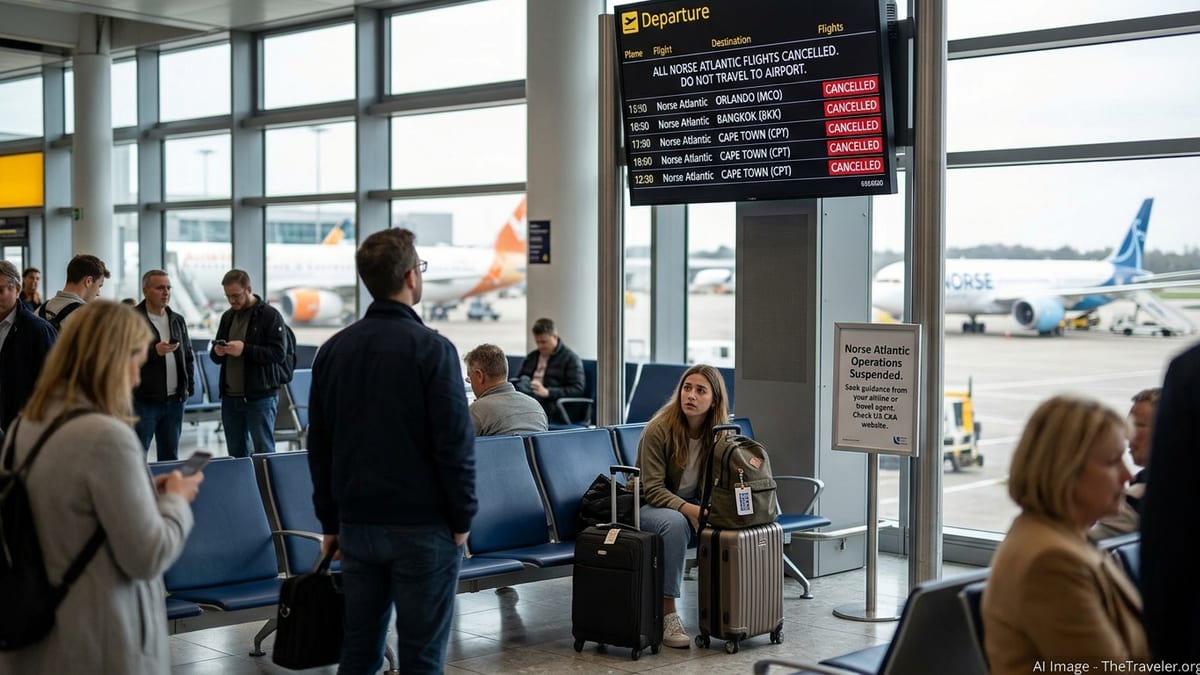
Low-cost long haul airline Norse Atlantic has suspended all flight operations and cancelled every scheduled service, including all departures from London Gatwick, after its board concluded the carrier could no longer continue and its main Norwegian operating unit moved to file for bankruptcy, leaving thousands of UK passengers facing last‑minute disruption to Christmas and winter travel plans.
Get the latest news straight to your inbox!
What Has Happened To Norse Atlantic?
Norse Atlantic’s collapse has unfolded in stages over the past few days. On 26 November 2026 the airline announced an immediate suspension of all services while it sought emergency financing, warning that it would have to file for bankruptcy if additional funding could not be secured. The suspension applied to the group’s entire network, including Norse Atlantic UK, which was operating most of the airline’s flights from London Gatwick to long haul leisure destinations.
By 27 November the situation had moved beyond a temporary pause. The board of Norse Atlantic Airways AS, the Norwegian operating company and core flying unit of the group, voted to submit a bankruptcy petition to Norway’s Agder District Court after determining that operations could not continue. Ticket sales were halted and all future flights were cancelled, with the airline confirming that passengers should not travel to the airport unless they had already been rebooked with another carrier.
The group’s listed parent company, Norse Atlantic ASA, has said it is still exploring whether any part of the remaining business, including the UK subsidiary, can be preserved. However, the UK Civil Aviation Authority (CAA) has treated the company’s move as a full cessation of service, stating that Norse Atlantic UK has cancelled all flights and advising customers not to go to the airport. At the time of writing there is no published restart plan or schedule, so travellers should work on the basis that all Norse-operated flights in the coming weeks are cancelled unless an official update states otherwise.
Impact On UK Passengers And Gatwick Routes
Norse Atlantic UK had become a visible presence at London Gatwick, operating Boeing 787 flights to Bangkok and Phuket in Thailand, Cape Town in South Africa and Orlando in Florida, alongside transatlantic routes. The cancellation of all services removes a significant chunk of Gatwick’s low-cost long-haul capacity at short notice, with the timing particularly disruptive for leisure travellers heading away for Christmas and New Year breaks.
Passengers are affected in two main ways. Some who were due to depart in the coming days have seen outbound flights suddenly disappear from departure boards, often after having already paid separately for accommodation and local connections. Others are currently overseas in destinations such as Thailand, South Africa and Florida and have lost their Norse-operated return journeys to the UK. Unlike in cases where an airline cancels individual services but continues operating overall, there is no obligation in an insolvency scenario for Norse to rebook travellers on rival carriers, so many customers are now trying to piece together their own journeys home or out from the UK.
The disruption is magnified because the cancellations are occurring in the peak winter travel period when alternative flights are both scarce and expensive. Travel industry analysis has already noted sharply higher fares on competing carriers for December and early January dates on some of Norse’s former routes. Some airlines may offer so-called “rescue fares” to stranded passengers who can show a Norse ticket, but these are at the discretion of each carrier and are not guaranteed. Travellers with flexible dates will generally find it easier to secure replacement itineraries than those tied to fixed Christmas week plans.
Official Guidance: What Rights Do Norse Customers Have?
The UK CAA has issued specific guidance for passengers booked on Norse Atlantic UK services. Because Norse flights from Gatwick were not sold as part of an ATOL-protected package holiday in most cases, there is no government-organised repatriation programme similar to those mounted after the collapse of some previous UK tour operators. Instead, affected passengers are being advised to seek refunds or compensation from their payment provider, travel insurer or, where applicable, an online travel agent that sold the ticket.
For customers who paid by credit card, Section 75 of the UK Consumer Credit Act may provide a route to recover money, as the card provider can share liability for breach of contract when goods or services are not supplied. Debit card users can try to use chargeback schemes, although these are not a statutory right and will depend on the individual bank. In both cases, passengers will generally need to provide evidence of the booking, proof that the flight was cancelled or that Norse has ceased operations, and details of any replacement travel purchased.
Where flights were booked as part of a package holiday through a UK tour operator or travel agent, the position may be stronger. In those cases the organiser is responsible for providing the transport element of the package, so it may be obliged to arrange an alternative flight or provide a refund if that is not possible. However, travellers should carefully check their booking documentation to confirm whether their arrangement is a regulated package and whether it carries ATOL protection. The CAA has emphasised that passengers should not assume they are covered unless this is clearly stated.
Compensation, Insurance And Outbound vs Inbound Travellers
Normally, when an airline cancels a flight at short notice for reasons under its control, passengers on affected services departing from the UK or EU, or arriving into these regions on an EU or UK carrier, may be entitled to fixed-sum compensation under air passenger rights regulations. In this case, however, the situation is more complex because Norse’s operating company is entering insolvency processes. Any compensation previously approved but unpaid is likely to become an unsecured claim in the bankruptcy, alongside other creditors, which means many claimants may never receive the funds.
For travellers who have already started their trips and are now stranded abroad without a Norse-operated return flight, the immediate priority is arranging transport home. There is no general legal duty on other airlines to step in, though some may offer discounted repatriation fares at their discretion. Travel insurance may cover some additional costs incurred in getting home, especially for policies that include scheduled airline failure or end supplier failure, but coverage varies significantly. Policyholders should review wording carefully and contact their insurer before making expensive new bookings wherever possible.
Passengers who have not yet travelled but held bookings for departures in December, including around Christmas and New Year, remain entitled to seek a refund of the unused ticket value from the airline. In practice, with Norse’s Norwegian operating subsidiary moving into bankruptcy and the group’s finances described as critical, most customers are instead turning to credit card protections or insurance. Travellers who booked through online travel agencies may face longer processing times while intermediaries receive formal notice from Norse and clarify their own refund procedures.
What Happens Next For UK Capacity And Affected Routes?
The immediate effect of Norse Atlantic’s collapse is a reduction in low-cost long haul choice from London Gatwick on routes to Florida, Thailand and South Africa. Other carriers operate on some of these city pairs, particularly between the UK and Orlando, but capacity had already been tight for late December. It is too early to know whether rival airlines will add extra flights or larger aircraft in response, though historically some have responded to competitor exits by adjusting schedules in the following seasons rather than within days.
For now, Norse’s Boeing 787 fleet is grounded and its booking systems have stopped selling tickets. The group’s parent company has indicated it is working with advisers to explore options for the UK subsidiary and any remaining parts of the business, but there is no confirmed restructuring plan that would see Gatwick services resume in the short term. Leaseholders of the aircraft and airport coordinators at Gatwick will be involved in reallocating slots if Norse exits permanently, a process that typically takes months rather than weeks.
For travellers, the most practical step is to assume that all Norse flights in the schedule, including over Christmas and into early 2027, will not operate unless the airline or regulators issue a clear update to the contrary. Anyone with a Norse booking should contact their payment provider or travel agent as soon as possible, keep copies of all correspondence and receipts, and avoid going to the airport in the hope that a flight may still depart. With winter holiday departures fast approaching, early action to secure alternative arrangements will give the best chance of finding manageable replacement options.