


More news on this day
U.S. holiday travelers heading into the late‑2026 storm season are flying under a new federal refund regime that requires airlines to issue automatic cash refunds after cancellations or significant schedule changes, even as most long delays, crowded airports and weather‑driven meltdowns still do not trigger cash compensation under national rules.
Get the latest news straight to your inbox!
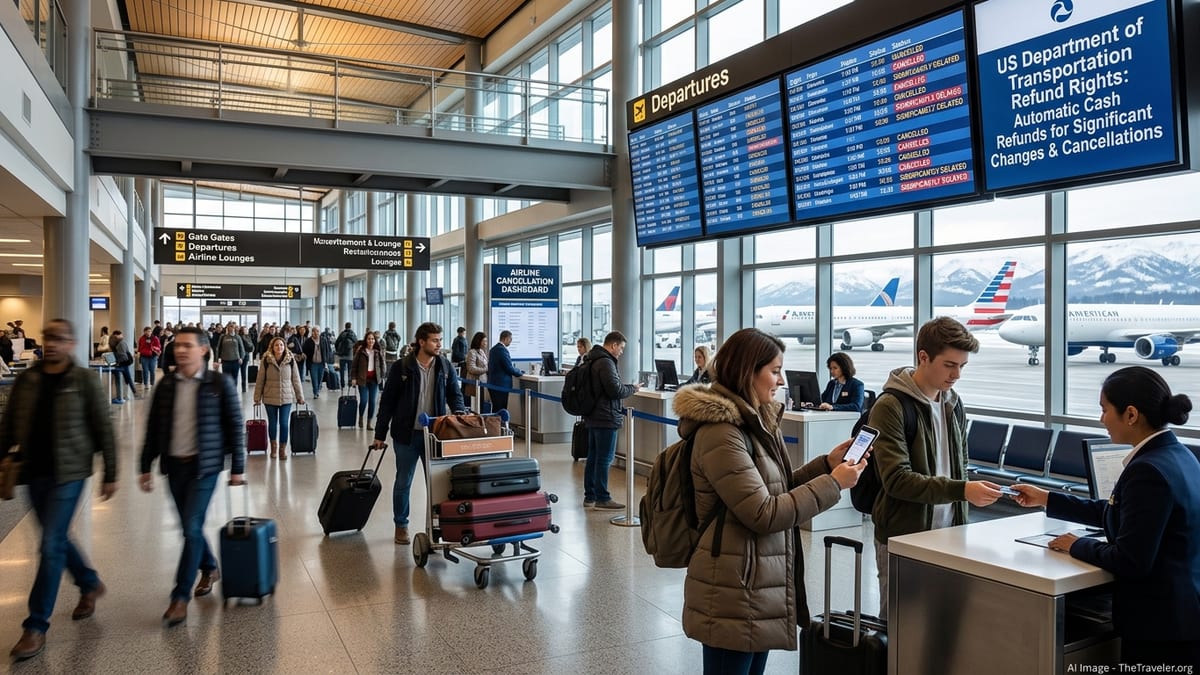
Automatic cash refunds now anchored in federal definitions
The most important change for U.S. flyers this holiday period stems from a Department of Transportation final rule on refunds and other consumer protections, published in the Federal Register on April 26, 2024 and taking effect for most provisions on October 28, 2024. For flights to, from or within the United States, both U.S. and foreign airlines must now provide prompt automatic refunds in money, not just travel credits, when a flight is canceled or significantly changed and the passenger does not accept the alternative offered.
The requirement applies regardless of whether a ticket was marketed as nonrefundable. Under the rule, once a traveler becomes entitled to a refund and chooses not to travel on the changed itinerary, the airline and any ticket agent that is the merchant of record must return the money to the original form of payment. The Department defines “prompt” as within seven business days for credit card purchases and within 20 calendar days for tickets bought with cash, check or other forms of payment.
To curb the broad discretion that airlines exercised during the pandemic, the rule also codifies when a schedule change becomes “significant” for refund purposes. For domestic itineraries, a significant change includes a departure or arrival time that moves by at least three hours from the original schedule. For international itineraries, the threshold is six hours. If a passenger decides not to travel under the new timing, and declines any rebooking, credit or other compensation that the carrier offers instead, they are entitled to a refund of the unused portion of the ticket and government taxes and carrier surcharges tied to that portion.
Timing is not the only trigger. A change of departure or arrival airport within a metropolitan area, adding one or more extra connections compared with the original routing, moving a passenger to a lower class of service than purchased, or substituting an aircraft in a way that removes a previously available accessibility feature are all covered. In each of these cases, the airline must clearly inform passengers that they may choose a refund instead of accepting the altered itinerary, and travelers who refuse the change are entitled to get their money back within the federal deadlines.
What the new rules still do not provide: compensation for most delays
Despite the tougher standards on refunds, there is still no U.S. federal requirement that airlines pay cash compensation simply because passengers arrive late. If a traveler accepts rebooking and eventually completes the trip, the airline is not obliged under national law to pay additional money for time lost, even if the delay runs many hours or disrupts holiday plans.
Current Department of Transportation guidance distinguishes between disruptions viewed as within an airline’s control, such as many maintenance issues or crew scheduling problems, and those outside its control, such as snowstorms, hurricanes, airport closures and ground stops ordered by federal authorities. But that distinction is mostly relevant to what airlines voluntarily promise, not to any automatic federal payout. A nonrefundable ticket generally does not become refundable solely because a traveler reaches their destination late. As long as the passenger accepts the revised schedule and flies, the core federal refund right tied to a cancellation or significant change typically does not apply.
Efforts by the administration in 2023 and 2024 to create European‑style cash compensation for controllable cancellations and long delays have not produced binding national compensation rules as of late November 2026. Instead, Congress directed airlines to adopt written policies on whether and when they will reimburse lodging, ground transport between lodging and the airport, and meals for cancellations or significant delays attributable to the carrier. The Department has emphasized in public statements that it cannot currently require airlines to pay standardized cash sums for delays, and that most such commitments remain matters of individual carrier policy.
As a result, the strengthened refund rules mainly protect travelers who decide not to fly at all once a schedule change crosses the federal threshold. Passengers who accept rebooking, even after a long wait at a crowded airport, generally must rely on airline customer service plans, travel insurance or credit card protections if they want help with hotels, meals or other knock‑on costs linked to the disruption.
Using the DOT dashboard and airline policies during holiday disruptions
To help passengers compare what airlines promise in those situations that fall outside mandatory refund rights, the Department of Transportation maintains an Airline Cancellation and Delay Dashboard covering the largest U.S. carriers. The dashboard summarizes, in plain language, what each airline commits to do when a flight is canceled or significantly delayed for reasons within the carrier’s control, such as certain mechanical failures or crew shortages.
For each listed airline, the dashboard indicates whether the carrier commits to offer free rebooking in the same cabin, complimentary meal vouchers after a specified waiting period, hotel accommodation when an overnight stay is required, and ground transportation between the airport and a hotel. Travelers can consult this information when choosing which airline to book for peak holiday periods, or when negotiating with staff during irregular operations.
The dashboard is intentionally limited to controllable events. It does not guarantee meals, hotel rooms or other benefits when a disruption is caused primarily by severe weather, airport or runway closures, security incidents or nationwide air traffic control problems. Some airlines may choose to extend courtesies during major storms or mixed‑cause disruptions, and recent Thanksgiving travel periods have seen carriers publicly state that they were assisting stranded passengers with lodging and meals after technology outages compounded bad weather. However, these gestures reflect company policy and case‑by‑case decisions, not any new across‑the‑board federal requirement.
Because the customer service plans behind the dashboard are treated as enforceable consumer commitments, passengers can point to them when seeking help at the airport or afterwards. If an airline’s published policy says it will provide hotel rooms for overnight disruptions that it controls, or meal vouchers after a three‑hour controllable delay, travelers can request those benefits by citing the policy. The Department has warned airlines that failing to honor public commitments may be treated as an unfair or deceptive practice, and that passengers can strengthen later complaints by saving screenshots of the policy in force on their travel date, along with boarding passes, receipts and notes from the disruption.
Checked bags, ancillary fees, bumping and tarmac delays
The April 2024 refund rule also tightened requirements around refunds of ancillary fees, particularly for checked baggage. For domestic itineraries, airlines were already subject to a federal limit on liability for lost, damaged or delayed luggage when passengers can document their expenses. Building on that, the rule requires airlines that charge separate checked‑bag fees to refund those fees automatically when a bag is lost or when it is significantly delayed and the passenger has filed a mishandled baggage report with the operating or final‑leg carrier.
For most domestic flights, a bag is considered significantly delayed for fee‑refund purposes if it is not delivered to the passenger within 12 hours of the aircraft’s arrival at the gate at the final destination. For international itineraries, the final rule allows longer time thresholds that vary with flight length; the Department’s materials describe windows that can extend to roughly a day or more for long‑haul services. When those thresholds are reached and a report has been filed, the airline must return the checked‑bag fee without requiring the traveler to file a separate refund request, and must process the refund to the original form of payment within the same seven‑business‑day or 20‑calendar‑day standard.
The rule also covers ancillary fees for services that are not provided at all. If a traveler has paid in advance for a specific seat selection, onboard Wi‑Fi or the carriage of sports equipment, and the airline does not deliver that service on the affected flight, the carrier must refund the charge. This applies even when the underlying ticket is nonrefundable. Airlines may still offer a voucher or miles in lieu of cash, but passengers must affirmatively choose that option; carriers cannot default travelers into credits when a cash refund is owed.
Other long‑standing rules that matter during the holidays remain in place. Oversales are still governed by federal denied‑boarding regulations. Airlines are allowed to sell more tickets than seats, but must first seek volunteers willing to give up their seat in exchange for compensation. When not enough volunteers come forward and passengers are involuntarily bumped, airlines must provide a written statement of rights and, in many situations, cash compensation based on the one‑way fare and the length of the arrival delay compared with the original schedule, with minimum amounts that increase for longer delays and are periodically adjusted.
Tarmac delay protections complete the core national framework. Under regulations in 14 CFR Part 259, airlines operating flights at U.S. airports must allow passengers on domestic flights to deplane before a tarmac delay exceeds three hours, and on international flights before it exceeds four hours, subject to limited safety, security and air‑traffic‑control exceptions. Carriers are also required to provide food and drinking water no later than two hours into a tarmac delay, maintain operable lavatories and ensure adequate medical attention if needed. The Department continues to bring enforcement actions and civil penalties when airlines keep passengers on aircraft beyond these limits without fitting within the narrow exceptions.
What holiday travelers should check before deciding whether to fly
In practical terms, the new refund regime means that holiday travelers in late 2026 should make an early, informed decision when a flight is canceled or significantly changed. If a revised departure or arrival time, a newly added connection or a reassignment to a different airport makes the trip unworkable, declining rebooking and clearly choosing not to travel will usually unlock the strongest federal protections, since the airline must then refund the fare and qualifying fees within the mandated timeframes.
For travelers who still need to reach their destination, airline customer service plans and the Department’s dashboard are the main tools for gauging what assistance to expect. Before booking peak‑season trips, passengers can compare carriers’ public commitments on controllable cancellations and long delays, including whether the airline pledges to provide hotel rooms when an overnight stay is required and when meal vouchers are offered. During a disruption, it is important to ask how staff are categorizing the cause of the delay or cancellation, because most voluntary benefits apply only when the primary cause is something the airline controls.
Because federal law continues to offer limited remedies for time lost to delays, some travelers rely on standalone travel insurance or premium credit card protections to cover extra accommodation, missed connections or nonrefundable arrangements such as tours and event tickets. Policies vary widely in when they will pay out, and many include exclusions or minimum delay thresholds for weather‑related and air‑traffic‑control events. Consumer agencies advise passengers to review coverage terms before departure, keep receipts and written records from any disruption, and confirm both with the airline and through official Department resources what rights apply in their specific circumstances.
As winter storms, congestion and periodic technology problems continue to affect U.S. air travel through the end of 2026 and into early 2027, the interaction between automatic refund rights, long‑standing bumping and tarmac protections, and voluntary airline customer service policies will determine what assistance passengers actually receive. For holiday flyers, closely monitoring bookings, checking flight status before heading to the airport, and being prepared to decide quickly between rebooking and a cash refund are now central parts of navigating the busy season.